

Asia-Pacific is becoming a region of increasing significance to some of the largest cross-border payments companies. Here, we look into the companies placing the most focus and investment there, as well as exploring the trends in the region itself.
Throughout 2026, Asia-Pacific (APAC) has increasingly become a larger focus region for several of the biggest cross-border payments companies based in the Americas and Europe. Across Q1 and Q2 26 earnings calls and announcements, it has become clear that many of these companies view the region as a major opportunity that could significantly bolster future growth.
Uruguay-based payment processor dLocal outlined APAC as one of its “strategic priorities” during its Q2 earnings call, having identified it as a “fast-growing” but “highly-fragmented” region where it believes it can begin to capture market share using the same strategies that contributed to its success in Latin America and Africa.
Several other companies have also shared regular updates into how they plan to achieve the same goal in the region, including remittance-focused companies, as well as other business-focused money transfer companies and infrastructure players.
According to FXC Intelligence market sizing data, APAC’s cross-border payments volume is projected to grow from $13.5tn in 2025 to $24tn by 2035. Representing faster growth than the global average, this would see the region make significant gains in global share, accounting for 36% of global outbound flows overall – up from 31% in 2025.
Here, we take a deeper look into some of the key moves these companies are making across APAC, exploring why the region is becoming a larger priority for expansion and whether companies based in the region are targeting global expansion themselves.
Which consumer money transfer companies are targeting APAC?
Many of the world’s largest consumer money transfer companies based in the Americas, the UK and Europe are increasingly looking into expanding their presence in parts of East, South and Southeast Asia – areas which currently contribute either a small percentage or none of their revenue.
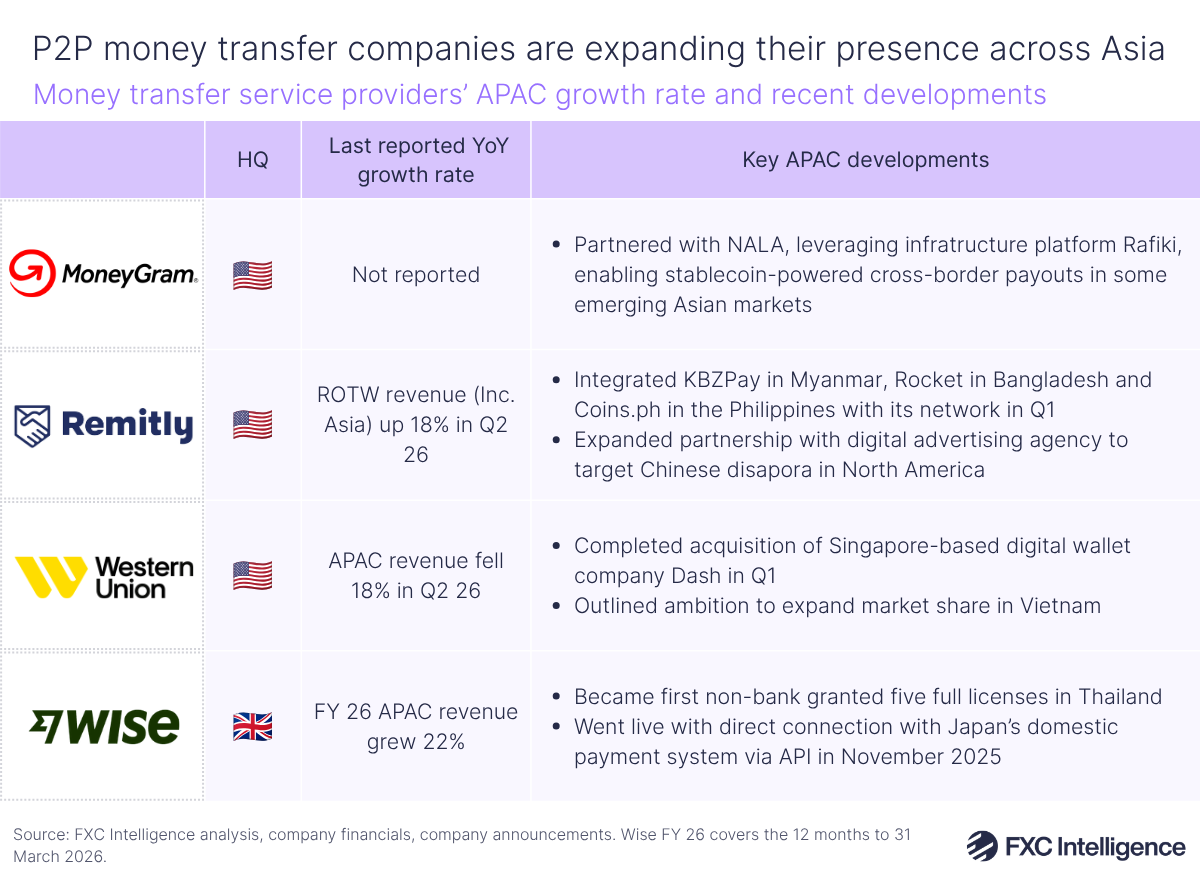
Money transfer giant Western Union is one such company that has outlined plans to grow, particularly in Southeast Asia, after completing its acquisition of Dash, Singtel’s Singapore-based digital wallet business, in April 2026. The move both bolstered the company’s digital capabilities and strengthened its presence in the region through the Dash platform’s over 1.4 million users.
Western Union has since explained that it has a “broader ambition to build a more connected Asia-Pacific network”, with CEO Devin McGranahan sharing that the company is now focusing on expanding its market share in Vietnam, which currently sits in the “mid-single-digit” range.
As part of the company’s Beyond strategy, a three-year plan to drive annual revenues up to around $5bn, it is regionalising its operations in each major geography it operates in – including APAC, with the Philippines’ capital Manila becoming its primary operating centre. This plan is also progressing, with Western Union sharing it is already moving agent onboarding for the region to Manila. As of Q2, APAC is the region contributing the smallest share of Western Union’s C2C revenues at just 5%, indicating a significant opportunity for future growth for the company.
Digital money transfer provider Remitly has also been expanding its reach in the region, adding KBZPay in Myanmar, Rocket in Bangladesh and Coins.ph in the Philippines to its network in Q1. In May, the company expanded its existing partnership with digital advertising agency Eastward Media to specifically target Chinese diaspora based in North America and drive growth in outbound volumes to Asia, using Chinese-language digital media alongside planned co-marketing initiatives with WeChat and Alipay.
In April, consumer money transfer provider MoneyGram joined forces with NALA, a stablecoin payments company, leveraging its payment infrastructure platform Rafiki to enable stablecoin-powered cross-border payouts into emerging markets in Asia and Africa. The move specifically targets payouts to mobile wallets and bank accounts in high-volume remittance corridors.
Wise serves both consumers and businesses with its multicurrency account offerings, although its consumer side currently remains larger than its business side. The company reported 22% YoY growth in APAC revenue in its FY 26 results (spanning Q2 25 to Q1 26) and later noted growing adoption of personal cards in APAC during its Q1 27 (calendar Q2 26) earnings call.
The company became the first non-bank to go live with direct connection with Japan’s domestic payment system, Zengin-Net, via API in the back end of 2025 and successfully directly connected to Malaysia’s national payments network, PayNet, in July 2026. It also secured the regulatory approval and five licences necessary to fully operate in Thailand in March 2026.
Which B2B companies are increasing their Asia focus?
A number of B2B and infrastructure-focused cross-border payments companies have also increased their focus on the region and are already seeing volumes and revenue grow across Asia.
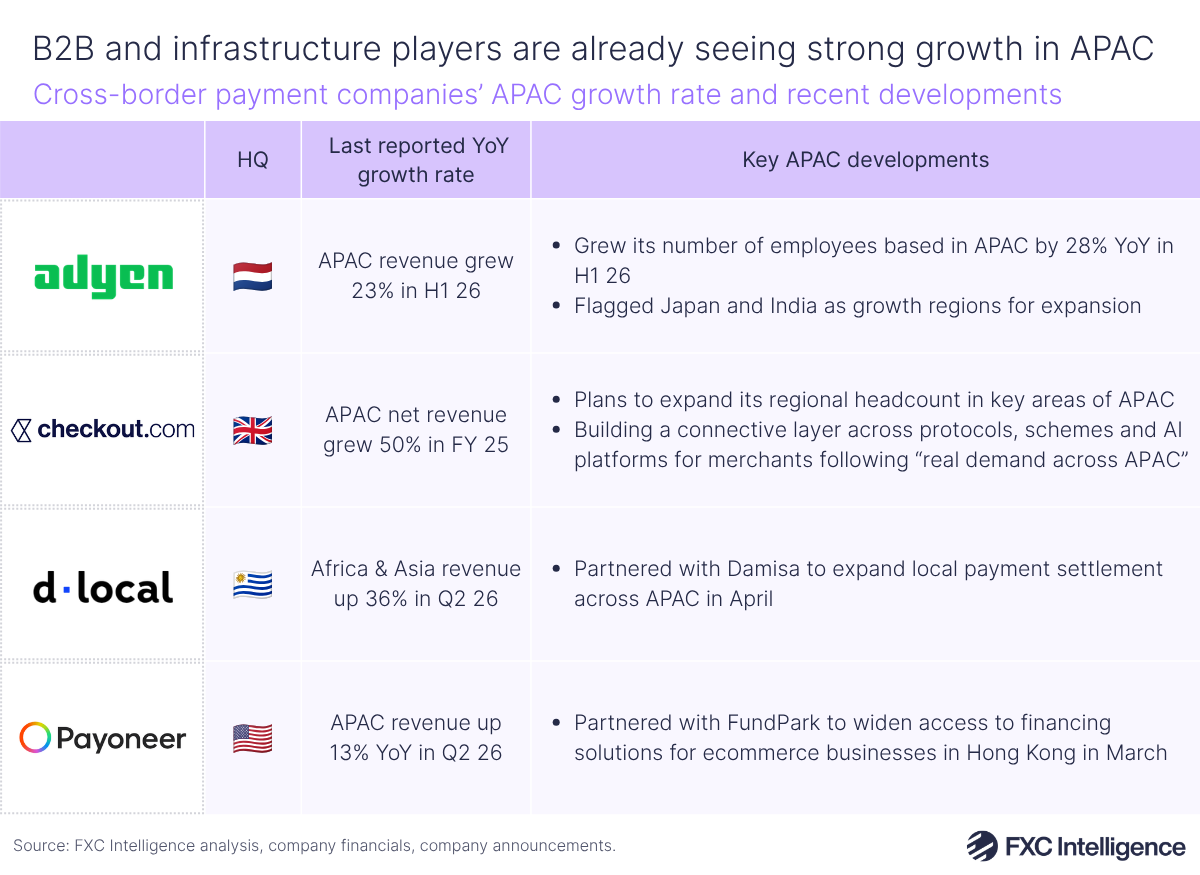
dLocal, which spoke in-depth about plans to build out in Asia during both its Q1 and Q2 26 earnings calls, reported that revenue generated in Africa and Asia equated to an 18% share of overall revenue in Q2. Despite Africa and Asia revenue growing 36% YoY in Q2 to $73m, the region’s share of dLocal’s revenue fell from 21% in Q2 25 to 18% in Q2 26, largely due to the company seeing considerably faster growth in its home markets in Latin America. In April, dLocal partnered with Damisa, a cross-border payment and settlement platform for emerging markets, in a move to expand cross-border settlement across APAC.
Netherlands-based payment processor and acquirer Adyen, which reports earnings on a half-yearly basis, saw APAC revenue grow 23% YoY (26% on a constant currency basis) in H1 26 to $160m, resulting in the region taking a 10% share in both H1 25 and H1 26. Adyen also reports the number of full-time employees it has in each region, with APAC growing faster in this metric than any other region, rising 28% to reach 506 in H1 26.
Checkout.com, the global payment processor and acquirer based in London, revealed in March that it had seen a 50% increase in net revenue across APAC for the third consecutive year in 2025, driven by total processing volume climbing 71% YoY in the region and a number of new local merchants choosing the company. To support its new partners and continue this growth, Checkout.com has pledged to grow its employee count in Singapore, Hong Kong, Shanghai, Tokyo and Sydney, as well as increasing the localisation of its offerings based on the demands of businesses in APAC.
In Q2 26, SMB-focused payment platform Payoneer saw its APAC revenue grow faster than any other region, increasing 13% YoY and reaching $61m – increasing its share of total revenue to 22% (up from 21% in Q2 25). Prior to payments infrastructure provider Nuvei announcing plans to acquire the company in July, Payoneer reported strong growth in its B2B business in China and said that the country’s SME export sector represented a “multitrillion-dollar opportunity” which it was focused on building a scaled compliant platform to capture a larger share of this.
Why are cross-border payments companies targeting Asia?
Because APAC covers a wide range of countries with significantly different economies and development, there are a number of reasons behind some cross-border payments companies beginning to view the region as a major opportunity.
Because of the significant fragmentation between countries in the region, with different currencies, compliance requirements and local payments systems, many companies have recognised an opportunity for specialised locally-connected platforms to make it easier for businesses to enter these markets without needing to address this complexity themselves.
dLocal’s CEO Pedro Arnt has explained that the company has changed its thinking on Asia after recognising that a “high level of fragmentation across Asia” and the “prevalence of alternative payment methods (APMs)” could mean that the strategy it saw success with in Latin America and Africa could also apply to the Asian market. Arnt has also noted that the total size of the market in Asia “dwarfs” that of Latin America and Africa.
Recognising the importance of direct local connections to specific countries’ domestic payment systems, Remitly and Wise have continued to work on expanding their respective networks.
Chart data
| Year | Singapore | Malaysia | Vietnam | Philippines | Indonesia | Cambodia |
|---|---|---|---|---|---|---|
| 2017 | 10% | 11% | 3% | 5% | 3% | 6% |
| 2021/22 | 31% | 28% | 16% | 22% | 9% | 7% |
| 2024 | 56% | 45% | 39% | 29% | 22% | 17% |
Digital payments are also seeing significant growth across Asia, particularly in emerging markets, where consumers are increasingly beginning to reduce their use of cash. This is presenting an opportunity for larger cross-border payments networks to provide businesses access to a variety of APMs, to help them improve the customer experience they provide end-users.
For example, Western Union’s target market Vietnam saw overall financial account ownership in the country rise from 31% of those aged 15 and older in 2017 to 71% in 2024, according to Global Findex data. Mobile money account ownership also rose from 3% in 2017 to 39% in 2024 – while cash-only utility bill payment fell from 69% to 25% over the same period.
Some other Southeast Asian countries also appear to be following this trend but are at an earlier stage. Cambodia saw mobile money account ownership reach 17% in 2024, up from 6% in 2017. This trend is particularly nascent in parts of Southeast Asia, which could become a growing area of focus.
Asia-based cross-border payments companies are also expanding outwards
While some of the largest consumer and B2B-focused cross-border payments companies are increasing their investment into Asia, many of the biggest players originally based in the region are moving the other way, expanding their reach into Europe, the Middle East, the US and elsewhere across the globe.
Airwallex, the financial platform serving businesses dual-headquartered in the US and Singapore, has been targeting expansion across the globe for a number of years, and is now accelerating these plans. The company is set to invest €200m into the Netherlands across the next five years, while committing $43m into the UAE. This comes as part of Airwallex’s broader strategy to invest more than $1bn in the UK, Europe, Middle East and Africa in the next five years.
Cross-border payments and card issuance solution provider Nium has served the APAC region since it was founded in Singapore in 2014, but it too has long-term plans to expand worldwide, most recently culminating in the company launching domestic card issuance in the US, adding to its existing coverage spanning much of APAC, Europe and the Middle East.
Payment infrastructure provider Thunes is headquartered in Singapore and also recently began accelerating expansion in the US, leveraging a $150m Series D funding round to open a new office in New York, adding to its operations in San Francisco and Atlanta.
China-based cross-border payment infrastructure company PingPong partnered with Visa in May to launch a card-to-account payment solution, specifically targeting mid-market finance teams in the EU and UK, although accessible by businesses worldwide.
As companies move both into and out of Asia, it is becoming apparent that the biggest cross-border players are targeting global expansion and want to capture as much global market share as possible. However, it is clear that Asia’s currently fragmented but rapidly growing landscape poses a huge opportunity for Western firms as digital payment and APM adoption climbs.