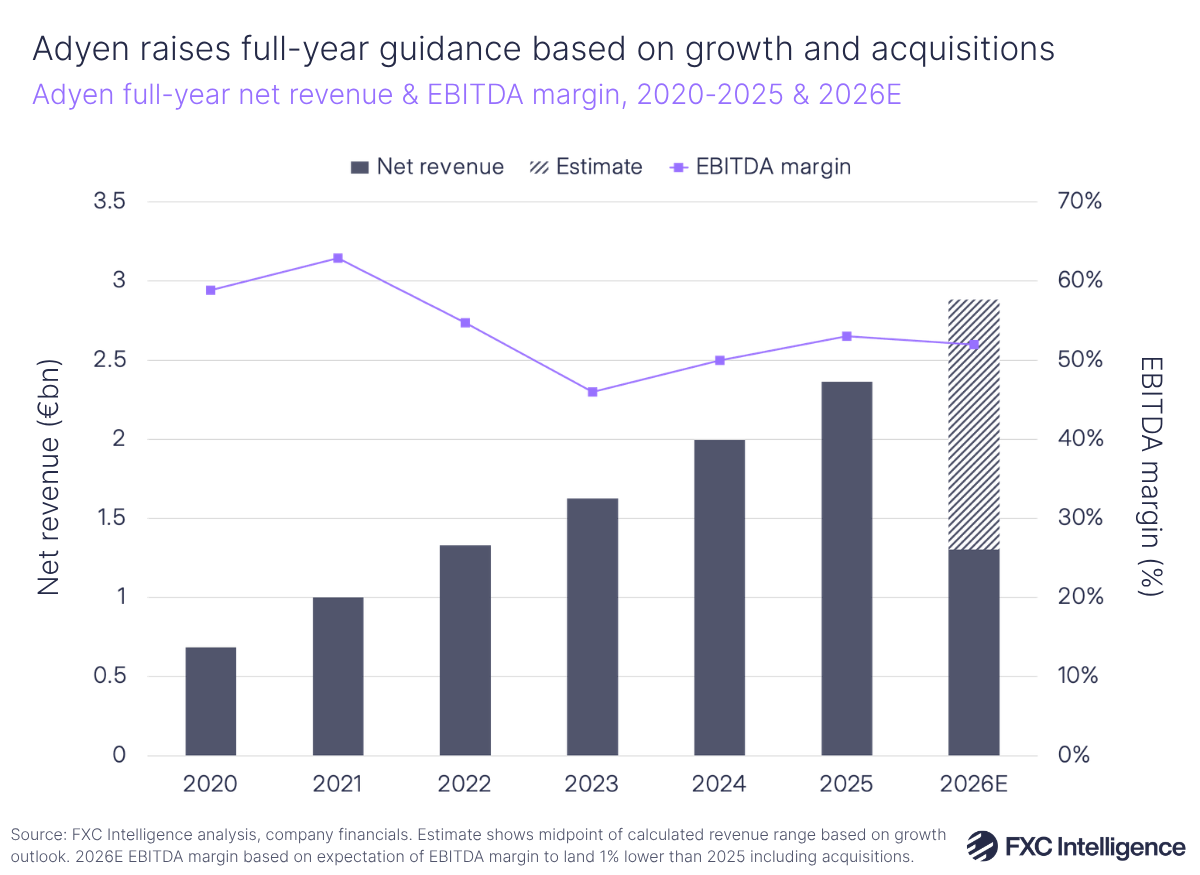
Adyen’s share price rose after its H1 2026 earnings report, which saw the Dutch payment processor’s net revenue rise by 19% YoY to €1.3bn ($1.5bn), driving a 49% EBITDA margin, or 50% excluding one-time transaction costs. The company is pushing beyond processing to offer a full financial platform for merchants.
Adyen saw some significant developments in H1. In June, Adyen launched Adyen Agentic, which aims to support merchants aiming to securely accept AI agent-led payments across different schemes. Then, in July, it completed acquisitions of loyalty programme provider Talon.One and automated billing company Orb, the company’s first takeover deals in its 20-year history.
As a result of its acquisitions, Adyen has raised its full year guidance. The company now expects a 21-23% net revenue rise in 2026 (equating to €2.86bn-€2.90bn), with an adjusted EBITDA margin of 52%. The acquisitions are expected to drive a one percentage point contribution to net revenue, and drive a one percentage point decline from its EBITDA margin.
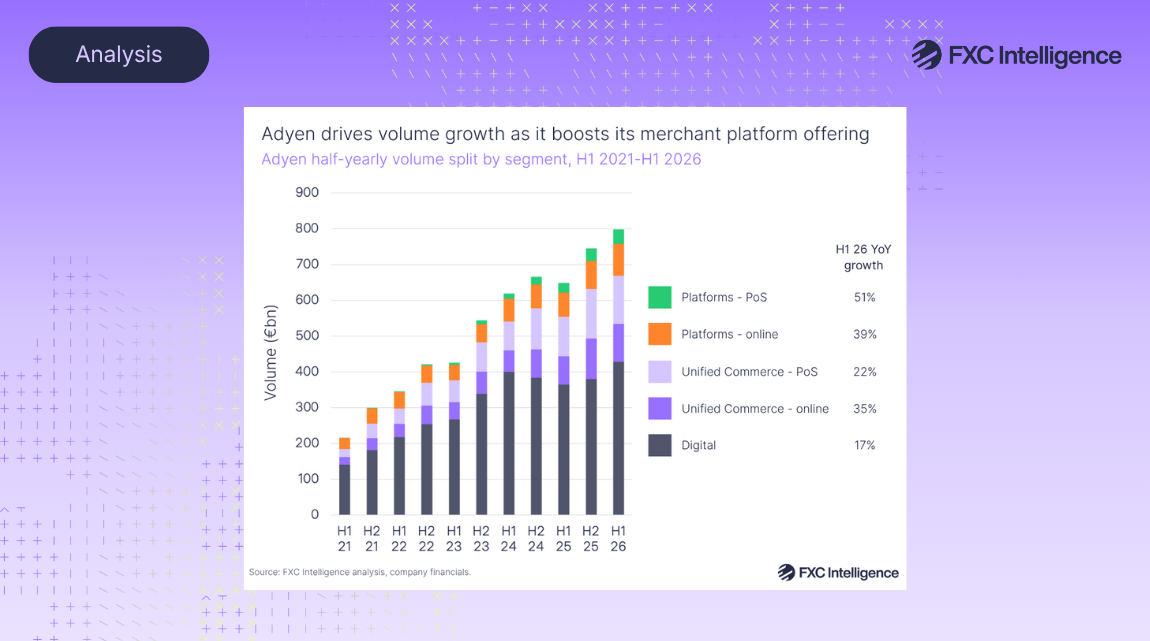
In its H1 report, Adyen noted its strength in acquiring new clients (such as Open AI) while also deepening relationships with existing ones. Overall, volumes rose by 24% to €803.8bn, with Adyen’s Digital segment (spanning online, in-app and subscription activities) volume growing by 17% to €427.9bn and net revenue for the segment up 13% to €719.7m. Meanwhile, Unified Commerce – Adyen’s payment processing platform for merchants across physical and ecommerce channels – saw volumes grow 27% to €240.9bn, driving a 25% net revenue raise to €417.7m.
However, Adyen saw its fastest growth in its smallest segment, Platforms – covering the company’s payment services offering for platform and marketplaces. Volumes grew 42% to €135bn, with revenue rising 37% to €165.5m, driven by Adyen’s expansion across SaaS businesses.
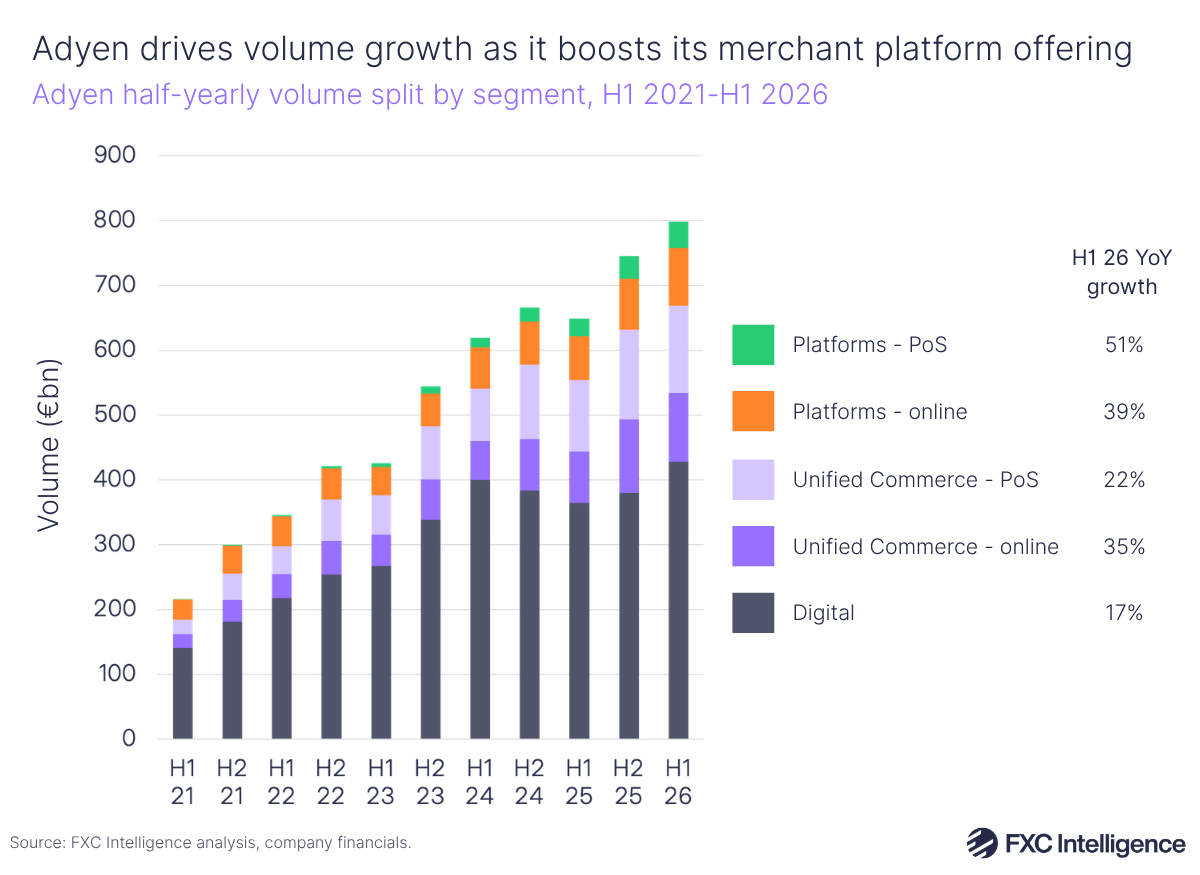
Point-of-sale (PoS) volumes grew faster (28%) than non-PoS volumes (23%), with PoS overall accounting for 22% of Adyen’ volumes in H1 2026. Having said this, both Platforms and Unified Commerce also saw strong growth in non-PoS (i.e. online) volumes, at 39% and 35% respectively. Alongside this, there are strong signals that cross-border will remain important as the company moves towards its target: becoming a “single, trusted platform for the financial infrastructure on which global commerce runs”.
For example, in April Adyen launched Intelligent Money Movement, which allows large enterprises to accept payments, manage liquidity and send payouts to 190+ countries globally. Here, Adyen is using its ability to connect to local rails and card schemes – powered by licences across the US, UK and Europe – to help businesses speed up treasury flows for big businesses that need to move money quickly but are currently hampered by legacy infrastructure.
Adding to a growing trend for the cross-border providers we cover, Adyen wants to continue to grow its appeal to existing customers, while at the same time capturing a much bigger opportunity by using its own infrastructure as a solution. It will be interesting to see how this affects its mix going forward.