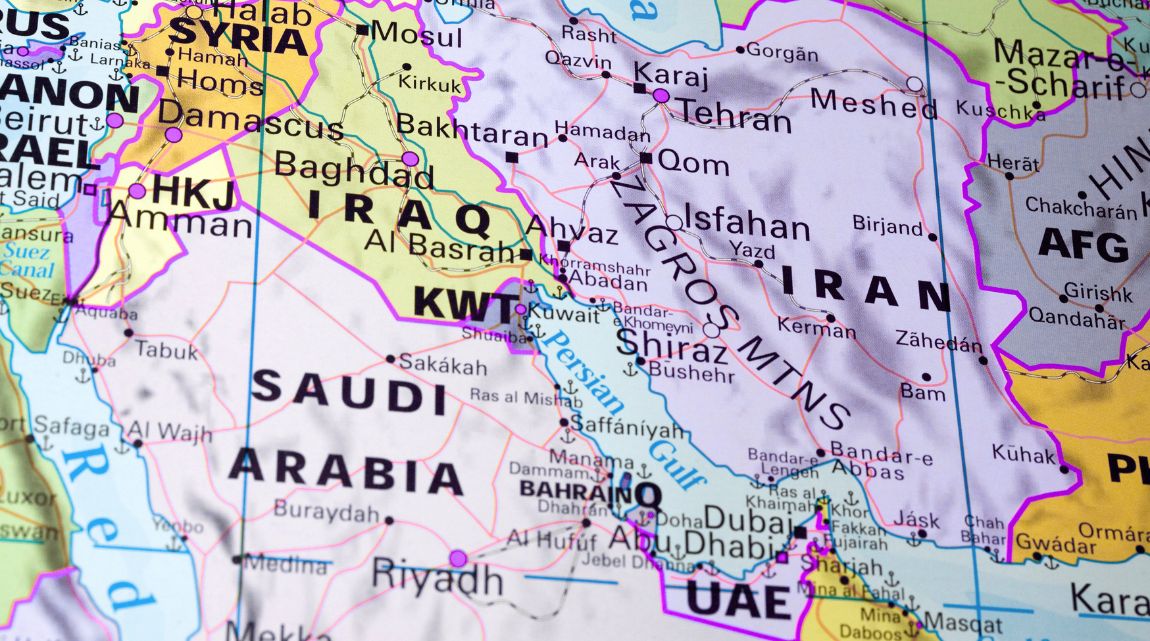

The Middle East, particularly the UAE, has become a significant focus region for a number of cross-border payment companies. Here, we take a look at which companies have made moves in the region in 2026 so far.
In the last year, much of the attention surrounding the Middle East has been related to ongoing conflict in the region. However, several cross-border payment companies have continued to expand their presence there, recognising an opportunity to grow their revenues in a part of the world that is investing heavily in economic development, backed by national strategies such as Saudi Arabia’s Vision 2030 and the UAE’s ‘We the UAE 2031’ vision.
These efforts have continued throughout 2026 so far, with companies working to secure local licences, partnering with local financial institutions and beginning to operate in new Middle Eastern markets.
Here, we take a look at the key developments that different types of cross-border payment companies are undergoing in the Middle East.
Which cross-border payment companies are expanding in the Middle East?
Throughout 2026 so far, several cross-border payment companies have expanded certain capabilities and services into the Middle East.
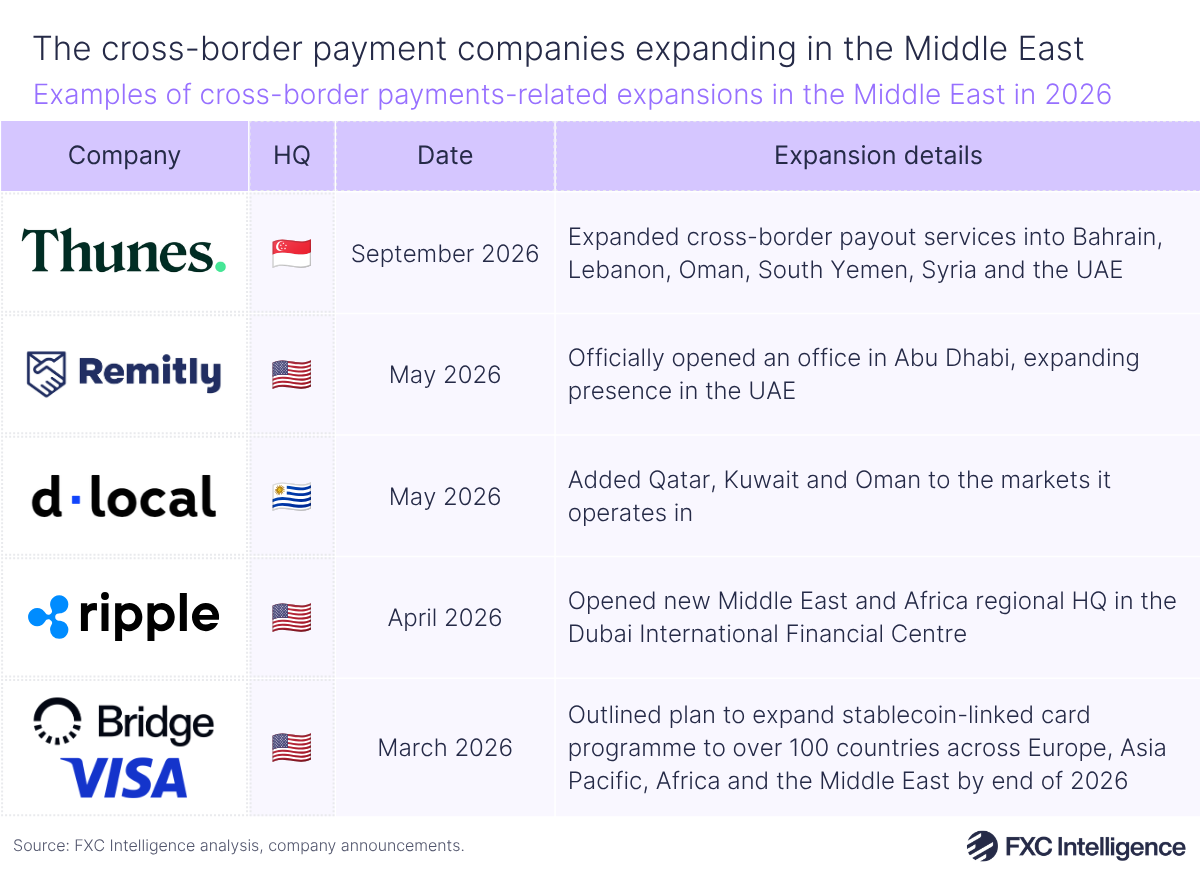
Uruguay-based cross-border payment infrastructure company dLocal began operating in Qatar, Kuwait and Oman during the first half of the year, looking to diversify its revenue sources beyond Latin America, Africa and Asia. Fellow infrastructure provider Thunes also completed expanding its cross-border payout services to Bahrain, Lebanon, Oman, South Yemen, Syria and the UAE in September, having launched real-time cross-border payments in Saudi Arabia the year before – an initiative to bolster its global money movement capabilities.
Visa and stablecoin infrastructure provider Bridge have also outlined plans to expand their joint stablecoin-linked card programme to over 100 countries by the end of the year, including in the Middle East.
In April, Ripple, the stablecoin-powered cross-border payment company, opened Middle East and Africa regional headquarters in the Dubai International Financial Centre, the UAE’s leading financial hub. The company explained that it now plans to grow its team locally, with the new HQ giving it the space to double the size of its team in the region. The following month, international payments provider Remitly also officially opened a new office in Abu Dhabi after spending the prior 18 months building out its presence in the UAE.
These moves follow in the footsteps of several other companies in the space, including digital payments giant PayPal, which opened its first headquarters for the region in Dubai last year.
One major factor behind companies increasingly deciding to expand in the region is its location, sitting at the intersection of major global trade corridors connecting Europe, Africa and Asia.
Companies focus on securing licences from the UAE
The UAE has become a key area of focus for these companies, with many securing licences from the Central Bank of the UAE (CBUAE) in recent months, enabling them to launch a range of new products and services in the country.
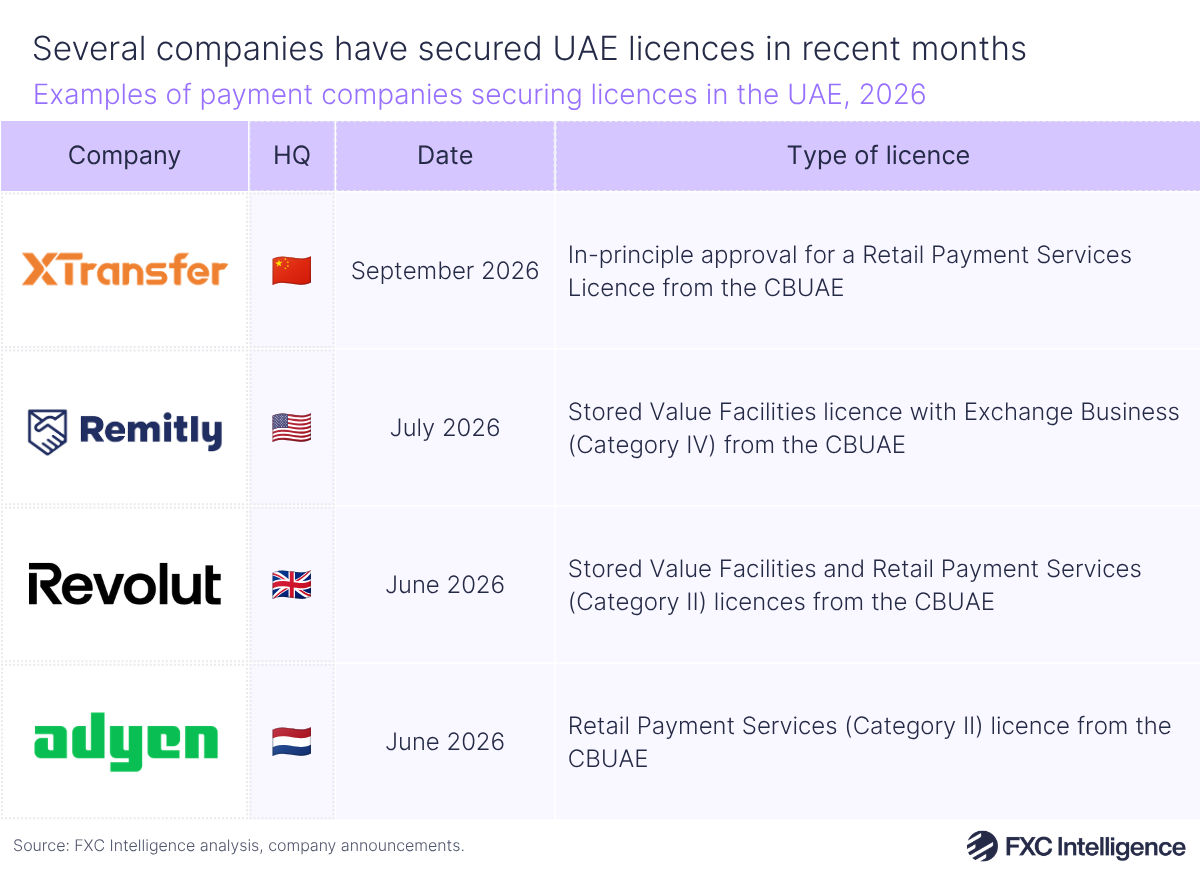
In June, Adyen and Revolut each secured a Retail Payment Services (Category II) Licence from the CBUAE, while XTransfer gained in-principle approval for the same licence shortly after. Revolut and Remitly have also received Stored Value Facilities (SVF) (Category IV) licences from the CBUAE this year.
For Adyen, the move signifies an evolution of the company’s presence in the UAE, having started operating there in 2020. With its new licence, it can begin to control local settlement without requiring the support of third parties. It says it can now begin to reduce third-party risk and develop its capabilities locally, enabling it to advance its standing in the region.
Meanwhile, now that Revolut has secured the same Retail Payment Services Licence, alongside an SVF Licence, the digital bank is building its local product offering and is planning a full-scale launch, replicating the model that has seen success in Europe.
B2B-focused payment company XTransfer also plans to expand its presence in the UAE after gaining in-principle approval from the CBUAE for its own Retail Payments Licence to begin serving local businesses. Remitly’s SVF Licence with Exchange Business Category IV also enables it to launch a variety of new products for customers in the UAE.
As part of the UAE’s efforts to diversify its economy, drive economic growth and develop its financial infrastructure, its central bank has developed a licensing framework that enables different types of financial institutions to acquire different types of licences. Each of these licences has a different tier or category, meaning not all types of companies have to meet the same bank-grade requirements depending on the type of product or service they want to launch.
This strategy enables it to attract internationally recognised companies including the likes of payment processor Adyen, digital bank Revolut and remittance provider Remitly. This helps it improve its standing as a global financial hub and progress towards its domestic policy targets, including the Digital Economy Strategy, which aims to double the contribution of the digital economy to the UAE’s GDP from 9.7% to 19.4% by the end of 2031.
Which companies are taking a partnership-led approach in the Middle East?
Aside from direct expansion and licensing, partnerships with regional players are also proving central for certain companies building out their presence in the Middle East in 2026.
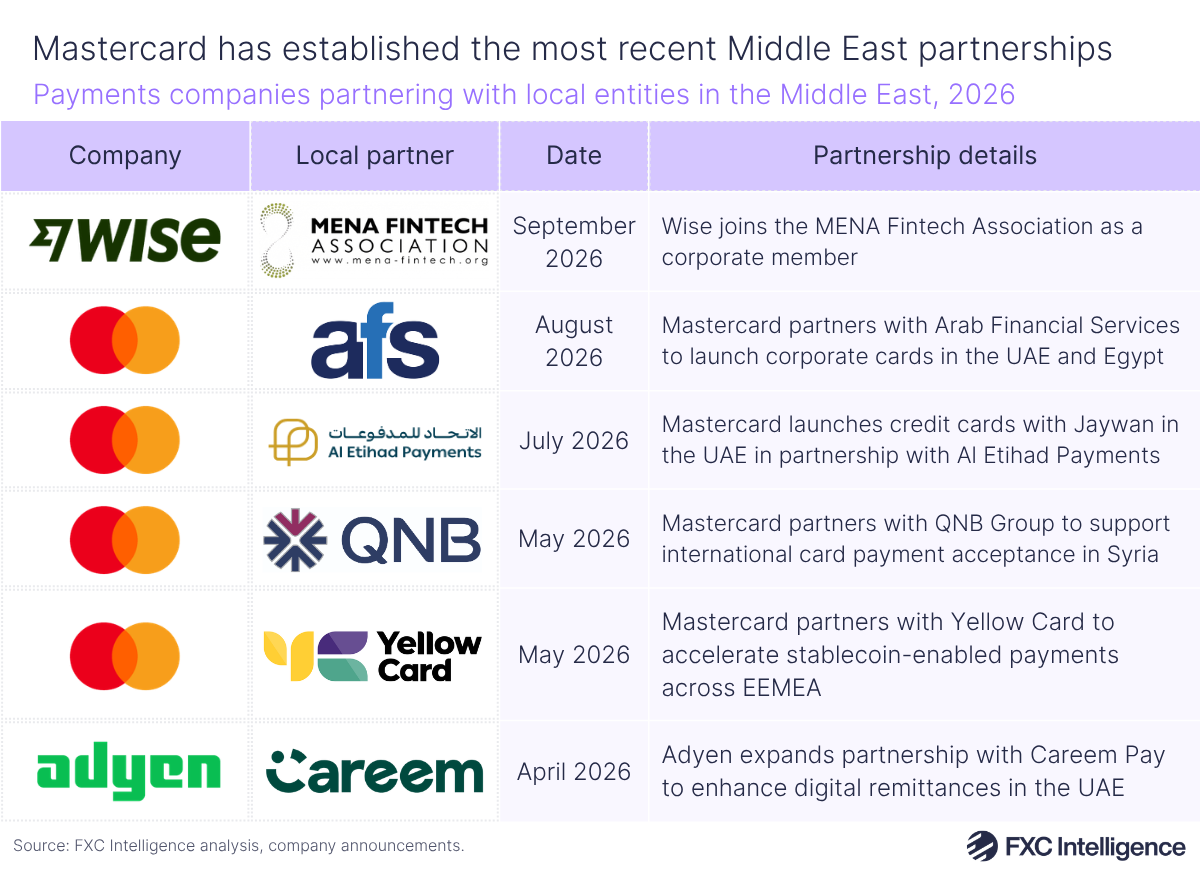
Mastercard has been especially active on this front, partnering with stablecoin payments infrastructure provider Yellow Card in May to develop stablecoin-enabled payments in Eastern Europe, the Middle East and Africa, with the UAE one of the initiative’s focus markets at launch. In the same month, Mastercard joined forces with Qatari multinational commercial bank QNB Group, working with the Central Bank of Syria to support the acceptance of international payment cards in the country.
In July, Mastercard launched co-badged credit cards with Jaywan, the UAE’s national card payment scheme, in partnership with Al Etihad Payments, a subsidiary of the CBUAE. Through the partnership, Mastercard will deploy its own payment infrastructure in the UAE for the switching and processing of Jaywan cards and establish a new Mastercard operations centre in the country. Following this, Mastercard also teamed up with Arab Financial Services, a digital payment solution provider in the region, launching corporate credit and prepaid cards for businesses in the UAE and Egypt.
Other companies have also established partnerships in the region; Adyen expanded its existing partnership with superapp Careem to enhance digital remittances, also in the UAE. Most recently, Wise joined the MENA Fintech Association as a corporate member, providing its expertise for payments, financial infrastructure and cross-border commerce initiatives.