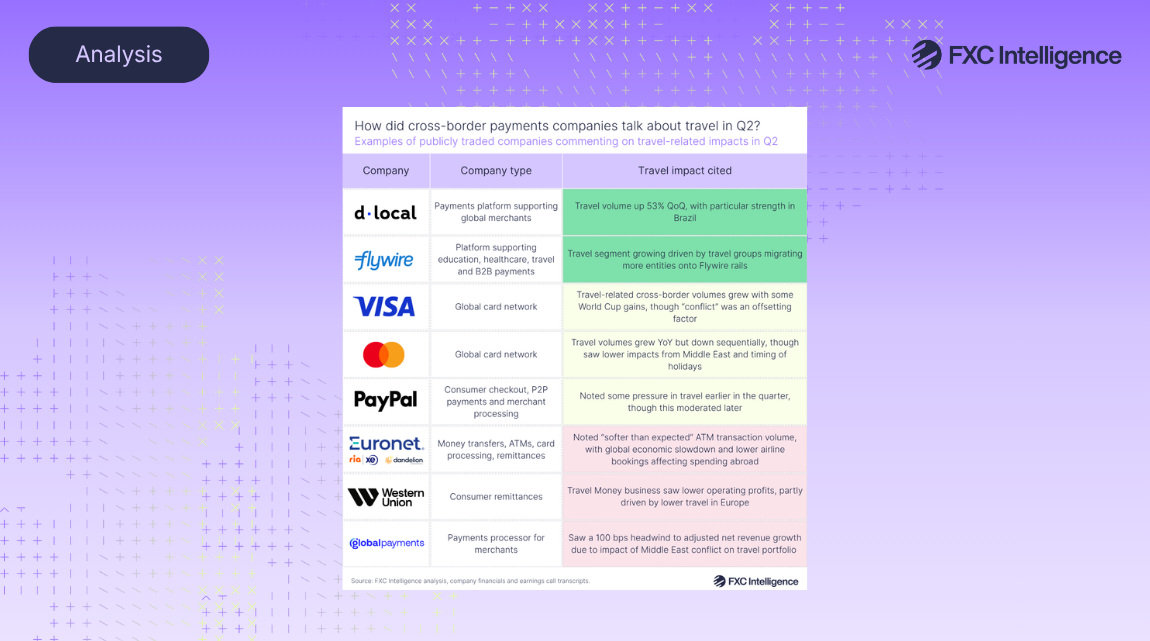
A number of cross-border payments companies mentioned impacts to travel-related spending in Q2 2026, though not all of this was negative, as our analysis below explores in more detail.
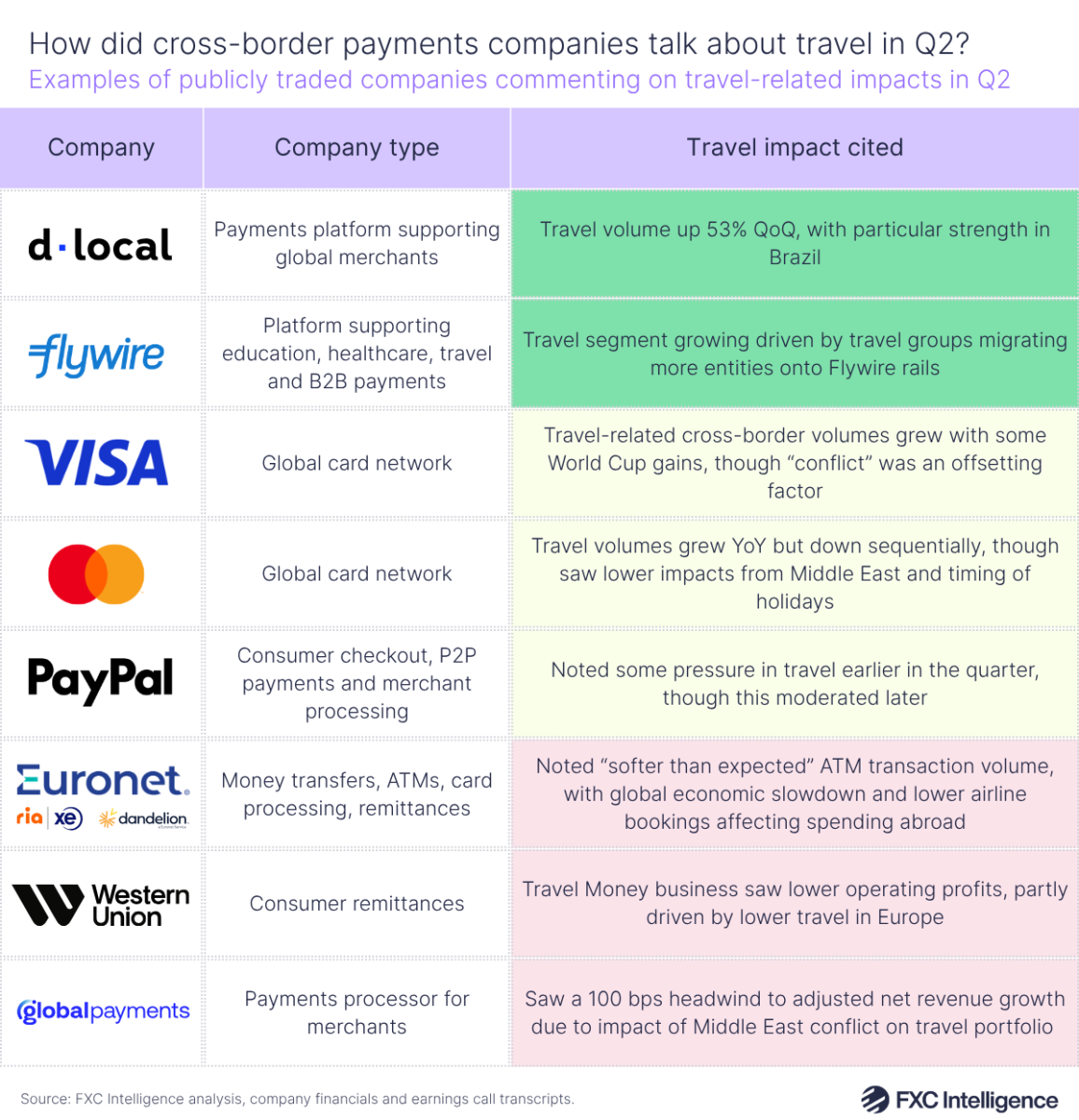
Several companies cited changing consumer travel habits in their earnings, with some linking this to the ongoing conflict in the Middle East. For example, payments processor Global Payments noted that it had continued to see its portfolio of travel payments offerings being impacted by conflict in the region, offsetting its adjusted net revenue growth to 4% YoY.
Meanwhile, remittance provider Western Union said that it had seen declining travel patterns, including in Europe, affecting its Travel Money business, through which it sells foreign currency exchange to people physically travelling abroad. This company is currently ramping up its focus on digital and non-remittances services as it sees other headwinds to its Consumer Money Transfer segment from US immigration policies.
Euronet – which saw similar policy-led impacts to its remittance business (which includes Ria, Xe and Dandelion) – said that ATM transactions had been “softer than expected” and noted an impact from lower airline bookings from the US to Europe and travellers tightening their spending amid a global economic slowdown.
For major card networks Visa and Mastercard, the travel picture skewed positive, with both reporting rising travel-related volumes, though there were some caveats. Visa noted that the “conflict” had been an offsetting factor, but it had continued to see commercial and US inbound volumes improve, with the Fifa World Cup giving a boost to North America and Latin America volume.
For Mastercard, cross-border travel volume growth in Q2 2026 was 6%, lower than 12% the previous year and continuing a deceleration trend for this metric from last quarter. However, Mastercard saw a ‘lower impact’ from the Middle East in Q2, while it separately noted significant strength in card-not-present excluding travel tied to increased dollar usage in Venezuela.
Notably, other cross-border payments companies that are not as exposed to consumer travel spending saw travel thrive during the quarter. Flywire, which sells B2B payments software to travel operators, saw its travel volumes outpace expectations, helping drive its overall transaction revenue up 35%. Meanwhile, payment processor dLocal, which services merchants mainly in Latin America, ramped up its travel merchant activity in Q2 2026, driving 53% QoQ growth in its travel volumes.
The global travel picture remains mixed. For example, a report from ACI Europe found that passenger traffic did rise across European airports by 1.3% in Q2 2026, though this growth notably slowed from 4.3% in Q1 2026, reflecting decreased traffic to the Middle East and airlines cutting capacity. Companies that are more exposed to travel-related impacts on consumers may need to continue to emphasise their resilience going forward.