
This year has seen a significant number of partnerships between payment infrastructure providers and other companies as banks, digital asset providers, remittance specialists and even other infrastructure companies try to build out their networks.
Below, we’ve pulled together information across publicly announced partnerships for a number of infrastructure providers, including Banking Circle, Mastercard, Nium, TerraPay, Thunes, Transfermate, Wise Platform and Visa, from January to August 2026 to give insights into how the space is developing, which customers and end use cases are being targeted and where these services are landing.
Banks and stablecoin providers lead in infrastructure partnerships
Payments infrastructure companies target a variety of businesses in the cross-border payments space. As part of our report, we noted several categories emerging consistently across the companies forming partnerships, including banks, digital assets providers, payments infrastructure providers, remittances/money transfer companies, payments processors and payroll providers.
Chart data
| Category | Number of partner companies |
|---|---|
| Banks | 11 |
| Digital assets/crypto Infrastructure | 10 |
| B2B2X/payments infrastructure provider | 7 |
| Remittances/money transfers provider | 5 |
| Other | 4 |
| Payroll/contractor payments | 4 |
| Payment processors/PSPs | 3 |
Banks have appeared more frequently in partnerships than other customer types this year as they continue to build out cross-border payout capabilities; the banks in question were located in a variety of regions, including emerging markets, and deals involved both modernising existing cross-border payments offerings and adding specific new offerings to cover a gap. For example, in July TerraPay partnered with Vietnam-based digital bank TPBank, as well as commercial banks HDBank and the Modern Bank of Vietnam, to offer real-time outbound payments to bank accounts and wallets globally.
There have also been a number of collaborations between companies focused on digital assets and payment infrastructure providers, with many of these reflecting the need for these providers to be able to convert digital assets back to local fiat currencies. In May, Nium joined Circle’s Payments Network, allowing financial institutions to route USDC payments through Nium’s payout infrastructure so that they can pay out in fiat local currencies across more than 190 countries.
Similarly, in May 2026 stablecoin platform provider Orbital partnered with Banking Circle to expand payment infrastructure capabilities with new currencies and allowing clients to set up virtual IBANs in several markets. Back in January, Mercuryo partnered with Visa Direct to facilitate crypto-to-fiat off-ramping.
Another regularly featured category was other B2B2X/payment infrastructure providers, which are partnering with companies to improve their own network offerings to other businesses. For example, Marqeta partnered with Banking Circle to use its regulated banking and payment infrastructure, giving its clients access to payment rails. Meanwhile, Backbase, which sells an AI-native operating system to banks, has partnered with Mastercard Move to speed up banks’ ability to bring cross-border services to market.
Remittances appear as frequent end use case
While the companies involved give an indication of who is buying services, highlighting the end users for products and services enabled by these partnerships shows what these partners are focusing their attention on.
Chart data
| Quarter | Revenue | Adjusted EBITDA margin |
|---|---|---|
| Q3 22 | $168m | -2.2% |
| Q4 22 | $190m | 3.9% |
| Q1 23 | $203m | 2.6% |
| Q2 23 | $232m | 8.7% |
| Q3 23 | $241m | 4.3% |
| Q4 23 | $264m | 3.1% |
| Q1 24 | $269m | 7.2% |
| Q2 24 | $305m | 8.2% |
| Q3 24 | $336m | 13.8% |
| Q4 24 | $351m | 12.4% |
| Q1 25 | $361m | 16.1% |
| Q2 25 | $411m | 15.5% |
| Q3 25 | $419m | 14.6% |
| Q4 25 | $441m | 20.1% |
| Q1 26 | $442m | 22.4% |
| Q2 26 | $494m | 23.2% |
| Q3 26E (projection) | $504m | 18.4% |
When categorising the end users for infrastructure partnerships seen so far this year, remittances stands out as a clear focus, with nearly a third of partnerships having remittance consumers as the end point of transactions. In some cases, this is aligned with the company’s main focus – for example, RemitBee integrating with Visa Direct to enable its users to make real-time payments to bank accounts and digital wallets globally. However, banks also made a showing here. Thunes, for example, has formed a number of partnerships with banks to support products for remittance consumers. This includes deals with Africa’s Absa Group and Sterling Group, as well as Banco Cathay in Costa Rica.
Notably, a number of banks are serving both retail and SME customers with enhanced money transfers through infrastructure payouts. This includes Wise Platform’s partnership with Capitec in April, through which the South African bank is enabling fast, low-cost transfers to individuals and businesses directly through their accounts.
Meanwhile, UnionPay International – the global payments subsidiary of China’s state-owned global card scheme UnionPay – partnered with Visa Direct in February to boost cross-border remittances and business-to-consumer payouts to the Chinese mainland, following a similar deal it made with Thunes in January.
The number of solutions serving digital asset consumers – which we have classified as individual retail users converting between crypto and fiat for personal use – is lower relative to other categories. Instead, many of the partnerships serving digital asset and stablecoin providers this year are focused on SMEs, businesses and banks as the end user.
One of the more significant examples of this from June this year is Banking Circle’s partnership with Bridge, through which the latter is using Banking Circle’s platform to enable businesses and developers specifically to convert stablecoins into local currencies.
Businesses are expanding infrastructure globally
The vast majority of companies partnering with infrastructure providers across the dataset are based in the US (14), with the next highest being in the UK (6), followed by Vietnam and China (3). In total, companies originated from 17 countries, spanning the Americas, Africa, Europe and APAC.
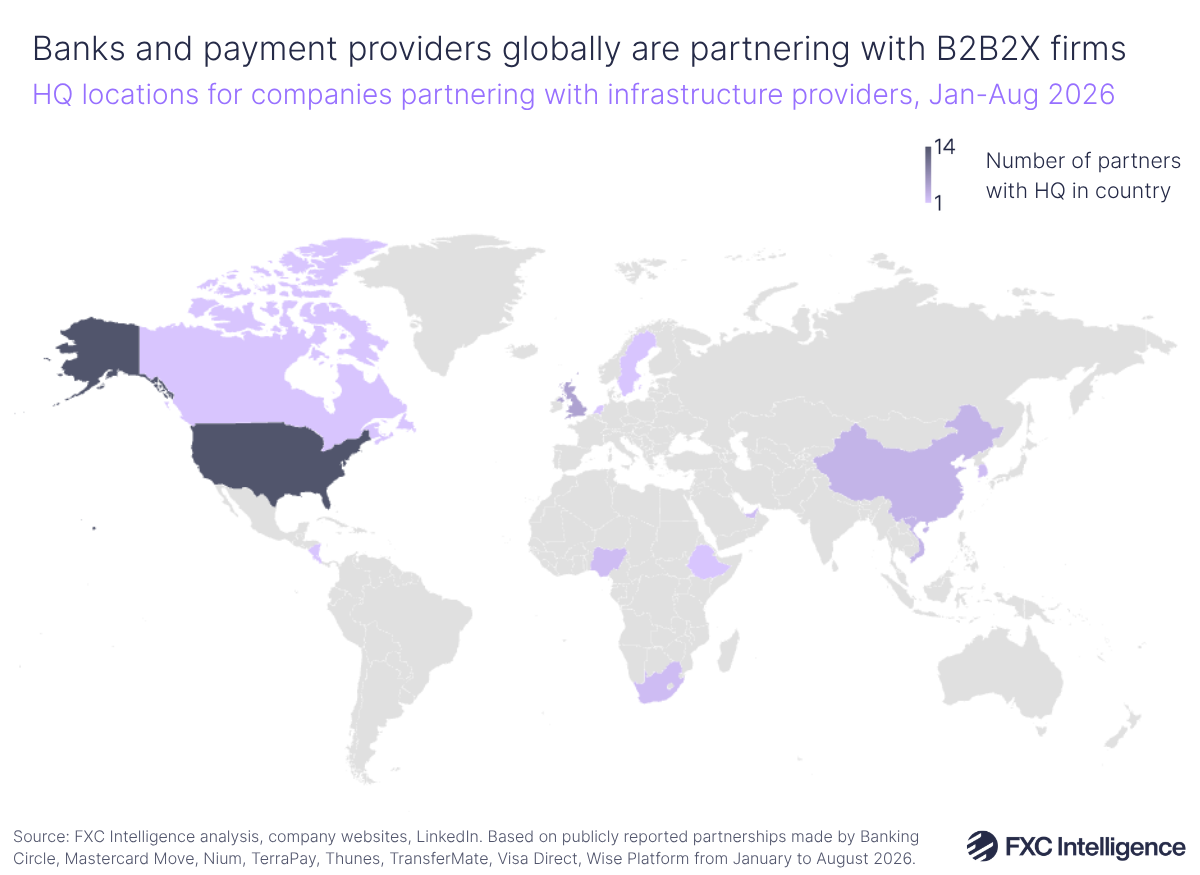
Comparatively, the B2B2X providers with which they have partnered are based in five countries: the US, UK, Singapore, Luxembourg and Ireland.
The US’s prominence in partnership announcements is likely linked to the relatively high number of payments companies in the US, aligning with our analysis of our own Top 100 report earlier this year. However, based on the reach of partnerships of these companies across a variety of different regions, the data points to a story in which businesses in many emerging markets around the world are using infrastructure solutions from developed markets, rather than building their own.
Overall, payments infrastructure partnerships this year point reflect how these companies are continuing to fill in gaps in companies’ ecosystems, with access to new geographies, last-mile and off-ramping capabilities being key drivers.