
OpenPayd is set to soon become a publicly traded company, but how does it compare to other payments companies? We review data shared as part of its SPAC-based Nasdaq listing to find out.
OpenPayd, a payments infrastructure platform spanning fiat and digital asset-based payments, is soon set to become a publicly traded company. With a public debut set for Q4 2026 via a merger with special purpose acquisition company (SPAC) Titan Acquisition Corp, the company will be trading on the Nasdaq.
First announced in June of this year, the deal will value OpenPayd at an equity value of $1.145bn and will be the first time in a while that a major payments company has made a debut via SPAC. Notable past examples include Payoneer and Paysafe, although the approach has fallen out of favour in recent years.
Last week, key documents relating to the deal, in particular an investor presentation and the company’s S-4 document, were published by the SEC for the first time, providing key insights into the company’s financial position and how it is set to position itself in the market. We look at some of the details to establish how we might be benchmarking OpenPayd going forward.
OpenPayd’s key financials: Revenue, volume and take rate
With $85m in annualised revenue as of March 2026 and FY 2025 revenue of $57m, OpenPayd has consistently seen its revenue grow over the past few years. Reporting a compound annual growth rate (CAGR) of 56% since 2023, the company saw its revenue climb by 46% in 2025.
It expects slowing but still elevated growth for 2026, with projected revenue of $72m – a 26% year-on-year increase.
This is aided by growth in its corporate client base, which climbed 60% YoY to 742 in 2025 and is anticipated to reach 1,100 in 2026.
The company has also seen gains over its EBITDA during this period, which climbed 50% YoY to reach $12m in 2025, and is expected to increase by 8% YoY to $13m in 2026. This translates into an EBITDA margin of 21% for 2025, dropping to 18% in 2026.
This has been achieved in part due to increases in gross profit, which grew 42% YoY in 2025 to $44m and is expected to increase by 50% YoY in 2026 to $66m, achieving a gross profit margin of 92%. However, planned capital deployment, including $60m set aside for M&A and $75m to scale the company further, is set to eat into the company’s earnings this year.
Chart data
| Year | Revenue | EBITDA margin |
|---|---|---|
| 2023 | $19m | -43% |
| 2024 | $39m | 21% |
| 2025 | $57m | 21% |
| 2026E (estimate) | $72m | 18% |
This has helped it drive growth in volumes, which reached $100bn in 2025, a 92% increase on the previous year. It also projects 2026 to reach $181bn – an 81% YoY increase.
This outsized growth in volume relative to revenue is, however, driving down its already low take rate. Having stood at 0.09% in 2023, this dropped to 0.06% in 2025 and is expected to reach 0.04% in 2026. Similarly, revenue per transaction has dropped from $3.80 in 2023 to $2.48 in 2025, and is expected to reach $2.32 in 2026.
This is likely a reflection of OpenPayd’s changing business offering over the period, with the company significantly expanding its crypto and stablecoin-based offerings over the past few years. This may indicate that the company earns less from products in this area than some of its open banking-related solutions, however it may also more generally speak to a wider shift in revenue mix.
While it has not shared historical changes in its revenue mix, the company has said that 41% of its revenue currently comes from transaction fees, with recurring fees from subscriptions or minimums for account access accounting for the next highest share, at 24%. Interest income on client funds accounts for 14%, while FX margin feeds account for 13%. Operational and setup fees together account for the remaining 8%.
The company has also seen its average transaction volume fluctuate around $3,400-4,400 for the last three years, however in 2026 it projects this climbing to around $5,800, suggesting that it has seen something of an evolution in client type over the past year.
Chart data
| Year | Volume | Take rate |
|---|---|---|
| 2023 | $22bn | 0.09% |
| 2024 | $52bn | 0.08% |
| 2025 | $100bn | 0.06% |
| 2026E (estimate) | $181bn | 0.04% |
OpenPayd’s market positioning: Bridging fiat and crypto
First launched in 2018 as a provider of payments and banking services for business, OpenPayd has grown to offer a diversified product portfolio that covers collections and payouts; banking-as-a-service and open banking; and stablecoin and digital asset payments.
With both fiat and digital asset licences in several major markets globally, the company is keen to highlight its mix of strong rail offerings and regulatory and licensing depth. This includes 43 state money transmitter licences in the US via the 2 September-announced acquisition of MSB USA.
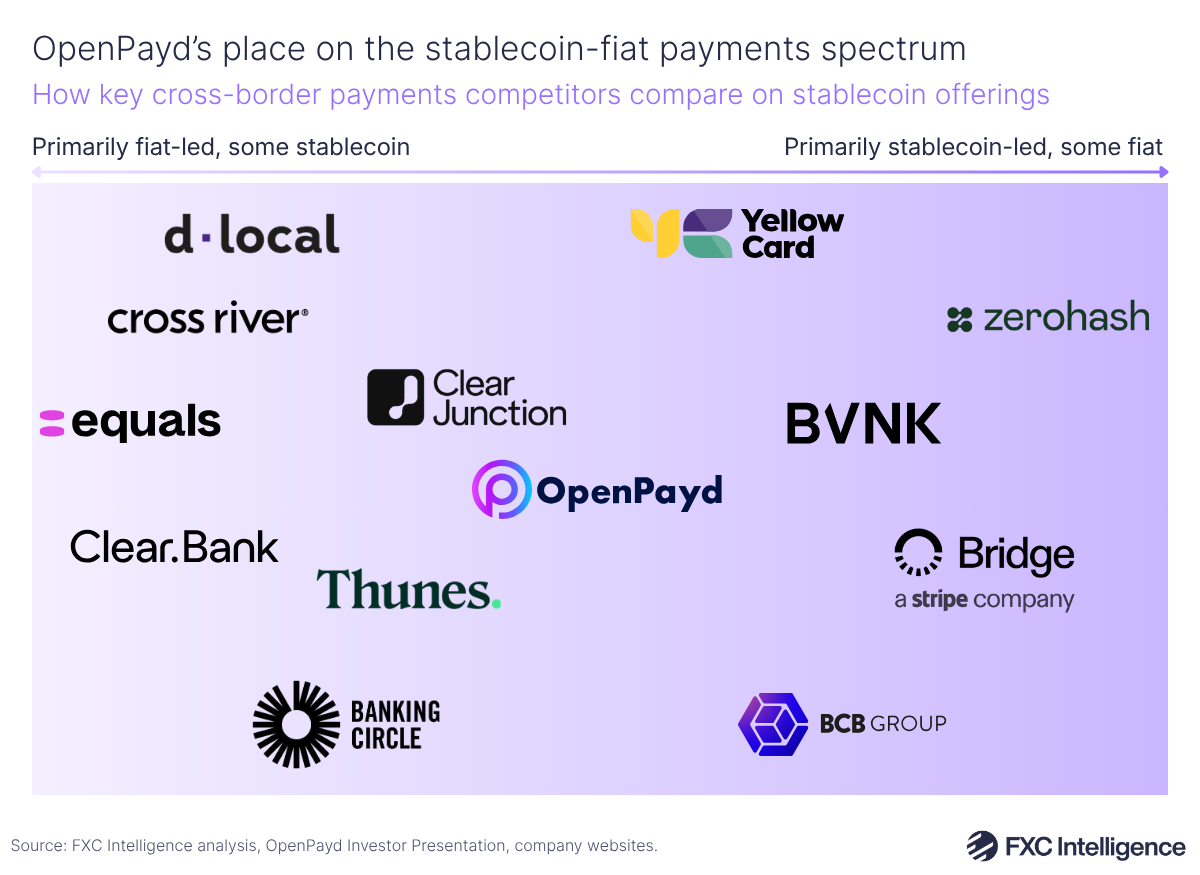
With connections to at least 11 different fiat rails, as well as support for multiple digital assets and more than 50 fiat currencies, the company has stronger fiat depth than more stablecoin-leaning providers such as Bridge and BVNK.
However, in some areas it also competes with infrastructure providers such as Thunes, Clear Junction and Banking Circle. Thunes, for example, offers many similar capabilities directly or via a third-party integration, however it has stronger fiat currency and rails connectivity and less broad digital asset support.
Key client makeup
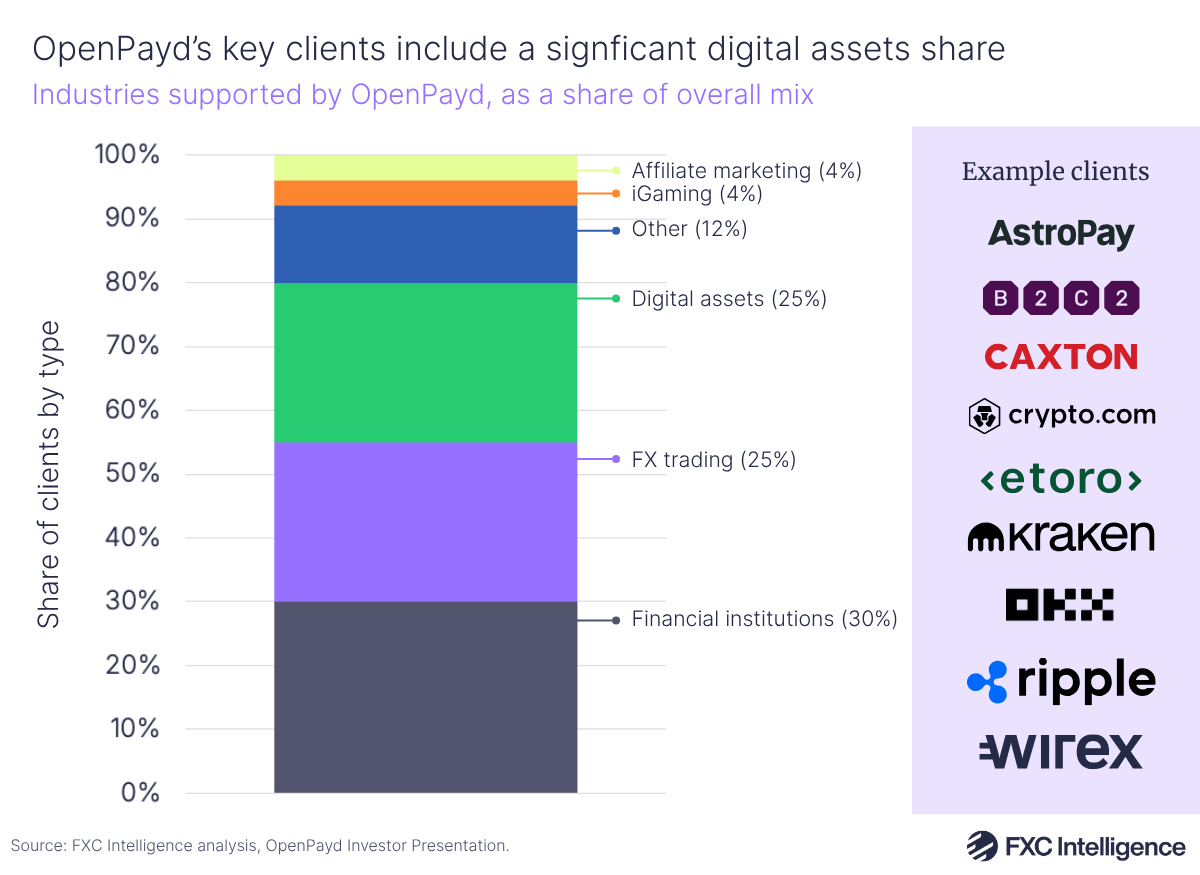
It is noticeable that OpenPayd’s client mix over-indexes on digital asset-related businesses relative to many other companies. The company’s investor presentation shows that 25% of its clients are primarily digital assets businesses, the same share as FX trading and second only to financial institutions, which account for 30%.
However, among recent logos highlighted as “key client wins” over the past few years in the investor deck, digital assets were more pronounced still. Among those logos, crypto exchange and retail trading trading providers accounted for 39%, while digital asset infrastructure providers accounted for a further 20%.
By contrast, while few other providers have such a clear breakdown, our analysis of front-page client logos of a number of other companies showed a greater focus on fiat-led financial institutions and fintechs. For example, 80% of BVNK’s front-page logos are fiat-first companies, while for Thunes it is 90% and for Banking Circle 84%.
This indicates that the digital assets industry is a particular priority for OpenPayd, and it will be interesting to see if this focus becomes more explicit as it begins communicating with the market as a publicly traded company.
Performance versus the market
Many of the companies in the space are not publicly traded and so providing consistent like-for-like comparisons is challenging. However, some of the data released when companies make end-of-year or fundraising announcements provides some comparisons.
Annualised revenue is one of the more common datapoints, with Thunes reporting a $150m revenue run-rate in April 2025, around a year before OpenPayd’s annualised revenue of $85m. Airwallex, meanwhile, with its more B2B-focused offering, is a step beyond this, having reported $1.3bn in annualised revenue in March 2026.
In this respect, OpenPayd is likely to be one of the smaller publicly traded companies in cross-border payments, although with its current rate of growth it is likely to scale quickly.
Opportunities and challenges as a public company
As OpenPayd eyes a public market launch it will be looking to quickly establish rapid growth, in part by cementing itself as a player with a strong organic growth trajectory, but also by augmenting this with strategic investments.
While it already has a strong presence in a number of key Western markets, the company still has many areas to expand, and its plan to use M&A to both accelerate its capabilities and enter new markets suggests it is mindful of the need to boost its presence quickly. This is reflected in its recent acquisition of MSB USA, although it is not yet clear how many other markets the company plans to take this approach with.
How much it doubles down on its position at the intersection of digital assets and fiat remains to be seen. The company’s balance of capabilities across both areas, as well as its client reach on the digital assets side of the industry, give it a relatively unusual positioning and allow it effectively differentiate itself within the space. However, this needs to be balanced with its more traditional finance offering, and OpenPayd is likely to need to sell this mix as a point in its favour rather than an association with sectors that can sometimes be perceived as more risky.
As a relatively small company with a somewhat unorthodox route to the public market in its SPAC deal, OpenPayd will likely need to work to convince investors that it has strong potential ahead. However, its clear and consistent profitability are likely to serve as key assets at a time when growth is expected to be sustainable and well-financed.