Mastercard has reported its Q2 2026 earnings, in which the company saw net revenue rising “above expectations” by 14% YoY to $9.3bn, while operating income rose by 17% to $5.6bn – giving the company an operating margin of 60%. As part of its latest earnings, the company continued to see some interesting shifts in what’s driving its cross-border volumes.
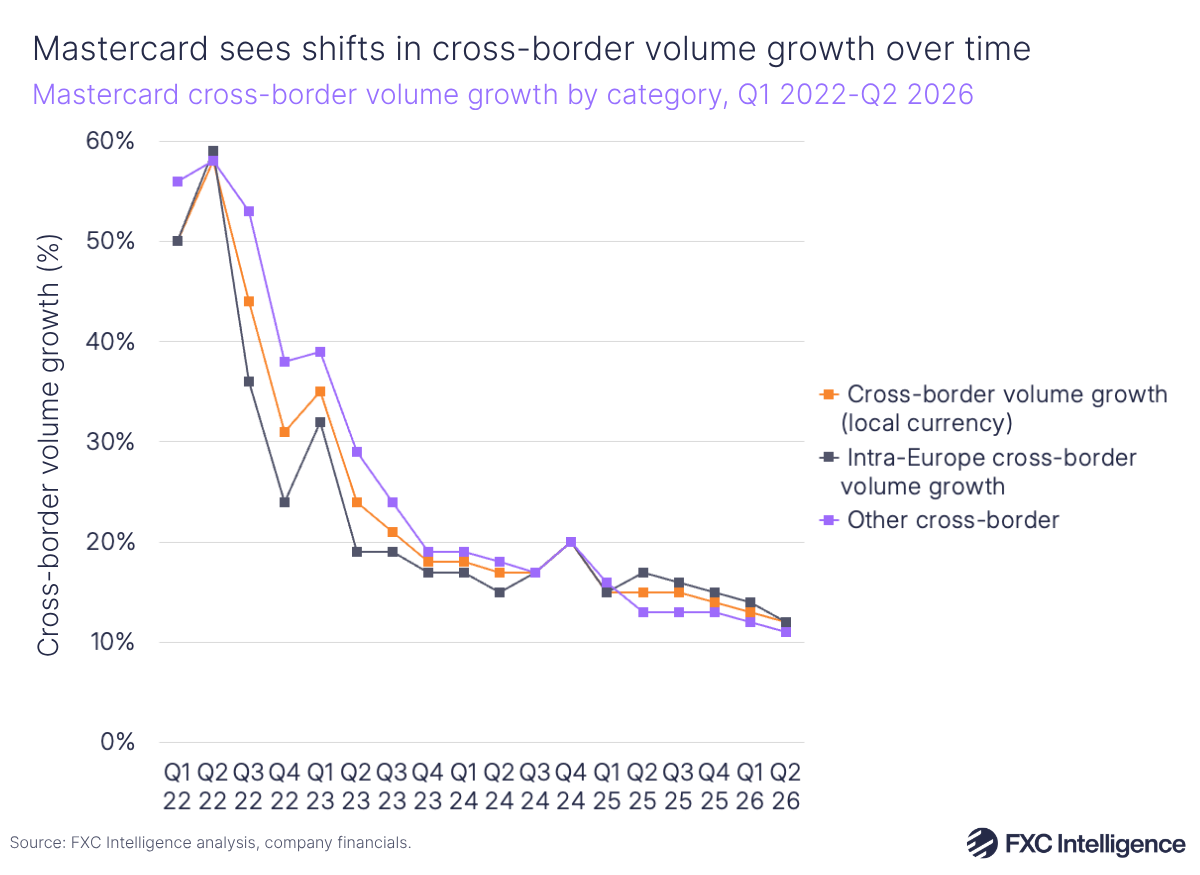
Overall, cross-border volume rose by 12% globally for the quarter, with Mastercard CFO Sachin Mehra (who is soon moving into a new role as Chief Business Officer at the company) attributing this to continued growth in both travel and non-travel related cross-border spending.
As part of this, Intra-Europe cross-border volumes grew 12% during Q2, which was slower than 17% growth in Q2 2025 but still faster than Other Cross-border volume growth (i.e. excluding Europe), which rose by 11% in Q2 2026. Overall, the company noted that both domestic and cross-border transactions had driven its payment network revenue to increase by 10% in Q2 2026.
Mastercard also noted that it saw switched volume grow by 9% in Q2, with this metric growing by 6% in the US, versus 12% worldwide minus the US. Together with cross-border volume growth, these numbers support continued growth in other countries as Mastercard diversifies its network.
The company gave only a minor update on Mastercard Move, its suite of global money movement capabilities designed for banks, businesses and other organisations, though it did highlight that it had made two recent deals with WeChat Pay in Hong Kong and Indian digital remittance platform FlyRemit.
How do cross-border travel and ecommerce factor into Mastercard’s growth?
Mastercard segments its cross-border volumes to show the impact of both travel and ecommerce-related payments on its volumes. The first category is cross-border card not present, excluding travel, which spans cross-border ecommerce (i.e. a UK consumer buying from a US retailer online) with any travel-related purchases removed.
The second category is cross-border travel, which includes both card-present transactions and card-not-present transactions related to travel (e.g. hotel bookings, flights and in-person purchases made while abroad). This effectively splits travel-related impacts away from other types of cross-border transactions being made online.
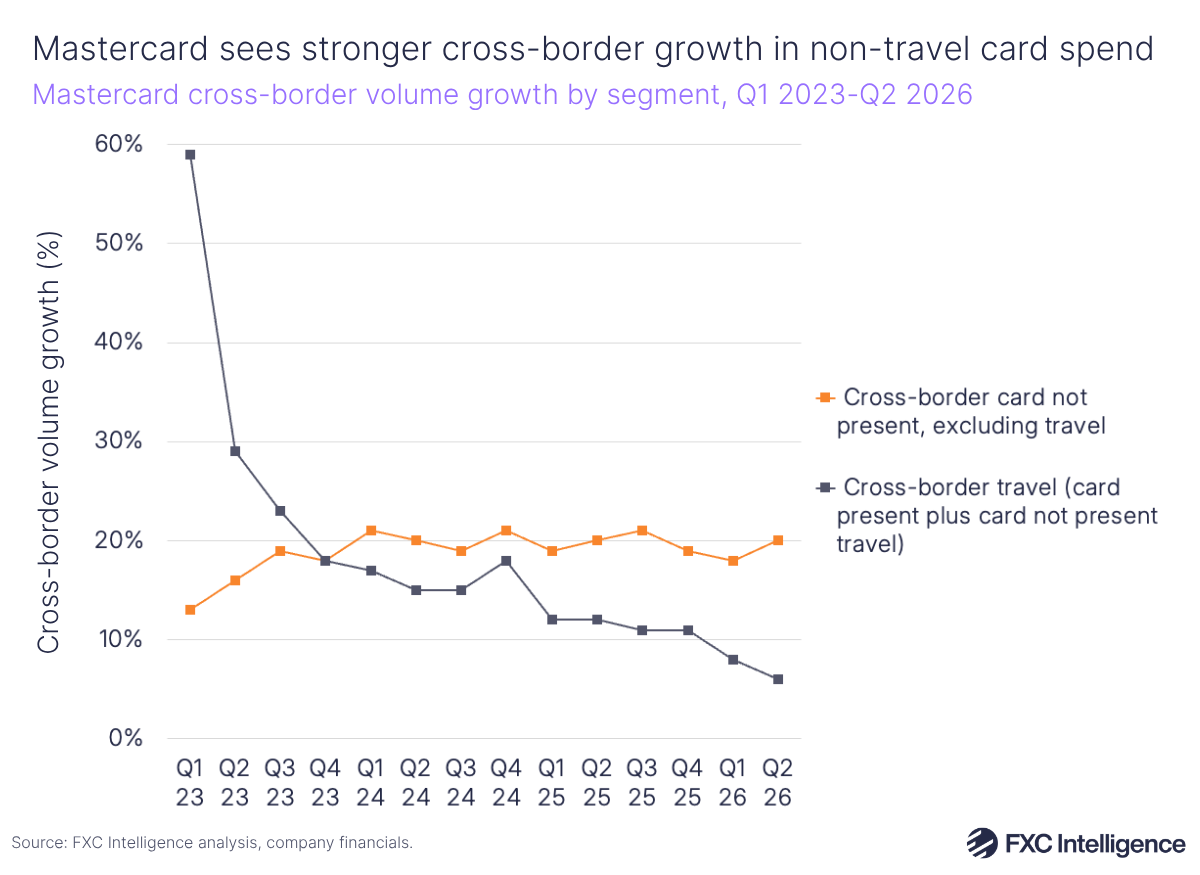
Cross-border card not present ex-travel volumes rose by 20% in Q2 2026, faster than overall cross-border volume growth, with the company tying this to an increase of card-not-present spending in Venezuela and some large promotional events during the quarter.
Mehra noted that across Q1 and Q2, there had been an increased availability of dollars in Venezuela. Though the company did not explain the underlying driver for this, Mastercard had previously deconsolidated its operations in December 2017 (i.e. it had stopped including figures for its operating subsidiary in its headline figures) after foreign exchange regulations in the country at the time restricted access to US dollars, which affected Mastercard’s ability to meet accounting requirements for including Venezuela in its figures.
From Q2 2026, the company has resumed including volume and transaction metrics including Venezuela back into its earnings results. The growth in dollar usage in the country meant that more customers are able to use US dollars in spending, helping power Mastercard’s cross-border growth.
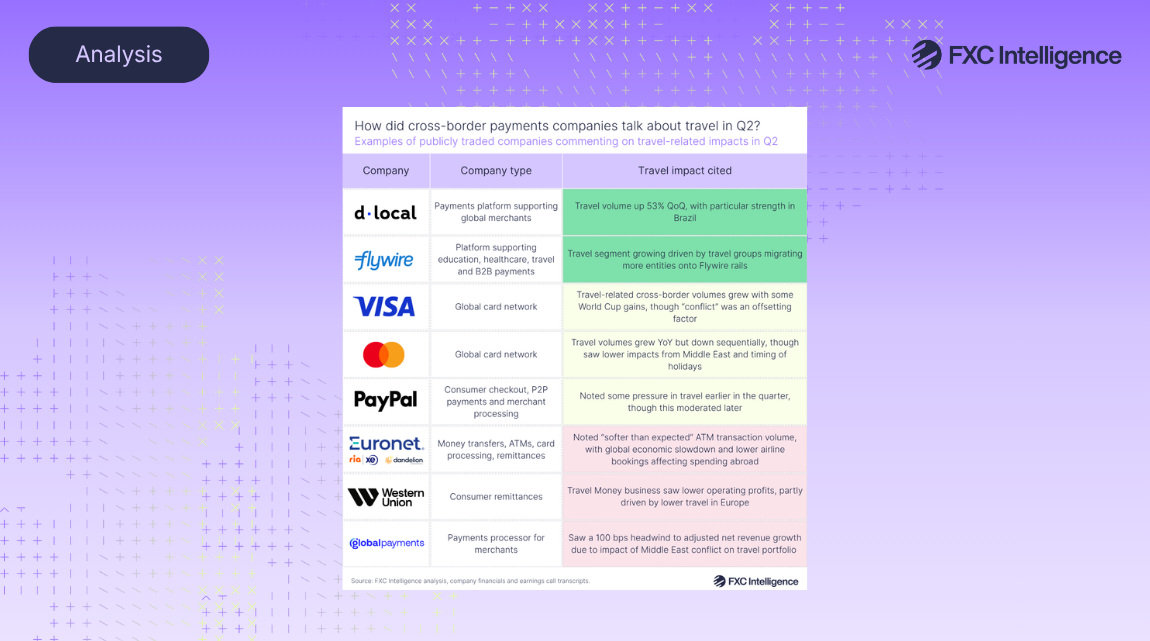
Meanwhile, cross-border travel volume growth in Q2 2026 was 6%, lower than 12% the previous year and continuing a deceleration trend for this metric from last quarter. Mastercard had seen impacts to cross-border travel from conflict in the Middle East, with the effects of things like travel restrictions (mentioned in its Q1 earnings call) dampening its volumes. However, it said that it had seen ‘lower impact’ from the Middle East in Q2, as well as a boost from the timing of holidays.
The shift in cross-border travel volumes versus other cross-border ecommerce volumes shows that even as macroeconomic effects may affect Mastercard in one area, its diversified network in other countries continues to spur growth, even if the company is still feeling an overall deceleration in the wake of the post-Covid-19 travel boom.
How do payment revenues fit into Mastercard’s wider mix?
Cross-border volumes continued to contribute to Mastercard’s overall payments network revenue growth in Q2, with this rising by 10% (8% currency-neutral) to $5.5bn, or 59% of Mastercard’s overall revenue.
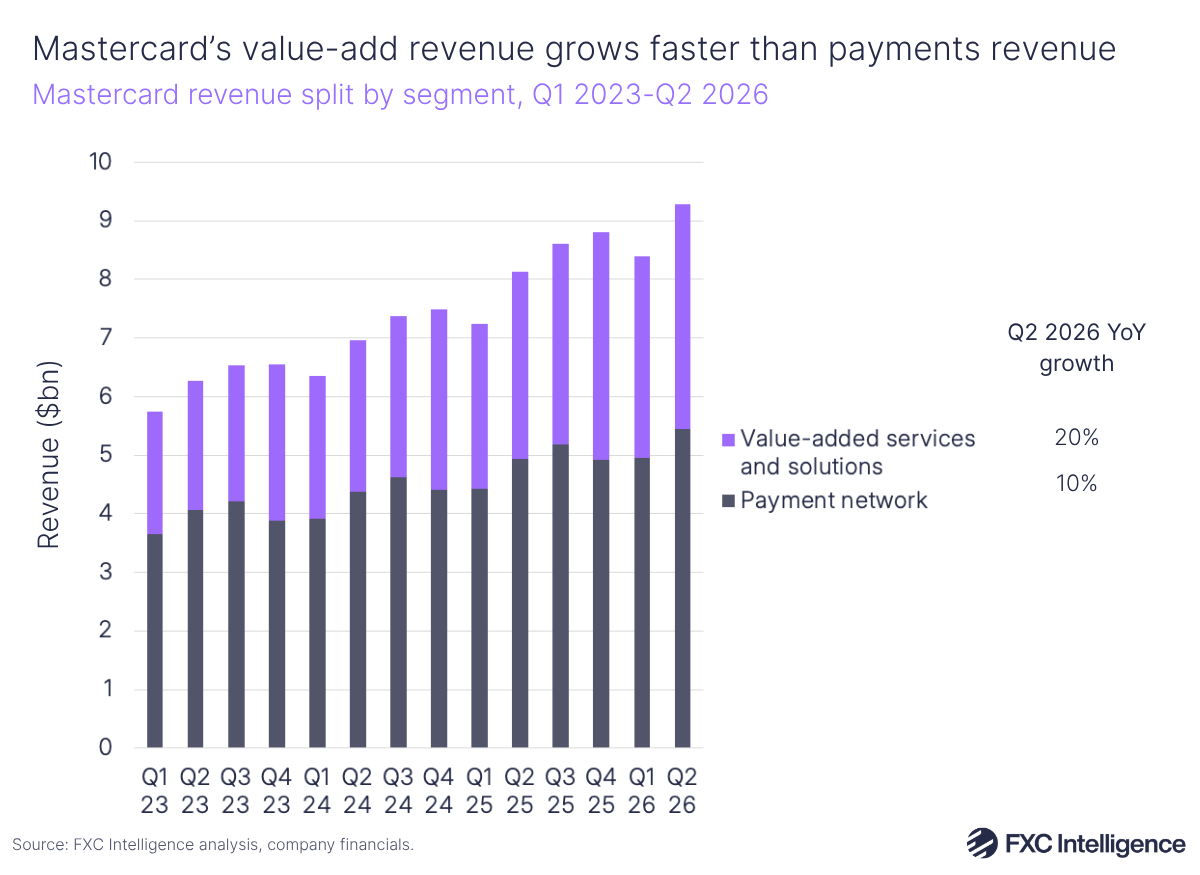
Having said this, value-added services and solutions revenue grew faster than payment networks revenue, rising by 20% – 18% on a currency-neutral basis. Mastercard linked this back to growth across a number of drivers, including strong demand for its security solutions, consumer acquisition, authentication services and business and market insights and pricing.
Building out Mastercard’s geographic footprint was a big theme in the earnings, and there was a stress on being able to add solutions onto the company’s core product. For example, CEO Michael Miebach said that the company had added 230 million net new Mastercards to the market in the 12 months through Q2 2026, adding new partners and the potential to attach new services to these cards. He also said that about 60% of Mastercard’s value-added services and solutions net revenue is “network-linked”, highlighting that strong growth in the company’s wider payments network spurs growth across the other side of the business.
Mastercard also reports assessments, which show the volume of card activity being priced in a given category. As part of this, Mastercard separates out cross-border assessments (charges based on activity related to its cards where the merchant country and issuing country are different) from domestic assessments (charges related to activity where the merchant and issuing country are the same).
Cross-border assessments rose by 20% YoY (on a currency-neutral basis) in Q2 2026 to $3.5bn. This grew faster than overall cross-border volume growth at 12%, with the company linking the eight-point difference to pricing in international markets. By comparison, cross-border assessments grew faster than domestic assessments, which rose by 10% on a currency-neutral basis to $3.2bn.
Mastercard’s next projections and stablecoins’ impact
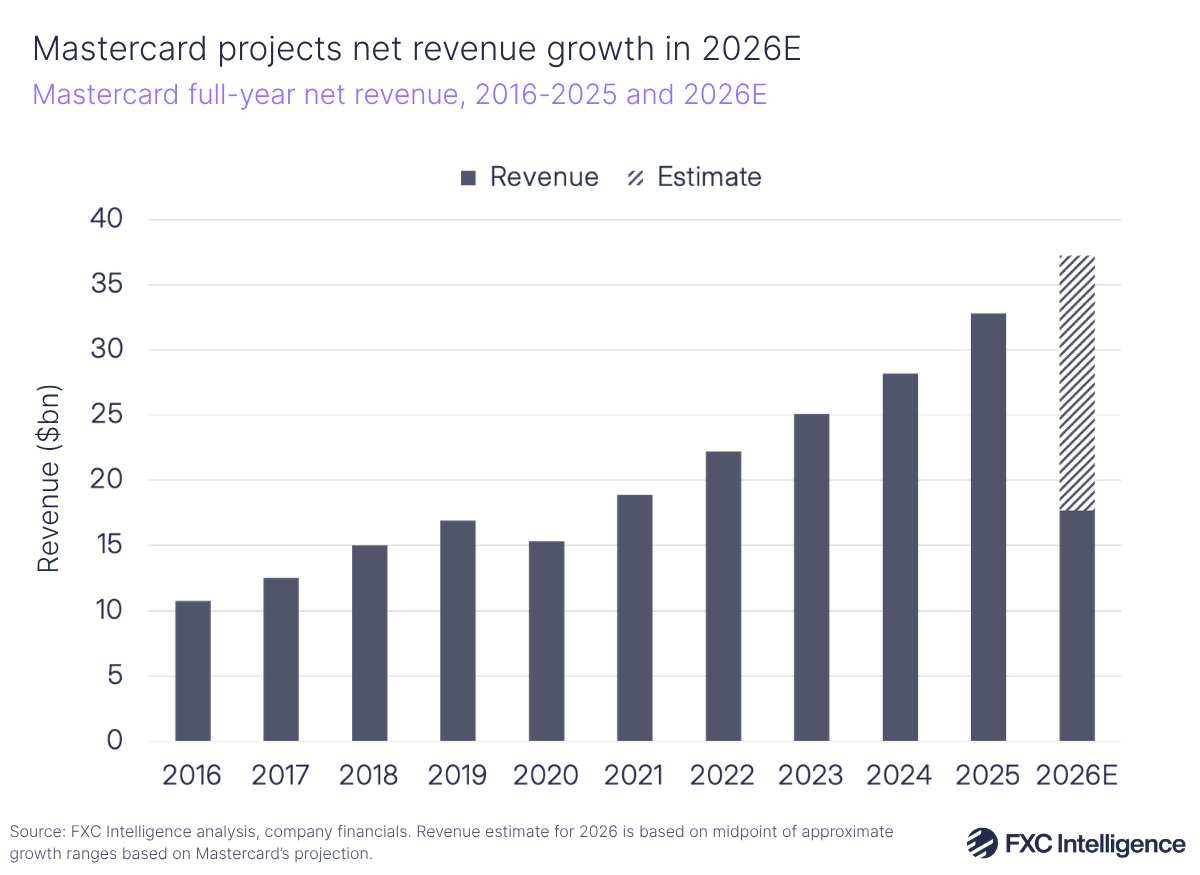
Mastercard expects net revenue growth to be in the “low teens”, shifting its language slightly from “high end of low double digits to low teens” that it gave in its previous earnings call. Based on a midpoint from an assumed projection range of 13-14%, this would put its FY revenue figure at around $37bn in FY 2026.
Beyond the headline figures, Mastercard also gave updates on some of its other major partnerships. Following its earnings call, the company announced on 3 August that it had closed its acquisition of stablecoin infrastructure provider BVNK, through which it aims to serve as an “interoperable” layer allowing customers to send, receive, store and convert digital assets. During the earnings call, the company had said that BVNK’s addition was expected to have minimal impact on net revenues in the short term.
Miebach said that the company expects the stablecoin market to remain a “world of multiplicity” with lots of chains, which is why Mastercard sees the value in being able to serve as an interoperable platform for its customers. Open USD – the stablecoin being developed by a consortium of 140+ payment companies including Mastercard, with plans to launch by the end of this year – will be just one of the coins in this network.
Miebach also commented that while the company sees the utility for stablecoins in some B2B and P2P flows, the technology currently has “no problem to solve in P2M”, which was reflected by digital asset players choosing to partner with Mastercard for its network. “We believe stablecoins have great potential, but to work there are a few essential principles for it to scale: reliability, security and interoperability, and that’s what Mastercard delivers,” he said.
Finally, Miebach said that stablecoins could play a role (though it won’t be the only piece) in the evolution of Agent Pay – Mastercard’s payment infrastructure solution that powers agentic commerce across its global acceptance network. The company recently announced Mastercard Agent Pay for machines, enabling AI agents to purchase low-value digital services at high speed.