Visa, Mastercard, Stripe, MoneyGram and BVNK are among over 140 businesses coming together to launch Open USD, a new stablecoin to power global money movement. We take a look into the new digital currency and see how it might differ from current leading stablecoins.
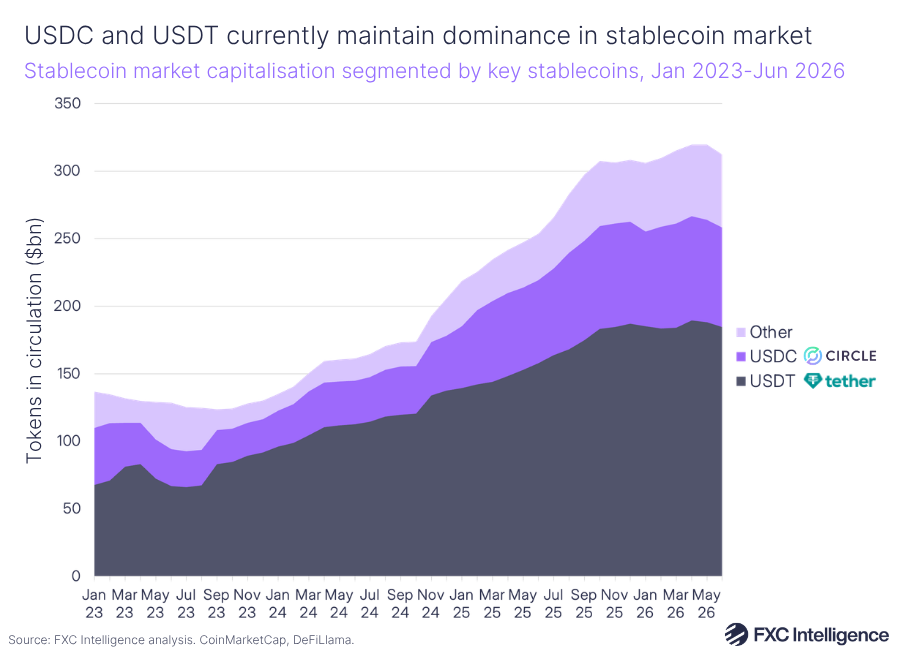
Tether’s USDT and Circle’s USDC continue to make up the vast majority of stablecoins in circulation globally. As of the end of June 2026, USDT remained the market leader, representing a 59% share of all global stablecoins – despite this dominance, this represents a 3% drop in USDT’s market share YoY. USDC, on the other hand, has maintained a 24% share in that time, while all other stablecoins have grown from 14% to 17% since June 2025. A shift away from USDT appears to be continuing, albeit slower than in the previous two years, in favour of the GENIUS Act-compliant USDC.
However, some of the largest banks, financial services, tech and crypto companies are now collaborating to launch a new stablecoin, Open USD, by the end of 2026. The stablecoin will also look to ensure compliance with the GENIUS Act in the US by maintaining its reserves in line with the country’s regulatory requirements.
The launch will aim to tackle the high costs of using stablecoins for businesses, particularly when handling large volumes, by not charging any fees to mint or redeem Open USD, regardless of scale. This is in contrast to how USDC operates, with parent company Circle retaining the interest earnt on its reserves.
Open USD will be governed and operated collaboratively through Open Standard, an independent company set to make all decisions in the collective interest of the more than 140 partner companies. According to the company’s website, the stablecoin will return the majority of revenue generated from its reserves to its partners minus a “small” management fee used to maintain the open infrastructure. Open Standard’s Founding CEO is Zach Abrams, Co-Founder and CEO of stablecoin orchestration platform Bridge, which Stripe completed its $1.1bn acquisition of in 2025.
Visa, Mastercard, BVNK, Klarna, MoneyGram, Western Union, Adyen, Nium, Remitly, Ria, Ripple, Stripe and Shopify are all part of a much longer list of Open USD’s launch partners. Although not all details about Open USD have been shared (such as more information about its reserves), the breadth of major companies backing the new stablecoin may indicate a significant shift away from the current leaders. Following the announcement, Circle saw its share price close 18% lower than the prior day, indicating that there is already strong belief that Open USD can rival its offering.