
Growing numbers of social media platforms are making moves into the P2P payments space, including X and, reportedly, TikTok. Should money transfers companies see them as potential competitors?
Over the past few decades, social media platforms have grown to become some of the most important consumer-facing companies on the planet, with daily interactions from up to billions of users globally. However, while this has seen them reach into many areas, including commerce, their level of movement into the P2P payments space has been highly varied.
While some platforms, particularly in Asia, have had significant success moving into payments, others have had less success and ultimately abandoned ongoing projects. However, a number of new developments suggest that some social media brands may be making fresh moves in P2P payments, either via extensions of existing product offerings or through new additions to their apps.
With strong brand presence and a favourable view from consumers, social media apps have significant potential to draw users for P2P payments and other related financial solutions. But should established money transfers providers see them as challengers?
Social media’s P2P payments moves: From WhatsApp to TikTok to X
Some social media brands have already built highly successful P2P payments offerings that have become notable names in their own right, such as 2013-launched WeChat Pay, which leads P2P payments in China, and South Korea’s KakaoPay, launched in 2014. Both benefitted from demand for digital wallet-type solutions in the region at the time, leveraging their already strong social media platforms into fully fledged consumer financial products of considerable scale, with WeChat Pay appearing on our Top 100 Cross-Border Payments Companies.
However, in other parts of the world, the path from social media platform to P2P payments platform has been less linear. Meta-owned consumer messaging platform WhatsApp has launched business payment solutions in a number of markets, but so far has only launched P2P payments in India and Brazil. While the former successfully scaled up from a pilot over several years, the latter saw a somewhat bumpy arrival: after initially being blocked by the country’s central bank following its 2020 launch, it only formally relaunched with approval from regulators in 2021.
That may soon be changing, however. Monitoring site WABetaInfo recently identified that WhatsApp is developing a new Payments section on its iOS app that includes the ability to add card payment methods and send payments to contacts. Crucially, the update also includes additional countries in the associated address information, covering several European countries, as well as other international markets including Australia, Canada, Ghana and the US.
This has led to speculation that WhatsApp is looking to expand its P2P payments solution to other markets, including the US, which has been bolstered by the fact that Kunal Shah, who joined the company as CEO in June of this year, previously founded several payments-related companies, including Indian payments services platform CRED.
App updates have also led to speculation that TikTok is similarly making moves into P2P payments, with Bloomberg reporting that analysis of code in TikTok’s US iPhone app included several payments-related features, including the ability to send money to other users in direct messages. It is thought that the feature is in the early stages of development and would use TikTok Pay, a merchant payment solution currently available to users in Southeast Asia. TikTok has confirmed that the feature is not yet being tested in any market.
In both WhatsApp and TikTok’s cases, the path from early code development to market launch is significant not just from a testing and development perspective, but also from a regulatory one. Both brands would need to acquire approvals in any markets that they offer P2P payments services in, and it is not yet clear if they have begun this process.
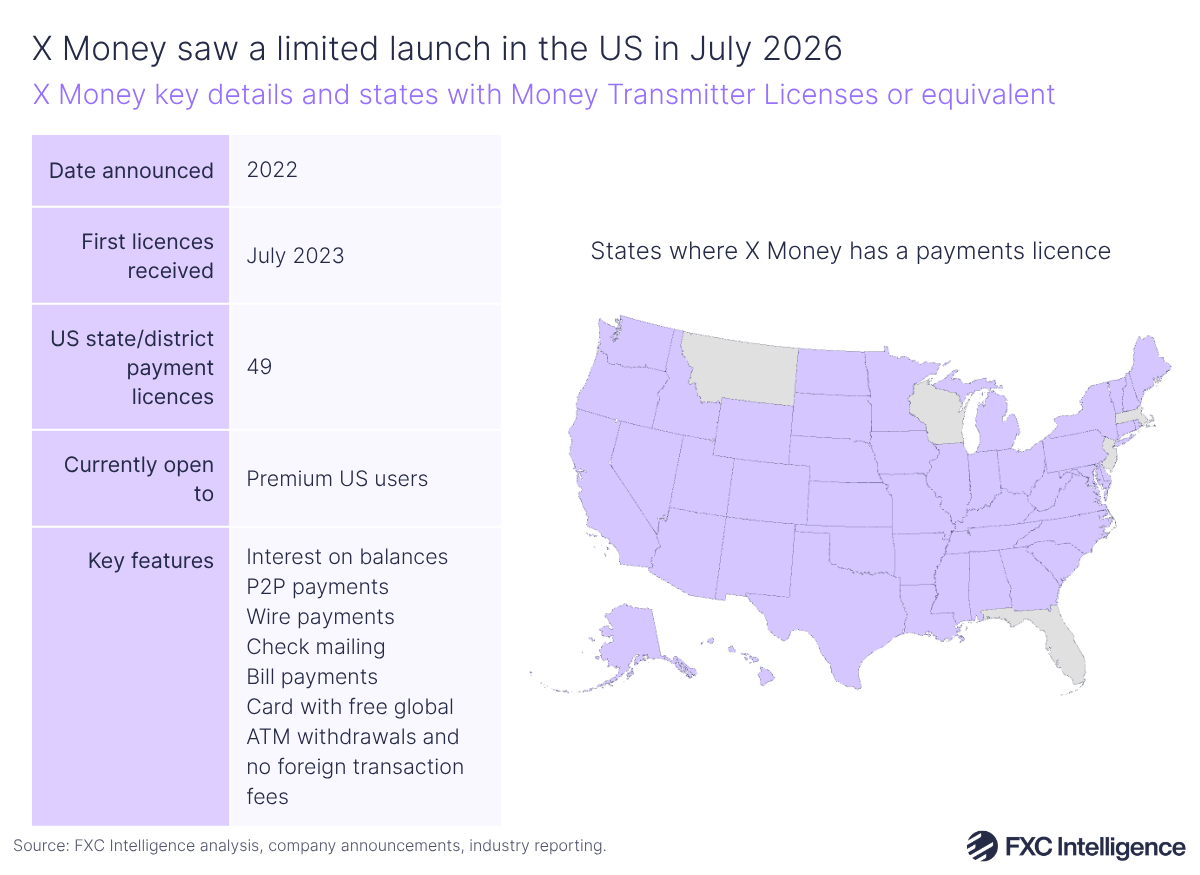
By contrast, X’s brand X Money has now launched in the US, three years after it first began applying for state-level licences. However, it is not yet clear when and if it plans to launch more globally.
Finally, Telegram has been offering crypto-based P2P payments between its users for some time via its Wallet solution, although by operating only using stablecoin and other cryptocurrencies it places itself in a different regulatory position than many other social media platforms, particularly as cryptocurrencies remain a legal grey area in many markets.
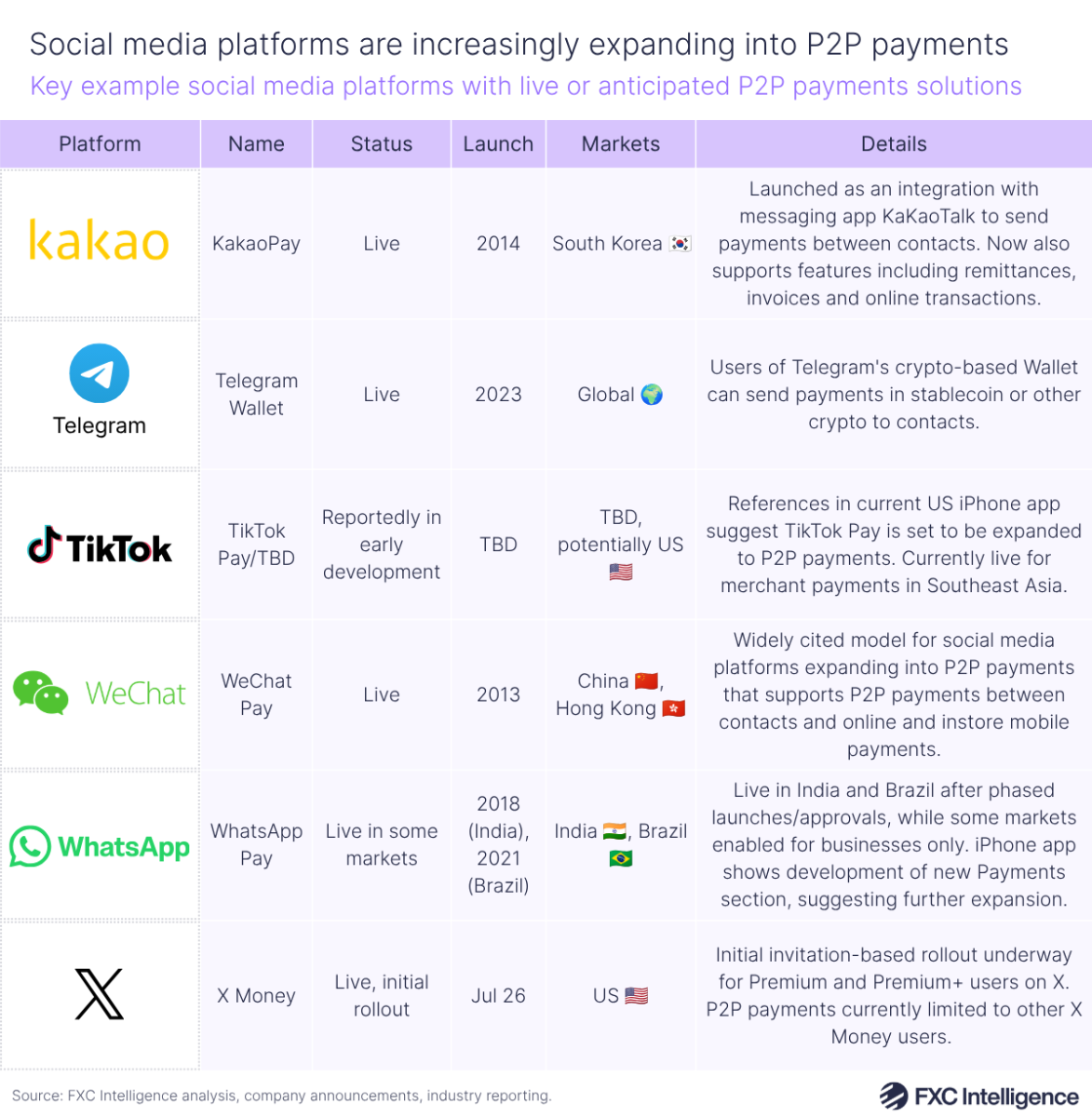
While many of these platforms have seen success, not all offer P2P payments internationally. X Money is currently only available to Premium and Premium+ users in the US, while WhatsApp Pay’s Indian and Brazilian offerings are restricted to payments within the country.
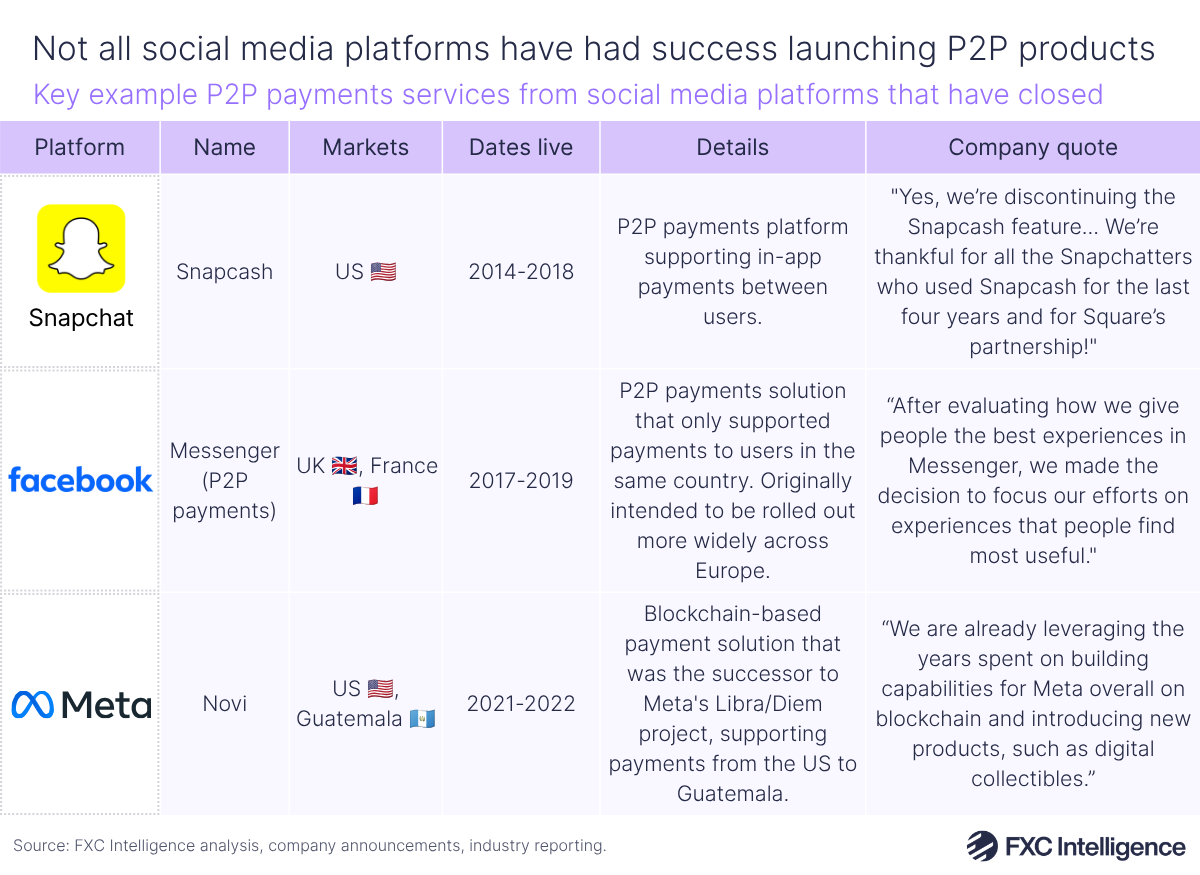
The same is true of some P2P payments offerings previously launched by social media companies, but which have since been closed. Snapchat, for example, offered P2P payments platform Snapcash to US users between 2014 and 2018, while Facebook Messenger supported domestic P2P payments to users in the UK and France between 2017 and 2019.
The notable exception is Facebook’s parent company Meta’s Novi brand, which allowed users to send remittance payments from the US to Guatemala between 2021 and 2022. This was the final form of the company’s blockchain-based payment solution that began life as the proposed digital currency Libra in 2019, before being renamed to Diem and ultimately shifting to use an already launched stablecoin issued by Paxos.
While stablecoin remittances have since seen an uptick in interest, particularly following the 2025 passing of the GENIUS Act, Meta was arguably too early with its initial plans in the space, with the underlying technology ultimately moved to apply to other areas of its business, including its also now abandoned metaverse project.
X Money launches: A P2P challenger?
While few of the more recent developments are likely to have drawn much concern from the wider money transfers industry, X Money has arguably seen some of the most interest, in part because it is the most mature US-focused project from a social media platform.
While it was first announced in 2022, it has taken several years for the company to acquire Money Transmitter Licenses for the majority of US states, and its July 2026 launch remains limited to only some US users on the platform.
Alongside P2P payments to other X Money users, the brand also promises support for wire payments, bill payments and mailing of cheques on users’ behalf, although little information has been provided about the extent of these capabilities at present.
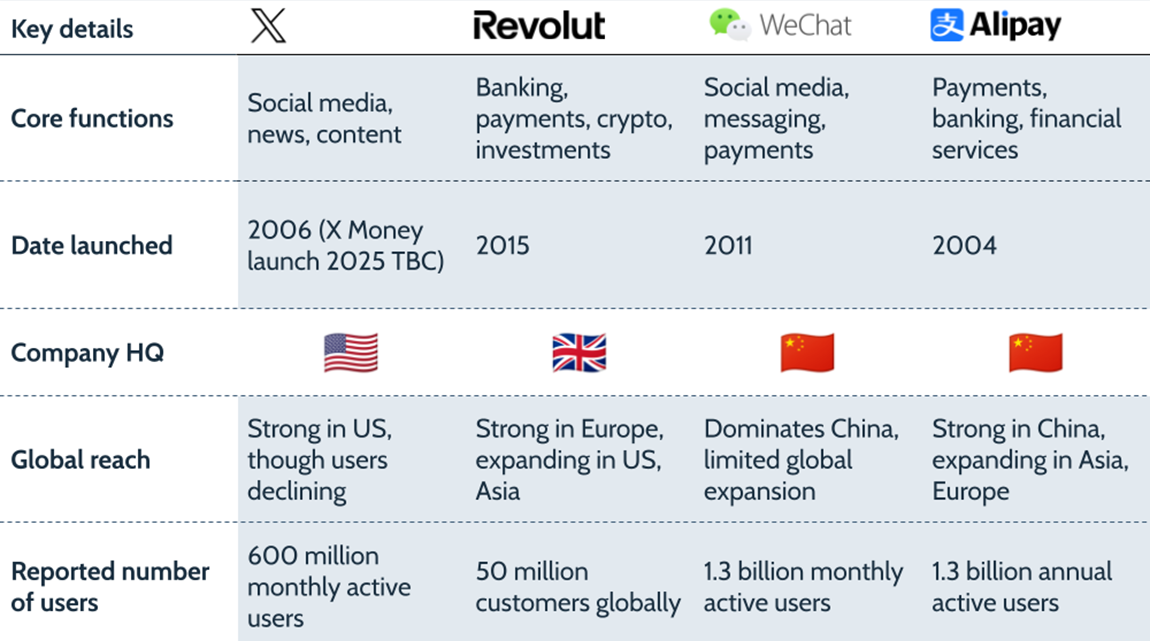
While the US-only nature of P2P payments on X Money for the foreseeable future means it is unlikely to draw any concerns from money transfer providers, its broader capabilities move it more towards neobank competitors such as Revolut – most notably via the ability to withdraw money from ATMs internationally for free, as well as a lack of foreign transaction fees on card payments made abroad.
The total addressable market challenge
Where X Money may face its biggest challenge, however, is in its total addressable market. X has one of the smaller userbases of leading social media platforms globally, with estimates putting the total number of active users at around 560 million, compared to Facebook’s 3.07 billion.
We have previously estimated that US users account for less than 20% of X’s active users, meaning that if this share still holds, X Money would have a TAM of around 100 million users if it was open to every US user, and significantly less if it remains open only to Premium users, with some putting the share that pay for Premium as low as 1% or less – which would give it a TAM of just one million.
By contrast, Revolut reported passing 70 million users globally in May of this year.
Chart data
| Category | Estimated active users (billions) |
|---|---|
| 3.07 billion | |
| 3.00 billion | |
| 3.00 billion | |
| TikTok | 1.99 billion |
| 1.41 billion | |
| Telegram | 1.00 billion |
| Facebook Messenger | 0.94 billion |
| SnapChat | 0.93 billion |
| X | 0.56 billion |
However, a social media platform’s TAM can also be a significant benefit at a certain scale. Meta’s brands Facebook, WhatsApp and Instagram each have around three billion active users, giving them a much stronger starting point from which to draw P2P customers, while WeChat’s one billion+ user base has similarly been key to its success as a P2P payment platform. TikTok’s two billion-strong user base similarly presents an appealing opportunity.
Social media is some way from presenting a serious challenge to money transfers outside of Asia, however that could eventually change if brands such as WhatsApp and TikTok center P2P payments in their expansion plans.