The last month has seen two major remittance providers – Remitly and Western Union – launch new cards that allow users to hold and spend stablecoins. Below, we explore why these providers are launching stablecoin-linked cards and where this fits into a wider strategy to capture remittance customers.
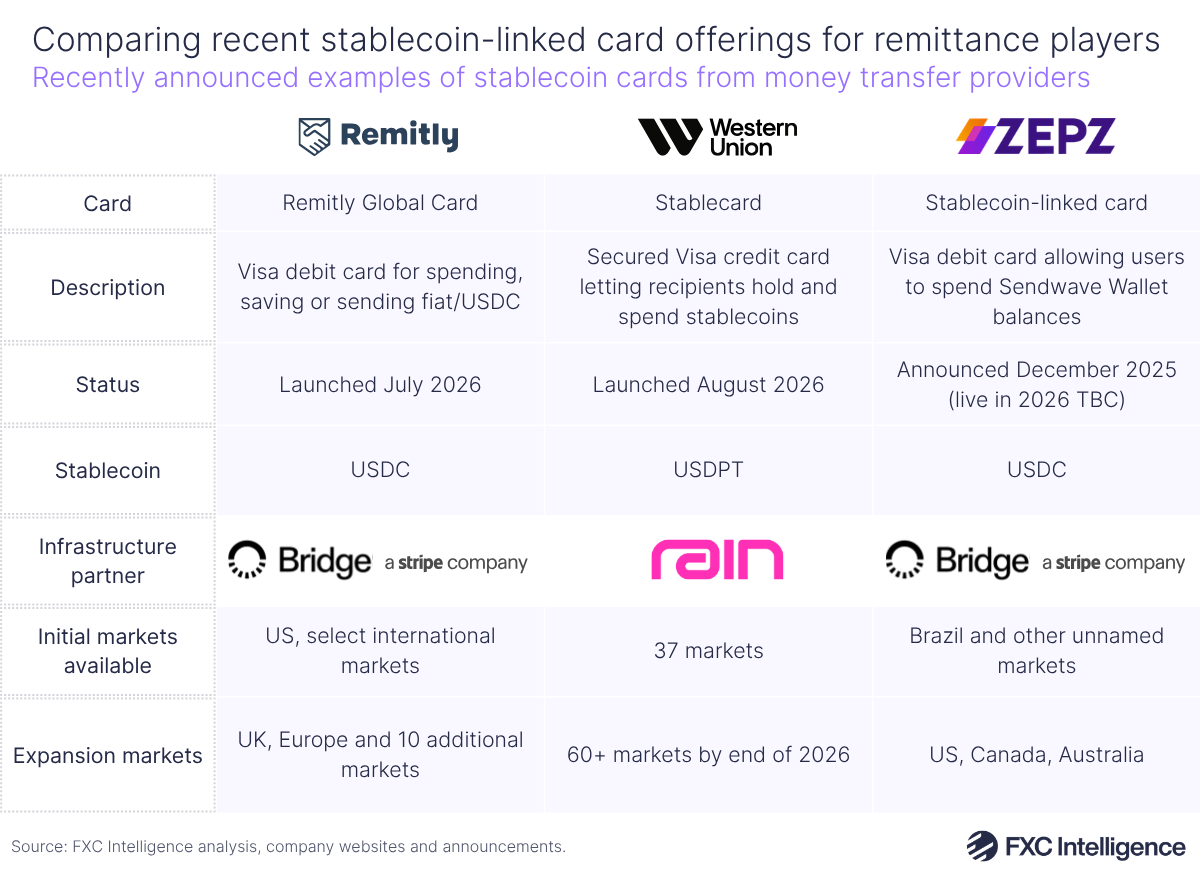
At the end of July, Remitly introduced Remitly Global Card, which gives users an account attached to a debit card that allows users to hold, spend and move money in both fiat currency and US-backed stablecoin USDC alongside other benefits, including better sending rates, access to an open line of credit and instant money movement between other cardholders. This came after Remitly launched its global stablecoin wallet with an attached debit card in Latin America, allowing users to get paid, hold and spend in USDC.
Following this, Western Union introduced Stablecard, a digital wallet and Visa-secured credit card enabling users to receive and store USDPT – the company’s own stablecoin launched on Solana – as well as spend it anywhere Visa cards are accepted. Western Union’s card is framed around holding stablecoins, while Remitly’s latest Global Card offers USDC as part of a set of features to attract sending and receiving customers.
Money transfer providers have already made significant steps into the stablecoin space. Besides Remitly and Western Union, MoneyGram launched its own stablecoin, MGUSD, in June to act as the “foundation” for a suite of financial services, while Zepz (which owns WorldRemit and SendWave) announced in December 2025 that it would soon be launching stablecoin-linked Visa cards through a partnership with Stripe-owned Bridge.
Before this, several money transfer providers had already introduced multicurrency wallets and cards offering users the ability to hold, store, spend and send fiat balances. What makes these recent card announcements interesting is that money transfer providers continue to lean into the consumer-facing aspect of stablecoin remittances.
Cards are another tool to help providers capture customers within their networks so they can offer them more services. For example, Remitly’s CEO Sebastian Gunningham told us that its key use cases in stablecoins are in enabling money transfers to USDC wallets and speeding up internal treasury. Separately, the company is trying to grow its focus on receive customers as well as send customers, with the new card being part of a broader suite of features that they can offer and monetise.
Diversifying to stablecoin-linked cards can help money transfer providers capture new opportunities should stablecoin adoption in remittances continue to grow. To put this in context, our recent report with Allium found that stablecoins accounted for just under 1% of consumer-to-consumer (C2C) cross-border payment flows in 2025, though this was the highest share versus other use cases (B2B, C2B and B2C), with C2C cross-border payment volumes growing 44% YoY.
Notably, both Remitly and Western Union – alongside Ria, MoneyGram, Taptap Send and Félix – joined the consortium to build Open USD, a new “open infrastructure stablecoin” alongside many other payment providers earlier this year. Alongside this development, these recent card launches show certain money transfer providers positioning themselves on the customer-facing side of stablecoins, putting them in a better position should the space continue to grow.