

Circle launched the mainnet version of its Arc blockchain to the public last week. We explore how the system fits into Circle’s wider strategy, as well as how it and other payments-focused blockchains are trying to capture the market.
Last week, Circle launched the public mainnet version of Arc – a payments-focused blockchain enabling real-time money movement for financial institutions.
Arc is a Layer-1 blockchain, meaning it is a base primary blockchain network (similar to Bitcoin or Ethereum) that processes or finalises transactions independently, as opposed to a Layer-2 blockchain, which refers to a secondary network built on top of a Layer-1 blockchain to add additional features (e.g. Base or Arbitrum).
Circle’s Arc is introducing a number of features that enable it to specifically target payments, including enabling payment of transaction fees (i.e. the fees for using the blockchain to process transactions, sometimes known as gas fees) through its own native USDC stablecoin.
Arc also aims to facilitate transactions with “sub-second finality”, meaning that payments essentially settle instantly, and it will serve as the underpinning infrastructure for Circle StableFX, a 24/7 currency conversion system that allows financial institutions to swap between stablecoins denominated in different currencies.
Circle is specifically targeting financial institutions with its blockchain, but it is not the only company in the industry doing so. For example, in March 2026, Stripe and investment firm Paradigm launched the mainnet version of Tempo, its payments-first Layer-1 blockchain that is built specifically to enable stablecoin payments across a variety of use cases, including remittances, global payouts, payroll, embedded finance, microtransactions, agentic commerce and tokenised deposits.
In this report, we explore how Circle’s Arc compares to other blockchains, as well as highlighting some of the key challenges for the service moving ahead.
What is Arc?
Arc is a blockchain that Circle says is “purpose-built for stablecoin finance”. Separate from other blockchains such as Ethereum that have been built to span general-purpose crypto activity, Arc is built specifically for finance and money movement purposes.
Arc has several potential applications spanning enterprises, startups and individuals, though its key use case is enabling banks, payments and fintechs to build applications and services on the back of its infrastructure. The system aims to capture many of the specific benefits in this area that other blockchains don’t, which are covered in more detail below.
Arc is being marketed as an “open” Layer-1 blockchain. This means that builders on the system do not need approval to start testing, building or deploying applications on Arc. However, while Arc is now open to users publicly, it is initially operating with a permissioned validator model.
This means that only specific, pre-approved organisations are allowed to validate transactions that are recorded on the blockchain (i.e. check that those transactions are legitimate and agree via a consensus method). Arc’s validators include BlackRock, The Depository Trust & Clearing Corporation (DTCC), Galaxy, ICE, Mastercard, MoneyGram, SBI Group, Standard Chartered, Sumitomo Corporation, Visa and Global Payments.
This permissioned validator model makes Arc different to the proof-of-stake public blockchains such as Ethereum, for example, where the criteria for becoming a validator is different. To become a validator on Ethereum, you need to own 32 ether (ETH) tokens, which is the cryptocurrency created directly on that chain (with each token worth approximately $2,739, based on September figures). This amount then needs to be staked on the network, which means it is deposited on that blockchain as collateral and remains locked there for as long as the validator continues to validate correctly.
However, for Circle and other permissioned validator models, selected validators are approved based on their status (in Circle’s case vetted, accountable financial institutions). This is an example of the proof-of-authority model.
A mainnet is a version of a blockchain that is fully live and functional for public use, running with real transactions and economic value. Circle had launched a public testnet for Arc in October 2025, which was a separate version of the blockchain designed for testing purposes. Following this, Circle launched its mainnet privately to selected invited participants, and on 16 September launched its mainnet publicly, opening it up to others to join.
In a press release alongside the launch of the public mainnet, Circle said that it had launched with a significant set of more than 100 “institutional and ecosystem builders” that were already live or exploring Arc’s private mainnet ahead of its public launch. On the “institutional” side, this is likely referring to the large global banks and financial institutions that are either validating the network or seeking to send money through it. By “ecosystem builders”, it appears to mean the wide variety of companies building products and services that will exist on Arc. This includes asset managers and issuers, global payments firms, digital asset exchanges, custody providers and digital wallets.
Circle has introduced Arc with a roadmap aiming to target low-cost payments. The system has applications that will enable use cases spanning wholesale, B2B, B2C and C2C payments, though the messaging from Circle appears to be focused largely on wholesale and B2B.
This is evidenced by several factors, including the use of “institution” across Circle’s messaging, as well as the fact that it focuses strongly on the fact that it is launching with permissioned, regulated validators. Circle is also integrating Arc with its other products, including its 24/7 FX trading feature Circle StableFX as well as Circle Payments Network, its existing orchestration network of banks, PSPs, virtual asset service providers (VASPs) and enterprises for stablecoin settlement.
How does Arc fit into Circle’s wider strategy?
Arc is set to support Circle’s wider strategy and be integrated with many of the different features offered across its platform. For example, Arc will underpin Circle Payments Network, its compliance layer spanning banks, payment service providers, virtual asset service providers and enterprises.
Arc is also intended to help Circle to diversify its revenues beyond interest income. The overwhelming majority of Circle’s income is currently derived from the income that it accrues on reserves being held to back USDC, meaning it is highly exposed to interest rate changes.
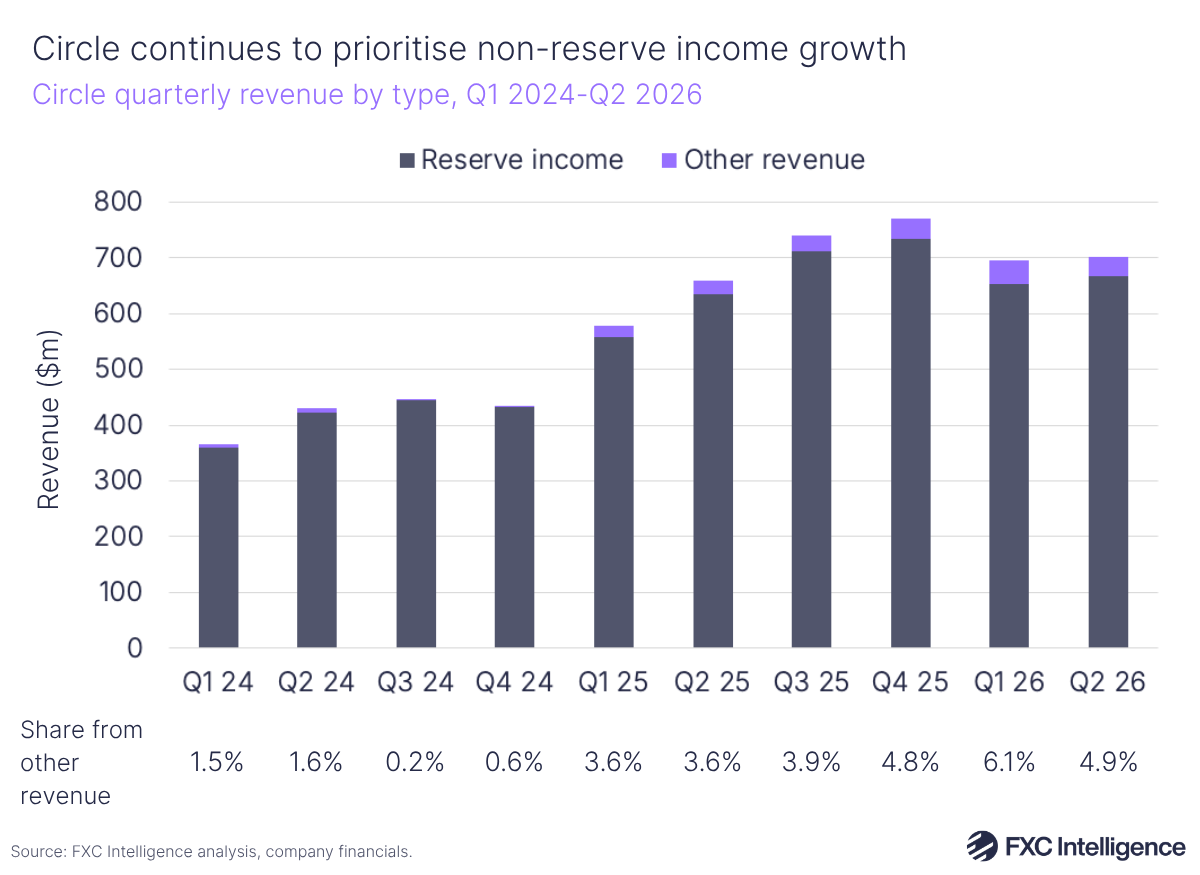
Arc is intended to help Circle to build out its revenues in various ways. This does include the increased usage of USDC – the primary focus digital asset for Arc, used to pay transactions on the network – thus growing its reserves and associated income. However, as Circle said in its recent Q2 2026 earnings, Arc is also set to generate revenue from staking, transactions that run on the network (which both Circle and validators will collect) and partnerships that are built on Arc.
Alongside the mainnet launch, Circle said it had minted 10 billion ARC tokens – the token that it aims to eventually use to coordinate and secure its network. ARC tokens are intended to underpin a future consensus model – the method a blockchain uses to get its participants to agree that a set of transactions is valid before it is permanently recorded.
Arc currently runs on a proof-of-authority model, in which transactions are validated by a small group of pre-approved institutions. Circle has, however, outlined a plan to move to a proof-of-stake model, in which validators would also have tokens committed as collateral, determining how often they are selected to produce blocks, how much they earn and how much they could forfeit for poor performance. In addition to this, token holders can hold and stake ARC without running infrastructure themselves, and share in newly issued tokens and transaction fees that are converted into ARC. However, the validator set is still ultimately “permissioned”, through the validators being approved by Circle.
ARC rewards will come from two places – newly issued ARC tokens minted by Circle, and fees that are converted from USDC into ARC. While validators will gain a commission for their validation work, the remainder will pass to other stakers in proportion to their stake.
In its white paper, the company outlined that the 10 billion ARC tokens would be split across different parties, with 60% going to participants building on, using and contributing to the network; 25% allocated to Circle and 15% existing as a buffer that can be used as “a resource that can be deployed to address market dislocations, fund critical infrastructure or support the network’s stability during periods of stress”. While Circle doesn’t outline the specific “unforeseen conditions” that could lead to these stress periods, this may refer to scenarios where the network’s economics could some under pressure – for example, a fall in the price of the ARC token that could make staking rewards insufficient to keep validators participating in the network.
None of this plan has a committed timeline yet, though Circle said that it expects to explore this transition in 2027. However, prior to the mainnet launch, the company executed a $222m presale of the token. At the time, it raised its Other revenue (i.e. excluding reserve income) projection to be between $310m and $330m, up from its previous projection of $150m-170m. This includes its recognised ARC token presale revenue, while the company cited the Q3 mainnet launch as key to this upwards revision. This demonstrates the scale of the bet that Circle is placing on Arc.
What challenges have led to payments-focused blockchains emerging?
Blockchains provide a shared ledger that allows money to move between parties, with a stablecoin-based cross-border payment consisting of three legs – on-ramping the fiat currency onto the blockchain by converting to a digital asset, moving that asset between parties, and off-ramping the digital currency back into the recipient’s local currency on fiat rails.
A number of established blockchains, including Ethereum, Solana and Tron, carry large payment volumes, with Ethereum being the biggest. It currently has a stablecoin market cap (i.e. the total value of all stablecoin payments currently stored on the blockchain) of $147bn, higher than Tron with $94bn and Solana’s $17bn, although only a portion of this will be used for payments.
The on-chain activity is only part of the picture. As blockchains handle digital rather than fiat currencies, fiat-to-fiat cross-border payments require the sender’s payment to initially be transferred via local fiat rails before being on-ramped and moved on the blockchain. After this, it needs to be off-ramped into the recipient’s fiat currency and transferred through local rails to the recipient’s account or wallet. This adds additional costs and settlement times to the end-to-end payment process.
Foreign exchange also needs to happen as part of the process if senders and recipients are not transacting in the same currency – this can either occur on the chain, through a stablecoin denominated in one currency (e.g. a dollar) into another currency, or when it is off-ramped, typically supported by a local partner.
Many blockchains already address key issues around cross-border payments by enabling near instant, 24/7 settlement. However, they may also present several frictions and challenges to the businesses aiming to build applications on them specifically for payments.
One particular consideration is transaction fees. Most blockchains require businesses to pay transaction fees using separate digital assets that aren’t stablecoins. Fintechs, banks and payment services providers need to acquire and hold these separately, adding additional friction, and their lack of fiat backing means they may shift in value and create unpredictable costs for these companies when they use blockchains to send money.
A number of different factors can also impact payment fees and speeds on blockchains. As with fiat networks, blockchains can only process a finite number of transactions per second, meaning network fees can be surge when demand outstrips supply. General purpose blockchains also see a variety of activities beyond payments that can cause unrelated traffic surges, further contributing to the unpredictability of transaction pricing.
Another key issue is privacy. Public blockchains record their transactions on ledgers, which can be inspected by other parties. This means that anyone, including a bank or business’ competitors, can see the transaction history for a particular wallet. Should that wallet become associated with a specific company, repeated activity can show how much money banks are moving and if the wallets they are sending to are associated with a specific company, this can imply a commercial partnership.
For financial institutions, this can present commercial issues, as competitors may be able to identify their clients and pricing strategies. There may also be contractual obligations around client confidentiality that could be breached if transactions are made transparent.
Related to this is the Travel Rule, a key area of compliance in stablecoin payments. Blockchain users sending cross-border payments must include details of both the payments originator or beneficiary in order to enable traceability in support of AML, fraud prevention and sanction compliance efforts. Blockchain transactions carry wallet addresses and amounts but the identities behind them are hidden, so this information needs to be exchanged separately through compliance systems on the chain.
Circle’s Arc joins other established stablecoin-focused blockchains
While general purpose blockchains can create frictions or lead to unpredictable costs for the businesses using them, Arc and several other Layer-1 blockchains have launched with a specific focus on finance and payments to gain control over the infrastructure on this payments layer.
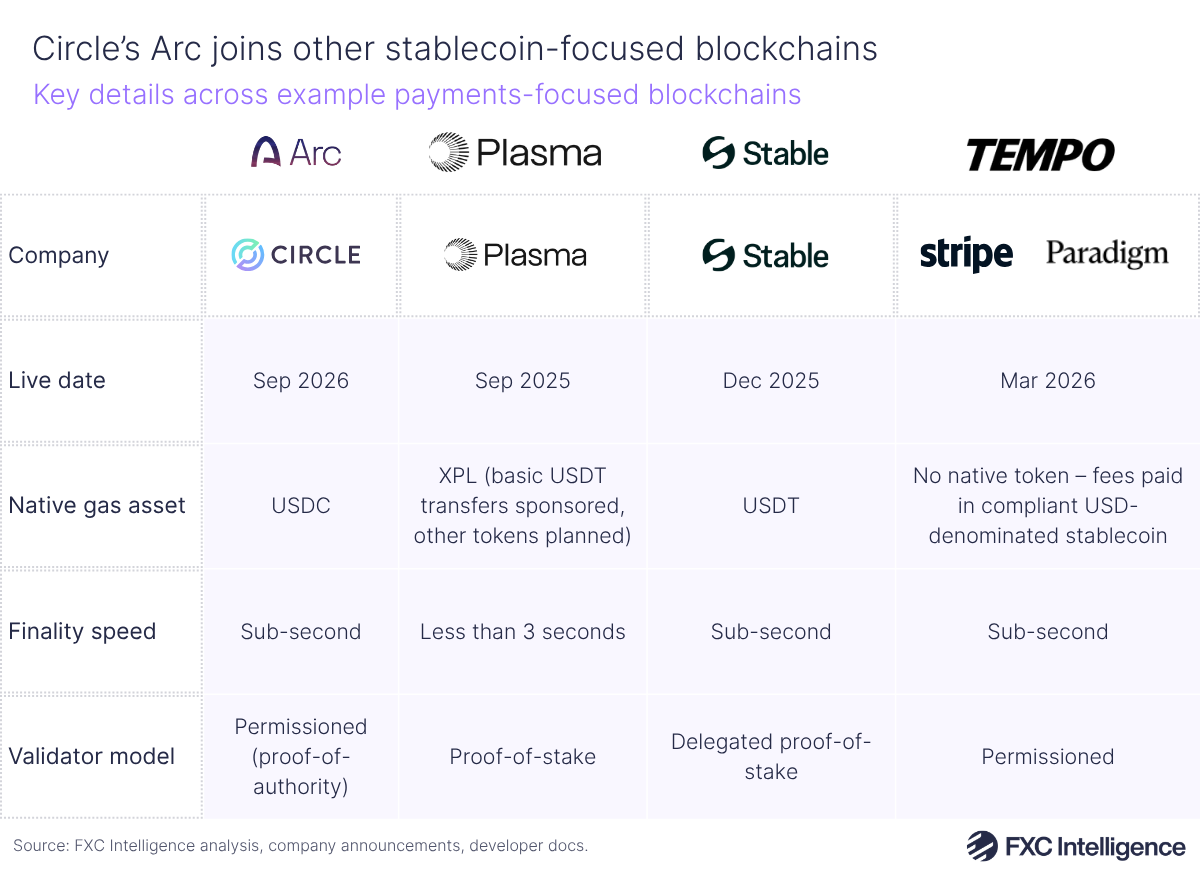
One recent example is Tempo, a payments-first Layer-1 blockchain incubated by Stripe and Paradigm that went live back in March 2026. The blockchain is aimed at enabling a number of different functions including payments acceptance, global payouts, remittances, microtransactions, tokenised deposits, agentic payments and more.
Last year also saw the launch of Plasma, a Layer-1 blockchain backed by Framework Ventures and Bitfinex. A purpose-built blockchain for stablecoin payments, Plasma reports an annual transfer volume of $250bn+ and, similar to Arc, is built to enable fast finality for payments. Its network spans a variety of use cases including global neobanks, stablecoin cards, payroll and cross-border payouts.
Also launched last year, Stable is a separate Layer-1 blockchain backed by a $28m seed round led by Bitfinex and Hack VC. Despite similar backing, it is a distinct project from Plasma, with a mainnet going live in December 2025. Stable uses USDT directly as a gas asset alongside a separate token, STABLE, used for governance and network security rather than payments.
The chains have similar features, with one of the main ones being that they remove the need to pay transaction fees using volatile tokens (e.g. Ethereum, where transacting in USDC requires separately holding ETH). They also promise fast, sub-second or near-instant settlement, based on their consensus mechanisms.
Using stablecoins to pay transaction fees
One of the main features of Circle aiming to boost its appeal is the ability for users to pay transaction fees in stablecoins. On Arc, transaction fees are paid in USDC, with the value pegged to the US dollar. This therefore provides a much more stable and forecastable amount for transaction fees than a volatile cryptocurrency.
Tempo similarly allows users to pay transaction fees in “any supported USD-backed stablecoin” as long as it is issued as a native TIP-20 contract (i.e. it complies with Tempo’s native standard for tokens being used for stablecoin payments). The stablecoin also needs to have sufficient liquidity on Tempo’s Fee Automated Market Maker – its dedicated system for converting transaction fees between different stablecoins.
While Tempo itself doesn’t provide a full list of compliant USD-tokens, it includes USDG and USDT as examples of tokens that can be selected as preferred tokens for transaction fee payments, and if no preference is set, the fee is paid in pathUSD – Tempo’s native stablecoin. Tempo also adds that it has plans to add non-USD stablecoins “as those markets develop”.
Plasma, meanwhile, uses XPL, its native token, for transaction fees. XPL is an asset built for staking, validator rewards and governance, similar to ETH or (eventually) ARC. Unlike a stablecoin, its price fluctuates with market demand rather than being pegged to a currency. However, Plasma is building a function that allows developers to register whitelisted ERC-20 tokens (i.e. digital assets that comply with Ethereum’s standards) to pay these fees. This includes stablecoins such as USDT, for which the platform offers completely zero-fee transactions.
This lets users move away from XPL and allows them to pay fees in stablecoins, gaining the value of no longer requiring users to hold an additional volatile token, and also meaning that apps can show fees in the local stablecoin value.
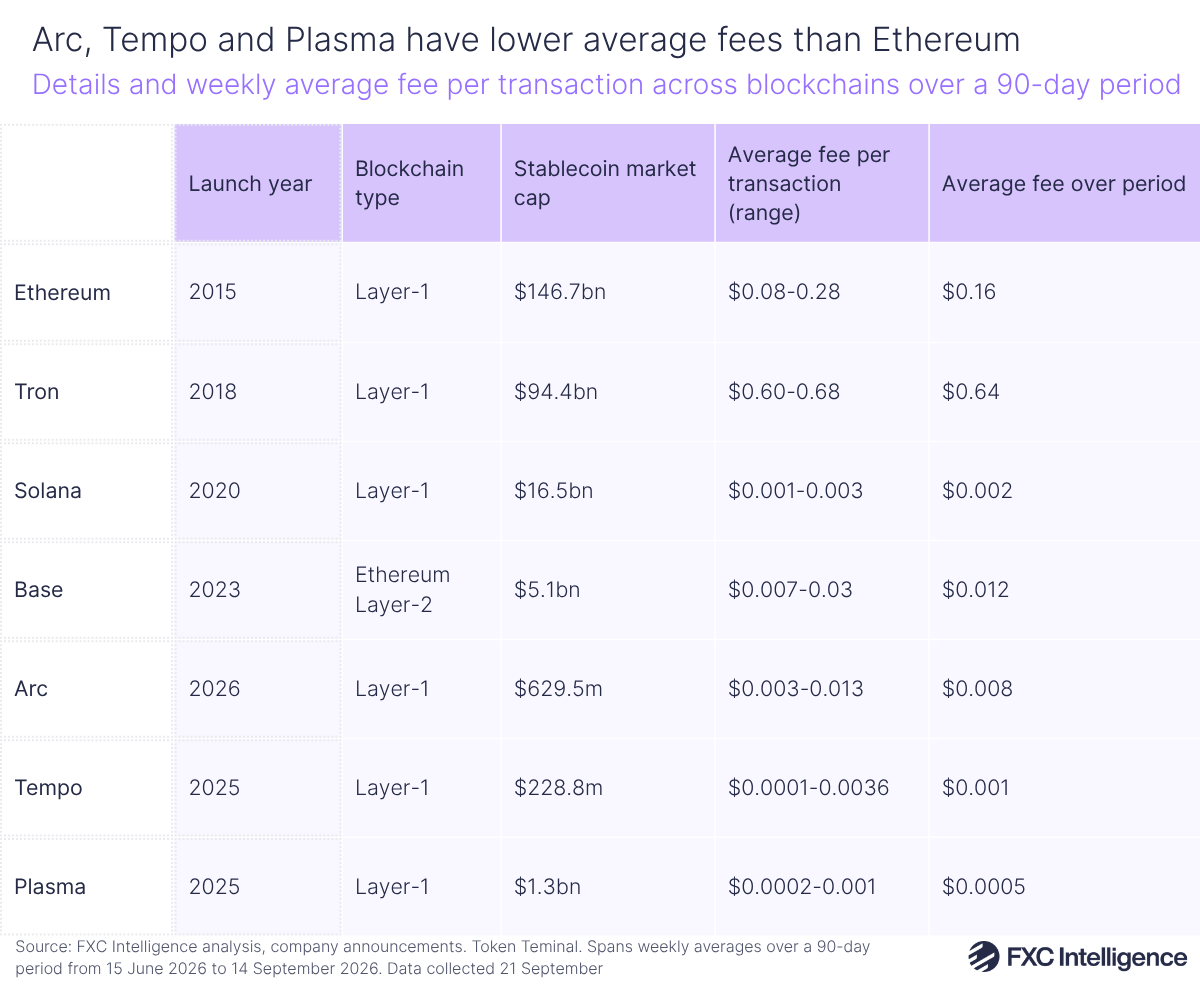
Analysing a 90-day window from Token Terminal, which has captured fees since the opening of Circle’s private mainnet in May 2026, shows that fees vary across stablecoin chains. However, fees on the stablecoin-focused payment chains – Arc, Tempo and Plasma – tend to be significantly lower than other major blockchains, including Ethereum and Tron.
Having said this, there is still some variation for each of these blockchains over time, showing that although gas fee changes are more predictable, these can still shift due to demands on the network over time. For example, Tempo shows the widest proportional range in the group over the 90-day period, with a range of $0.0001-$0.0036 – the high price being 36 times the low price. By comparison, Ethereum’s range of $0.08 to $0.28 is larger in absolute terms, with 28 cents versus a third of a cent, but the proportional movement is lower, with the high price being 3.5 times the low price.
For businesses that are processing payments at scale, even small variations can carry operational differences for lower-value payments, where the fee may represent a larger proportion of the transaction. Having said this, even at the top end of the ranges across the payments-focused blockchains, average fees per transaction remain at the lower end of the scale versus the non-payments focused blockchains.
Where Arc has a different approach to other stablecoin-focused chains is its decision to introduce a separate token, ARC, designed to specifically secure the network and pay out to validators. The idea is that gas fees paid in USDC are then turned into an ARC token, with some of this being provided to validators as payment for running the networks, while some of it is burned as an inflationary measure.
The introduction of this token is designed to motivate validators to secure the network, as it gives them a direct financial stake in the long-term success of Arc. The more users use the network, the more it is converted into a share of ARC that grows over time.
Keeping transactions private
Payments-focused blockchains have also begun introducing ways to enable better privacy on transactions. Circle’s Arc, for example, is in the process of developing an opt-in privacy system to its blockchain that will enable confidential transactions and balances using a system involving view keys.
Rather than a transaction being either fully public or fully hidden, view keys are tools that would allow specific parties to view transaction data, without allowing them to enable or send transactions.
Plasma is similarly developing an additional confidential payments feature on its blockchain that uses zero-knowledge proofs, so the network is able to confirm payments are valid without seeing its actual details. It also uses “stealth addresses”, which refer to one-time generated wallet addresses that can be used to mask the wallet address of the sender.
Tempo, meanwhile, has introduced Tempo Zones – private chains that run in parallel to the Tempo mainnet and allow users to send funds to a specific address that is private and invisible to the public. Aside from the sender and the recipient, the operator of that zone is the only party that can view the transaction.
Notably, a number of the major blockchains have made steps towards integrating privacy features into their platforms. In June, Base introduced an enterprise-only private transaction feature using zero-knowledge proofs to shield sensitive transaction data. Meanwhile, Ethereum is moving to introduce a native system using cryptography for private transfers.
Under the Travel Rule, financial institutions need to collect and transmit information identifying the sender and receiver of transfers. That data does not travel on the blockchain itself, but is exchanged separately between institutions through dedicated compliance systems. The result is that institutions need confidentiality from the public and their competitors while being able to disclose information to regulators and counterparties, which is why the features emerging on payments-focused chains are built around selective disclosure rather than concealing data.
Building in features for FX
While it is common to send stablecoins across borders on general-purpose blockchains such as Ethereum or Solana, converting this stablecoin into different currencies often needs additional parties to be involved. This forms part of the market liquidity challenge for blockchains.
Companies want to be able to convert into or out of stablecoins in a given currency at a stable spread, but a challenge arises when the demand for a specific stablecoin is too low relative to the amount someone wants to trade in it and what they want to trade for, which can lead to higher costs when trading.
There have been several different processes involved in enabling conversions across blockchains, all of which add an additional layer of complexity to payments going through blockchains. One is decentralised exchanges, which are marketplaces that trade crypto tokens for other tokens. Another is an over-the-counter desk (OTC), a company that arranges large trades privately. Thirdly, there are market makers, which buy stablecoins from the payment company in exchange for the local currency of the recipient, before selling the stablecoin into global markets where demand exists, thereby profiting from the spread between its buy and sell price.
Alongside Circle’s Arc mainnet launch, it reported the inclusion of StableFX, which features a request-for-quote system that allows liquidity providers to compete off the chain to offer the best available prices for trades. Businesses are able to swap stablecoins denominated in one currency for a stablecoin denominated in another. Once a business accepts the quote, the trade settles on Arc itself using Payment-versus-Payment settlement logic, with both sides of the trade settling or neither does. This removes the risk of one party delivering funds without receiving the other currency in return.
Circle’s argument is that this replaces a series of bilateral relationships with a single one. Rather than negotiating separately with an OTC desk or market maker in each corridor it operates in, a business contracts once with StableFX and accesses multiple competing liquidity providers through it — reducing onboarding costs and tightening the spreads it receives specifically for that on-chain conversion.
StableFX consolidates the on-chain leg of currency conversion, replacing bilateral trading relationships with a single venue. However, it does remove the need for relationships with liquidity providers when it comes to off-ramping. Circle states that participants must contract directly with local stablecoin issuers to access fiat on-ramps and off-ramps for their currencies.
This means that a business converting dollars into Brazilian reals, for example, would use StableFX to swap USDC for BRLA, a real-denominated stablecoin, but would still need to have relationships with other parties to convert this into spendable reals at the other end. However, generally speaking, converting into a local currency stablecoin and moving this into fiat would be an easier process because the local issuer is redeeming its own stablecoin for its own domestic currency, rather than performing a foreign exchange conversion as well as an off-ramp. StableFX participants are also required to source their own custody for local currency stablecoins at the other end, though USDC and EURC custody is available through Circle.
Tempo also has an approach to stablecoin exchange, though rather than using a product on top of the blockchain, it has its own enshrined decentralised exchange for stablecoins. However, based on Tempo’s documentation, its exchange can swap between different companies’ stablecoins of the same underlying asset (e.g. USDG to USDT) rather than different underlying assets, which means it is not providing the same cross-currency function as Circle’s Arc, which allows a conversion to stablecoins that are pegged in the recipient’s local currency
Arc’s current transaction speeds
In Circle’s Q2 earnings at the start of August, CEO Jeremy Allaire said that during its testnet phase Circle had processed more than half a billion transactions across nearly three million wallets. As part of its roadmap, Circle aims for Arc to be able to facilitate 100,000 transactions per second, which is the same target as Stripe’s Tempo. Based on usage so far (from the start of the private mainnet phase for Arc), the daily transactions peaked at 89.86 per second on the day of the public mainnet launch, though this shows how many transactions were sent on Arc’s busiest day so far, rather than the theoretical capacity of the network.
There is a difference between the theoretical maximum transactions per second – the measure that provides the rough top end of what the network could achieve, but which may not be reached due to frictions or demand on the network – versus the actual maximum transaction figure that has been achieved. However, against other blockchains and non-fiat networks, Circle’s roadmap target of 100,000 transactions per second is high.
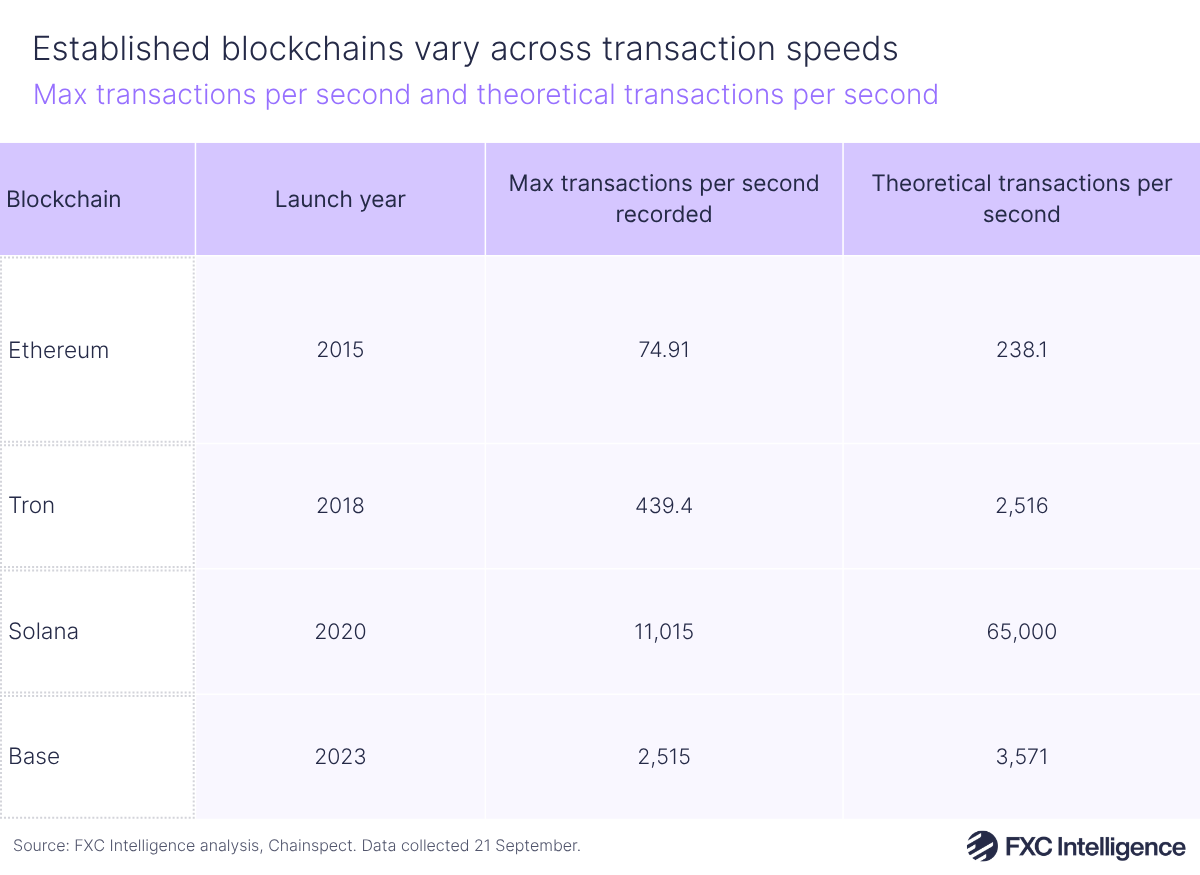
Data from Chainspect shows that transaction speeds vary across blockchains, with Ethereum seeing max transactions per second of 75, while its theoretical transaction per second rate is 238. On the higher end of the spectrum, Solana has achieved a max transaction per second rate of 11,000 versus a theoretical transaction per seconds number of 65,000. Circle’s target of 100,000 transactions per second would therefore make it faster than these systems, assuming their speeds do not substantially increase.
According to Visa, VisaNet – Visa’s global electronic processing network – has the capacity to process up to 83,000 transaction messages per second worldwide, though it is unclear how close the company has come to actually processing at that speed. Mastercard, meanwhile, noted that its transaction per second rate was 15,000 in 2025.
Arc’s key challenge going forward
Arc has now launched its mainnet, but the system is still at the start of a roadmap, with the network running purely on a proof-of-authority consensus model, an opt-in privacy feature that is still in development and an ARC token that has been minted but hasn’t yet been launched.
Aside from competing with other stablecoin-focused chains that have already been live for longer, such as Stripe’s Tempo and Plasma, Arc is also competing with major established blockchains with significant usage already, so it remains to be seen whether it can attract more usage from financial institutions going forward.