
Circle’s Q2 2026 earnings were relatively muted in terms of numbers, but showed a change in narrative from the stablecoin major as it centres its leadership via USDC and beyond.
Circle’s Q2 2026 earnings have seen the company pair solid but unremarkable growth with a marked shift in tone to characterise it as a competitive leader, suggesting it is becoming increasingly aware of challenges from competitors such as Tether.
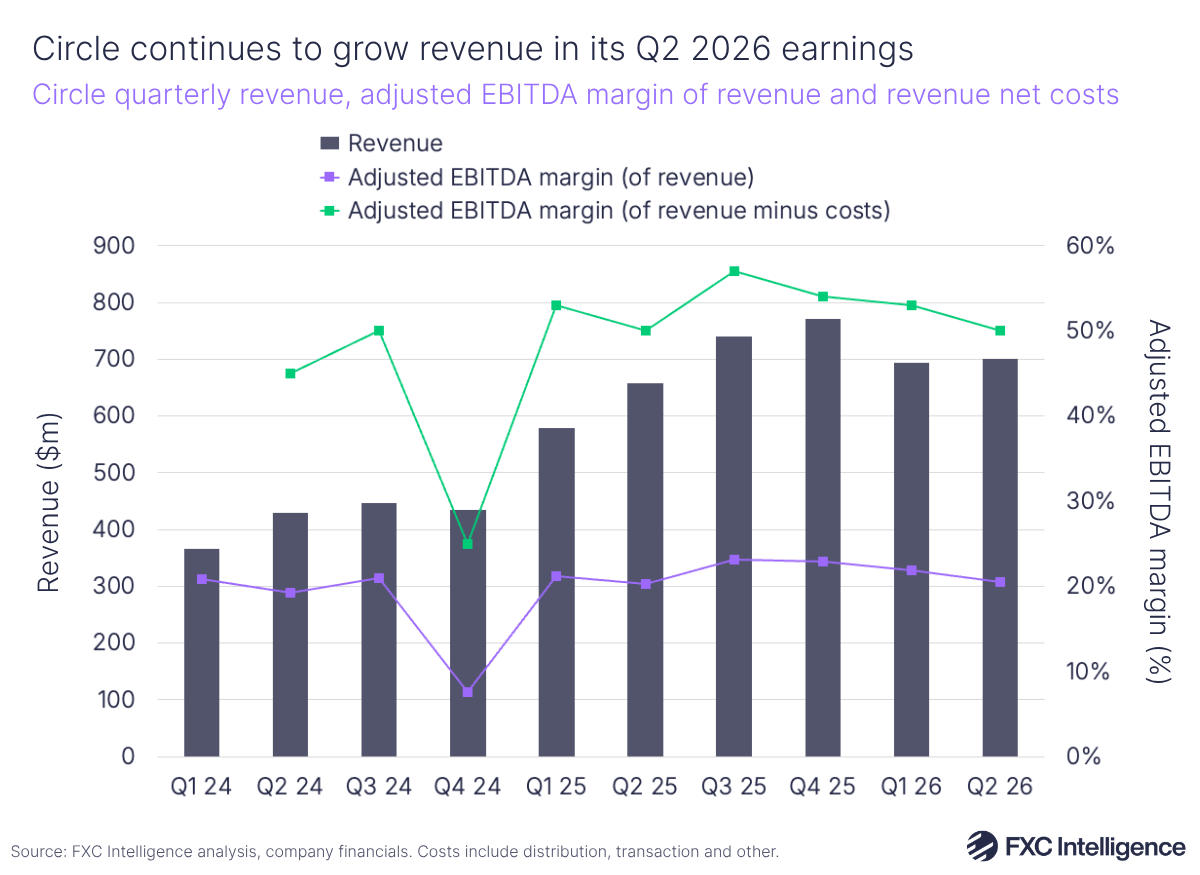
In a high-production earnings call that was somewhat unusually streamed via YouTube, the company reported solid results but its weakest growth to-date. Revenue climbed 7% YoY to $701m in Q2 2026, the first time the company has seen growth drop to single digits, while adjusted EBITDA grew 8% to $143m.
This translates into an adjusted EBITDA margin of 20% when calculating this using revenue, or 50% using Circle’s preferred method of calculating it as a margin of revenue minus costs. In both cases, this represents a small decline from Q1 2026, although is more-or-less flat on Q2 2025.
However, Circle spent relatively little time in its earnings call focusing on the top-level numbers, with CEO Jeremy Allaire instead focusing on the current fast-growing state of stablecoin adoption, Circle’s strong position within this and the product developments the company continues to roll out to further entrench itself, in particular its payments-focused blockchain Arc.
Characterising the current state of stablecoins as a “global moment”, Allaire both opened and closed by highlighting the growing adoption of the digital assets by mainstream institutions globally and the resulting opportunity for the company.
“Stablecoins are becoming federally regulated digital dollar money and the world’s leading financial institutions, technology companies and enterprises are moving onto this infrastructure,” he said. “Circle enters this moment from a position of extraordinary strength.”
USDC circulation “remains resilient” as Circle focuses on non-crypto adoption
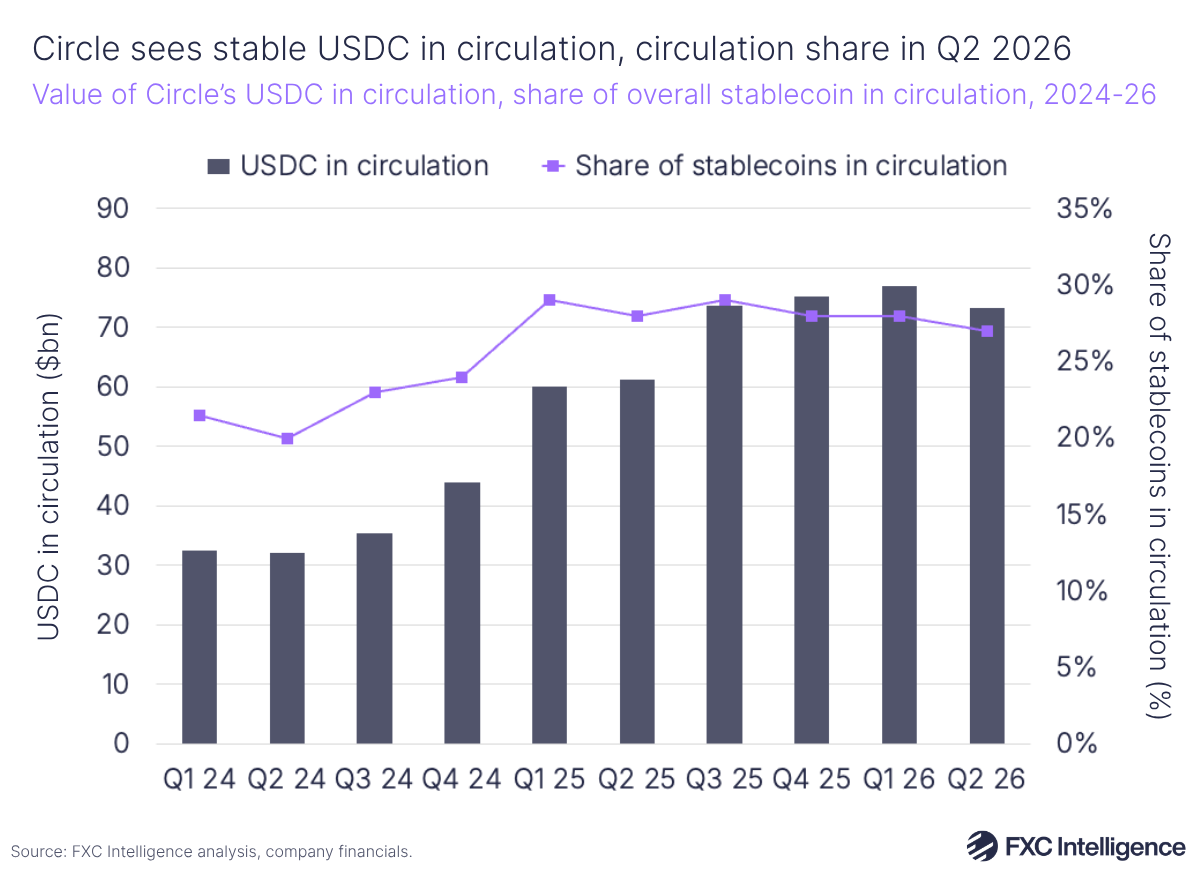
Considered alone, Circle’s USDC in circulation numbers may appear disappointing, reaching $73.3bn at the end of the quarter, a 19% YoY increase, though a small decline quarter-on-quarter of 5% – the first time the company has seen such a contraction since Q2 2024. The company also saw USDC’s share of stablecoins in circulation reduce from 28% to 27%.
However, this comes amid a far more challenging macro environment, with the wider crypto space seeing a contraction, with CFO Jeremy Fox-Geen highlighting a roughly 40% YoY decline in the overall market capitalisation of digital assets, which he said showed that USDC had “remained resilient” and pointed to increased adoption for applications beyond the crypto sector.
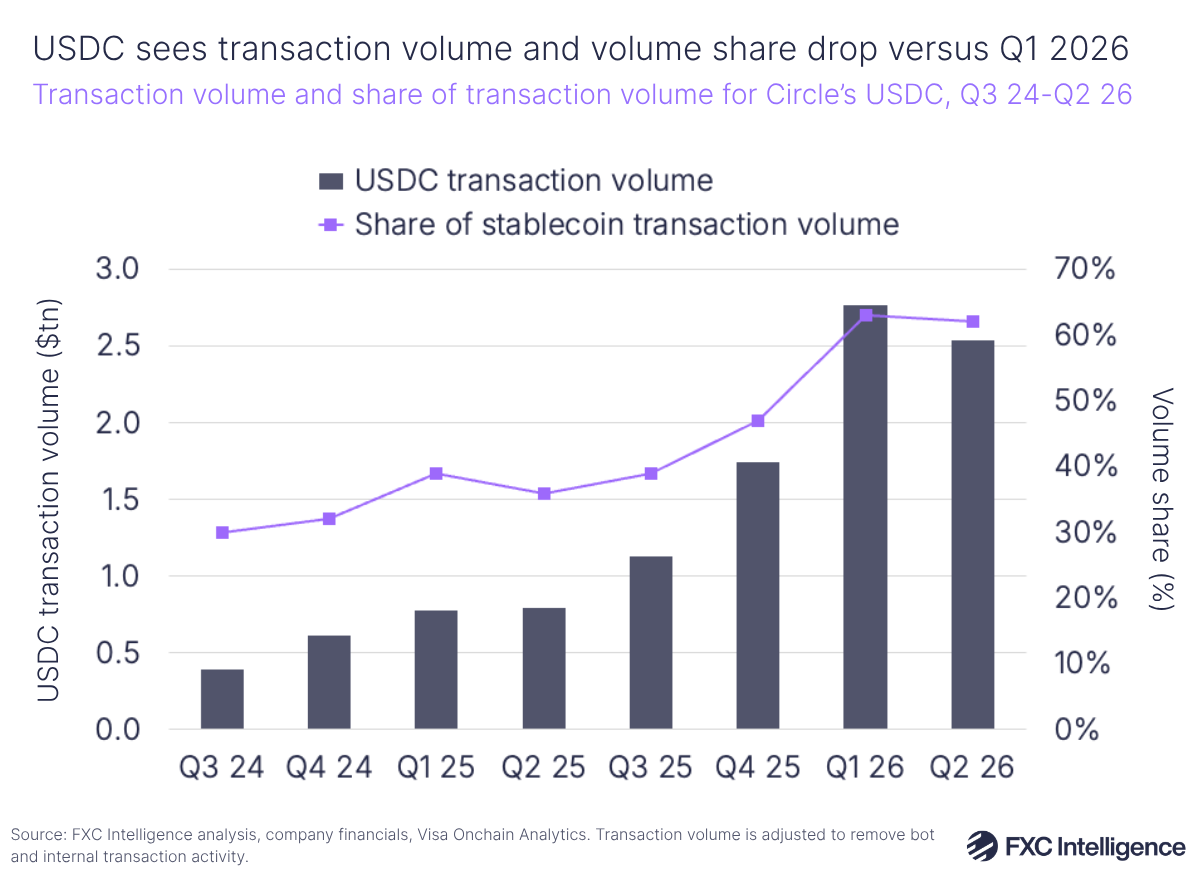
The picture is relatively similar for transaction volume, with USDC seeing a 221% YoY increase in the number of transactions using the stablecoin to $2.5tn for the quarter. This translates into a 62% share of all stablecoin transactions, a percentage point lower than the previous quarter but almost twice the share Circle had a year previously.
Coinbase renewal underscores shifting narrative around platform
Fox-Geen also highlighted a 106% YoY increase in the amount of USDC held within Circle’s own platform infrastructure to $12.4bn, while an increased use of USDC on trading platform Hyperliquid has seen it account for 6% of all USDC for the first time.
However, there was also an interesting shift of narrative around USDC on the Coinbase platform. As the co-creator of USDC, Coinbase has a long-standing role in the stablecoin that in 2023 turned into an agreement that saw Circle take full control of USDC but pay out distribution costs to Coinbase when it held more USDC on its platform.
As a result, more USDC on the Coinbase platform means higher distribution costs for Circle, something that in the past has been seen as something for Circle to work to minimise. However, this latest earnings call saw Allaire announce that the agreement had been renewed on the existing terms, raising it as a key example of strong strategic partnerships that sit among Circle’s range of primary defensive moats that protect its competitive leadership.
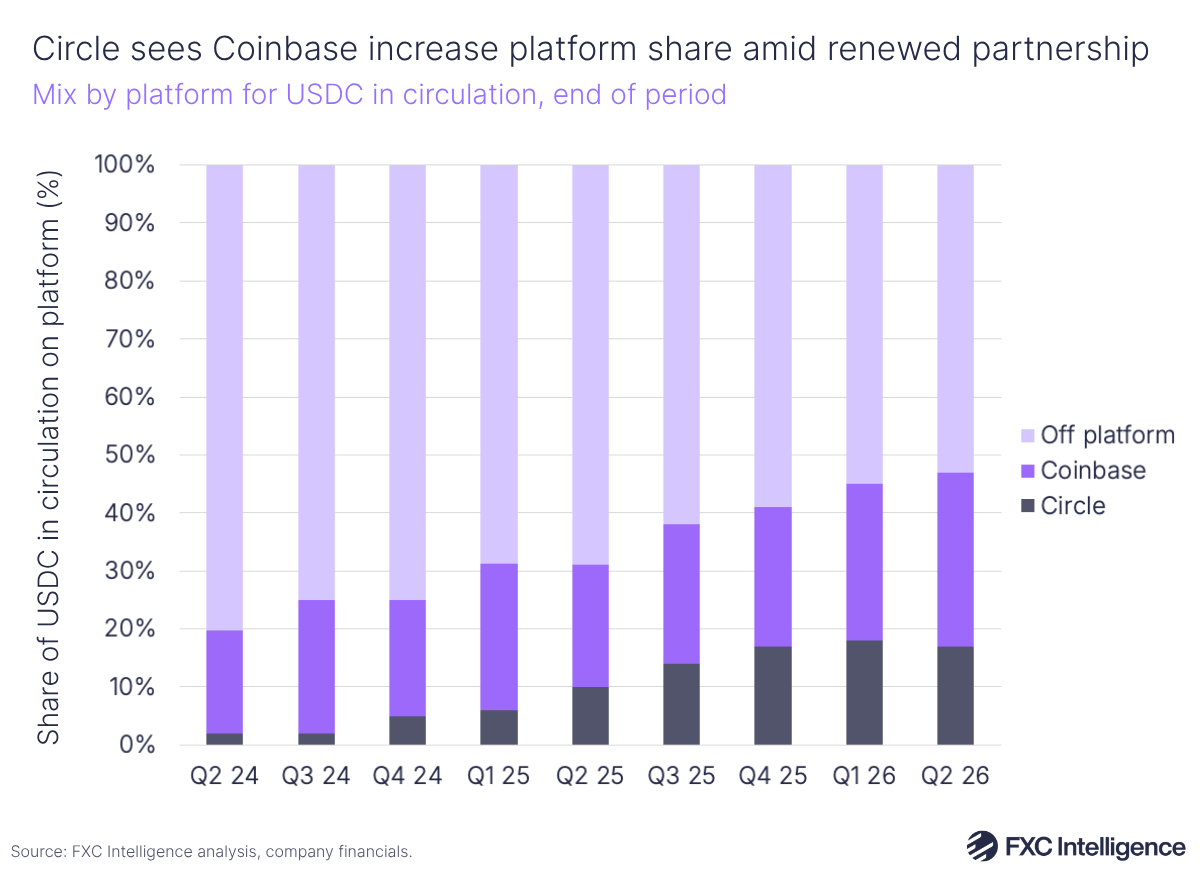
This narrative was also echoed by Fox-Geen, who highlighted that Coinbase’s share of USDC had grown to 30% by the end of the quarter, up from 27% in Q1 2026 and 21% in Q2 2025.
Circle boosts other revenue guidance amid bullish perspective on Arc
What has not changed, however, is the focus on other revenue as a key area of ongoing revenue growth. Circle has long been keen to move away from its central reliance on revenue from reserve income due to the lack of control it has over interest rates, which has led it to increase focus on other revenue-generating products, including Circle Cross-Chain Protocol and revenue derived from subscriptions and other partnerships.
In this respect, the general trend of outsized growth in other revenue continues. Other revenue saw a 42% YoY increase to $34m, compared to just 5% YoY increase in reserve income, however it did see a slight decline versus Q1 2026.
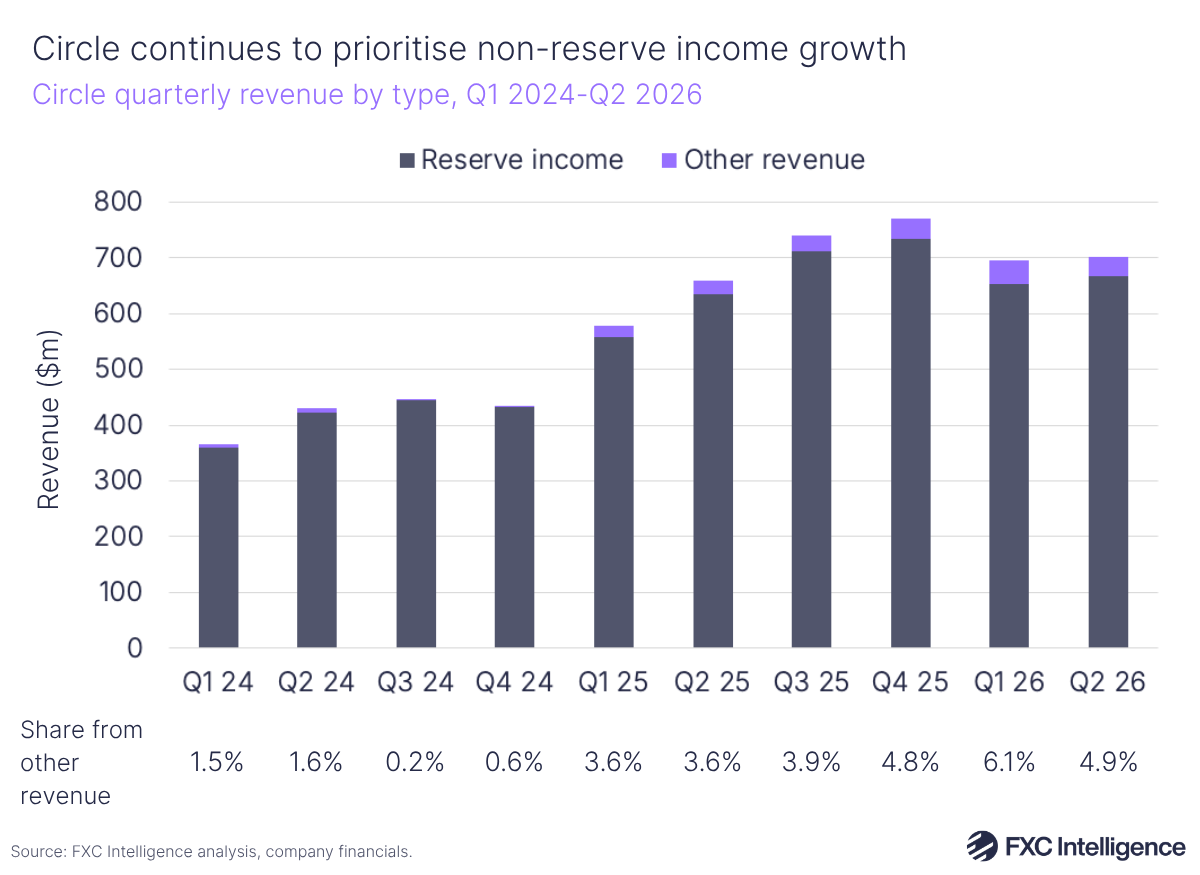
The quarter-on-quarter reduction in Other revenue is largely due to a contraction in subscription and services income, largely due to the company’s decision to focus less on blockchain partnerships and instead prioritise the upcoming mainnet launch of its payments-focused blockchain Arc.
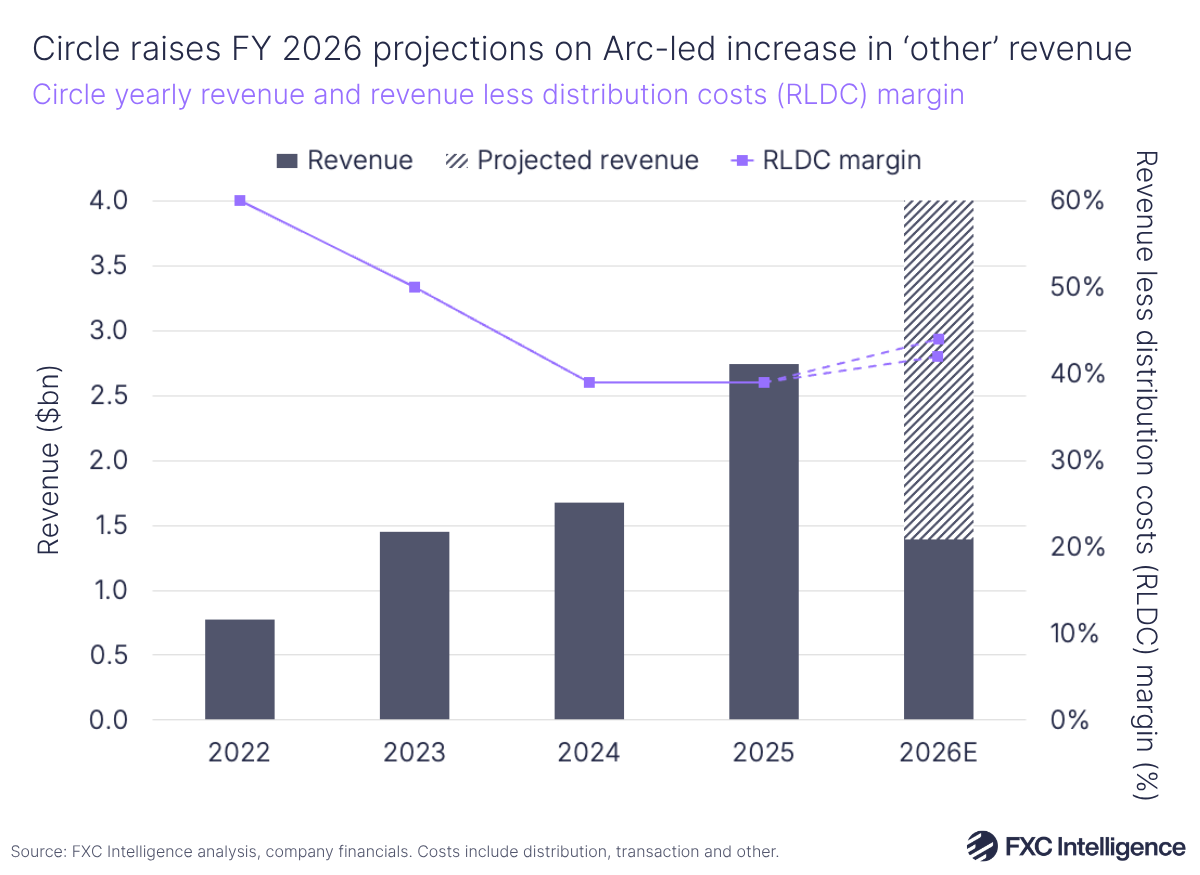
Arc is set to become a central part of the company’s strategy to grow Other revenue and its Q3 launch has prompted a revision of Circle’s FY 2026 projections, with the company now expecting Other revenue of between $310m and $330m, up from its previous projection of $150m-170m. This has also helped grow its projections for its revenue less distribution cost margin for the year.
Arc payments blockchain gets Q3 launch date
This increased projection is largely because Circle now plans to launch the full version of Arc, known as the mainnet version, on 16 September, following what Allaire described as “tremendous traction” from its testnet version of the blockchain.
The company reports that this test version has already seen 502 million cumulative transactions across 2.8 million wallets, with more than 100 private partners making use of the test version. The company has also now secured partnerships with a wide range of leading financial companies to serve as network validators, including MoneyGram, Mastercard, Visa, Standard Chartered and Global Payments.
It has also announced several new partnerships for Arc, including the launch of a tokenised treasury fund from BlackRock and an integration with DTCC to tokenise real-world assets on the blockchain.
Circle Payments Network sees surge in adoption
Meanwhile, Circle’s other main payments-focused product, Circle Payments Network (CPN), has also seen significant growth in the quarter, with the company reporting annualised transaction volume processed (TPV) has passed the $10bn mark for the first time, reaching $14.7bn for the trailing 30 days at the end of the quarter. This is slightly higher than 10% of the funds FXC Intelligence and Allium estimated were moved using stablecoins for cross-border transactions in FY 2025, representing a potentially meaningful share of the market, although it is not clear what share of CPN transactions are cross-border rather than domestic.
Regardless, it demonstrates a notable jump for CPN, up 76% QoQ. The company has also seen a 29% QoQ increase in financial institutions enrolled to 175 and has announced a number of enhancements to the product, including increased geographic reach through support via Circle Singapore and Circle France.
Circle sees growing costs amid new AI focus on operations
Beyond CPN, Circle also gave an update of Circle Agent Stack, its agentic AI solution that is designed to support the use of stablecoins for agentic payments. While this area is fairly nascent, Circle reports that USDC accounts for 99.3% of the agent-payment volume settled using dominant agentic protocol x402, while there are now more than 900 paid services live in Circle’s agent marketplace.
However, the company also for the first time addressed AI as a means of operational efficiency, joining the broader industry in centering the technology in its drive to cut costs. This comes as its adjusted operating expenses continue to rise, climbing 23% YoY to $146m.
To counter this, the company is “building toward operating an agentic corporation”, according to Allaire, with the company reporting that 86% of employees are already using AI tools on a weekly basis. The company plans to roll out hybrid agent and human teams across H2, as well as developing what it describes as a “company brain” that combines human and machine intelligence.
In this sense, Circle is framing itself alongside many incumbents in the payments space, with AI tools being widely used in business transformation.