
Euro-denominated stablecoins are becoming more commonplace, particularly as banks and businesses recognise a need for them for use cases that USD-pegged coins don’t fit. Here, we take a look at the use cases behind the biggest euro stablecoins, their scale and major launches that are on the way.
Stablecoins pegged to the US dollar currently dominate the global supply of digital currency, although the number of euro stablecoins in use is gradually on the rise.
Most recently, global digital bank Revolut began rolling out EURR, a EUR-pegged stablecoin issued by a subsidiary of Stripe-owned stablecoin infrastructure platform Bridge to select customers in Denmark, Poland and Portugal. Following a testing period for the offering, Revolut plans to expand accessibility to EURR later this year, opening it up to more of its seventy-five million plus customers.
Launches like this have slowly become more commonplace following the EU’s Markets in Crypto-Assets Regulation (MiCA) – which outlines the regulatory rules for stablecoins and the reserves that back them – implementation in 2024, providing a clear framework for companies and banks to develop their own EUR-backed stablecoins.
MiCA requires issuers of EUR-denominated stablecoins to be licensed as either a bank or an electronic money institution (EMI), to hold reserves 1:1 with the number of tokens in circulation, for the majority of these reserves to be held as cash deposits at regulated EU banks and demands for regular reporting on these reserves for transparency.
Tether, the company behind the largest stablecoin globally by market cap, USDT, opted to stop supporting its own EUR-denominated stablecoin EURt in response to MiCA instead of adapting the token and its reserves to comply with the new rules, eventually officially closing the door to all redemptions in November 2025.
However, several entities are now planning their own launches in light of the regulatory clarity MiCA provides, indicating that a new generation of EUR stablecoins which comply with the rules could soon begin to have an impact on the space.
Which euro stablecoins are currently in use?
Aside from Revolut’s new launch, several other companies and issuers have already introduced their own stablecoins pegged to the euro, each with varying use cases and scale.
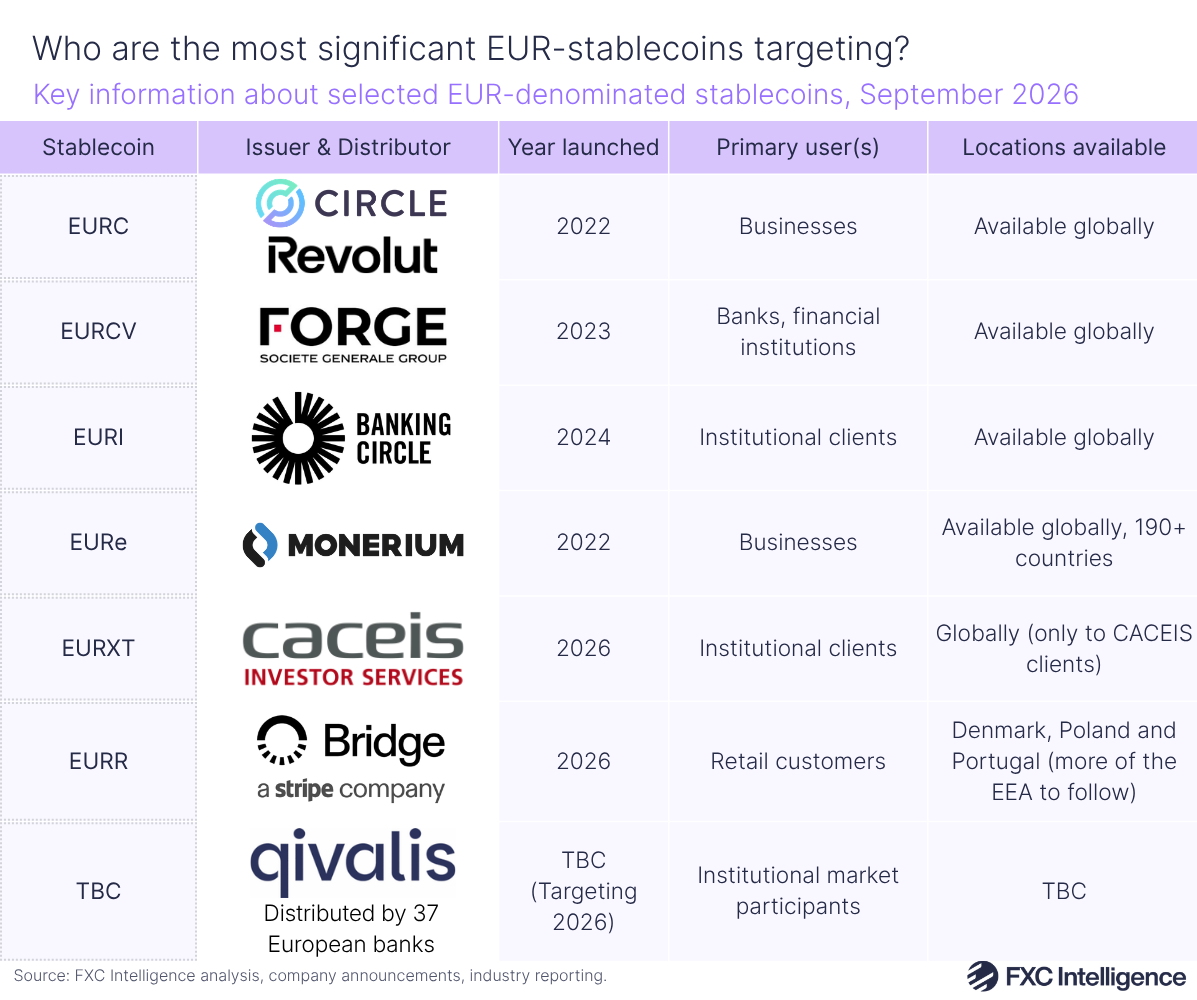
Unlike Tether, Circle, the company behind USD-pegged stablecoin USDC, has ensured that its own EUR-denominated offering EURC is compliant with MiCA and has secured a larger share of the global EUR-pegged stablecoin market than any other offering. The globally accessible stablecoin is primarily used by businesses for FX trading, borrowing and lending.
Société Générale-Forge (SG-Forge), the European multinational bank’s digital assets subsidiary, issues EUR CoinVertible (EURCV), its own EUR-pegged stablecoin primarily built to serve the bank’s institutional clients. However, since 2024, EURCV has also been open to wider adoption, enabling investors to explore new use cases for the stablecoin. Banking Circle also issues its own variant – Eurite (EURI) – for institutional clients, giving them access to round-the-clock settlement and euro liquidity outside normal banking hours. Digital asset infrastructure provider Fireblocks handles all minting and burning of EURI via its Tokenisation Engine.
Iceland-based fintech Monerium also primarily targets corporate companies with its EURe stablecoin, enabling them to embed euro payments into their own products by leveraging Monerium-powered IBANs. This setup enables users to send and receive EURe between off-chain bank accounts and on-chain Web3 wallets. Monerium also issues IBANs for individual users directly via its app, although appears to mostly serve retail customers indirectly via wallets from the likes of MetaMask and Zeal.
International banking group Crédit Agricole also launched its own MiCA-compliant stablecoin in July 2026, Euro Exchange Token (EURXT). Issued by the bank’s digital asset-focused subsidiary CACEIS, EURXT is initially only available to its institutional investor clients and corporate clients.
Revolut’s new offering differs from the current leading euro stablecoins as it targets individual users, with the bank saying it wants to give its customers options aside from dollar-backed stablecoins. It is also not responsible for the issuance of EURR – Bridge’s subsidiary Bridge Building is handling this. Instead, Revolut is responsible for the distribution of the token, which it says will give customers an on-chain option for moving between fiat, crypto, digital wallets and supported blockchain networks.
How big is the euro stablecoin market?
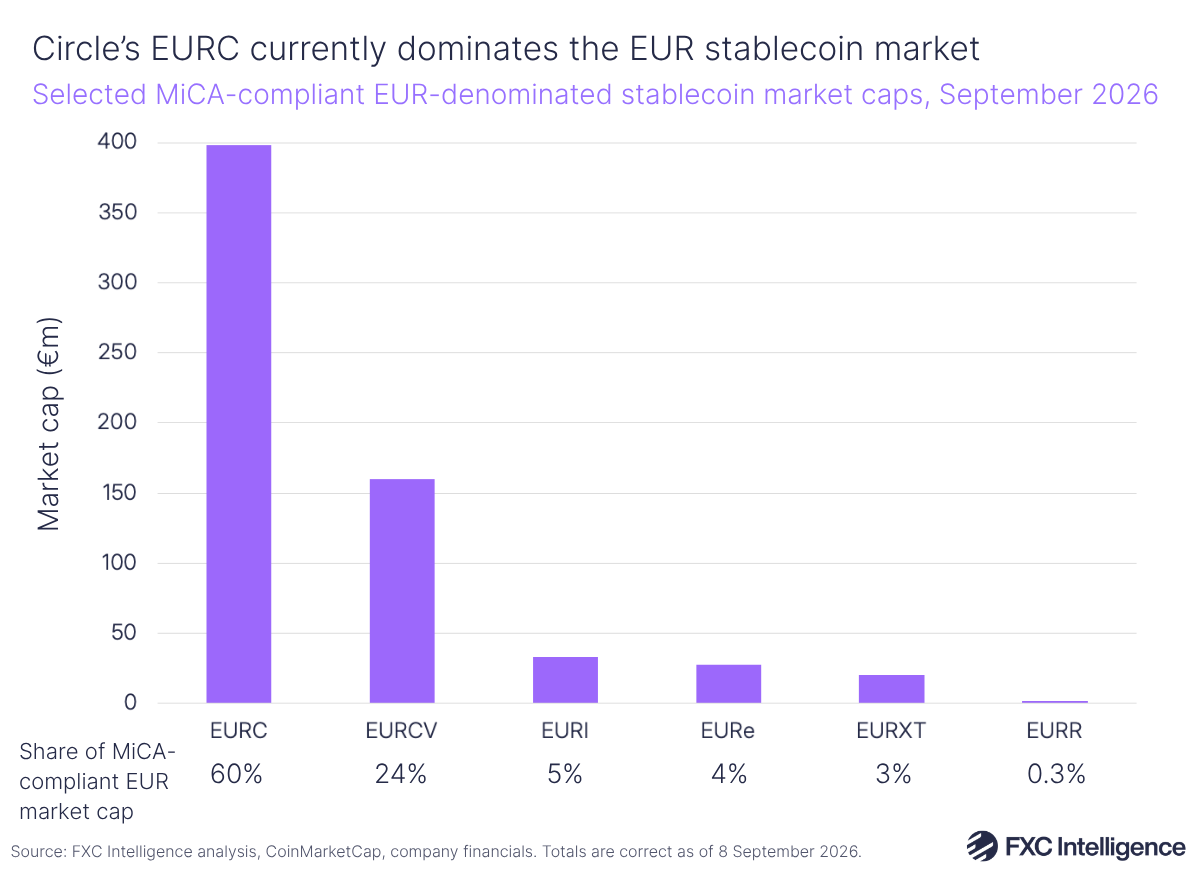
Circle’s EURC is currently the largest stablecoin by market capitalisation and sits far ahead of the competition, with more than €390m worth of the token in circulation – more than double that of the second-largest, EURCV, which has around €160m in circulation. EURC’s current total is slightly below its peak, having surpassed €400m in August, although Circle has seen fast growth in recent years, up from approximately €80m in circulation at the end of 2024.
Banking Circle’s EURI, Monerium’s EURe and Crédit Agricole’s EURXT all have between €20m and €35m in circulation, while Revolut’s EURR surpassed €1.6m in circulation in early September. Although EURR is currently far behind the market leaders in the EUR-denominated stablecoin space, Revolut’s newly launched offering has seen impressive growth since its launch in August – growing 106% in just the six days up to 8 September 2026, more than doubling from €812,000 to €1.67m.
According to CoinMarketCap, the total size of the euro stablecoin market currently stands at $896m (€770m). Adding in the market caps of the newly launched EURXT and EURR takes this total to $921m (€792m). However, this includes several stablecoins that are not currently compliant with MiCA regulations, including Tether’s no longer supported EURt.
MiCA-compliant stablecoins have a total market cap of $767m (€660m). Just under 60% of this is EURC tokens in circulation, while EURCV has a 25% share. EURI and EURe cover 5% and 4% respectively and EURXT has a 3% share, while EURR’s share sits at just 0.3% – although given it is still very early in its lifecycle, it is likely this share will grow significantly in the coming months.
Despite strong recent growth and significant new launches, the euro stablecoin market still pales in comparison to stablecoins pegged to the US dollar. Per CoinMarketCap, USD stablecoins have a combined market cap exceeding $305bn, more than 300 times larger than the EUR-pegged equivalent.
EURC, the largest euro stablecoin, has an approximate 0.15% share of the total stablecoin market by market capitalisation, although in reality this is lower given the total figure does not include every stablecoin in circulation.
Despite the huge disparity between the two, it remains very early in the adoption of stablecoins. Our report with on-chain data provider Allium found that stablecoins accounted for just 0.31% of the cross-border payments market in 2025, responsible for an estimated $135bn of the $44.3tn moved globally in 2025. It looks likely that more amounts of money will be increasingly moved across the globe on stablecoin rails as time progresses, which could leave an opportunity for euro stablecoins to see rapid growth and reduce the current gap.
What’s next for euro stablecoins?
A number of new EUR-pegged stablecoins look set to launch in the not-too-distant future, as adoption continues to gradually increase and long-term projects come to fruition.
One of the most advanced examples of this is Qivalis, a venture by a consortium of European banks to build and launch a new MiCA-compliant EUR-pegged stablecoin targeting wholesale use cases, aiming for an official launch in H2 2026.
Initially formed of nine European banks in 2025 – including CaixaBank, ING and Raiffeisen Bank International – the group has seen rapid expansion in 2026. In February, BBVA reportedly shelved its independent euro stablecoin plans in favour of joining, followed by 25 other banks entering the consortium in May – including ABN AMRO, Rabobank and the Bank of Ireland – increasing its size to 37 banks spread across 15 European countries.
In September 2026, a separate consortium of 21 financial institutions spread across the globe – including Bank of America, Citi, Banco Santander, BBVA and MUFG Bank – announced an intention to form a new company in H2 2026 that would issue new stablecoin solutions. While the group plans to initially focus on a USD-denominated stablecoin, it also outlined that a MiCA-compliant euro offering will be a priority when it begins expanding issuance into other G7 currencies. The group is currently targeting the launch of its first stablecoin in H1 2027.
This suggests that although USD-pegged stablecoins remain the foremost priority, the biggest financial institutions and banks now recognise the importance of expanding offerings into other currencies.
Although euro stablecoins remain minuscule compared to the wider stablecoin market, it appears that larger-scale bank-led issuance targeting institutional use cases will continue to grow in importance, which could be a key driver in the growth of EUR-denominated stablecoins. Whether they can truly challenge USD stablecoins is yet to be seen, although this may become clearer when these bank-led initiatives launch.