
As digital adoption grows in Central Asia, what are the key challenges to payments connectivity in the region? We found out, with commentary from panellists at the recent Silk Road Finance & Technology Forum in Uzbekistan.
Central Asia is seeing a rapid transformation in how money moves, with rising digital adoption and established payments companies in the region.
Several countries in Central Asia have developed home-grown payment systems that have changed their local payments landscape, with Uzbekistan and Kazakhstan in particular forming bilateral linkages to other nations to improve connectivity. However, despite rapid growth in some areas and strong remittances and trade opportunities, connecting to global markets beyond Central Asia remains a challenge.
Taking place in Tashkent, Uzbekistan, the recent Silk Road Finance & Technology Forum saw a number of panel discussions discuss the nature of payments in Central Asia, as well as what’s needed to enhance cross-border connectivity and establish rails and how stablecoins and digital assets could play a role in the region’s evolution.
In this report, we explore the local payments landscape in Central Asia and highlight some of the key takeaways from the recent conference, including key challenges for payments connectivity and what can be done to solve them.
Central Asia’s shift towards digital payments
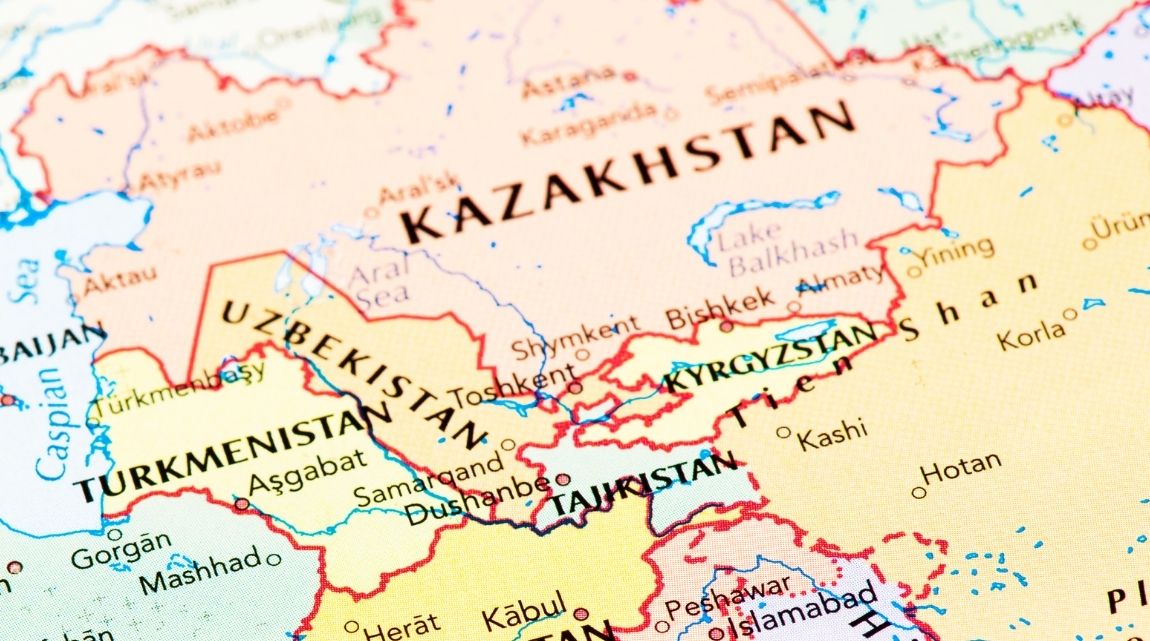
Central Asia spans the landlocked region including Kazakhstan, the Kyrgyz Republic, Tajikistan, Turkmenistan and Uzbekistan. From a payments perspective, they are connected by a move towards digital payments, though progress on this varies across the different countries.
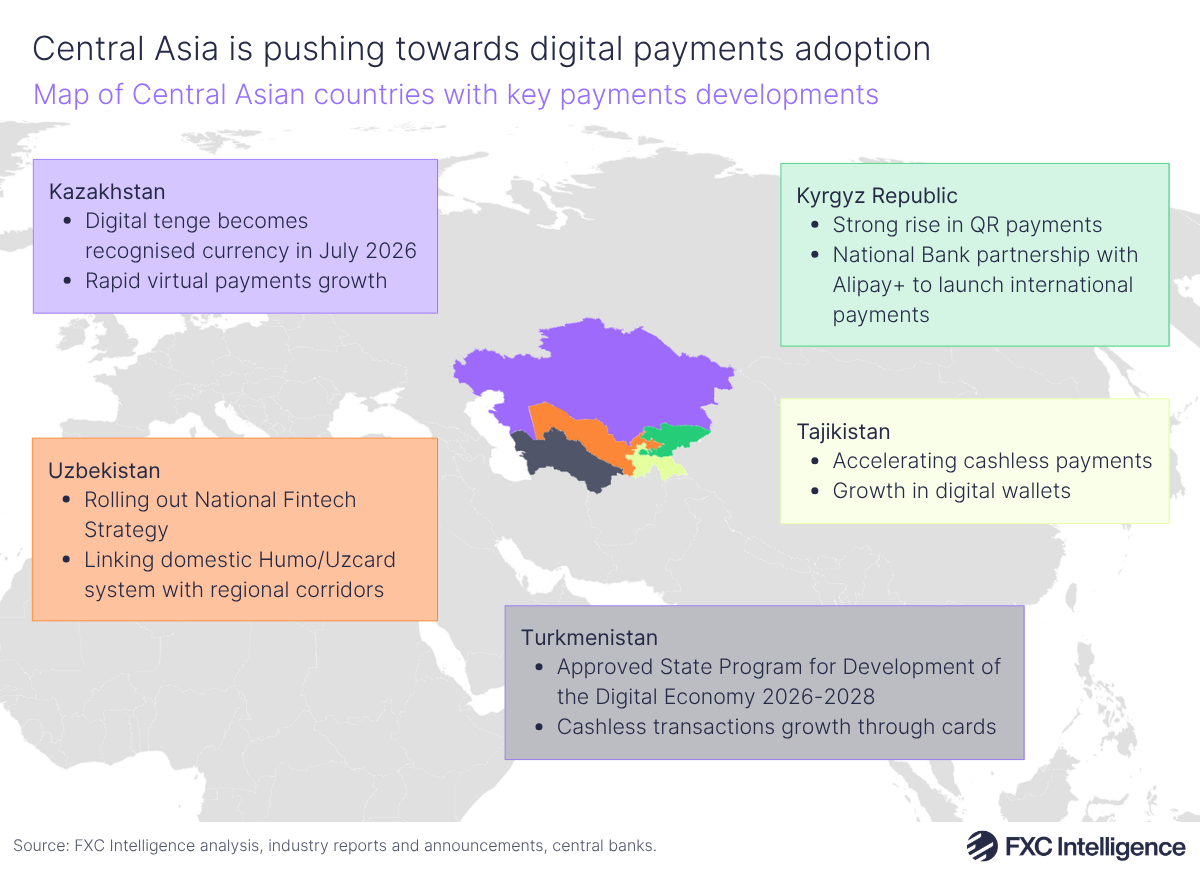
Kazakhstan, the largest region, has seen continued strength in its drive towards digital payments adoption, with non-cash transactions rising 7.2% to 1.3 billion in June 2026 and 90% of non-cash payments and money transfers being made through internet/mobile banking methods. Virtual cards are now being used more than physical cards for payments in the country, according to the country’s central bank.
Uzbekistan is also driving additional digital adoption, with 57% of the country’s payments now cashless, Governor of the Central Bank of Uzbekistan Timur Ishmetov said at the conference. Uzbekistan has also seen significant partnerships to extend the reach of its HUMO payment system to other countries, and at the conference announced a new fintech strategy designed to secure $1bn of foreign investment in its fintech sector by 2030.
The Kyrgyz Republic has seen significant adoption of its QR payment system, which has transformed consumer habits. QR payment volumes in Kyrgyzstan grew tenfold to KGS 908.6bn ($10.4bn) in 2025.
Meanwhile, Tajikistan and Turkmenistan are still heavily cash-based societies, though both have continued to make progress towards growing digital adoption in the country, with Tajikistan for example seeing cashless payments reach 41% in H1 2026, up from 28% in the same period the previous year.
Growing mobile adoption, a young population and the low penetration of banks and online retail has encouraged fintechs and payments companies to build a foothold in Central Asia’s more developed nations. For example, Kaspi.kz is Kazakhstan’s largest payments marketplace, combining banking, payments and travel booking into one platform with a market cap approaching $20bn in August 2026. In Uzbekistan, Uzum, a fintech platform that became the country’s first unicorn in 2024, hit a $2.3bn valuation in March 2026.
From a cross-border perspective, remittances still account for a large share of both Uzbekistan and the Kyrgz Republic’s GDP, though the highest share is in Tajikistan, where remittances accounted for 46% of GDP in 2025, according to World Bank data.
Another key aspect of the conference was cross-border payments’ impact on trade, with a need to build better payment systems to help accelerate growth for businesses. In Uzbekistan, Ishmetov said that more than half of the country’s economy is powered by SMEs, a key factor in its new strategy, which aims to open up access to finance and build a “resilient financial system” to enable businesses to thrive.
“Efficient regional corridors are of the utmost economic importance,” Ishmetov said during his address to the conference. “There remains potential to strengthen payment connectivity between countries of our region and to expand the range of financial services available across borders.”
Why does Central Asia still face cross-border payments challenges?
Several Central Asian countries have seen the development of national payment systems, with the biggest economies by GDP, Kazakhstan and Uzbekistan, seeing particular successes here. However, connecting Central Asia to other countries globally creates a number of challenges.
One issue discussed at the conference was that existing correspondent banking networks are insufficient to support money movement. David Kleiman, CEO of Klearium, said during a panel that a lack of correspondent banks is still the significant damaging factor when ensuring money movement across countries, including in Central Asia.
“There’s about 3,000, maybe 3,500 banks globally that don’t have access to correspondents,” Kleiman said at one panel. “They can’t actually move money on their own for their own citizens, and that became the real bottleneck in a kind of ultimate financial inclusion problem that really urgently needs a solution, if we’re going to talk about integrating SMEs or providing trade finance for a huge swathe of the market.”
Another issue is that as countries continue to build up national payment systems and see the rise of local fintechs drive faster payments domestically, ensuring the same speed across borders is a much bigger challenge. While countries have built case-specific links across certain corridors, differences in KYC/AML laws, capital controls and licensing regimes make connecting payment systems across borders difficult.
Chek-Tchung Foo, Director of Regulation & Policy at the Global Finance & Technology Network, explained during a panel on building rails that digitalisation alone does not automatically result in connectivity across markets.
“A country can have world-class payment systems,” he said. “Another can have advanced digital identity infrastructure. Another can have a thriving and innovative fintech ecosystem. However, if all these components cannot talk to each other, and if data cannot move securely across platforms or borders, or if regulatory frameworks remain fragmented, then the potential of a truly integrated regional economy will remain unrealised.”
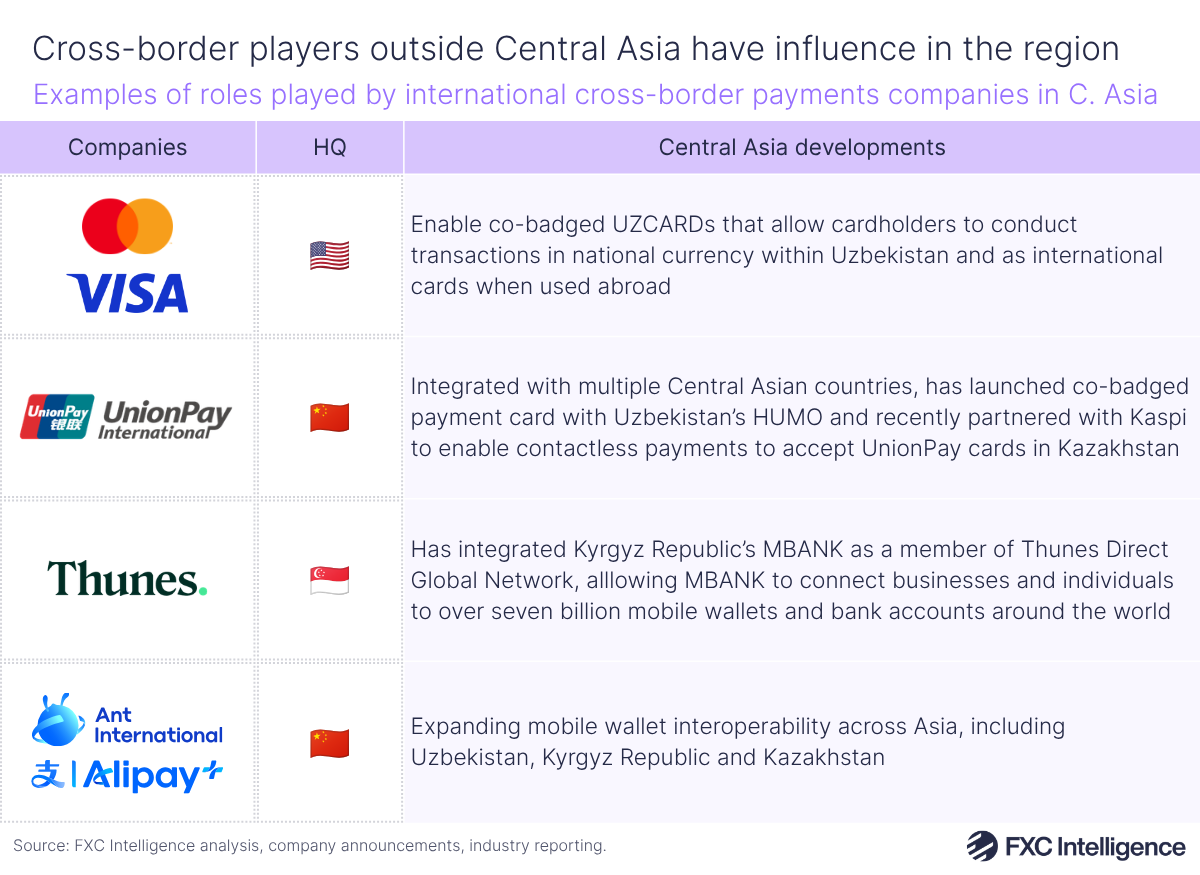
Card schemes that have emerged across the region – including Uzbekistan’s HUMO, the Kyrgyz Republic’s Elkart and Tajikistan’s Korti Milli – have been built with domestic payments in mind. Enabling connectivity globally has required connecting with a number of international card schemes such as Visa, Mastercard, UnionPay or Alipay. Each of these integrations only covers specific corridors.
Sergio Mello, Global Head of Stablecoin Solutions at Anchorage Digital, said during a panel that the speed seen with the internet has not translated to money, from central banks to commercial banks, SMEs, businesses and retail – this has often been due to a disconnect between the innovative fintech layer and the central banks above it.
“The problem is the interface between this bottom-up developed market and the top-down, central bank-driven approach to faster money,” he said. “The lack of common standards and interfaces is introducing friction.”
What are the solutions to payments connectivity challenges in Central Asia?
One of the themes that emerged from the Silk Road conference was the need to build out integration-based relationships with other countries.
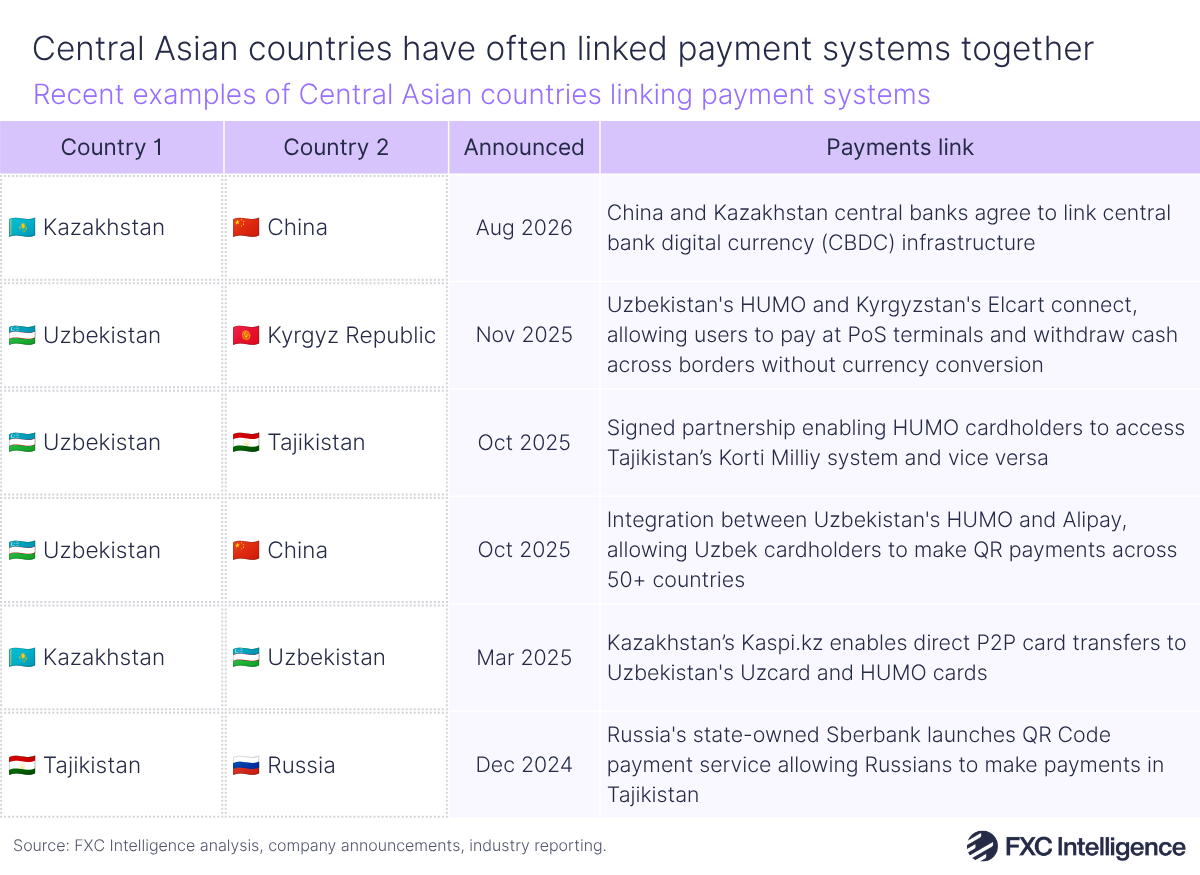
There have been several instances already of this within the region already, with Uzbekistan in particular forming partnerships to enable connections between its HUMO system and payment systems in the Krygyz Republic and Tajikistan, while also integrating with Alipay to allow Uzbek cardholders to make QR payments across 50+ countries.
Related to this, another view expressed at the conference was a need for national systems to establish common data transfer standards across borders and embed deeper KYC into payments messages. Currently, when banks are moving payment messages between each other, if this information doesn’t contain embedded data that identifies who senders are, whether they have been through KYC processes or where funds originated, this can lead to additional screening in the chain.
“Imagine a message packet or a protocol that carries this information about KYC, because a lot of the sanctions are around your KYC, around your AML,” said Arif Khan, Chief Innovation Officer at Razorpay, during one panel. “If it can carry that packet, I think it will solve a lot.”
Another major theme was highlighting this split between a top-down, central bank-led approach to improving payments and the need to encourage more innovation from the ground up.
Khan spoke about his previous work on Unified Payments Interface (UPI), India’s instant payments system that has transformed payments in the country and is now increasingly being used in countries around the world. The key, he says, is for central regulators to encourage more innovation from the sidelines that encourages the creation of companies like Wise and Razorpay, and he sees AI as being a potential driver because it makes coding much more accessible.
“Whether global or domestic, I think the key thing is the ability for the central bank to encourage its youngsters to do more and more innovation,” said Khan. “You don’t need a global protocol. All you need is innovation happening on those edges, and I think it will take care of itself.”
Uzbekistan’s new national fintech strategy announced at the conference includes several steps designed to position the country as a fintech hub for Central Asia, which will include the introduction of regulatory sandboxes that provide an environment for testing innovative financial products and services, as well as setting the goal of training 5,000 young people in financial technology by 2030. In 2028-2029, it will also include the launch of regional payment connectivity initiatives, as well as cross-border interoperability pilots.
Prajit Nanu, Founder and CEO at Nium, said during the same panel that Uzbekistan in particular has become a more attractive opportunity for the company’s payments infrastructure services as a result of the growth in the country. “Uzbekistan specifically solves all three: the scale, regulatory clarity and the fact that there is an instant payment system which works,” he said.
In addition to building out the rails, there is also a need to prove that this can have a measurable economic impact. Naveed Arshad Khawaja, Director for Strategy and Growth at Parkin, Dubai’s exclusive public parking operator, said that his work in the Gulf region has identified the need to back up funding for rails and economic development by identifying the additional revenues that can be gained from assets that sit on top of them. “When you look into the whole matter, funding is quite essential, but I genuinely feel if the assets which lie on top of these rails are built properly, the funding will follow,” he says.
The overall picture is one in which Central Asian countries should continue the push to enable linkages between payment systems and establish ways of ensuring better compliance across payments. However, reflecting the growth of cross-border payments providers in other countries, driving innovation through things like sandboxes and encouraging the growth of fintechs to help solve cross-border payments challenges will also be important.
How digital assets could play a role in Central Asia’s evolution
As we’ve seen across other areas of the industry, much of the interest around stablecoins and digital assets has been around how they might fill in connectivity gaps while cutting intermediaries from the process. In Central Asia, particularly in Kazakhstan and Uzbekistan, this has been a key driver in launching initiatives in this area.
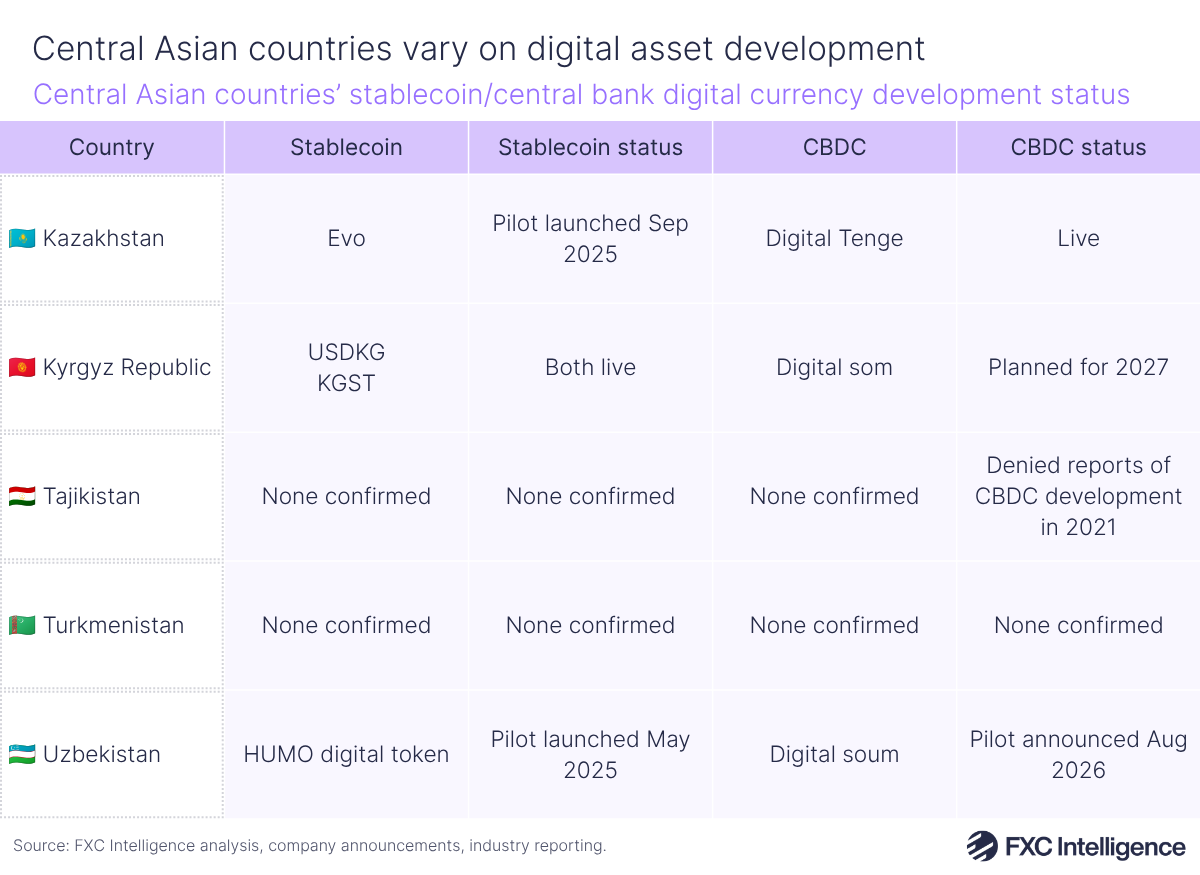
Several nations in Central Asia have introduced or begun testing various initiatives to introduce their own digital assets. For example, Kazakhstan has launched the Digital Tenge, its central bank digital currency that has been used across many digital projects. In late 2025, the Kyrgz Republic launched USDKG, a gold-backed stablecoin pegged 1:1 to the US dollar, which is intended to be used for cross-border payments and international trade.
Nanu says that one of the key problems stablecoins could solve is the issue of trapped liquidity in nostro-vostro accounts, but he adds that the use of stablecoins will see more use on outbound corridors. “I think stablecoin will see more money going out of Central Asia than money coming in,” he says. “Everybody wants US dollars. But money going out, the local currency converting into stablecoin, you’ll see more of that.”
Around the topic of how USD stablecoins could impact non-USD markets, Mello also says that stablecoins will not change the need for most countries in the world to need dollars, but will instead speed up the existing settlement process.
“The ability to settle and clear dollars 24/7 without any pre-funding requirement, trapped liquidity, or being barred from a risk-free rate is, I would say, a human right, or a central banker right in this case, and should be granted to every bank in the world,” he explained.
“Whether those sovereign states would prefer to introduce limitations and frictions for their own monetary policy in terms of FX and dollarisation of their own retail economy, that’s a totally different story. But it has to be understood that trade finance and global settlements still work in dollars mostly. And so, cutting one country or several countries out of that faster system is only net-negative value.”
However, some panelists also expressed caution around seeing stablecoins as being a complete solution for cross-border payments connectivity challenges. Mu Changchun, Director of the Digital Currency Research Institute of the People’s Bank of China, said that there was demand across regions to solve cross-border payments frictions including low efficiency and high costs.
However, he argued that the efficiency seen in the stablecoins and crypto assets today has largely stemmed from “bypassing compliance requirements, rather than inherent technological superiority.” He also noted that in China virtual currencies are not legal tender, and related exchange and issuance are illegal, which does shape the bank’s view on the topic.
“If you want to build an ecosystem for the stablecoins [or] crypto assets, I think what we have to do first is to enlarge the tolerance on money laundering, on telecom frauds, on capital flight, whether you are ready to have such a kind of tolerance, and whether you have a deep enough capital to accommodate the development of stablecoins and capital crypto assets,” he added.
Kleiman – whose company Klearium is significantly focused on the correspondent banking issue – explains that stablecoins are one of the ‘workarounds’ necessitated by the lack of correspondent banking connections in certain markets, which is also the case with the rise of fintechs in the region. However, he says that they are not the “panacea or the solution for everyone”.
“In those places where there’s not regulation to accept stablecoin, where there’s currency controls in a market, where the regulation or the central bank has not perhaps made a decision as to which way to go, it actually doesn’t foster the kind of development that we would like to see,” Kleiman explained.
“What is necessary is a compliance-native architecture that can sit within a central bank, that can give them the oversight and the supervisory potential and promise an opportunity that they’ve had all along with fiat currency.”
What’s next for payments in Central Asia?
Despite digital progress, Central Asia continues to see challenges as a result of structural issues around correspondent banking networks. What emerged from experts commenting at the Silk Road Finance & Technology Forum is that there is not necessarily a single fix, but a mix of solutions that require a focus on innovation to deliver.
A positive theme from the conference is that central banks and governments, particularly in Uzbekistan and Kazakhstan, are introducing measures to boost the presence of fintechs in the country, while the movement of populations towards digital payment methods is creating the foundations for easier money movement.