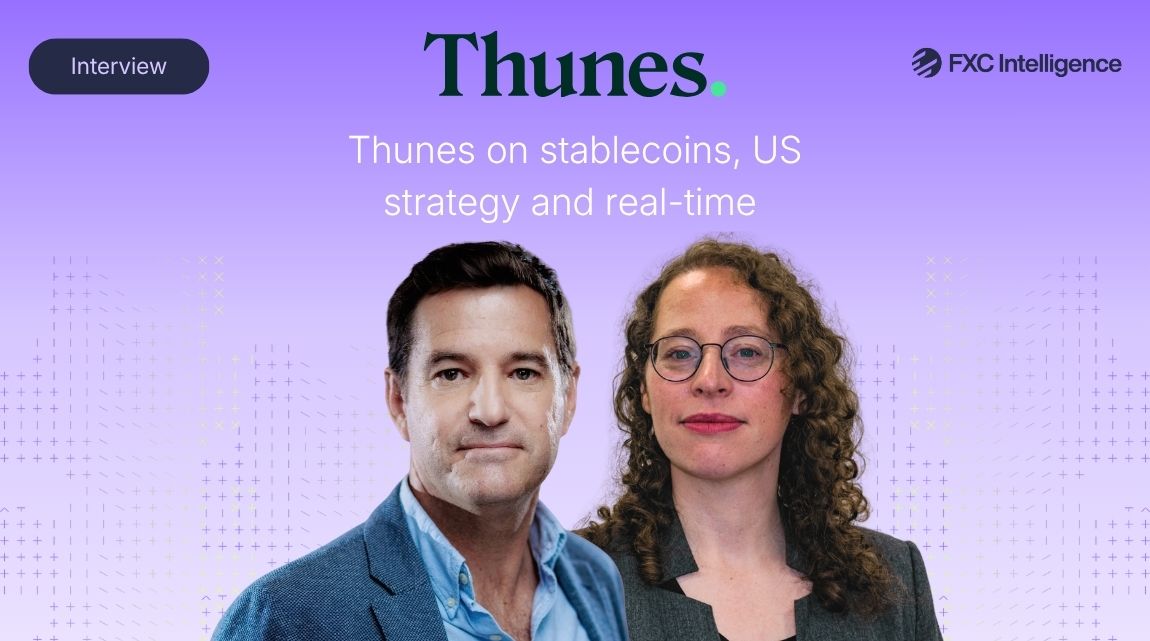

Thunes has added multiple high-profile providers to its network in quick succession as it doubles down on its US business and deepens its stablecoin play. We spoke to Andrew Stewart, Chief Revenue Officer, about the company’s strategy across expansion, stablecoins, AI and beyond.
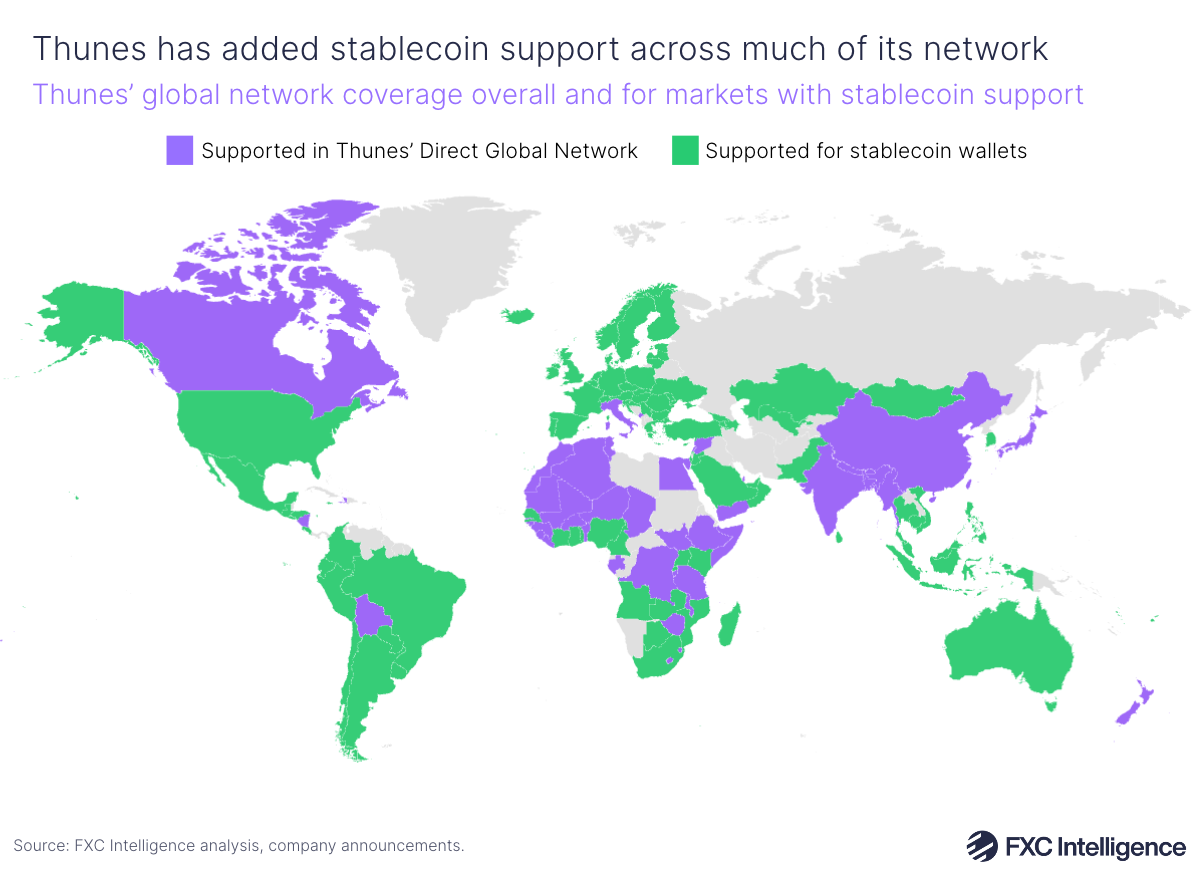
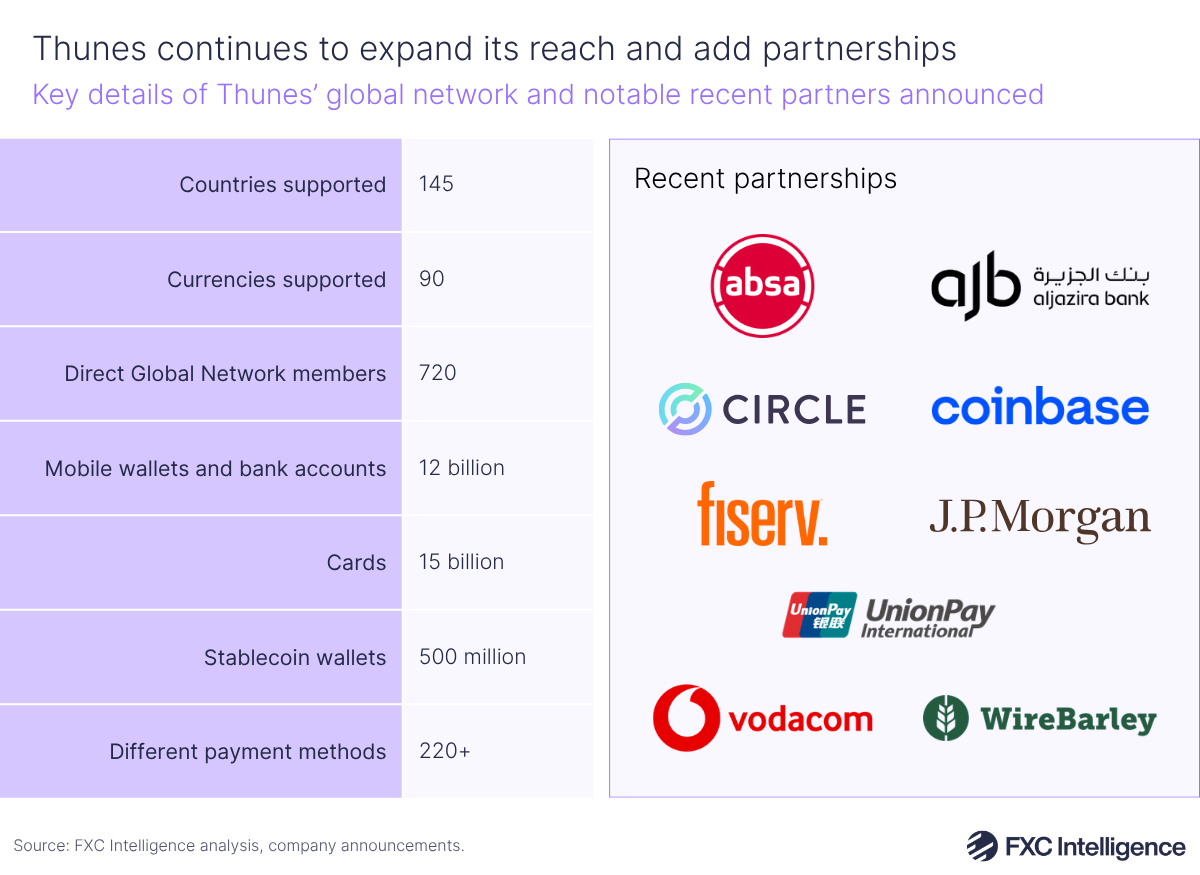
Singapore-based Thunes has long been known for its Direct Global Network, which the company has prioritised building out since its $150m Series D funding round in 2025. Today, its network connects its 720 members with more than 12 billion bank accounts and mobile wallets across 140 countries and 90 currencies, with the company now supporting stablecoin wallets in addition to its existing bank deposit, card, mobile wallet and cash pickup capabilities.
A focus on stablecoins has also seen the company partner with Coinbase to power its stablecoin infrastructure and boost the Web3 major’s payout reach to cover local bank accounts and mobile wallets. Meanwhile, the company has been broadening its reach in other ways, with a partnership with UnionPay International launching high-capacity instant payouts into mainland China, while a partnership with J.P. Morgan sees the company expand the cross-border payments capabilities of J.P. Morgan Payments’ Xpedite Remit product.
Thunes has also broadened its operational footprint with the opening of its latest office in New York, and is also increasingly harnessing AI in some parts of its business.
During Money20/20 USA, Lucy Ingham, FXC Intelligence VP of Research, caught up with Andrew Stewart, Chief Revenue Officer at Thunes, to find out more about how the company is approaching its strategy and onward growth.
Thunes’ Coinbase partnership and stablecoin strategy
Lucy Ingham:
To start with, you announced your partnership with Coinbase a few weeks ago, specifically pairing their stablecoin infrastructure with your global payout rails. What’s the thinking behind that and how do you see that fitting into your wider strategy?
Andrew Stewart:
Super excited about the announcement. I think it’s part of our broader strategy of creating an interoperable network and really almost being quite agnostic in terms of if it’s fiat, if it’s stablecoins. I think the genesis behind it is twofold: one is leveraging Coinbase’s infrastructure to push to stablecoin wallets, because we’ve seen tremendous growth, in particular [with] SMEs. I think you hear it often around trapped liquidity or the inability to actually open up a dollar account. They don’t want to hold a currency that is incredibly volatile, so the best alternative is stablecoin.
That’s one part of the partnership, and the other one is actually Coinbase using the Thunes rails for that last-mile payment. That really goes into the ethos or the thesis around Thunes building out an interoperable rail to support pretty much any new, emerging payment method – stablecoin, fiat, and no doubt there’ll be more to come.
Lucy Ingham:
You’ve moved from USDC liquidity to stablecoin wallet payouts, and now EURC pre-funding across four blockchains. Where is stablecoin genuinely changing how money moves on your network? And is demand mainly about treasury liquidity, or are there other areas?
Andrew Stewart:
There’s a number of aspects or use cases. At the heart of it, yes, it’s supporting some optimisation on liquidity management, treasury. We’ve seen significant growth there in terms of our ability not only to be pre-funded or funded in stablecoin, but fund our downstream obligations off the network.
But I touched on earlier about the Coinbase example; we’ve seen a lot of demand with SME payments pushed to stablecoin in that use case where the individuals can’t open a dollar account, they don’t want to receive local currency because it’s too volatile. That’s a use case that we’ve seen tremendous growth in. So, it’s a continuation of that, and then supporting the likes of Coinbase on that last-mile payment.
Expansion and ecosystem buildout: The US and beyond
Lucy Ingham:
Thunes has signed a number of key US clients in quick succession, and you recently opened your New York office. How central is the US to your strategy now, and what do these wins say about where your network is heading?
Andrew Stewart:
I think it’s paramount to our success, long-term success. We all know that the US is the largest originating market. If you’re not successful in the US, you’re not going to be successful globally from a payments perspective. So, I think it’s a testament to our focus and belief in the US.
As you said, post our Series D fundraise, we’ve invested quite heavily in the US. We acquired a company called Tilia, which is to support the gaming industry. We’ve set up an office in the US, we’ve doubled down on our sales organisation. And then, as you’ve just seen of late, we’ve had key marquee signings like J.P. Morgan, the Coinbases of the world.
So, very excited: it’s a long journey ahead, but I think it’s such a large market with such huge potential for Thunes.
Lucy Ingham:
You’re expanding payouts across the Middle East and Africa while also targeting things like workforce and platform payouts. How do you balance kind of deepening remittance corridors against those kind of B2B and platform opportunities?
Andrew Stewart:
For us, it’s about building out that payment ecosystem that is interoperable and almost, again, agnostic to the various different use cases or verticals, payment types. As you know, we service and support MTOs globally, we support the platforms, the gig economy, the freelancers, we support SME payments. So for us it’s ensuring that the network can cater for all those different use cases – existing or even new.
Stablecoin is a good example of that: two, three years ago, nobody really spoke about last-mile payments or push to stablecoin wallets. So, I think it’s continuing building a network that can cater for all flows.
How Thunes sees AI impacting payments
Lucy Ingham:
You already use AI in a number of places, particularly your forecasting and liquidity management, which is through your SmartX Treasury Management? Where do you see the most potential for AI, and to what extent do you see AI agents in particular being a part of the payment space?
Andrew Stewart:
It’s interesting. I think we need to focus on the practical applications of AI rather than a little bit of navel-gazing too far on the horizon. There’s a few things we do. One is, you said it, on SmartX Treasury. So, it’s really around optimising our cash positions, optimising liquidity, automation of payments.
There’s the traditional back office in terms of efficiencies on the network. It’s around how do we look at smart routing, looking at if a route’s down or there’s a better unit economics, AI can play a role.
Then I think that comes to the point: we’re not there yet, and I know there’s a lot of discussions around agentic AI, especially in payments and on ecommerce. I do think there’s a role for AI in that generating a wire or a funding mechanism, and then actually when we know that the balances are low in a particular market, it automatically triggers a payment. There’s obviously a few considerations around hallucinations, error, etc. So, we’re not there yet, but I think that’s definitely one to look out for.
Networks in the changing cross-border payments landscape
Lucy Ingham:
With developments such as Swift’s retail push, multilateral links like Project Nexus and stablecoin networks, how do you see the role of an independent cross-border payments network like Thunes changing in the future?
Andrew Stewart:
It’s less about changing; it’s doing more of what we do today. What you’ve seen, the themes of RTP, real-time domestic, now our expectation is, if payment can be real-time domestically, why can’t it be real-time globally? We’re not there yet, and obviously that’s a big focus of ours: pushing real-time payments cross-border.
But I think for Thunes, it’s really about building out a network that, a) is agnostic, and building a network that’s interoperable, because the reality is I believe the market will remain fragmented. Because you’ve got the stablecoins emerging, you’ve got RTP emerging, you’ve got variations of stablecoin, you’ve got local payment methods that are becoming more popular. And if we don’t connect them and continue to connect them, you’re not going to have a global interoperable network.
I like describing Thunes as the ‘network of networks’. As long as we remain at the cutting edge and at the forefront of ensuring that those new emerging payment methods are connected and part of the ecosystem, I think that’s how we will win in this payment landscape.
Lucy Ingham:
How do you expect cross-border payments to be different in 2027 versus 2026? Anything you’re excited for?
Andrew Stewart:
I think real-time is the theme. The expectation is it needs to be real-time everywhere. Embedded payments is, I think, going to be a theme for 2027 and 2028. So, not just having a monoline of payments, but how payments is embedded into marketplaces, into the ecosystem, and it becomes, as it says, embedded. We’ve seen a lot of that across the globe.
So, I think it’s more of the same: it’s interoperability, real-time and embedded payments.
Lucy Ingham:
Exciting times ahead. Andrew, thank you so much for your time.
Andrew Stewart:
Thank you. Appreciate it.