

J.P. Morgan Payments has firmly established itself as one of the world’s largest payment processors, processing more than $10tn in payments every day. We caught up with Rakesh Purohit, Global Product Head – Cross Currency Payments and Solutions, to explore how the bank is approaching payments partnerships, digital assets and AI.
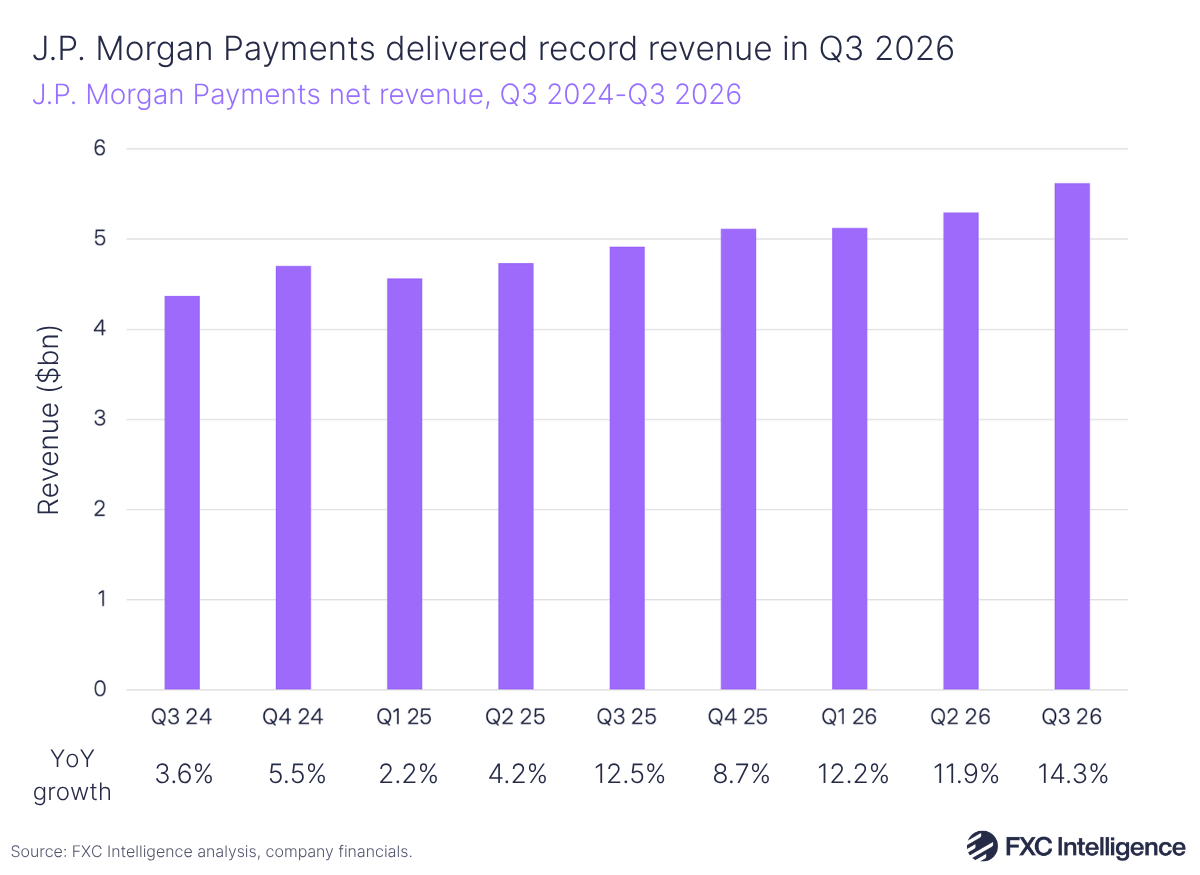
JPMorgan Chase’s global payments business, J.P. Morgan Payments, continues to see rapid growth, reporting record net revenue for a seventh consecutive quarter in Q3 2026, reaching $5.6bn and accounting for 25% of the group’s Commercial & Investment Bank net revenue, which it remains a key driver of growth for. The business also processed 1.9 trillion payments in Q3 26 – 100 billion more than it reported in Q3 last year.
To maintain this momentum, J.P. Morgan Payments continues to invest in the evolution and expansion of its global network and has announced a number of major developments throughout 2026 so far. In September, it partnered with payment infrastructure provider Thunes to expand its Xpedite Remit cross-border payments suite, giving clients real-time access to 12 billion local bank accounts and mobile wallets across more than 100 corridors via Thunes’ Direct Global Network.
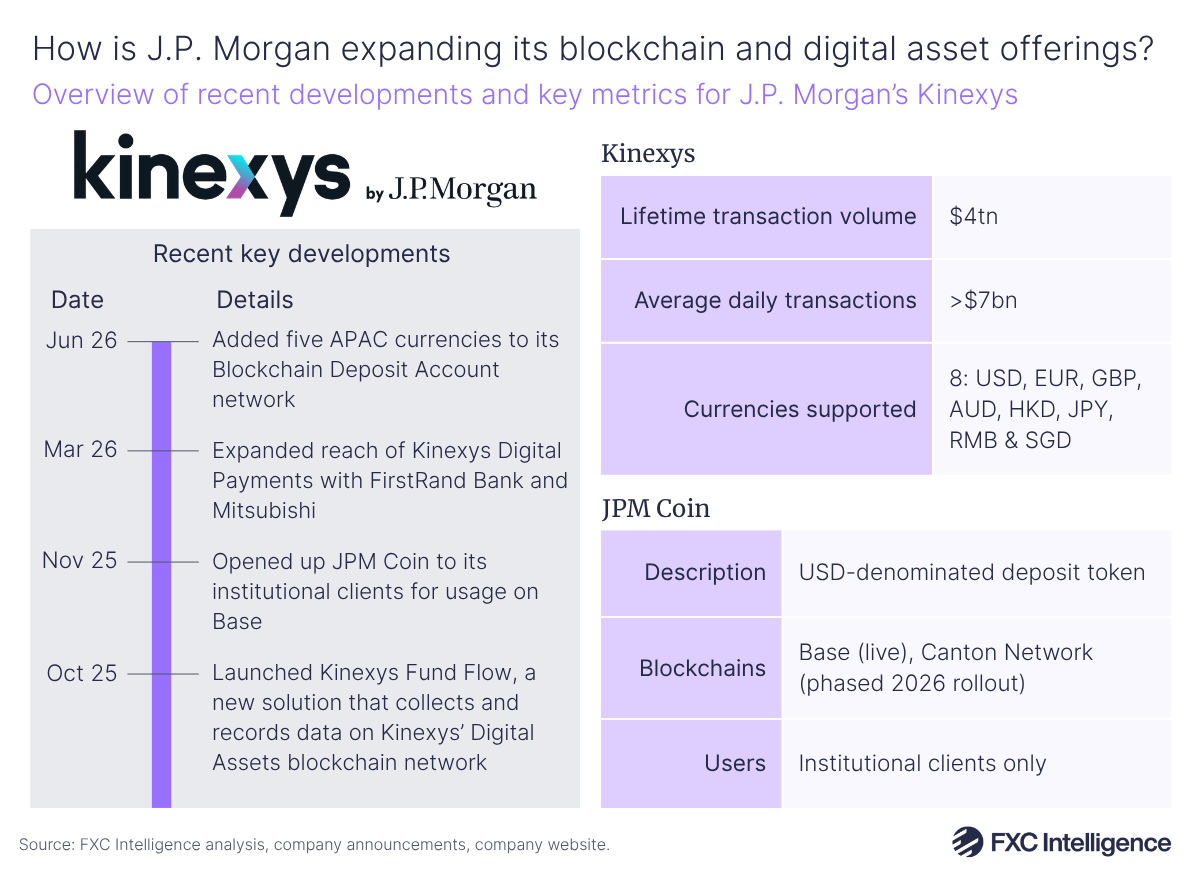
J.P. Morgan’s blockchain business unit, Kinexys, also recently expanded its Blockchain Deposit Account network, adding Australian dollar (AUD), Hong Kong dollar (HKD), Japanese yen (JPY), Chinese renminbi (RMB) and Singapore dollar (SGD)-denominated accounts. The move enables its clients to move money on-chain between these new currencies and existing rails for the euro (EUR), the British pound (GBP), and the US dollar (USD).
AI has also been a key area of focus for the business, leveraging it to bolster efficiencies in-house while developing its agentic commerce capabilities. Earlier this year, J.P. Morgan Payments partnered with ecommerce software company Mirakl to enable agentic commerce for merchants at scale, powering the shopping journey from discovery to checkout for AI agents and enable subsequent agentic transactions.
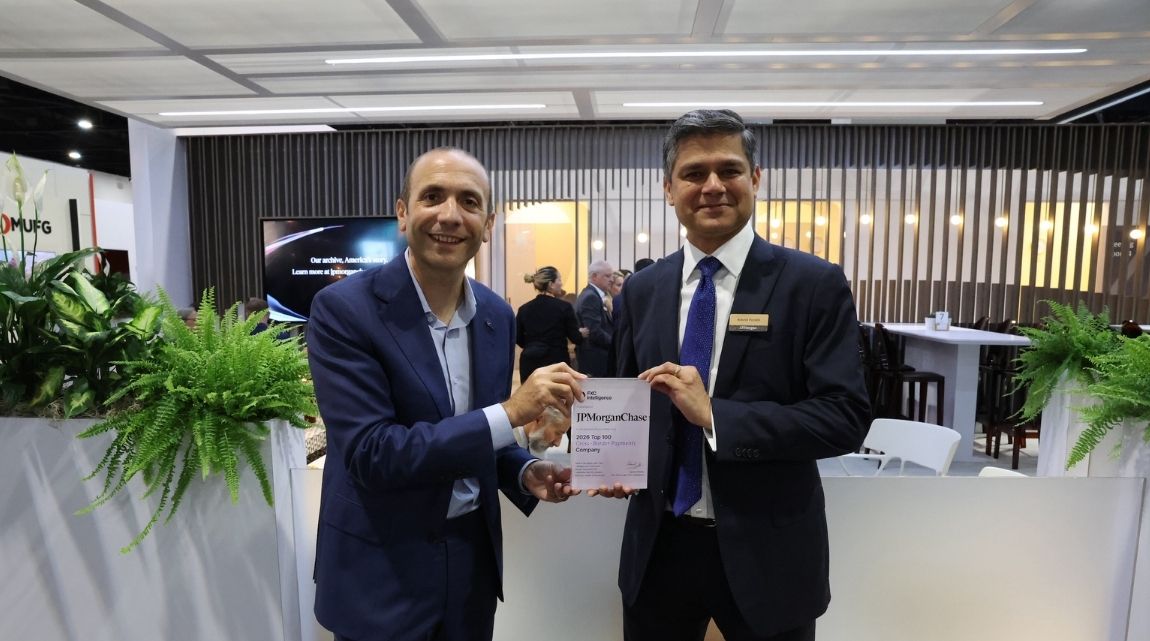
During Sibos 2026 in Miami, we caught up with J.P. Morgan’s Global Product Head, Cross Currency Payments and Solutions, Rakesh Purohit, to discuss how the bank is evolving its payment offerings and leveraging partnerships and emerging technologies to meet its client’s needs. You can watch highlights from that interview or read the transcript below.
How is J.P. Morgan considering the G20 targets for payments?
Daniel Webber:
The G20 targets are a very good framing for how we think about what we’re trying to build and achieve in the cross-border payments space. How are you thinking about that at J.P. Morgan?
Rakesh Purohit:
I think that sets the benchmark that every bank is trying to achieve across their payments ecosystem – not necessarily for all payments to go through, because payments themselves have very different needs. So, whether it calls for real-time payments to move within a certain time frame or whether it’s costs that need to be kept low, all of those need to be factored in within those benchmarks, which we’re actively looking to as a bank and as a global payments industry.
How is J.P. Morgan serving different types of clients?
Daniel Webber: J.P. Morgan has so many different client groups around the world, what can you tell us about what they’re saying they need at the moment and how J.P. Morgan is helping them?
Rakesh Purohit:
I think the one thing that runs common across all client segments is that they’re increasingly starting to see payments as a complex space and they want assurance that their global bank partners can satisfy all their requirements front-to-back.
They’re not looking at it as separate payments, cross-border payments. They’re not coming to us for one particular type of payment. They’re asking us if we can make their payments fast, safe, reliable and efficient.
Having said that, across client segments, the clients that we serve can be financial institutions, corporates and even SMEs. All of them have different requirements. Banks or FIs are asking how they can help address the same competing challenges that we are getting from different fintech clients.
On the corporate side, it is making treasury more efficient as payments are embedded into systems and processes. On the SME side, it is much more solutions that will go up the value-chain.
Extending capabilities with suitable partners
Daniel Webber:
I think the ecosystem has very much evolved now where there is a lot of co-operation between non-banks and the banks. How do you think through when the right time for partnership is and what type of partnerships you need to make?
Rakesh Purohit:
We see it as a range of offerings for our clients. There are some areas which we service very well ourselves, but there are other areas where we can still extend our capabilities – that’s where we get specialist partners who can help us.
So, that’s how we see that and the partners that we choose, they also go through a very robust selection process to make sure that they come in exactly the space we want them, so that when we go back to the client, it’s not one particular rail or one particular geography, we give them the full offering and then we orchestrate the entire payment routing – both through our own rails and through our partners.
J.P. Morgan’s digital asset strategy
Daniel Webber:
Let’s talk about the digital assets space – J.P. Morgan has very much been a leader in this space with JPM Coin and Kinexys. Where does that fit in?
Rakesh Purohit:
We see the entire new ecosystem that is developing and you’ve seen what we’ve done over the last decade or so as another element to the liquidity path. It’s not necessarily about payments – but payments by itself have liquidity use cases. With Kinexys and everything that we do, it is about being able to optimise liquidity for our clients, where we can make our payments as needed.
So that’s another way to learn what are the things that that ecosystem provides that we can bring back to our own payment rails, such that the entire ecosystem and our offerings that we have for clients includes anything that is blockchain, Kinexys or tokenised deposits, as well as the normal payment rails.
Evolving to meet future client needs
Daniel Webber:
Clients, I’m sure, ask you particularly at J.P. Morgan for an experience that goes all of the way, from the beginning to end, front to back. How do you think that will change, if at all, over the next few years?
Rakesh Purohit:
Change is often driven by the need from our clients asking us to make both ends simpler, easier and more efficient. But the one part of that is the payments ecosystem itself will become more complex – as more payment rails come in. All of that complexity is what clients want to ask us to manage and orchestrate so that what they get is a very simple, efficient and reliable process.
Daniel Webber:
What are you most excited about looking to the future? You have a fantastic franchise here and worldwide – what really excites you in payments?
Rakesh Purohit:
I think the innovation landscape across payments excites us. One of the things that we have done is real-time payments with Thunes, paying to digital wallets. But we see a very large landscape where we keep changing and innovation that will bring in both our scale and our investment in learning new things and new ways of doing things. That makes me really excited, not only for the sake of learning new things but being able to apply that to help clients get to the outcomes that they want from payments because ultimately, payments is a process. What happens at the beginning and the end and what outcomes it achieves for our clients is the more important thing.
Leveraging data to improve outcomes
Daniel Webber:
We’re a data company with a focus on cross-border payments and of course you’ve worked for J.P. Morgan for a number of years – where do you see the value of data to the industry and where players like us can help?
Rakesh Purohit:
I think data comes right across the payment cycle. In terms of validation: what kind of validations can be done on the structured data that we have, so we don’t wait for claim rejection at the end, but right at the outset you can identify what outcomes we can get and correct it.
To the last mile, where we can use the data that was sent out with the embedded structured addresses that ISO is now mandating, as well as other elements of data that allow both our clients to do reconciliation of whether this invoice was paid, whether that invoice was not, and being able to actually use that in the models that are going to come up with AI in terms of account matching, figuring out fraud, what we can do, all of that. Data, I think, is a critical element as we go across payment modernisation.
Daniel Webber:
If you think about the market intelligence type of data and the benchmarking work that we produce, where do you feel like that fits in and adds support and help for organisations?
Rakesh Purohit:
What you bring in is the ability to look at it beyond our world of what we see. We do see a large part of the payments world, but there are things that we definitely cannot see – including our client’s client’s point of view. That whole landscape of data outside our own realm gives us an idea about where not only our industry is, but where we need to focus on.
Developing J.P. Morgan’s AI capabilities
Daniel Webber:
Here at Sibos, a lot of the attention has been focused on stablecoins and tokenisation, but, actually, AI is an amazing enabler. Talk me through where AI fits in for J.P. Morgan.
Rakesh Purohit:
I think all of us in the payment ecosystem industry are working through our own ways of figuring out how AI can help us. J.P. Morgan is a very controlled environment so anything that we do with AI has to be very robust before we release it. But at the same time, we’ve been able to do quite a few things with AI, especially enhancing our capabilities in the fraud area.
Things also appear to be moving towards agentic AI and J.P. Morgan is already underway in working out how we enable those types of transactions in a controlled way.
Daniel Webber:
Rakesh, it’s been an absolute pleasure talking with you, thank you very much and thank you to J.P. Morgan for having this conversation with me today.
Rakesh Purohit:
Thank you. Thank you very much.