
Global payroll is a key business use case within cross-border payments. As businesses scale up or enter new markets, they may seek to hire internationally for a variety of reasons, such as accessing specialised skills, saving money or otherwise facilitating their expansion. However, they may face significant challenges when paying workers in other countries, including currency value shifts, the slow or unreliable nature of payments, difficulties in funding and a lack of transparency.
As a result, companies have emerged to solve this need, including global payroll platforms such as Deel and Papaya Global, as well as cross-border payment providers that enable the underlying infrastructure for and facilitate B2B payouts and disbursal. Revolut’s recent launch of its new Employer of Record (EoR) service GlobalHire, as well as acquisitions in the space – Papaya Global’s takeover of Azimo and more recently Payoneer’s acquisition of Boundless – continue to signal a move from payment providers to capture more revenue from flows around global salary payouts.
Our most recent market sizing update for the global cross-border payments market found that B2C cross-border payments – which includes international payroll to employees, payouts made through the gig economy and social media payouts – is set to see faster growth than any other segment, rising 138% versus 2025 to $5tn in 2033, with a CAGR of 11.4%.
This report highlights the key challenges and business opportunities that global payroll providers are targeting, as well as how both global payroll providers and payment providers are increasingly highlighting the need to own the infrastructure behind cross-border transactions as businesses seek out all-in-one solutions to HR complexity.
To find out more, we spoke to key representatives in the global space, including Barry Flanagan, VP of Payroll GTM at Remote; Dee Coakley, Head of Workforce Management at Payoneer and former Boundless CEO; and Kristin Reischel, Senior Director, Solutions and Partner Marketing at Rapyd.
What challenges can global payroll solutions solve for businesses?
Payroll spans the calculation and distribution of employee compensation, accounting for their salaries, wages bonuses and any deductions made. When businesses have to address global payroll – the same process, but paying out to other countries – they can face additional complexity. One challenge, for example, is accounting for the different labour and tax laws in other countries, which may bestow different reductions on employees based on their individual circumstances.
Different countries may have different benefits for employees around things like pensions, healthcare and parental leave, or they may define employees versus contractors differently, which creates complexity when a business is trying to standardise its policies and ensure a consistent payroll experience across markets. In addition, data for employees can also be fragmented or siloed across different countries, making it harder for companies to track who they are paying and when.
On top of this, payments add an additional layer of difficulty. Employees expect to be paid in their local currency, on time and in a payment method of their choice. However, delays are still a consistent problem across much of the cross-border payments landscape due to fragmented correspondent banking systems. One of the G20’s cross-border payments targets is that 75% of all cross-border retail payments globally provide funds for recipients within one hour from when the payment was initiated by 2027. However, as of the FSB’s most recent update, the share of cross-border retail payment services that credit recipients within an hour of initiation is still far below this, at 35.4%, highlighting that speed remains a significant issue.
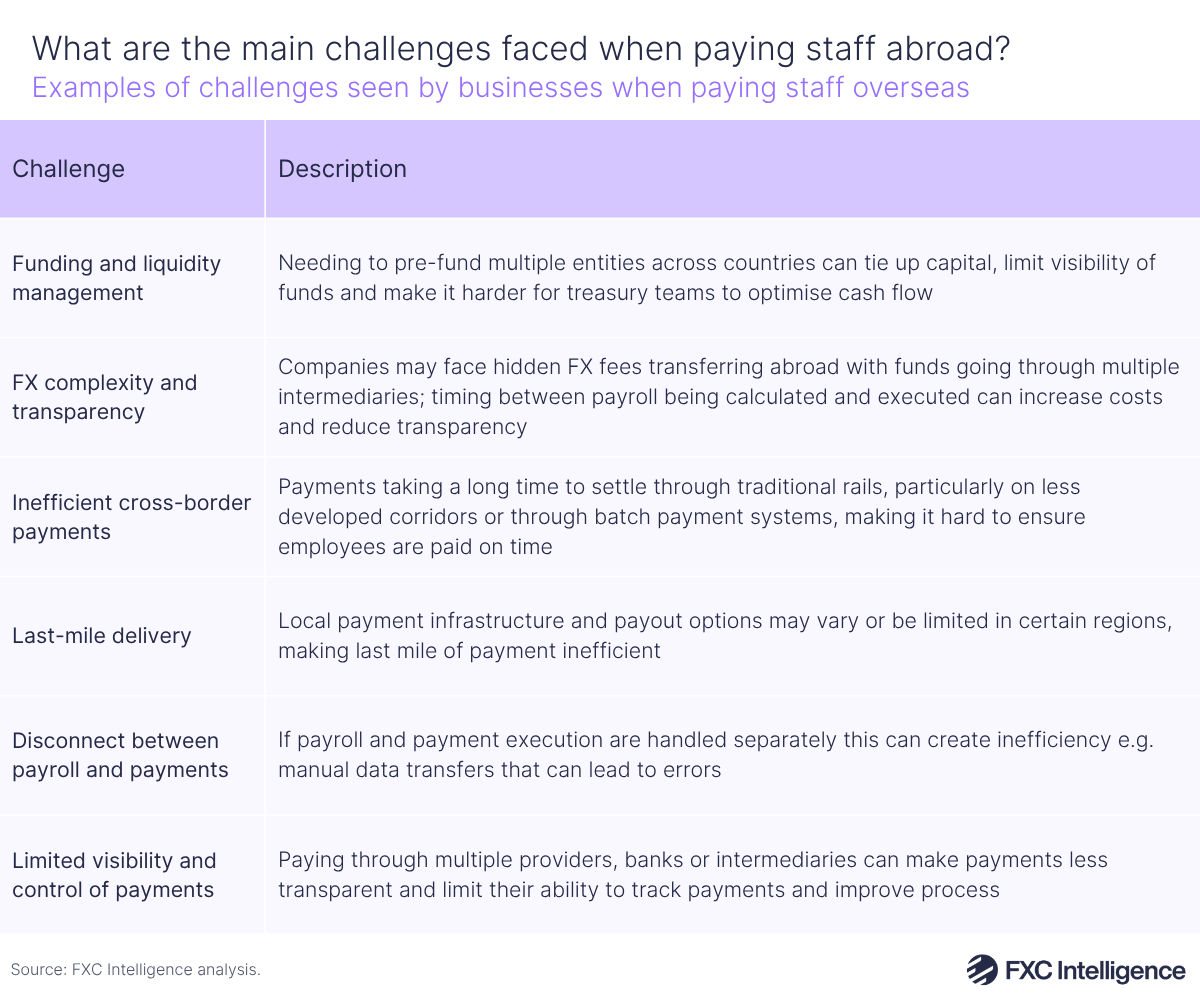
Another challenge stems from a need to be able to fund global payroll in other countries. If a business does not have a local bank account set up, they need to rely on sending money to local providers or banks, often through banks or an FX provider. However, this can mean there are high conversions and multiple intermediaries for payments to pass through, potentially slowing down the transaction. A further problem is in the degree of manual work and labour still required at various aspects of the global payroll process, such as in approving conversions, exporting files and verifying bank details. This can add to the capacity for errors and slow down the overall payments process.
Another issue is currency exchange, with rates often shifting between the time that businesses calculate payroll against the time it is paid. Some countries may even require salaries to be paid out to employees in their local currency to prevent them from losing out due to currency fluctuations. Changing rates can therefore make it harder for businesses to accurately budget for global payroll. In addition, depending on the banks and providers being used to facilitate payments, there may be hidden costs within the spreads and fees being charged and it might not always be clear how much money is being lost towards paying for the conversion.
These issues can have different impacts depending on a business’ size. For small and medium-sized businesses, it adds additional difficulties when they are looking to scale up and enter new markets. These businesses may lack in-house expertise or the local entities needed to navigate foreign labour laws and payroll processes. For larger multinational companies, there is complexity to managing payroll across lots of countries, which often creates data siloes or inconsistent processes.
Challenges often compound when it comes to paying out to emerging markets. Barry Flanagan, VP of Payroll GTM at Remote, explains that in established markets such as Germany or Australia, the rules are complex but they are knowable and stable. The challenge is more about precision in areas such as getting tax filings right, hitting statutory deadlines and handling pension contributions correctly. However, in emerging markets, businesses need to deal with currency volatility, limited local banking infrastructure and regulations that can shift with little warning.
“Payment corridors that work fine one month can become a problem the next,” he explains. “The thing I always come back to is that for employees in those markets, this isn’t abstract. A delayed or incorrect paycheck can genuinely affect someone’s ability to pay rent or support their family.”
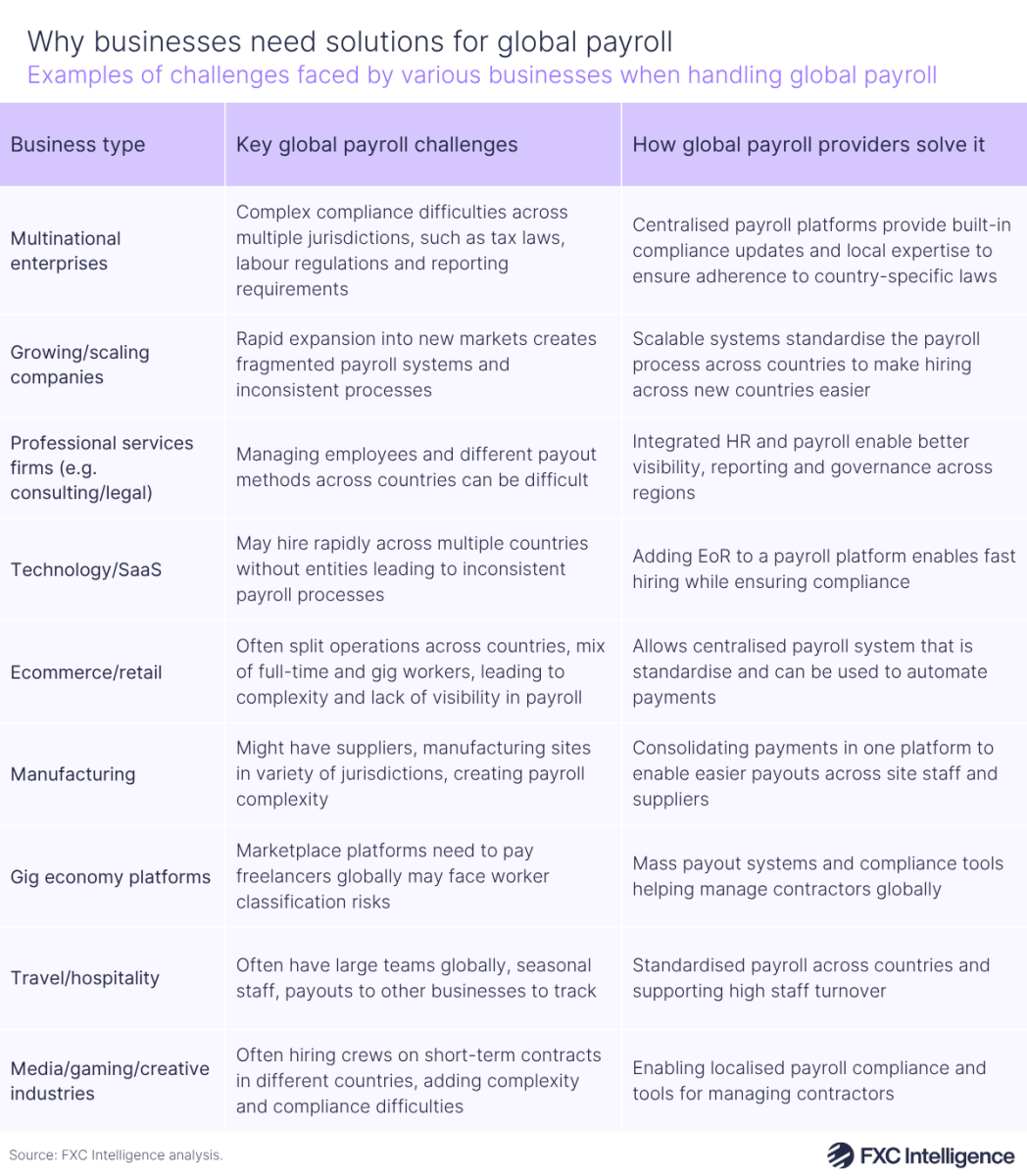
Varying business types might have a specific need to serve other markets abroad. For example, global manufacturers and retail companies might have split operations across countries with a mixture of full-time freelancers, contractors and mixed-term employees. Meanwhile, media and creative companies may need to offer short-term contracts, with workers sometimes being hired for a few days or weeks in different countries and lots of onboarding and offboarding.
Dee Coakley, Head of Workforce Management at Payoneer, says that the company continues to see demand from “pretty much all” sectors with knowledge workers (i.e. those who generate value through their expertise), including companies such as tech startups, financial services providers, marketing agencies and non-profits. “We’re seeing more requests for partnership coming through from recruiters and staffing agencies whose clients are seeking the best talent, wherever they may be.”
The complexities involved with global payroll mark a significant challenge for businesses, but they also highlight an opportunity for global payroll and payment providers to serve.
“The nature of work has changed fundamentally, and modern payroll companies are catching up,” says Kristin Reischel, Senior Director, Solutions and Partner Marketing at Rapyd. “The old model consisting of large, cumbersome payroll applications managing a largely domestic workforce simply doesn’t reflect how businesses operate today. Companies are hiring across borders, engaging short term and long-term contractors in dozens of countries, and working with gig workers and creators on every continent.”
Why paying gig and freelance workers adds complexity
Similar to paying employees locally, paying full-time employees and temporary, freelance and contract workers can create different complexities globally.
For example, full-time employees may be paid through a formal process that needs to account for the different tax rates and labour laws in each country, making considerations for things like social and pension contributions, overtime pay and different types of leave such as maternity/paternity or sick leave. They receive a fixed salary, sometimes with variable additional pay, and the local employer is obligated to handle employee tax filings & payments.
Contract or gig workers, meanwhile, may work within a specific period of time on specific projects, and submit invoices for their work rather than being paid under a specific schedule. They may also want to be paid in a different ways – i.e. hourly or on the basis of projects being completed – and during different time periods – i.e. weekly or monthly.
The complexity of serving the needs of this different employee type ramps up when a business is trying to pay these employees across different countries and currencies. An additional challenge this brings up is misclassification, whereby companies may classify an employee as an independent contractor, thereby denying them access to the various benefits that may be attached to this.
Classification laws can vary across different countries and misclassifying employees can come with significant risks to companies, which can face back taxes, social security and wage arrears, as well as having to agree to large settlement amounts when workers are reclassified as employees or workers. This thus creates an even bigger challenge for companies operating with mixed workforces across the world.
“Appropriate classification of workers is becoming increasingly important, as more countries now have case law relating to workers rights and taxation of gig economy workers,” says Coakley.
Coakley adds that gig workers often receive high-volume, low-value payments, whereas payroll transactions tend to be lower frequency and higher volume. While paying gig workers and running global payroll mainly differ on classification, compliance scope and payout mechanics, Coakley says that the underlying infrastructure and vendor landscape have been “converging”.
“Platforms such as Payoneer Workforce Management are increasingly designed to handle employees and contractors side by side, with shared payment rails but with documentation and support adapted to ensure alignment to the type of worker that’s being paid.”
What is the global payroll opportunity?
The significance of the market opportunities is highlighted by the anticipated shift in B2C flows. Last month, our cross-border market sizing data highlighted that B2C payments had a cross-border TAM of $2.1tn, with this set to rise at a CAGR of 11.4% to $5tn by 2033. This indicates that the segment is set to grow faster than other segments and outpace recent B2C growth of 10% CAGR between 2017 and 2025.
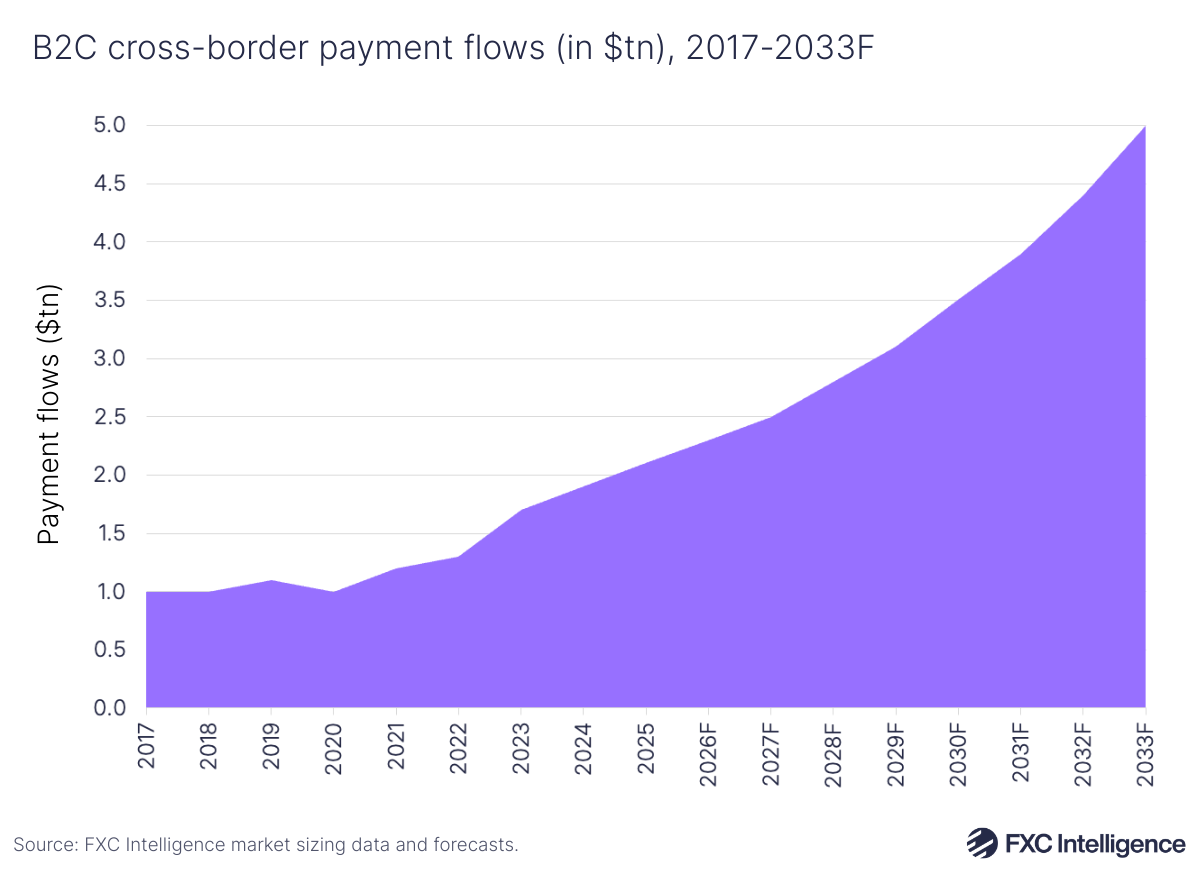
Various factors are helping drive this growth, including the expansion of gig and creator payouts and the digital economy, as well as improvements to payments infrastructure that could bring about additional speed and cost benefits. Our report also noted that over 75% of cross-border B2C flows originate from North America and Europe, with a substantial portion coming from the US, where many global payroll platforms are based.
As well as the rise in gig economy workers, Coakley says that growth in the cross-border contractor payments market is being driven by an increasing number of startups being established from day one as remote-first, as well as “greater openness” to internationally remote hires.
“Many companies are becoming more conscious of cost, and so businesses in high-cost territories are frequently looking to lower-cost regions when hiring,” Coakley explains. “For organisations investing in AI, we are seeing increasing demands for specialist skills, leading to the businesses widening their net to a global talent pool when recruiting for these roles.”
While remote and distributed work has accelerated the market, businesses themselves are also evolving. According to a survey by Remote of 3,650 HR and business leaders across 10 countries, the average white-collar company today employs people in 3.6 countries, with 45% of companies having hired internationally in the past six months, while 53% plan to hire internationally in the next six months.
“What that means for payroll is significant,” says Flanagan. “You simply can’t run international payroll the way you run domestic payroll. Patching together regional vendors and manual processes breaks down fast when you’re paying people in ten or fifteen countries.”
Global payroll providers shift to own more of the payments layer
At the moment, there are a variety of different models through which businesses approach global payroll challenges. Some businesses, for example, might seek to handle their payroll in-house but use local payroll providers to handle the process for each country. However, as companies scale this can make reconciliation much harder, as the data, processes and reporting are then split across lots of different providers.
Alternative models have emerged that are connecting up the system and making it easier for businesses to handle global payroll. In one instance, companies could work with a global payments aggregator, which is where a single platform essentially builds a network of reliable payroll partners globally. Another solution often offered by global payroll platforms is an EoR service, which is essentially a third-party organisation that formally acts as the legal employer of a workforce on behalf of another company.
Several providers in the space have also formed partnerships with payment providers to enhance services, such as partnering with Wise, Payoneer or Stripe to enable cross-border payouts and working with local banking partners, card networks and digital wallet providers to support alternative payment methods for workers abroad. This is particularly significant for contractors or people working in emerging markets where a lack of financial infrastructure may have escalated the rise of alternative payment methods for payouts.
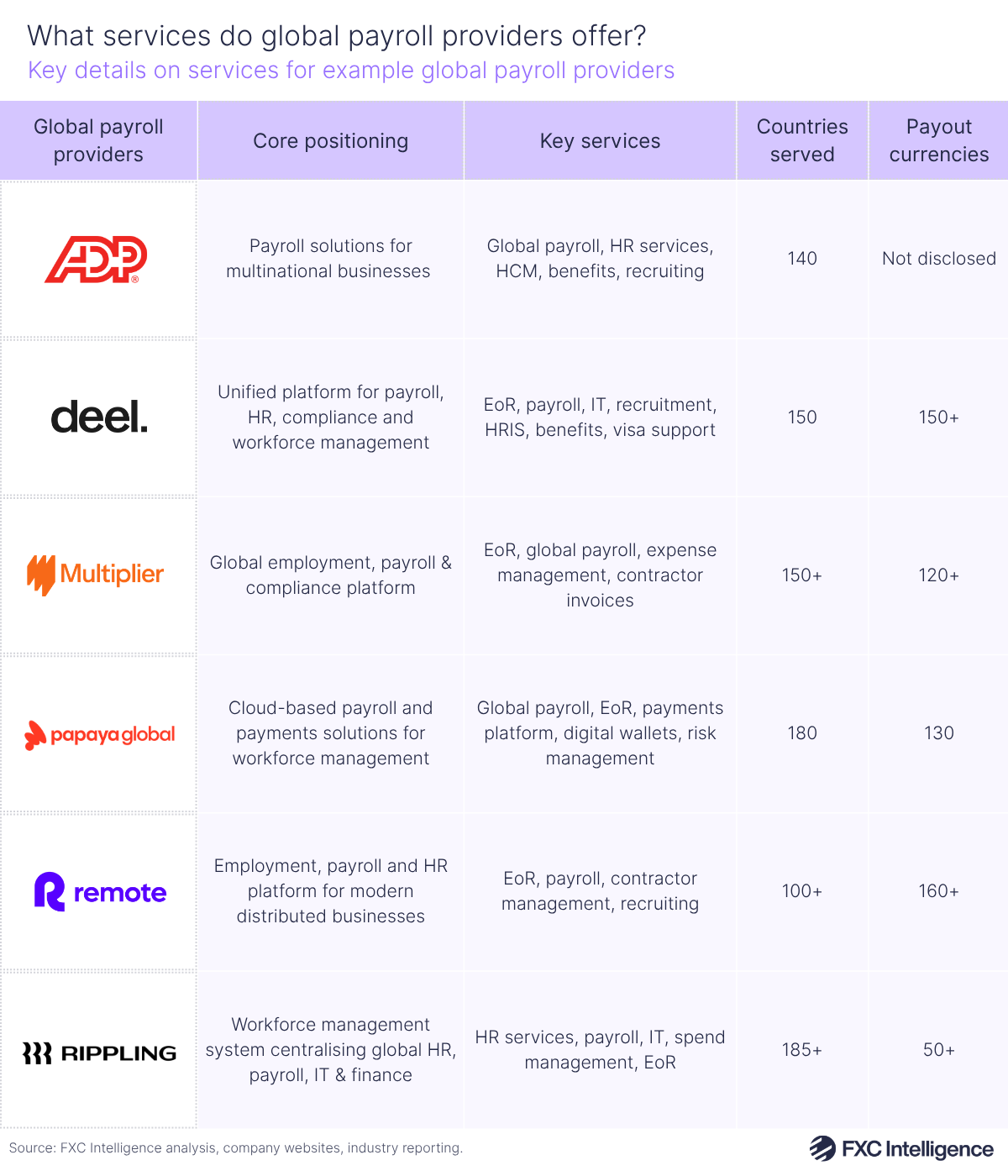
Flanagan claims that most providers operating in the space are aggregators sitting on top of a network of third-party vendors in each country, meaning that they don’t actually control payroll processing, the compliance logic or speed of execution. Remote, meanwhile, is an example of a payroll provider that has built its own AI-powered payroll engine from the ground up; this is already live in key markets, with more coming.
“What that enables is genuinely different: instant payroll processing, automatic adaptability to local requirements and accuracy and compliance at a scale that patchwork systems can’t match,” adds Flanagan. “When something needs to change or be fixed, we’re not waiting on a third party. That’s what being built for global payroll actually looks like.”
Some of the leading existing global payroll players in the space are combining different models in order to offer solutions that address however a business wants to handle its payroll. As part of this, cross-border payouts to employees may form part of a wider business suite containing other HR solutions around things like hiring and recruitment, managing global teams, visas and relocation and even running global automated IT operations.
Deel, for example, offers a single consolidated platform that allows businesses to set up a single platform for paying their staff anywhere, with the company itself handling the FX, local payment rails and multicurrency payouts. However, it also provides an EoR service that allows businesses to essentially use one of Deel’s entities in another country to make payments, allowing companies to bypass the costly and slow process of setting up an entity to do this in another country. This is on top of a suite of services serving various recruitment, IT and workforce management, offering an all-in-one solution for global teams.
A key trend with global payroll platforms such as Deel, Papaya Global, Remote and Rippling is their move into specifically owning the payments layer, giving them more control over how payments are facilitated and allowing them to service cross-border payments directly. Deel, for example, holds payment licences across several of the markets it serves, which allows it to expand the range of financial products it can offer and enable more transparent, faster payment services that it controls. Another example is Papaya Global, which in 2023 acquired money transfer provider Azimo, giving the company access to the latter’s global digital payment network across more than 150 countries and providing it with payment licences in the UK, the Netherlands, Canada, Australia and Hong Kong.
The move to grab more of the payments layer represents the significance of cross-border payments challenges within global payroll across a variety of different business types. Leaders in the space – such as ADP, Deel, Papaya Global, Multiplier, Remote and Rippling – are targeting businesses of all sizes, including those that are scaling and those that are already serving large global workforces. These businesses span a variety of different sectors, from software-as-a-service companies to manufacturing, retail and professional services firms, supporting workforces that range from remote-first teams to shift-based and globally distributed employees.
Some of the leading providers in the space also offer solutions that specifically address the unique challenges posed by global payroll and paying temporary, contract or other non-permanent workers. For example, Remote’s website splits out separate solutions for Contractor of Record and Contractor Management from its core payroll solution. Papaya Global, meanwhile, offers a specific Contingent workforce solution focused on unifying classification, onboarding and global payments across workers.
Payments providers push global payroll as a potential use case
While global payroll platforms are emphasising a shift to own more of the payments layer, the reverse is also happening, with some of the leading providers of cross-border payments increasingly focusing on global payroll as a use case. This includes infrastructure providers such as Airwallex, Nium, Payoneer and Rapyd; consumer and business payments providers such as Remitly and Wise; and digital bank Revolut.
Reischel says that cross-border payments specialists already have the global reach and local integrations in place to solve payroll challenges for businesses, meaning they don’t need to manage it through a patchwork of disconnected processes. “What’s driving payment providers into this space is the recognition that payroll is, at its core, a payments problem,” she explains. “The complexity of cross-border payroll – including supporting multiple currencies, local compliance requirements and diverse payout preferences – is exactly the kind of challenge that modern payments infrastructure is built to solve.”
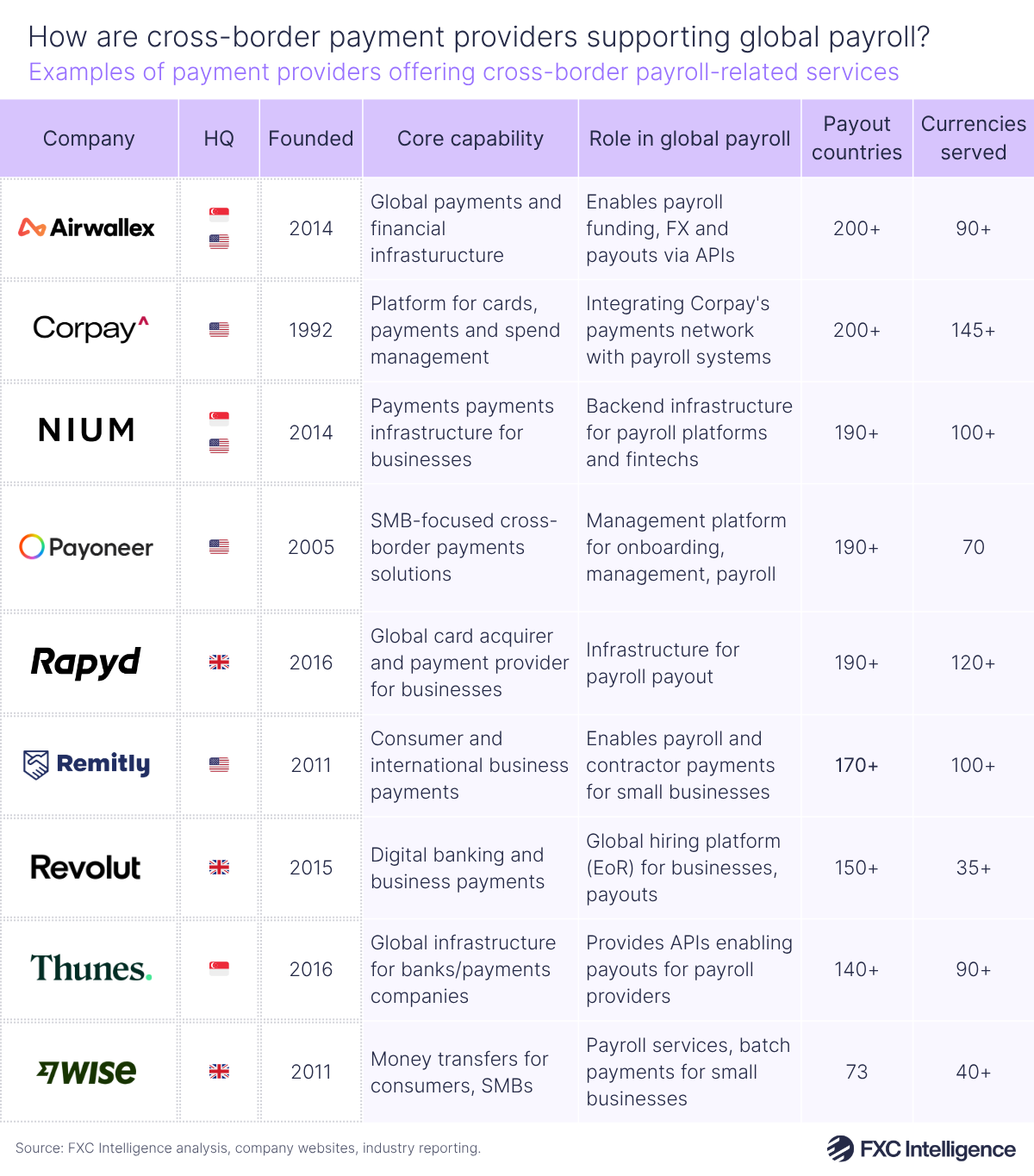
Payments providers have increasingly grown and established their network to the extent that they are targeting the global payroll opportunity at various levels of the HR stack. For some providers, a significant part of this is providing the underlying infrastructure to support payments, such as offering multicurrency accounts, FX, mass disbursements and access to global payout rails.
Coakley says that demand for global payroll is accelerating the need for seamless payouts to freelance workers, long-term contractors and employees via routes spanning all geographies – but ultimately companies are not just looking for a solution to deal with payments. “As well as payment rails, companies are seeking support with compliance and guidance on appropriate worker classification,” she says.
In some cases, businesses are providing these capabilities to businesses directly, but also offering network solutions that are targeting global payroll platforms. Nium, Rapyd and Airwallex offer APIs that can be added to payroll management software to enable several payments functions, such as multicurrency accounts, payouts, global card issuing and FX services.
In Rapyd’s case, for example, the company enables payroll companies to generate virtual accounts that make it easier to collect funds, as well as branded digital wallets where end users can hold, manage and spend funds.
“Being global doesn’t mean much if the money doesn’t arrive in a way the recipient can actually use,” says Reischel. “We’ve integrated with major e-wallets, Visa Direct and Mastercard Send, and we’re connected to 2,000+ banks to ensure funds reach employees, contractors and gig workers through the methods they prefer.”
Payoneer, meanwhile, has significantly expanded its Workforce Management platform, which covers payments but is also a full-fledged payroll system, offering services on everything from recruiting and onboarding, to EoR and Agent of Record services (for contractors) to guidance on tax laws, visas and work permits. This platform was built through its 2024 acquisition of Singapore-based global and HR and payroll startup Skuad, and has expanded further into Europe through the company’s acquisition of Ireland-based EoR platform Boundless.
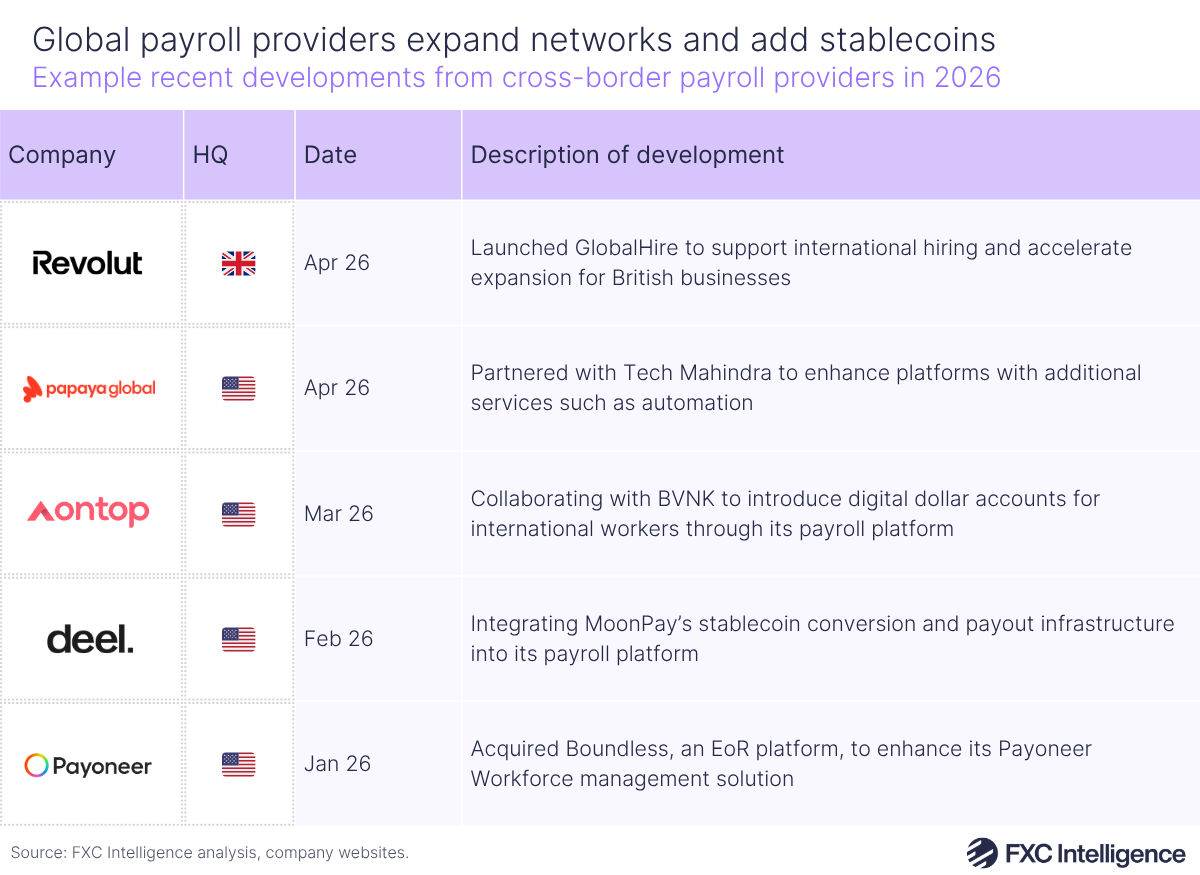
Earlier this month, Revolut launched its own EoR platform in the form of GlobalHire, integrated with its Revolut Business solution to specifically target UK businesses hiring and paying staff abroad. Aside from enabling regulatory compliance, Revolut specifically highlighted the payments benefit of its solutions, arguing that legacy EoR providers often charge a “hidden growth tax” in the form of currency exchange fees. This shows the potential of businesses with an existing FX product line to target the global hiring space.
“A business’s ambition shouldn’t be limited by where it is headquartered, nor by local currency barriers,” said Alex Codina, General Manager of Merchant Payments and GlobalHire at Revolut, in a press release. “GlobalHire goes beyond recruitment; it’s a strategic asset in a business’ arsenal to fuel borderless growth.”
Meanwhile, Wise and Remitly – which have grown from being consumer-focused money transfer solutions to increasingly serve the needs of businesses – now offer global payroll services to support businesses. For Remitly, this is still an early-stage opportunity, focusing on UK SMBs aiming to set up the ability to pay remote employees their salaries on time in local currencies. However, it is another example of a payment player with an already established large network moving into the growing B2C space.
The crux is that as global payroll platform providers seek to expand and own more of the payments layer, cross-border payment providers are moving to use their payment infrastructure to more clearly target businesses for global payroll purposes, creating a landscape that is more competitive but increasingly centralises the payments layer as businesses seek out a one-size-fits-all solution to global hiring.
How is AI changing global payroll?
A consistent thread across global payroll is its complexity and how businesses can break down and execute the different aspects of it more efficiently. Recent moves around AI have highlighted how providers in the space aim to move from bolstering services to actually executing more aspects of payroll.
Reischel argues that AI has the potential to “transform payroll operations from the inside out”, handling tasks from automating compliance checks across jurisdictions, flagging anomalies in payroll and optimising the timing and routing of cross-border payments. “AI can take significant complexity off the table. As these tools mature, we expect AI to make global payroll faster, more accurate and more adaptive to the needs of an ever-changing workforce.”
There has been a strong focus on agentic solutions. Last year, Deel launched the beta version of AI Workforce – a product that allows its customers to launch and manage AI agents on its platform to help relieve HR leaders working on admin-heavy tasks. Its agents have been trained to handle a variety of needs across HR, payroll, talent acquisition, finance and operations. From a payments perspective, this includes agents checking rules to flag payroll errors before payouts occur.
“For HR and payroll leaders that means going above simply automating tasks,” said Alex Bouaziz, Co-founder and CEO of Deel, in a press release. “It’s about baking AI into already-used and loved technology to remove the barriers that slow teams down.”
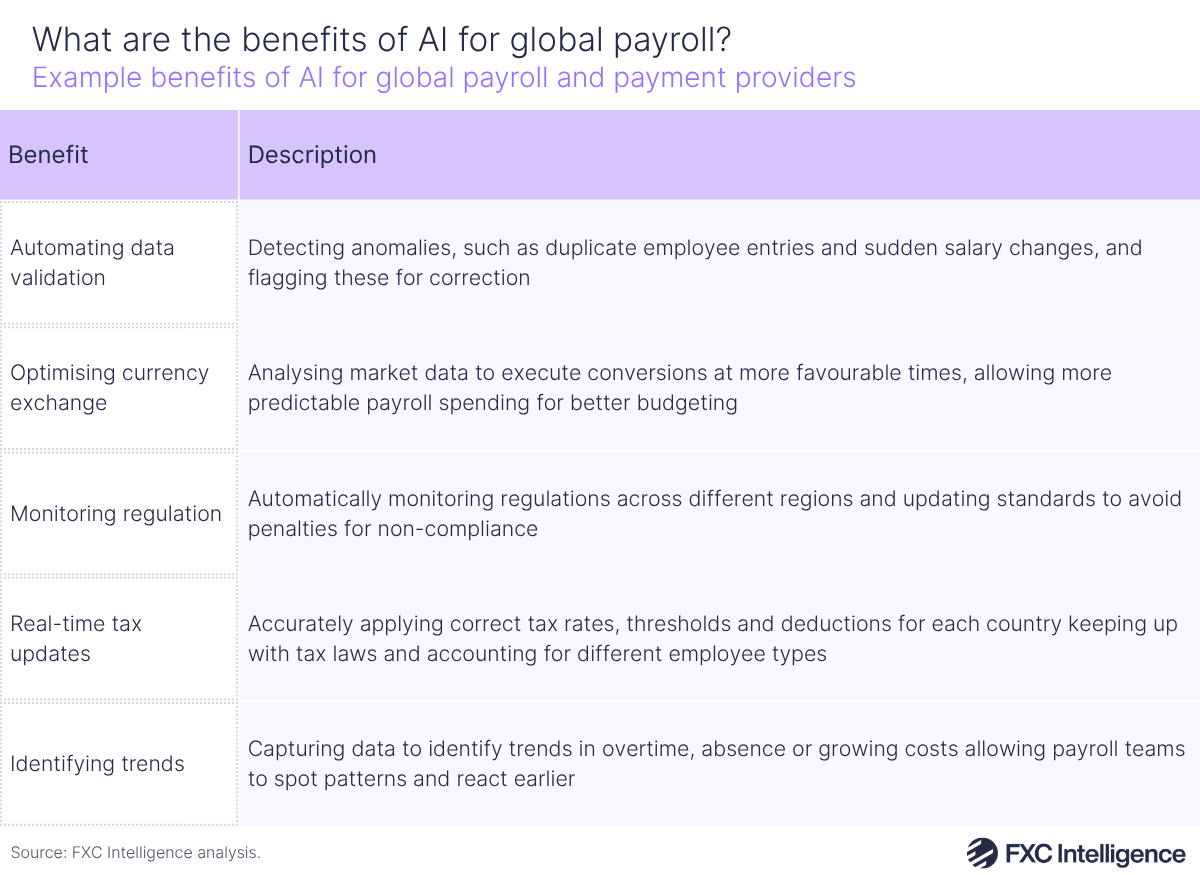
ADP commenced the rollout of a similar agent-based solution for fact-checking payroll earlier this month, initially available to enterprise companies with deployment for mid-market clients planned for mid-2026.
Flanagan says that AI is going to reshape the actual mechanics of running payroll. “We expanded our AI-driven payroll infrastructure to over 100 countries last year and the practical difference in speed, accuracy and compliance monitoring has been real,” he says. “Things that used to require manual intervention get caught and resolved automatically. That will become table stakes.”
Having said this, as AI continues to ramp up, legislation and regulations around the technology’s use are increasing. For example, the EU’s AI Act – a legal framework for AI usage across companies in Europe – entered into force in August 2024 and has a full enforcement deadline by 2026. The Act puts tools that are used in employment decisions, including EoRs and workforce platforms, into a “high-risk” category. This means they need to include a number of mitigating items, including risk assessments, technical documentation, transparency disclosures and bias testing. They also must have full human oversight and continuous monitoring.
On the one hand, growing regulatory scrutiny does create an additional burden to deploying and using these solutions – however it also gives global payroll providers the ability to stand out in the market by building the most trustworthy and compliant systems.
How might stablecoins enhance global payroll?
While payroll providers have been embedding AI, there have also been more moves to explore and adopt stablecoins in the space.
The key cross-border use cases of stablecoins – which we’ve assessed in more detail as part of our FXC Buyer’s Guide: Stablecoin Payments Infrastructure – are focused on their ability to enable payments outside of the traditional correspondent banking system. This in theory makes payments faster and gives businesses access to 24/7 settlement outside of traditional banking cut-off times, but also may reduce costs by reducing the number of intermediaries in the chain.
For payroll, there could be specific advantages. In a blog from March 2026, Scott Johnson, Vice President of Technical Program Management at B2B payments provider Convera, highlighted that specific workers – particularly those working in mobile roles such as on cruise ships – may have limited access to traditional banking systems or a stable home currency. A USD-backed stablecoin could therefore give these workers access to a single currency that can also allow them to hedge against macro effects such as inflation or exchange rate fluctuations.
Key to stablecoins potential in payroll will be the extent to which stablecoins can become the norm within workers’ everyday life. Johnson added that the potential of stablecoins lies in them being able to be spent, converted and off-ramped easily, as without these stablecoins remain “just a store of value”.
Several providers in the space have been experimenting with enabling stablecoin-based payroll. Deel, for example, integrated with fintech MoonPay in February to enable salary payouts in stablecoins to workers’ wallets across more than 150 countries. The goal has been to help pay out to regions with limited access and high inflation.
Similarly, Payoneer announced plans to launch a suite of stablecoin solutions powered by Stripe-owned Bridge in February. Ontop recently partnered with stablecoin infrastructure provider BVNK to expand cross-border payroll to stablecoins in March.
Coakley says that stablecoins will be a key driver in the evolution of global payout infrastructure going forward, which is why the company is integrating stablecoin capabilities such as wallet functionality and conversion into local currencies. “[Stablecoins] can reduce friction in cross-border B2B payments by enabling near real-time settlement and improving liquidity”, she argues.
Rapyd is another provider that has launched stablecoin pay-in and payout capabilities for its business customers. Reischel also emphasises that stablecoins are a particularly practical payroll tool in emerging markets and, as the gig workforce continues to expand globally, there is a clear and growing demand from workers who want to receive at least a portion of their pay in stablecoins.
“In markets where local currency volatility can erode purchasing power overnight, stablecoins offer a degree of financial stability that traditional payroll simply can’t guarantee,” she argues. “This isn’t a future trend, it’s already happening, and payroll providers that don’t offer stablecoin payouts will increasingly find themselves at a disadvantage in these markets.”
Similar to AI, the introduction of regulations around stablecoins, such as the US’s GENIUS Act and the EU’s MiCA regulation are providing more clarity around their usage, but also placing more stringent compliance rules on providers in the space. For global payroll providers, the key will be in identifying which emerging markets and stablecoins will offer the most value for workers while maintaining compliance.
What will the future of global payroll look like?
In a vastly complex space, the future points to one in which global payroll providers are increasingly able to represent themselves as one centralised place to handle all aspects of payroll, from workforce management to cross-border payments. This could mean further moves in the market from payroll providers to focus on building their own payments infrastructure in-house, while payment providers will increasingly move to build bespoke solutions for the space.
Flanagan says that he expects companies to consolidate onto fewer platforms. “Right now a lot of teams are managing payroll, HR, contractors, performance and more through separate systems that don’t talk to each other well, and that fragmentation has real costs,” he says. “The direction is clearly toward integrated platforms where everything lives in one place.”
Coakley expresses a similar prediction, saying that as businesses hire globally payout infrastructure will need to connect with workforce management, compliance and broader financial operations. “Platforms that bring this together into a single system will define the next phase of global commerce,” she says.
“Over the next three to five years, global payout infrastructure will become faster, more programmable and more interoperable, combining traditional banking rails with blockchain and local payment networks. Payoneer’s role is to orchestrate across these systems through a unified financial stack so businesses can move money globally with greater speed, transparency and reliability.”
As part of this consolidation, compliance will become an even more important issue, as regulation becomes more complex and pay transparency laws expand across Europe and beyond. “Employment status rules around contractors are tightening in more jurisdictions,” says Flanagan. “The companies building compliance capability now rather than reacting to it later will be in a much stronger position.”
He adds that transparency is another key aspect that providers in the global payroll space need to consider. “Employees want to understand how their pay was calculated, not just receive a number,” Flanagan says. “Treat pay as a trust-building exercise rather than just a transaction and the relationship with your workforce changes quite a lot.”
Alongside increasing scrutiny, the expectations of consumers to receive money quickly is also growing. While regulators push towards faster cross-border money transfers, real-time payment rails continue to be implemented across different countries. The emergence of wallets and alternative payment methods will require continued expansion from those serving the global payroll space to pay out to the most popular methods, particularly for those using digital wallets across emerging markets.
Reischel adds that she sees a “universal digital wallet”, where workers can receive and manage earnings anywhere (as opposed to a traditional bank account), as being the norm for cross-border and gig workers over the next few years. This could then expand to broader financial services, where workers can not only receive their pay, but also hold multiple currencies, make investments, access credit or loans based on their income history and send money internationally, all from the same interface.
“Payroll providers that embrace this vision will transform from transaction processors into genuine financial partners for their users,” says Reischel. “That’s where the real opportunity lies, and it’s the direction the most forward-thinking players in this space are already heading.”
As businesses continue to hire across borders and cross-border B2C flows grow, global payroll represents a significant area of opportunity. Ultimately, the providers that are able to combine the different aspects of global payroll while owning a competitive payments layer will be the ones to get ahead. Continuing to track and respond to how consumers are receiving money, as well as how ongoing trends such as AI and stablecoins are changing payments in key markets, will be crucial to competing in the space.