
USDC stablecoin issuer Circle has reported another quarter of strong revenue growth in Q1 2026, but has also made key steps in its ongoing efforts to diversify its revenue through a number of payments, blockchain and AI-related initiatives.
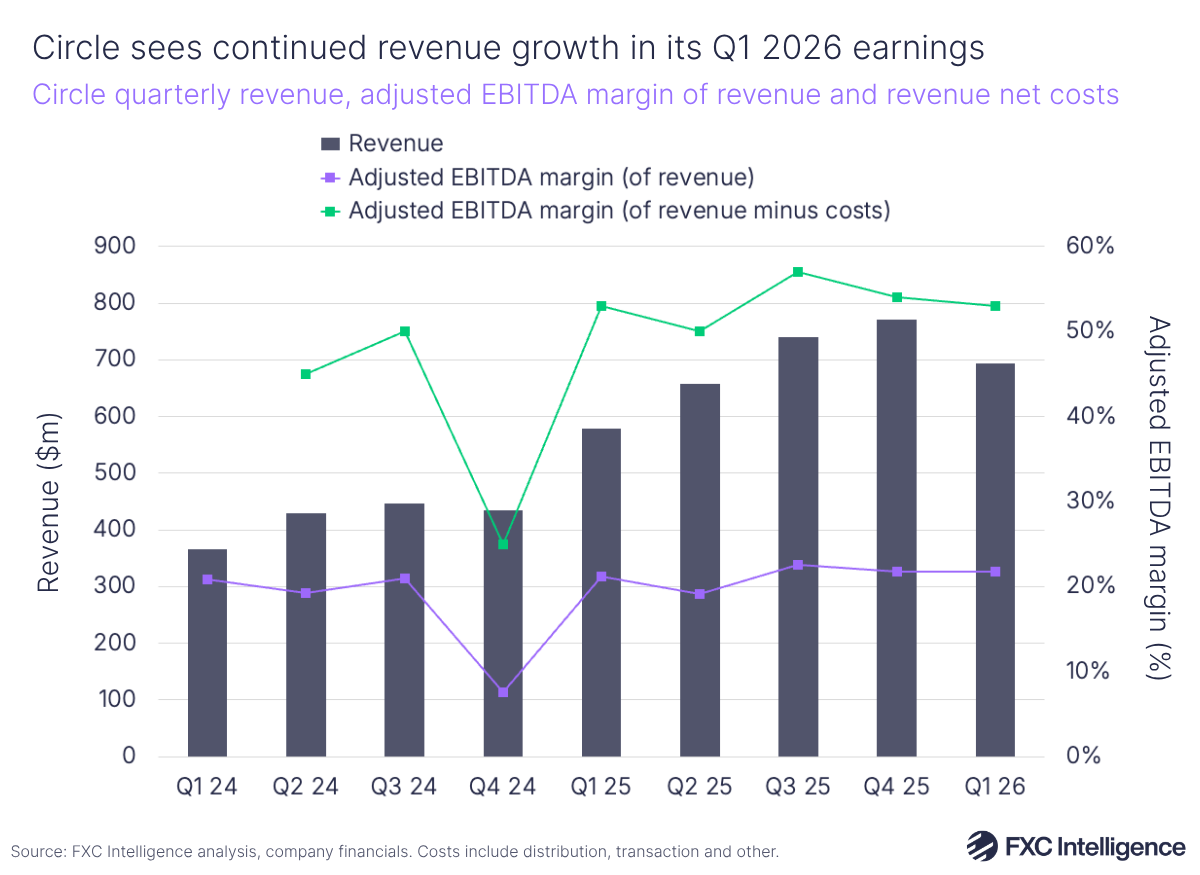
The company reported a 20% YoY increase in overall revenue to $694m, while adjusted EBITDA increased 24% YoY to $151m. This has seen the company’s adjusted EBITDA margin remain at 22%, while its own reported metric of adjusted EBITDA margin of revenue minus costs was 53% for Q1 2026.
The quarter not only saw positive financial results, but several key platform launches, including a token presale for its upcoming payments blockchain Arc, the launch of BVNK rival CPN Managed Payments and most recently the launch of Circle Agent Stack, a set of solutions for AI-based agentic payments.
Investors responded positively to the news, with Circle’s share price rising following the earnings announcement.
Circle reaffirms FY guidance amid interest rate headwinds
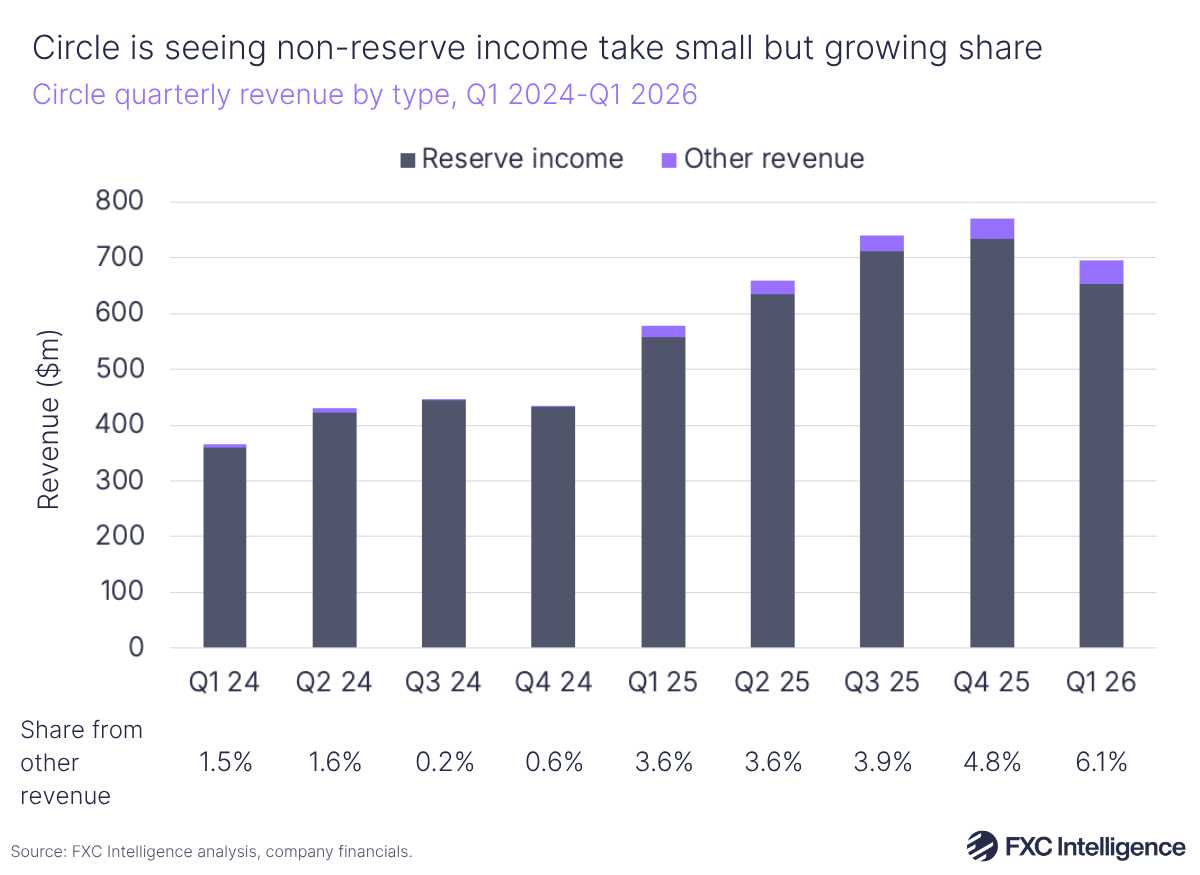
While the company has seen YoY revenue growth, it did see a sequential dip in revenue from Q4 2025’s $770m following a year-long period of consistent quarter-on-quarter growth. This was in part due to a one-off benefit in Q4, however is also driven by a lower reserve rate that impacts how much revenue it earns on the reserves underpinning its stablecoins in circulation.
While reserve return rates have been falling for some time, the reduction in Q1 2026 was particularly pronounced, dropping 66 bps YoY to 3.5%. This posed a headwind for reserve income, which contributes the majority of Circle’s revenue. However, it was offset by a 28% YoY jump in end-of-period USDC in circulation, resulting in a 17% YoY increase in reserve income to $653m.
The results saw Circle restate its full-year guidance originally presented during its FY 2025 earnings call, with the company projecting a 40% increase in USDC in circulation and other revenue to reach between $150m and $170m. If reserve return rates remain at Q1 levels throughout the year, this would translate into overall revenue of around $3.8bn for FY 2026.
The company also expects to see its revenue less distribution costs (RLDC) margin remain at around the same levels as FY 2024 and FY 2025.
USDC takes transaction volume lead despite USDT circulation leadership
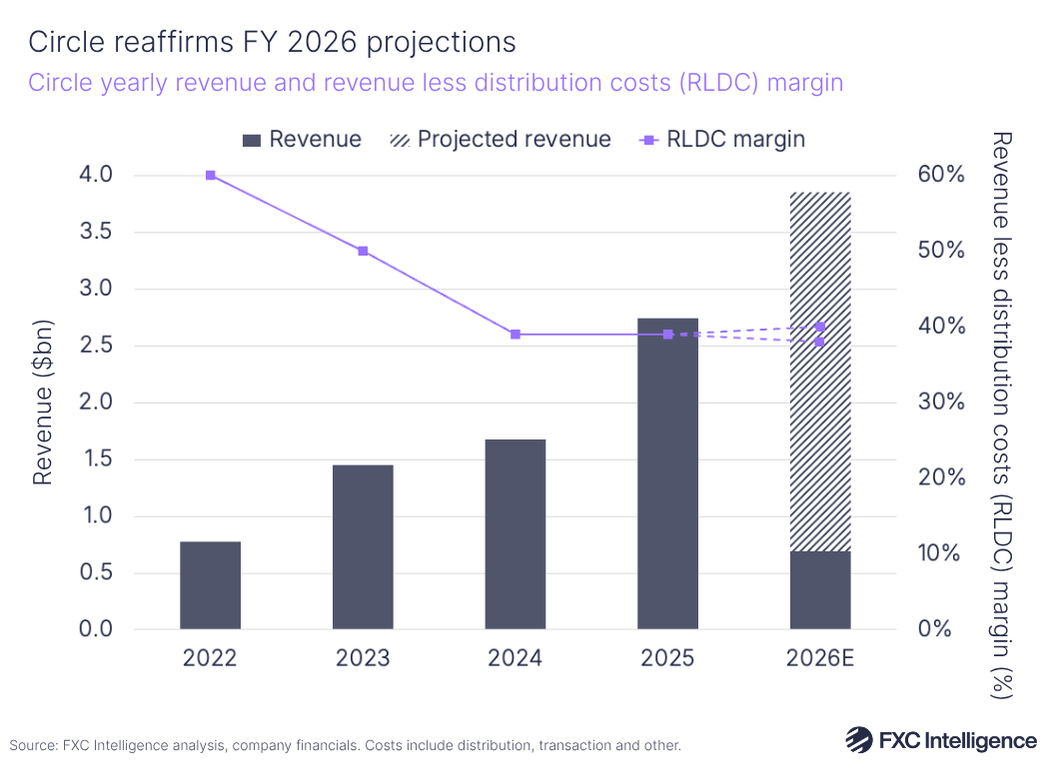
USDC in circulation ended Q1 at $77bn, up 28% YoY, however the stablecoin’s circulation growth has moved in line with the overall market, with its share of all stablecoins in circulation remaining at 28%. This is the fifth quarter in a row that USDC has seen its share remain at around this amount.
The company has seen a significant increase in meaningful wallets (onchain wallets with more than $10 in USDC), which increased 47% YoY to 7.2 million, suggesting broadening adoption beyond institutional flows.
Circle CEO Jeremy Alliare also highlighted high-profile examples of increased USDC adoption among key enterprise players, citing Meta’s adoption of the stablecoin for creator payouts and DoorDash adding the ability to pay USDC out to drivers.
Crucially, Circle has also reported an increase in the amount of on-platform USDC, which earns a much better margin for the company versus that held by Coinbase or by other off-platform entities. In Q1 2026, Circle held 18% of USDC on-platform, up from 6% in Q1 2025.
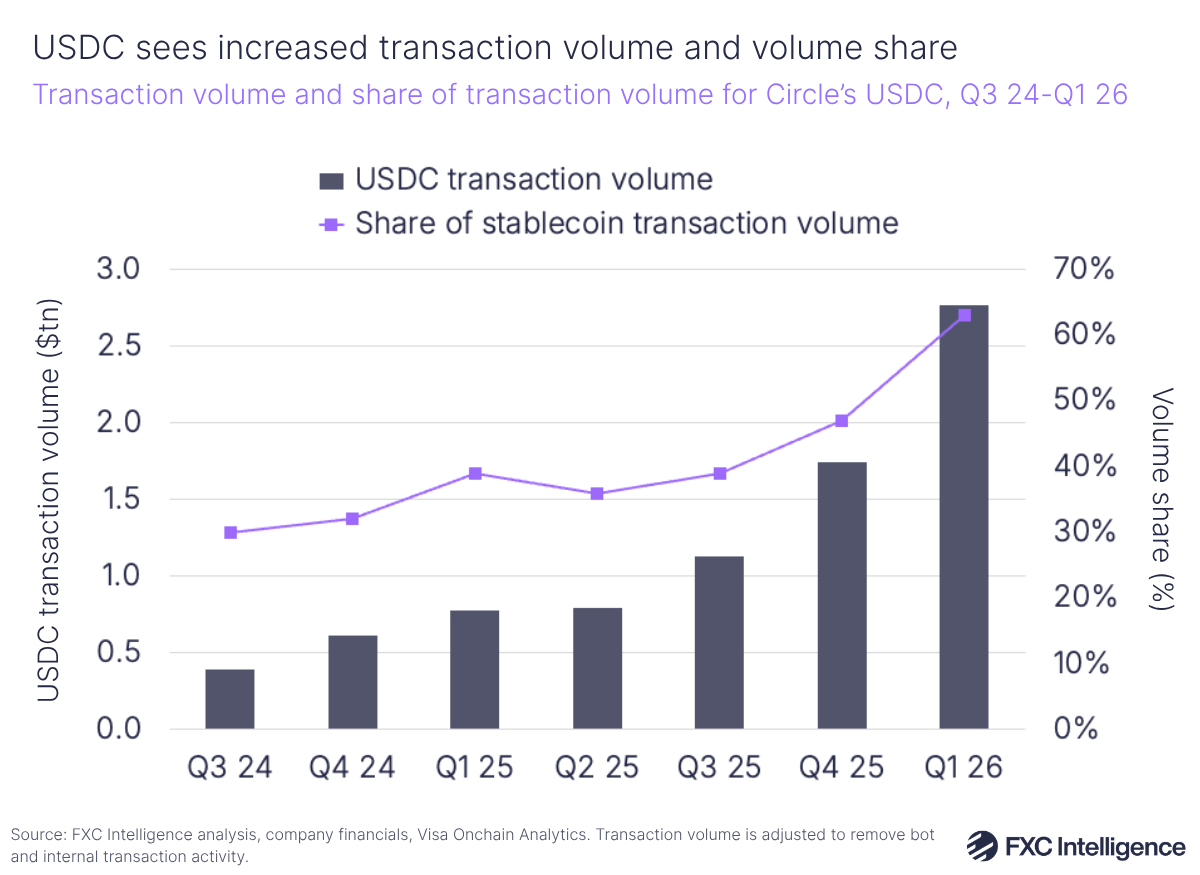
However, the most notable change for USDC use this quarter was in transaction volumes. For the first time, Q1 2026 saw the stablecoin overtake Tether-issued rival USDT to account for more than half of all stablecoin transaction volume.
USDC reached 63% of all transaction volume in the quarter, according to data cited by Circle from Visa Onchain Analytics, or $2.8tn of the stablecoin market’s $4.4tn total, which is adjusted to exclude transaction volume for internal trades, bot activity and other ‘noise’ in stablecoin transaction data. This represents a 255% YoY increase in adjusted transaction volume using USDC.
Unadjusted, Circle saw its transaction volumes total $21.5tn in the quarter, a 263% YoY increase. However, Circle did flag that around $9tn of this was attributable to market-making repricing activity on decentralised exchange Aerodrome.
While considerably smaller, Circle also reported growth in circulation for its euro-pegged stablecoin EURC, which grew 109% YoY to reach €358m.
Circle sees key revenue diversification gains
Circle’s reliance on revenue earned from income on its reserves has made it highly sensitive to changes in interest rates, and has been a major factor in its post-IPO focus on diversifying its revenues. While the company has a long road ahead on this front, it made arguably the most significant gains in revenue diversification this quarter since it went public 11 months ago.
Other revenue, which covers all income not attributable to interest earned on reserves, saw 103% YoY growth to $42m this quarter and saw its share of overall revenue climb to a high of 6%.
Within this, subscription and services revenue reached $35m, primarily driven by blockchain network partnerships, while transaction revenue reached around $7m. The latter was aided by growth in Circle’s Cross-Chain Transfer Protocol (CCTP), which enables its stablecoin to be moved between blockchains. CCTP volume saw more than 300% YoY growth to $49bn and is now being opened to third-party assets, improving interoperability for blockchain-based money movement while potentially increasing the revenue contribution for Circle.
The company’s full-year expectations of $150m-170m in other revenue indicates that the segment will continue to see elevated growth over the next few quarters. This is likely to be helped by a number of key initiatives, particularly around CPN and blockchain network Arc.
CPN grows volumes amid Managed Payments launch
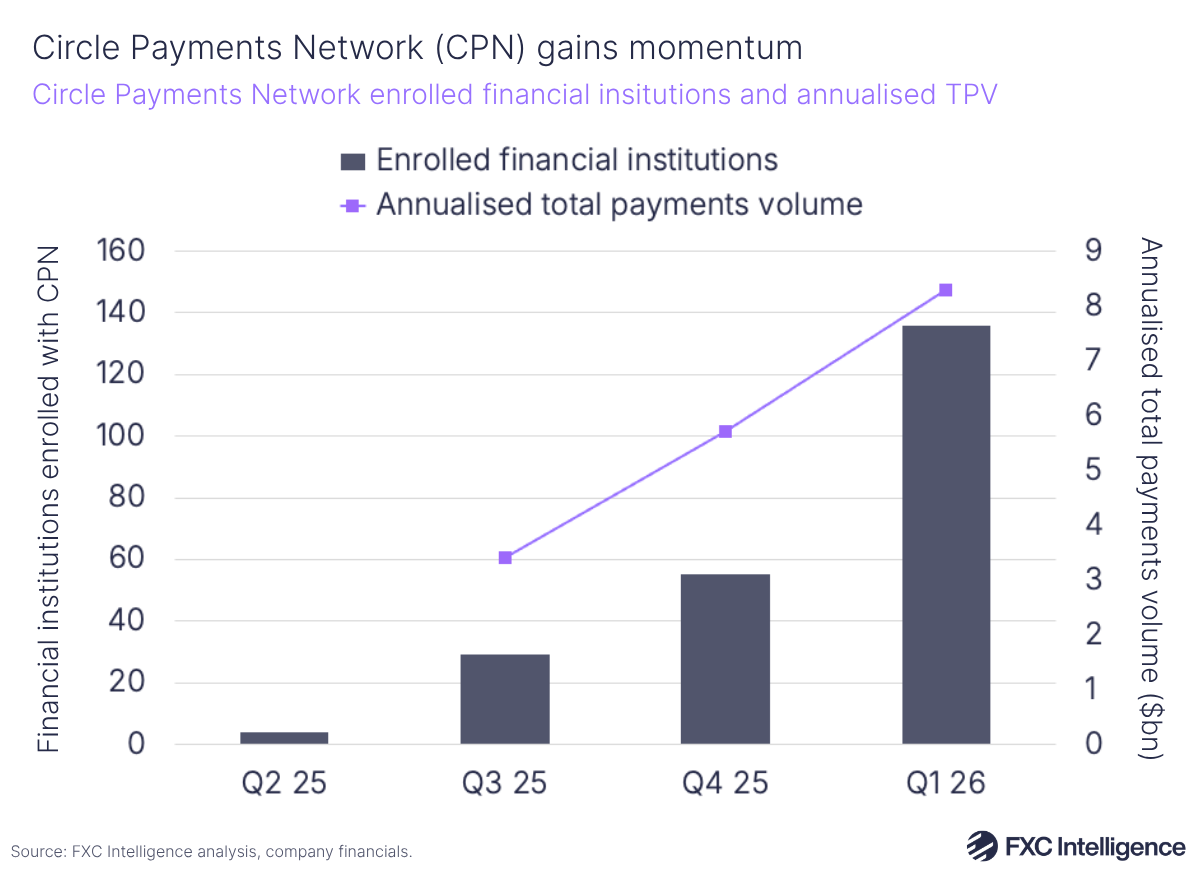
At only a year old, Circle Payments Network (CPN) remains a nascent business line for Circle, however the company has reported a number of key gains, with annualised total payments volume (TPV) now standing at $8.3bn as of 31 March. This represents a 17% increase on the previous quarter, but has continued to rise since, with Circle reporting that as of 7 May its annualised TPV was around $10bn.
This growth has been aided by the number of financial institutions that are now enrolled in CPN, which stands at 136 as of Q1, a 36% increase on the previous quarter. The company also now has CPN coverage for stablecoin payments in over 180 countries, while local fiat payouts are supported in more than 50.
Most notably, this quarter also saw Circle launch CPN Managed Payments, a solution that directly challenges managed payments providers such as BVNK, Bridge and zerohash, although it has not yet provided any data on its adoption or use. Designed to provide a unified solution for banks, fintechs, global enterprises and managed service providers, this solution abstracts the more technical elements of digital asset money movement while enabling clients to avoid touching stablecoin directly.
“With Managed Payments, we can bring a bank into CPN on an accelerated basis, delivering all of the benefits of Circle’s global infrastructure, our compliance, liquidity, network effects and interoperability, while compressing time to market,” said Jeremy Allaire, CEO of Circle, during the earnings call.
“We see this as a significant opportunity to bring banks, payment firms and financial institutions onto CPN at scale.”
Arc network emerges as key strategic bet
Beyond CPN, Circle also addressed key developments in Arc, its dedicated blockchain that is specifically designed to support payments. While currently only the Arc testnet is live, having been launched in October 2025, the blockchain has already seen more than 244 million transactions and 1.6 million unique wallets.
However, the company is now gearing up for the mainnet launch of Arc, which will see the blockchain operated by leading financial institutions, with a strong focus on interoperability, speed of settlement finality and accessible, predictable fees.
In readiness for this, the earnings call saw Circle announce the pre-sale of the Arc token, which gives holders the ability to participate in decisions about how the network operates and evolves and enables them to earn a share of fees generated on activity on the network. Designed to raise $222m at a $3bn fully diluted network value, the pre-sale will see Circle retain 25% of all Arc tokens while 15% are held in reserve. The remaining 60% are earmarked for ecosystem development to grow network adoption and use, starting with this presale.
While the presale is likely to generate significant revenue for Circle, the company stressed that it has not included this in its FY projections for other revenue.
Circle Agent Stack sees move into agentic payments
This earnings call also saw Circle announce the launch of Circle Agent Stack, a wide-ranging solution for AI-based agentic payments, which have gained considerable interest as a key application for stablecoin payments in the future. As AI agents become more widespread and sophisticated, they are increasingly needing the ability to autonomously manage and make payments, and many have seen stablecoins as a key tool for this, particularly given their rapid settlement and low payment overheads.
A growing number of companies have announced solutions that are designed to tap into demand for agentic payments, however this is the first time Circle has addressed the area directly.
Built natively on Arc, Circle Agent Stack consists of four key solutions that together are designed to support the payment needs of AI agents and companies looking to harness them. These are:
- Agent Wallets: Permissionless, multi-chain wallets that essentially act as payment accounts for AI agents, with the ability to hold USDC, transact autonomously within set guardrails and on-ramp funds.
- Agent Nanopayments: A solution that supports USDC transfers as small as $0.000001, enabling high-frequency machine-to-machine micropayments, built on the x402 protocol, an emerging standard for HTTP-based agent-to-agent payment requests.
- Agent Marketplace: A platform where agent services can be identified, paid for and hired programmatically, with some parallels with CPN.
- Circle Platform CLI: A command-line interface that gives developers and AI agents direct access to Circle’s full infrastructure stack, enabling actions such as wallet provisioning and transaction integration to be handled by AI agents or via AI tools such as Claude Code.
It is not yet clear what the TAM for agentic payments is or may ultimately become – although the share of stablecoin payments volume attributable to AI agents is likely still very small – but Circle Agent Stack does represent a clear move by Circle to center USDC in this highly nascent market.
Circle reports rising costs amid investment focus
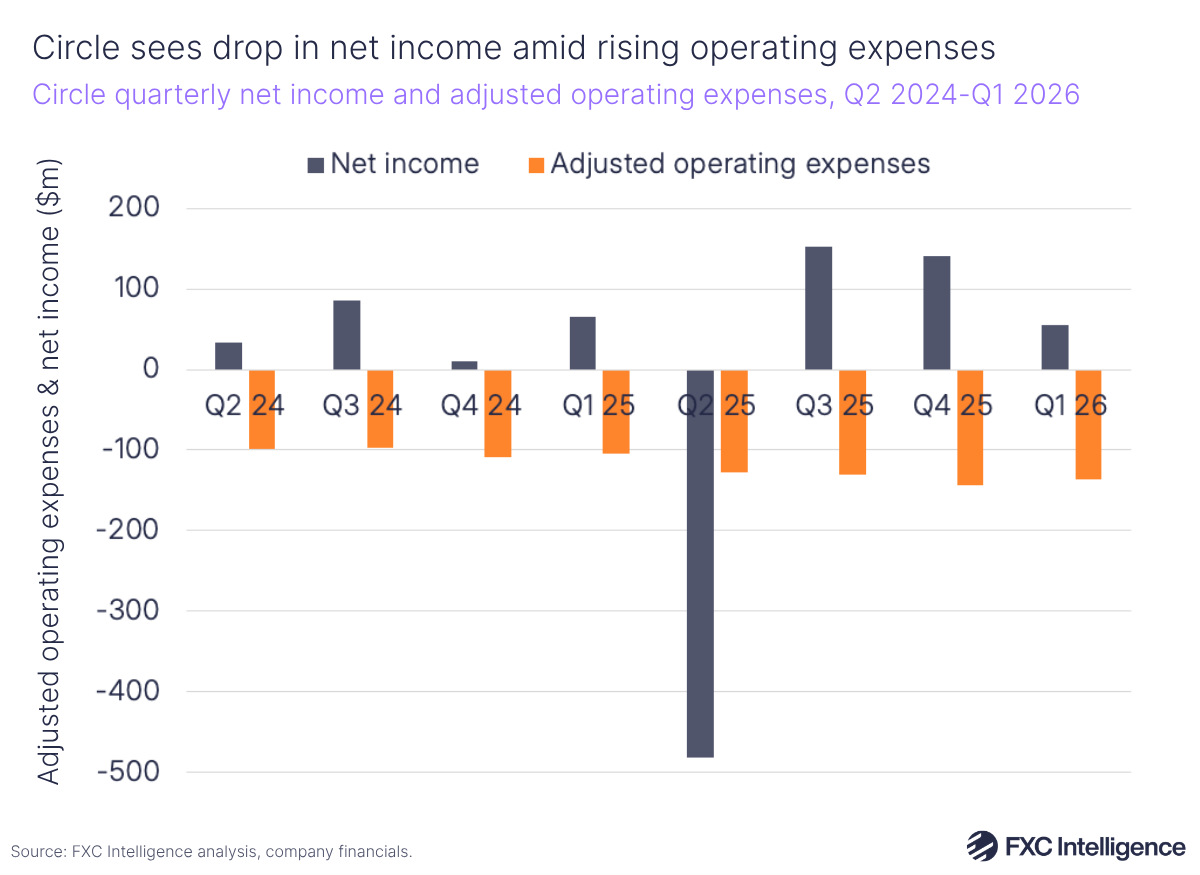
While the company has seen continued growth this quarter, it has also seen some headwinds that have impacted its bottom line. Circle’s net income reduced by 15% YoY, largely as a result of post-IPO stock-based compensation, while adjusted operating expenses increased 32% YoY to $136m amid widespread investment expenditure.
Distribution costs, which are payments the company pays to distribution partners including Coinbase, remain the largest cost item, and grew 17% YoY to $407m.
However, Circle has been keen to highlight that its ongoing operational efficiency efforts have helped keep other costs down, with revenue less distribution costs (RLDC), a key metric for the company, increasing 24% YoY to $287m.
The company also joined several others in the payments industry in highlighting internal use of AI tools as a key efficiency driver, with 85% of employees now being weekly active users of AI coding tools as of the end of April. Taking this in addition to the rollout of products such as Agent Stack, we are likely to hear much more on AI from Circle in coming quarters.