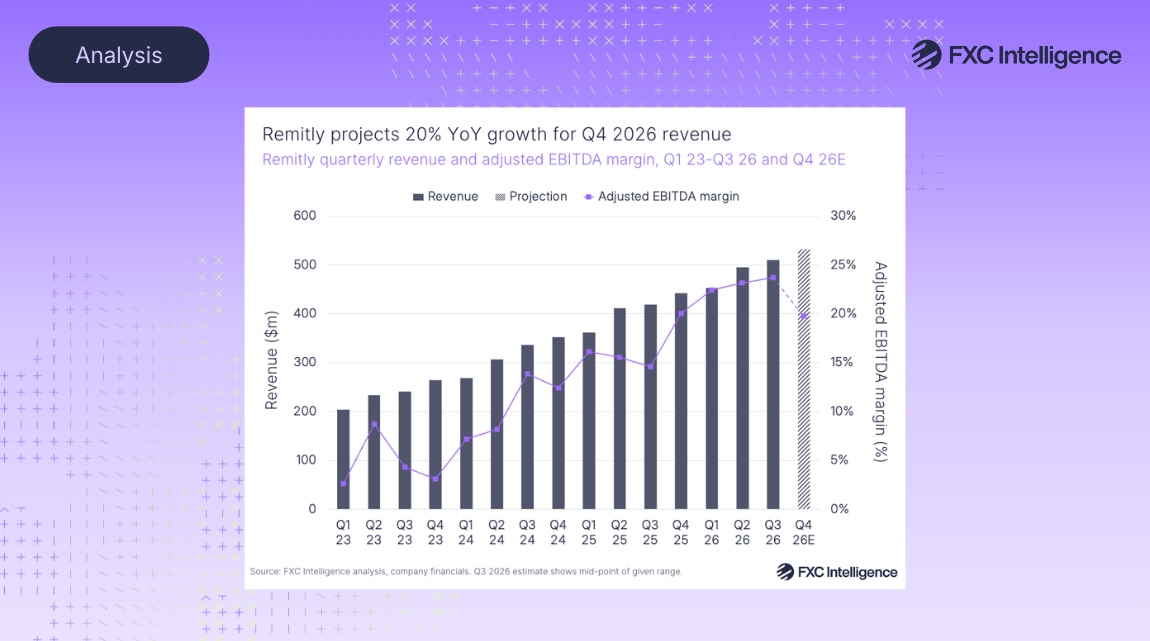
Remitly grew revenue by 22% YoY to $510m in Q3 2026, beating its estimate for the quarter as it continues to diversify its offering and increasingly focus on larger money transfers.
The digital money transfer provider saw a 17% increase in active customers to 10.3 million, with other key revenue drivers including strength from existing customers, increased send volume from high-amount senders and its continued shift in mix towards digital disbursements.
Remitly’s send volume grew 25% YoY in Q3 2026 and the company saw a take rate of 2.09%, down from approximately 2.15% a year earlier as Remitly’s send volume growth continues to outpace revenue growth.
Chart data
| Quarter | Revenue | Adjusted EBITDA margin |
|---|---|---|
| Q1 23 | $203.9m | 2.6% |
| Q2 23 | $234.0m | 8.7% |
| Q3 23 | $241.6m | 4.3% |
| Q4 23 | $264.8m | 3.1% |
| Q1 24 | $269.1m | 7.2% |
| Q2 24 | $306.4m | 8.2% |
| Q3 24 | $336.5m | 13.9% |
| Q4 24 | $351.9m | 12.4% |
| Q1 25 | $361.6m | 16.1% |
| Q2 25 | $411.9m | 15.5% |
| Q3 25 | $419.5m | 14.6% |
| Q4 25 | $442.2m | 20.0% |
| Q1 26 | $452.8m | 22.4% |
| Q2 26 | $495.2m | 23.2% |
| Q3 26 | $509.8m | 23.7% |
| Q4 26E (projection) | $532.0m | 19.7% |
The company also continues to drive profitable growth this year. Net income rose sevenfold to $68m YoY, while adjusted EBITDA grew by 97% to a record $121m, the fastest quarterly growth rate this year, giving a margin of 24%, up from 20% in Q4 2025. Remitly attributed EBITDA growth to higher-than expected revenue, lower-than expected transaction losses and higher-than-expected AI-related operational efficiency.
Transaction margin dollars (revenue less transaction expenses) grew by 27% YoY to $347m, giving the company its highest ever transaction margin of 68%, up 312 bps compared to last year. Alongside customer growth and lower transaction losses, Remitly’s improved partner economics and scale benefits are helping it grow, even as its transaction expenses rose by 11% to $162m.
Chart data
| Quarter | Send volume | Active customers |
|---|---|---|
| Q1 22 | $6.1bn | 3.0m |
| Q2 22 | $7.0bn | 3.4m |
| Q3 22 | $7.5bn | 3.8m |
| Q4 22 | $8.1bn | 4.2m |
| Q1 23 | $8.5bn | 4.6m |
| Q2 23 | $9.6bn | 5.0m |
| Q3 23 | $10.2bn | 5.4m |
| Q4 23 | $11.1bn | 5.9m |
| Q1 24 | $11.5bn | 6.2m |
| Q2 24 | $13.2bn | 6.9m |
| Q3 24 | $14.5bn | 7.3m |
| Q4 24 | $15.4bn | 7.8m |
| Q1 25 | $16.2bn | 8.0m |
| Q2 25 | $18.5bn | 8.5m |
| Q3 25 | $19.5bn | 8.9m |
| Q4 25 | $20.8bn | 9.3m |
| Q1 26 | $22.1bn | 9.6m |
| Q2 26 | $23.5bn | 10.2m |
| Q3 26 | $24.4bn | 10.3m |
AI is also helping Remitly to ship updates and new products faster with the same headcount, analyse transaction pricing, and speed up marketing initiatives. The company has actually reduced its AI token costs by 55% in Q3 versus the previous year.
Remitly’s growth beyond remittances is paying off
Remitly is driven by its core growth stream of remittances but also its growing business payments and card segments. The company’s ‘growth accelerators’ – including high-value senders, Remitly Business, receivers and its Global Card services – comprise around 5% of revenue in 2026, with the company expecting these to exceed 10% of total revenue by 2028.
Consumers range from everyday senders moving less than $300 per transfer to customers sending up to $300,000 in a single transaction. However, the company is broadening its relationship with receivers through a request money feature on its Remitly app, as well as a send with text feature.
Where Remitly is really branching out is serving larger transfers, which is reflected by its volume continuing to grow faster than active customers in Q3 2026. Based on Remitly’s figures, average send volume per active customer rose by 8% in Q3 2026 to $2.4k, while average revenue per active customer was $49.50, up 5%.
Chart data
| Quarter | Average send volume per active customer ($k) | YoY growth |
|---|---|---|
| Q1 22 | $2.01k | 0.2% |
| Q2 22 | $2.06k | -0.8% |
| Q3 22 | $1.97k | -2.8% |
| Q4 22 | $1.93k | -8.8% |
| Q1 23 | $1.85k | -7.8% |
| Q2 23 | $1.92k | -6.7% |
| Q3 23 | $1.89k | -4.3% |
| Q4 23 | $1.88k | -2.5% |
| Q1 24 | $1.85k | 0.4% |
| Q2 24 | $1.91k | -0.4% |
| Q3 24 | $1.99k | 5.2% |
| Q4 24 | $1.97k | 4.9% |
| Q1 25 | $2.02k | 9.2% |
| Q2 25 | $2.18k | 13.8% |
| Q3 25 | $2.19k | 10.3% |
| Q4 25 | $2.24k | 13.3% |
| Q1 26 | $2.30k | 13.7% |
| Q2 26 | $2.30k | 5.9% |
| Q3 26 | $2.37k | 8.1% |
Remitly said that large transfer volume has increased more than 50% over the last 12 months as the company has raised its send limits, and the company also launched FX protection and guaranteed instant bank transfers for customers sending more than $5,000 at a time. Large transfer volumes grew 25% YoY in Q3 2026, but excluding India (which was affected by new foreign currency policies this year), volumes would have grown 80% in Q3, with the UAE being a strong driver.
On business payments, Remitly has grown its B2B payments offering to 26 countries and has more than 30,000 business users. It is allowing other companies to plug into its network to move money through a separate platform offering, with Etsy signing on as a first partner in Q3. As well as just sending money, Remitly sees an opportunity to serve more financial needs with customers – spanning domestic payments, holding balances and paying international teams and contractors – and it plans to expand into payroll in 2027.
Remitly also gave an update on Remitly Global Card, its card offering allowing users to send and spend money through the same account. The company has expanded the card’s availability across the US, where it allows users to send and request domestically, and has added new features to its membership plan surrounding it. The goal is to bring the card to more customers, with Remitly saying it sees the card as a “meaningful standalone revenue driver”.
New market opportunities and policy impacts
Remitly continues to see revenue diversifying across geographies, with send revenue in the US growing by 25% YoY while Rest of World revenue grew 23% YoY, accelerating from the previous quarter. In the UAE, the company noted 150% growth in revenue. Meanwhile on the receive side, revenue from transactions to regions outside of India, the Philippines and Mexico grew faster than overall revenue growth, comprising half of Remitly’s revenue mix.
Remitly also talked about the impact of the US’s 1% tax on cash remittances, which was introduced at the start of the year. CFO Vikas Mehta said during the earnings call that the tax had influenced customer acquisition significantly for the company in H1 2026. He added this would lead to tougher comparisons in 2027, where the company is expecting revenue growth to be in the high teens range, though formal guidance will be shaped by the company’s results in Q4 2026.
Chart data
| Year | Revenue | Adjusted EBITDA margin |
|---|---|---|
| 2020 | $0.26bn | -7.7% |
| 2021 | $0.46bn | -2.3% |
| 2022 | $0.65bn | -2.1% |
| 2023 | $0.94bn | 4.7% |
| 2024 | $1.26bn | 10.7% |
| 2025 | $1.64bn | 16.6% |
| 2026E (estimate) | $1.99bn | 22.2% |
Going into Q4 2026, the company expects similar revenue growth of 20-21% YoY to $531m-533m, with an adjusted EBITDA margin around 20%. This raises its full-year expectation to be around $1.99bn, up 22%, with an adjusted EBITDA margin of 22%, higher than 17% last year.
Where Remitly stands on stablecoins
Remitly was a founding member of the consortium that launched shared stablecoin Open USD earlier this year, and has also launched some of its own stablecoin-related offerings, including a wallet and card for recipients in select Latin American countries.
The company said that stablecoins are expected to strengthen Remitly’s network, allowing them to use USDC to help settle prefunding for transfers faster. However, CEO Sebastian Gunningham said that stablecoins were an “opportunity we’re building on early, not a threat we’re reacting to”, with the digital assets still accounting for a low percentage of consumer cross-border payments.
The company sees stablecoins as solving the movement of value between treasuries, but its argument is that Remitly remains crucial for solving the challenge of taking in local currencies and delivering the last mile of payments. This feeds into Remitly’s wider diversification narrative, in which it has created a wide-reaching network with growing customers and is now seeking to tap into more financial avenues, while at the same time building out its business segment.