
Airtel Money, one of Africa’s largest mobile money operators has announced its intention to IPO in London. In this report, we analyse the company’s latest earnings and key figures, which give insights into the opportunities being seen by African mobile money players.
As mobile adoption and digitalisation continues to grow in African markets, the money being stored, sent and received is often in a mobile wallet. This has been the driving force behind Airtel Money, a digital wallet and mobile finances brand established over a decade ago by British telecoms provider Airtel Africa, which last week announced its intention to float on the London Stock Exchange.
Operating across 13 markets, Airtel Money provides users with a phone-based wallet that allows customers to store, send and spend money without needing a bank account. Users are able to deposit and withdraw cash in wallets through a network of more than 2.3 million agents and across 43,00 retail touchpoints, such as branches, kiosks and shops.
Through this, Airtel Money has monetised a number of payments-related services, spanning P2P transfers, airtime and data bundle top-ups, utility bill payments, merchant payments, collections and bulk payments for businesses, international money transfers and online payments. In certain markets, the company also offers a number of financial services, including loans, savings, wealth products and more.
Since being established in 2011, Airtel Money has grown to become a major mobile player in Africa, serving approximately 53 million users each month. The company saw revenue reach $1.3bn for FY 2026 (year ending in March 2026), with an EBITDA margin of approximately 50%.
The news so far amounts to an intention to float on the LSE, but the listing is not yet fully confirmed. The company expects to publish a prospectus in early October, with a final share expected in mid-October. Having said this, Reuters reported that Airtel could seek to raise at least $800m from investors with a target valuation of $8bn-$9bn, making this one of London’s biggest IPOs in recent years.
This comes amid other IPO developments in the cross-border payments space. In May 2026, Wise moved its primary listing to the US Nasdaq, retaining a secondary listing in the UK, while in September Revolut’s CEO said that it was exploring a dual stock market listing in New York and London.
Alongside Airtel’s intention to float, the company published additional information about its earnings and strategy, including insights about the role of cross-border payments in its mix. Below, we’ve explored Airtel Money’s positioning in the industry and next opportunities, as well as what these say about the wider cross-border payments landscape in Africa.
Airtel Money’s evolution and global coverage
Airtel Money’s growth over time has belied an underlying trend in Africa, in which telco providers – in this case Airtel Africa – have established mobile money brands to help fill gaps in financial inclusion across the continent.
The company was launched in September 2011 within Airtel Africa, which itself is majority-owned by Indian conglomerate Bharti Enterprises and is a provider of telecoms services across 14 countries.
Initially, the focus for the company was to use Airtel Africa’s reach in the region to focus on enabling everyday financial transactions, including wallet services, P2P transfer, bill payments, merchant payments and airtime recharges.
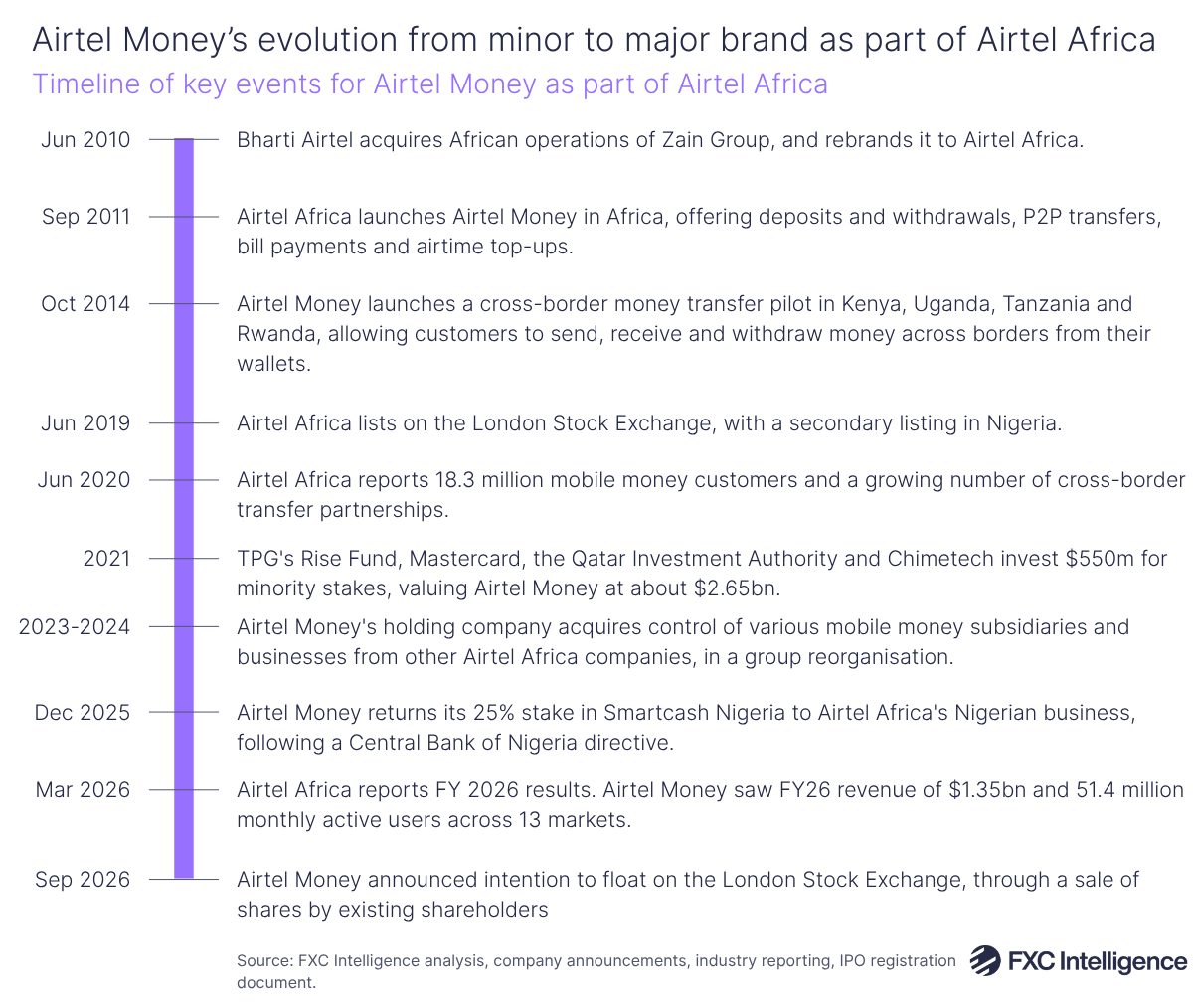
Airtel Africa owns 77.85% of the company’s operations through a holding company (Bharti Airtel International (Netherlands)), and in 2019 was itself listed on the London Stock Exchange with a secondary listing in Nigeria.
In 2021, Airtel Money also received backing from minority investors, including Mastercard, the Qatar Investment Authority and investment firms TPG and Chimetech. During its financial year for 2024, Airtel Money also acquired control of various mobile money businesses from other subsidiaries of Airtel Africa.
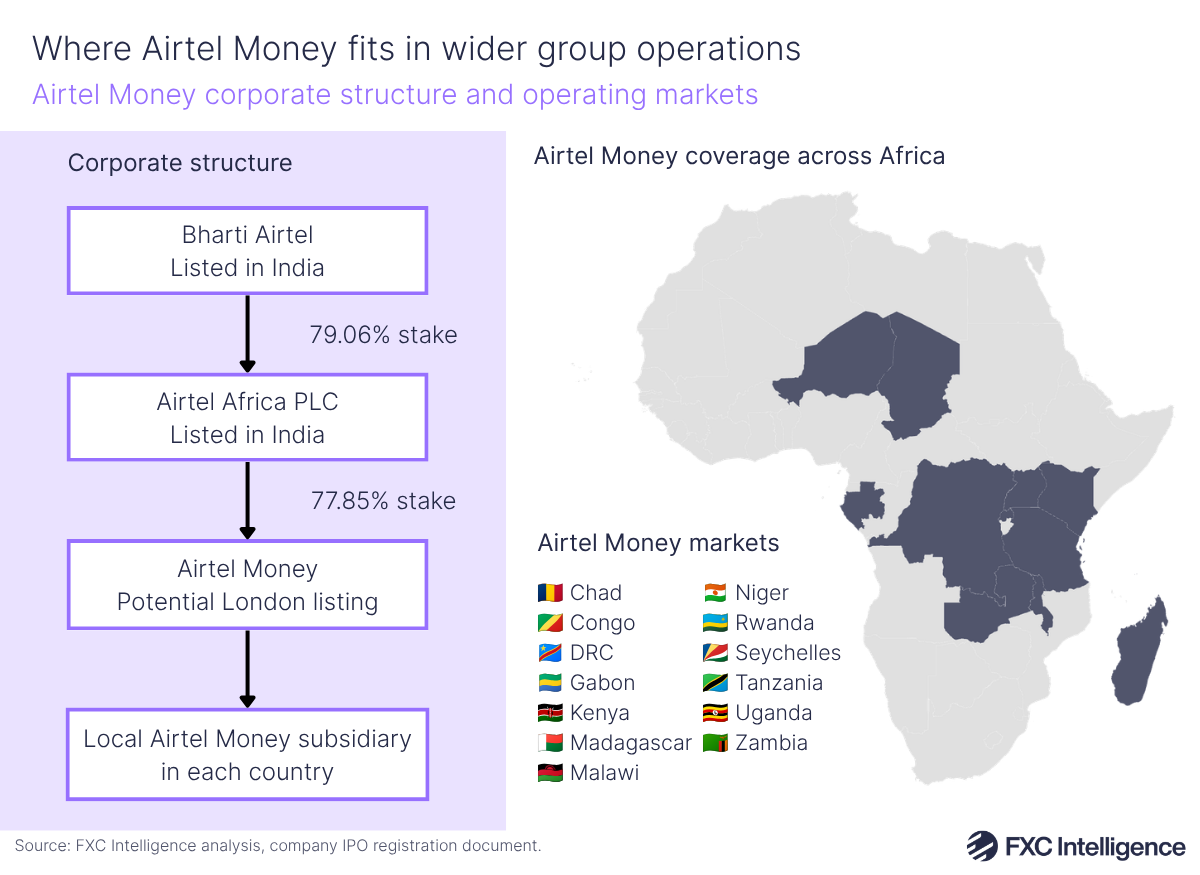
Airtel Money categorises its operations across two regions: East Africa, including Kenya, Malawi, Rwanda, Tanzania, Uganda and Zambia; and Francophone Africa, including Chad, the Republic of the Congo, the Democratic Republic of the Congo, Gabon, Madagascar, Niger and the Seychelles.
As it has evolved, Airtel Money has seen significant changes to its structure, including a growing number of cross-border partnerships and coverage across different regions. It initially launched a cross-border payments pilot in Kenya, Uganda, Tanzania and Rwanda in 2014, and has since partnered with a number of companies that enable these services. This includes global payment networks, including Mastercard and Network International, as well as money transfer providers such MoneyGram and Remitly and infrastructure providers including Thunes, Onafriq and TerraPay.
Airtel Money’s growth within Airtel Africa
Based on figures provided in a registration document, Airtel Money saw revenue grow 36% to $1.3bn in FY 2025, driving an EBITDA margin of 50%.
The figures provided exclude revenue from Nigeria, which have previously been reported as part of Airtel Africa’s mobile money revenue. This appears to be linked to the company transferring a 25% shareholding in digital payments bank Smartcash Nigeria back to Airtel Africa’s Nigerian mobile network operator, Airtel Networks Limited, which is a separate subsidiary. However, the company has said that it was exploring options to reintegrate Smartcash Nigeria in the future.
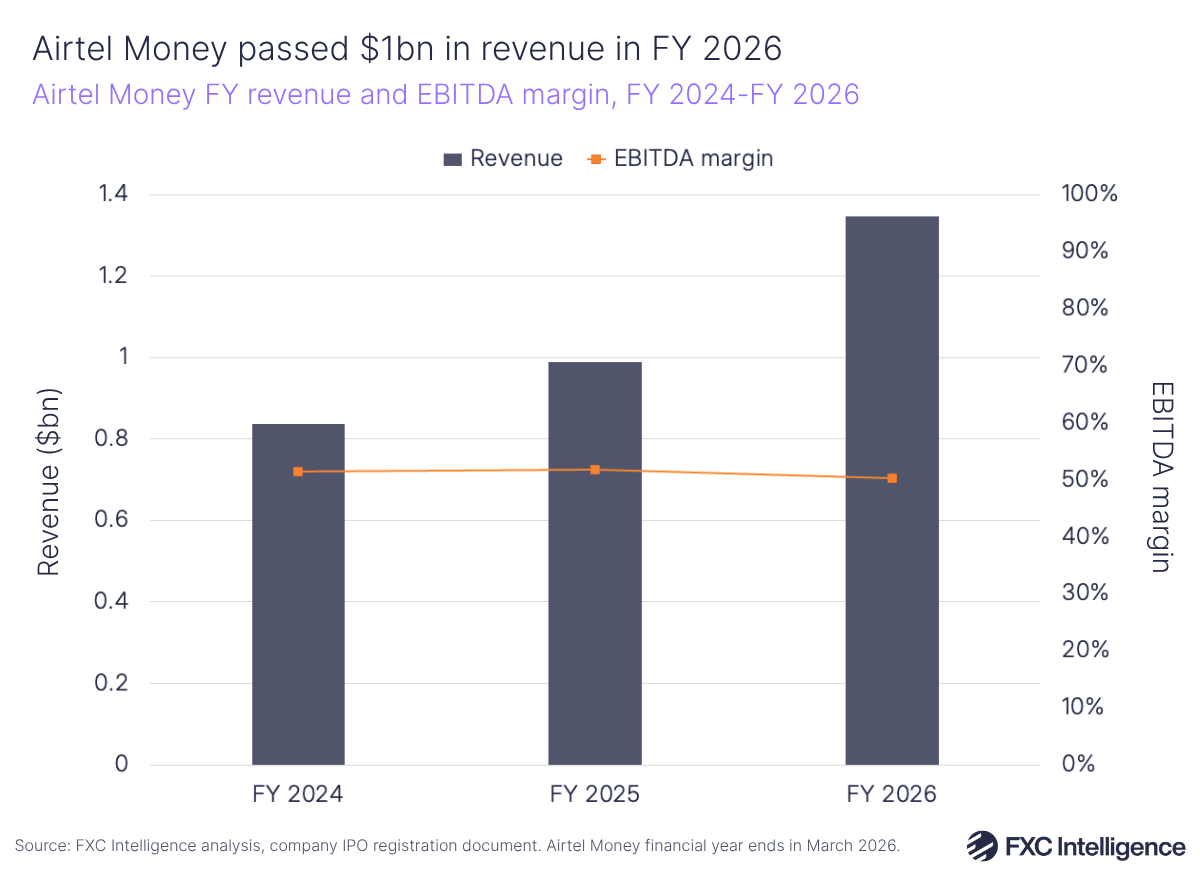
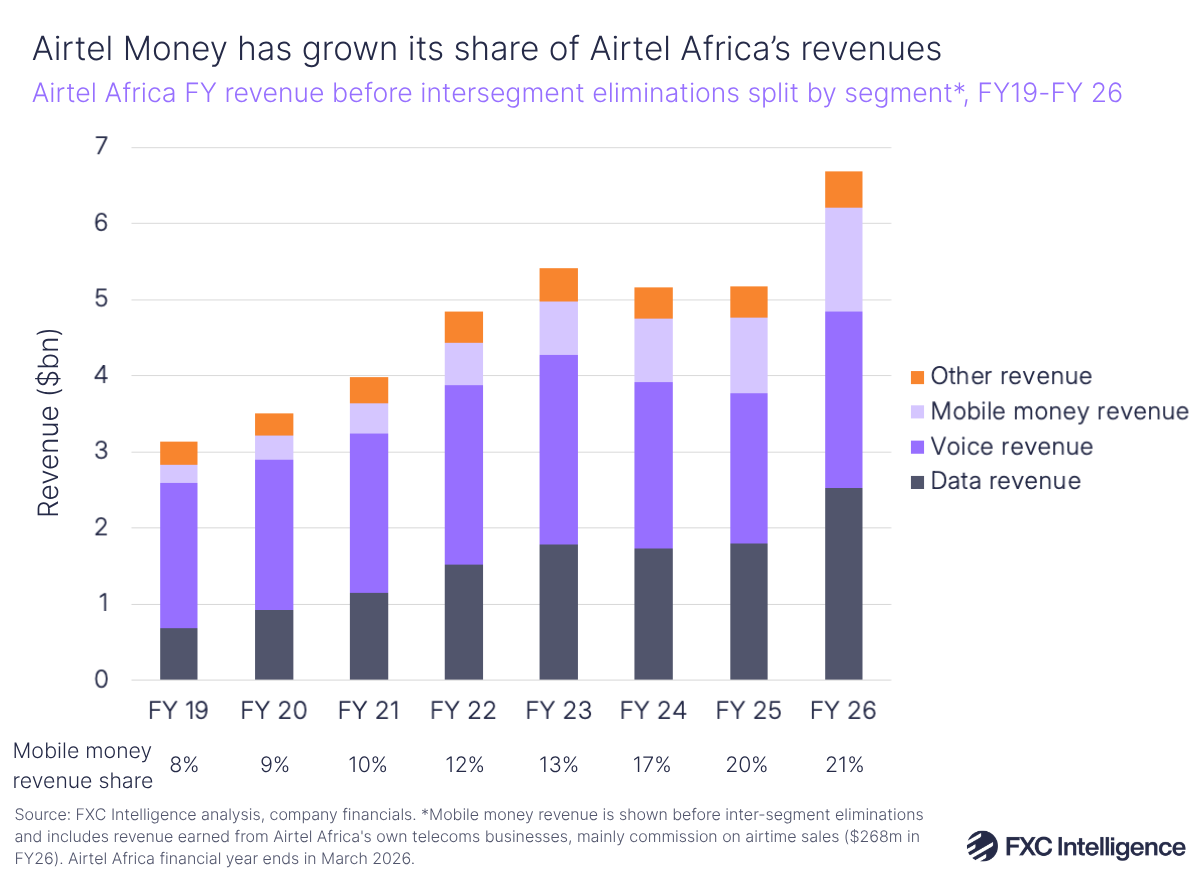
The rise in revenue continues a shift that has been seen in Airtel Africa’s wider business, in which mobile money services have a growing share among the business’ other mobile services, including voice revenue (earned from phone calls) and revenue generated from mobile data usage.
Based on Airtel Africa’s reported revenue results across 14 markets (including Nigeria), mobile money accounted for 21% of Airtel Africa’s total revenue, versus a 36% share for voice revenue and a 39% share for data revenue. However, mobile money was the second-fastest growing segment that year, behind data revenue rising 40%.
Consistent growth over time has meant that mobile money revenue has moved from accounting for an 8% share of Airtel Africa’s revenue in FY 2020 to a 21% share in FY 2026.
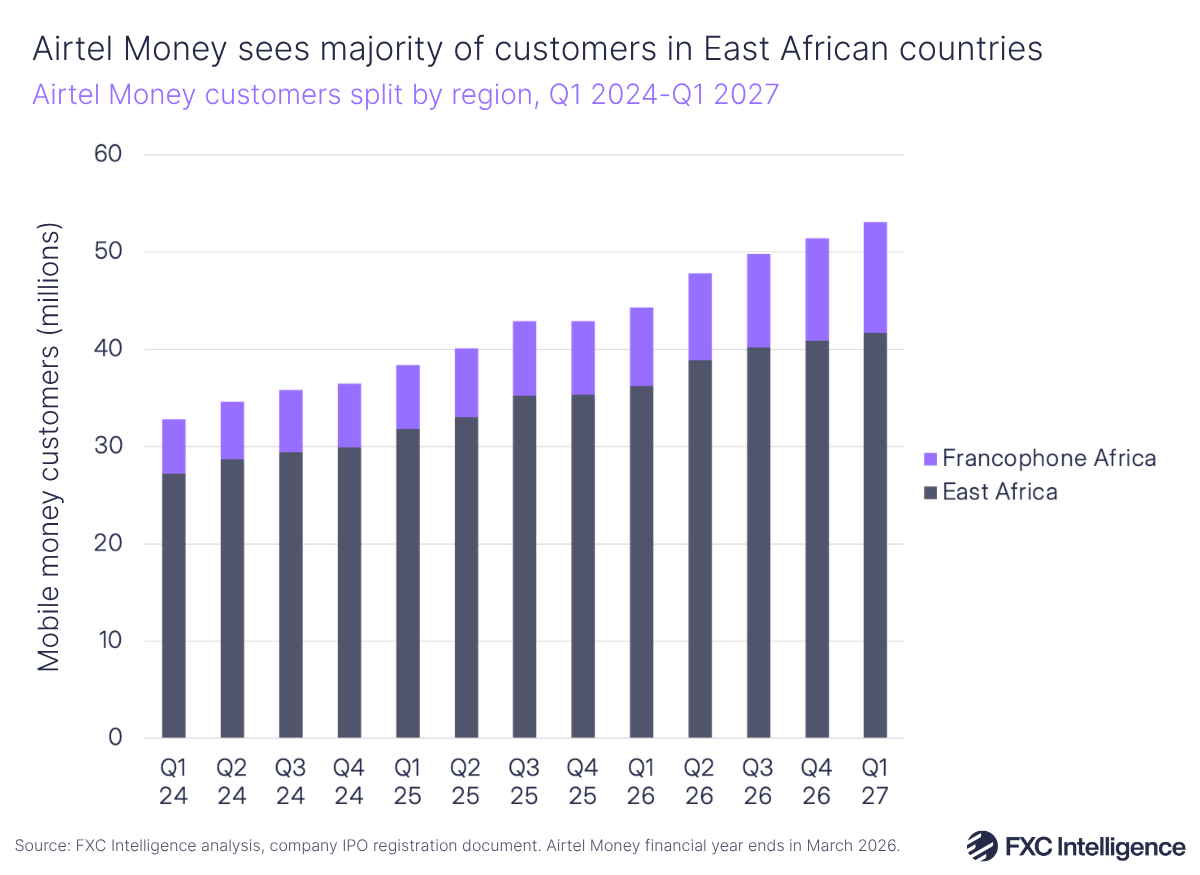
Driving growth in transactions and use of the mobile money platform, Airtel Money has seen a rising number of customers over time. Customers rose by 20% in FY 2026 to 51.4 million, with this growing again to 53 million by June 2026.
The majority of Airtel Money’s customers are based in East African countries, with the number of customers rising 16% to 40.9 million in FY 2026, though the number of customers in Francophone Africa rose by 38% to 10.5 million. Airtel has achieved a much higher penetration of its telco customers in East Africa at 48.5% in FY 2026, versus 25.6% in Francophone Africa.
One of the biggest factors contributing to Airtel Money’s customer growth has been Airtel Africa converting its own millions of telecoms subscribers into Airtel Money customers. Across the 13 markets Airtel Money is targeting, Airtel Africa has a customer base of 128.9 million telco subscribers as of June 2026. 41% of these have been converted into Airtel Money customers, up from 20% in FY 2018. However, it aims to expand this figure to over 70% in the future, which it has already achieved in its top three markets.
How does cross-border payments fit into Airtel Money?
Airtel Money’s revenues are split across four different segments: payments and transfers, wallet services, financial services and other retention revenue, which includes remuneration payments from Airtel Africa to reflect the fact that telecoms customers with an Airtel Money wallet stay on its network for longer.
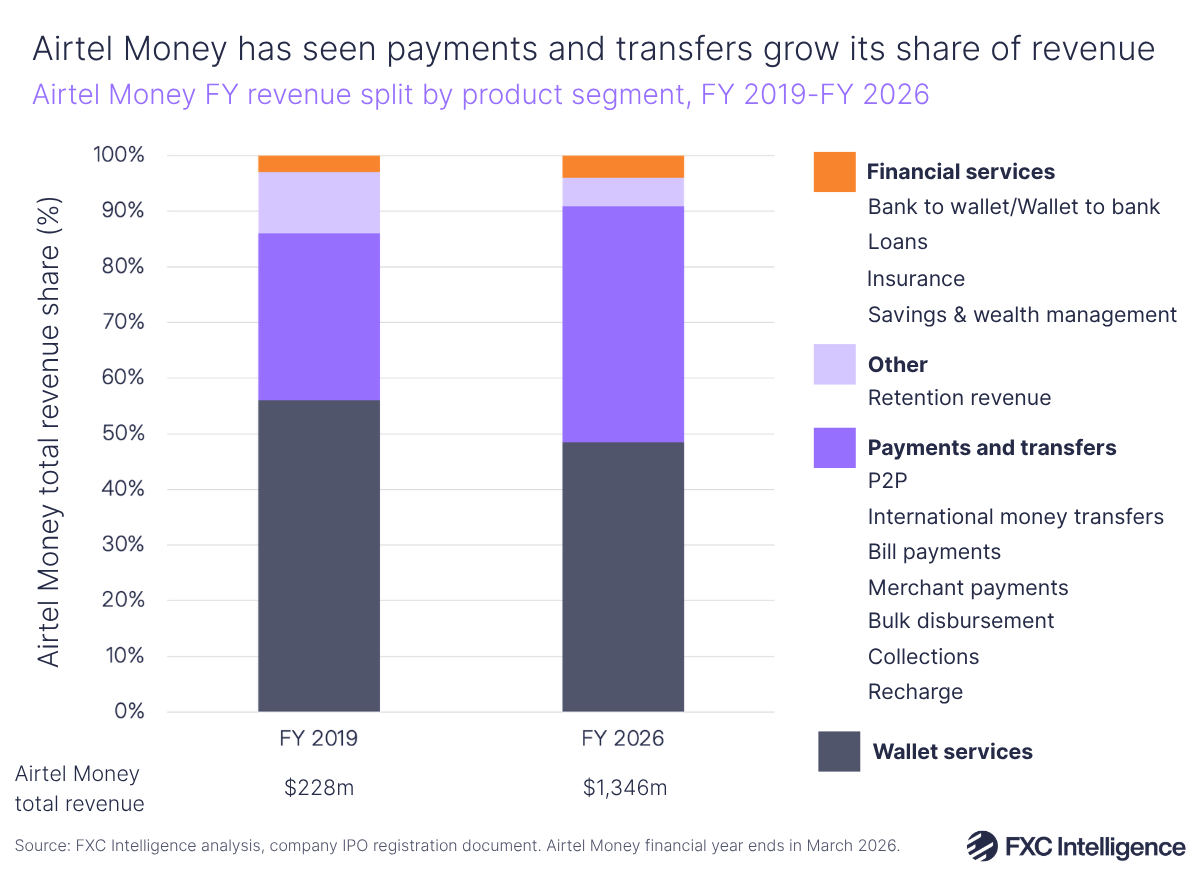
The payments and transfers segment spans a number of services, including P2P (domestic) and international money transfers, bill payments, merchant payments, bulk disbursement, collections and recharge (where customers buy airtime or bundles directly from their wallet). Wallet services, meanwhile, covers the revenues the company gains from cash-out withdrawals, primarily from percentage-based or fixed transactions fees paid when a subscriber makes a money withdrawal from one of the company’s agents.
The company’s financial services segment includes offerings such as bank to wallet/wallet to bank transfers, loans, insurance and savings and wealth management.
The payments and transfers segment has seen the most significant upwards shift across the business since 2019, accounting for 42% of overall revenue in FY 2026 versus 30% in 2019. In earnings calls, Airtel Africa has attributed this to the company continuing to innovate and introduce new products.
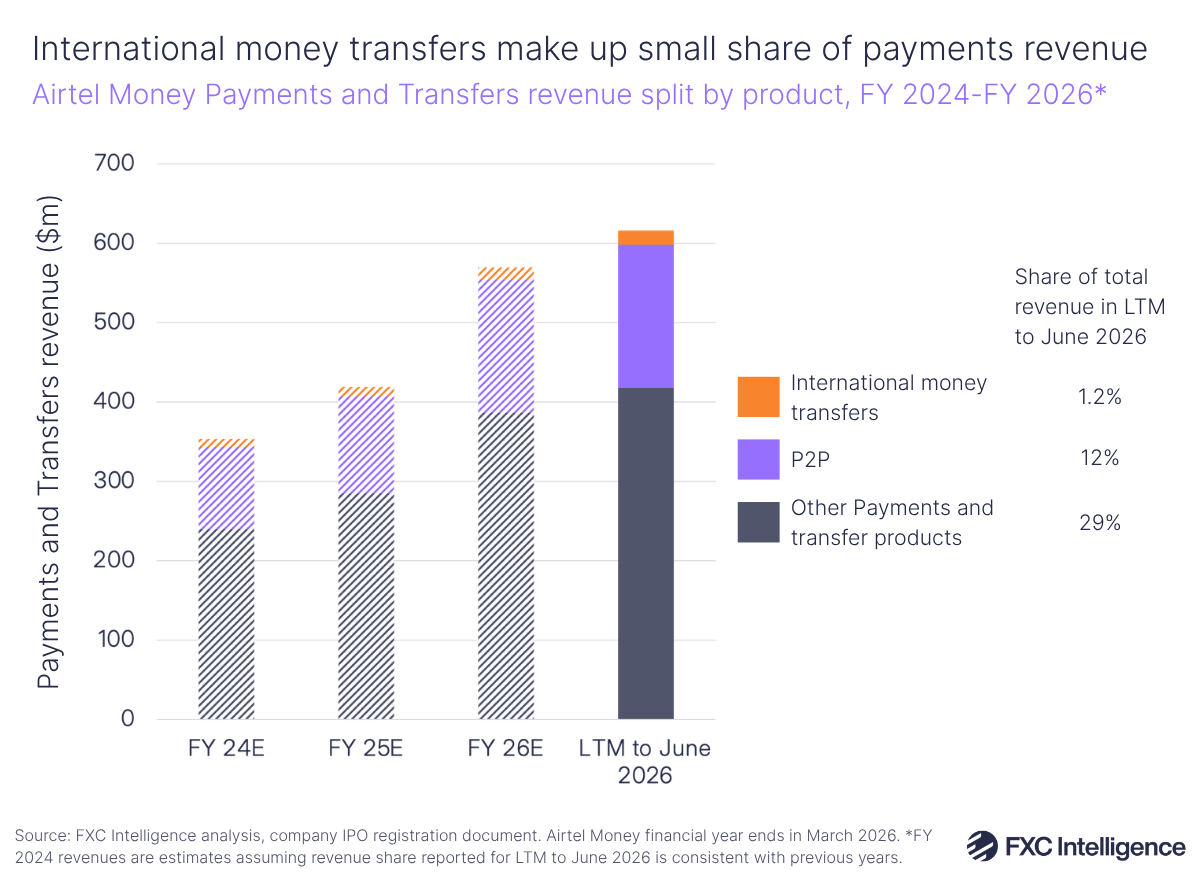
Breaking down Airtel Money’s payments and transfers revenue further, international money transfers currently make up the smallest portion of Airtel Money’s overall revenue, accounting for 1.2% of revenue for the 12 months up to June 2026. Airtel Money receives either a percentage-based or fixed transaction fee from senders, as well as a share of foreign exchange markup that comes from money transfer partners.
Other products within the payments and transfers segment make up a much larger portion of Airtel Money’s revenue. In particular, domestic P2P transfers, which includes transfers to other Airtel Money subscribers or non-Airtel mobile money wallets through the recipient’s mobile number, has a much bigger revenue share at 12%, with this also coming from transaction fees.
Bill and merchant payments, which the company combines together in its financials, accounted for 14% of revenue in the 12 months up to June 2026, recharge fees accounted for 12% and bulk disbursements and collections accounted for 2%.
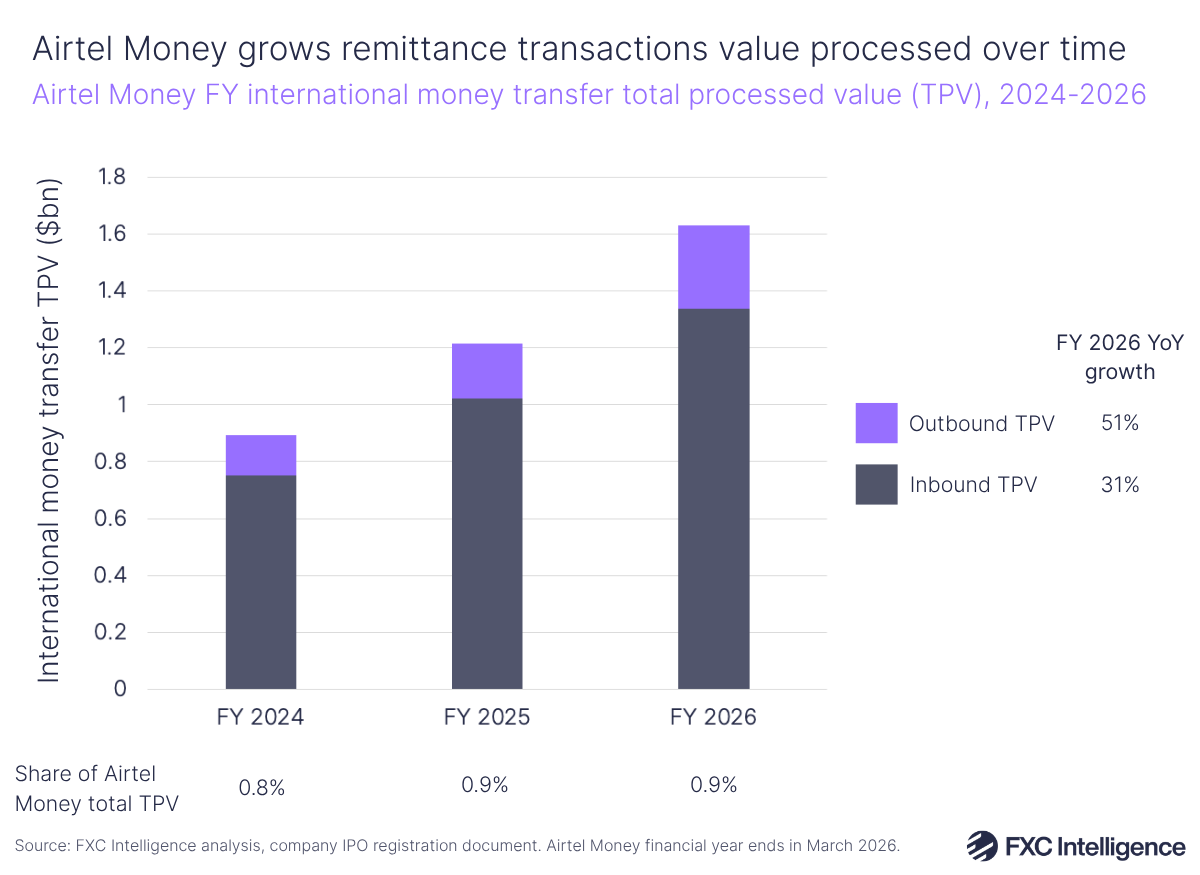
The total processed value (TPV) through international money transfers also accounts for a low share of Airtel Money’s total TPV, though it has seen strong growth over time. In FY 2026, Airtel Money’s international money transfers TPV grew by 34% to $1.6bn, accounting for 0.8% of Airtel Money’s total TPV.
Within international transfers’ TPV, there is a clear split between the amount of inbound and outbound transaction value. Inbound transactions represented 82% of international money transfers TPV in FY 2026, though this share has declined slightly from 84% the preceding year. This was due to a faster increase in outbound TPV growth, at 51% YoY vs 31% for inbound TPV, as calculated from the IPO registration document figures.
The numbers show that cross-border is a small part of Airtel Money’s mostly domestic business and that while cross-border volumes are growing strongly, they aren’t growing faster than its wider platform. Airtel Money is primarily a receiving infrastructure, and with a significant portion of its international money transfers being inbound, the company’s main role in the cross-border chain is last-mile infrastructure.
That being said, the growth in outbound volume suggests that customers are increasingly sending money abroad through Airtel Money. There is a difference in the fee structures from sending compared to receiving. For senders, Airtel Money receives a fixed or percentage based fee, in addition to a revenue share on foreign exchange markup that comes from money transfer providers or international money transfer ‘aggregators’ (i.e. money transfer comparison platforms). However, for receiving transfers, the group notes that it just earns the fixed transaction fee from the money transfer provider or aggregator. Though the exact breakdown of these fees has not been provided, this implies that there is an additional revenue stream for money being sent through the platform as opposed to being received for it.
Airtel also notes that in one of its operating companies (which it doesn’t name), it has seen a CAGR of 119% in international money transfers inbound TPV from FY 2020 to the 12 months ending 30 June 2026. It says this was driven by integrations with partners, its trusted wallet infrastructure and “the convenience of instant settlement directly into a mobile wallet”.
Also in its registration document, the company has noted international money transfers as being a “high-margin” product, which is helping create new revenue streams while boosting its ecosystem liquidity – this speaks to Airtel Money seeing the value of cross-border transfers bringing money into its system that could then be used to interact with its various products, whether this is a domestic P2P transfer, merchant payments, bill payments or something else.
Airtel Money says that it sees a number of new growth opportunities, including expanding into new routes through partnerships, integrating with payments companies such as Zepz, PayPal, Alipay and UPI. These are large global payment networks, though Alipay and UPI have a distinct Asia focus, on China and India respectively, pointing to an additional push towards targeting Asia-Africa corridors.
Another opportunity the company mentions is scaling international bank-to-wallet and wallet-to-bank transfers, which could significantly widen the range of senders and recipients beyond other wallets.
How does Airtel Money compare with other players?
Airtel Money exists within a growing landscape of competitors that have launched mobile money offerings, including telcos, traditional banks and financial institutions, and fintechs. However, the companies’ primary competitors are telcos, with some of the most significant of these having built financial platforms that include international money transfer companies among their offerings.
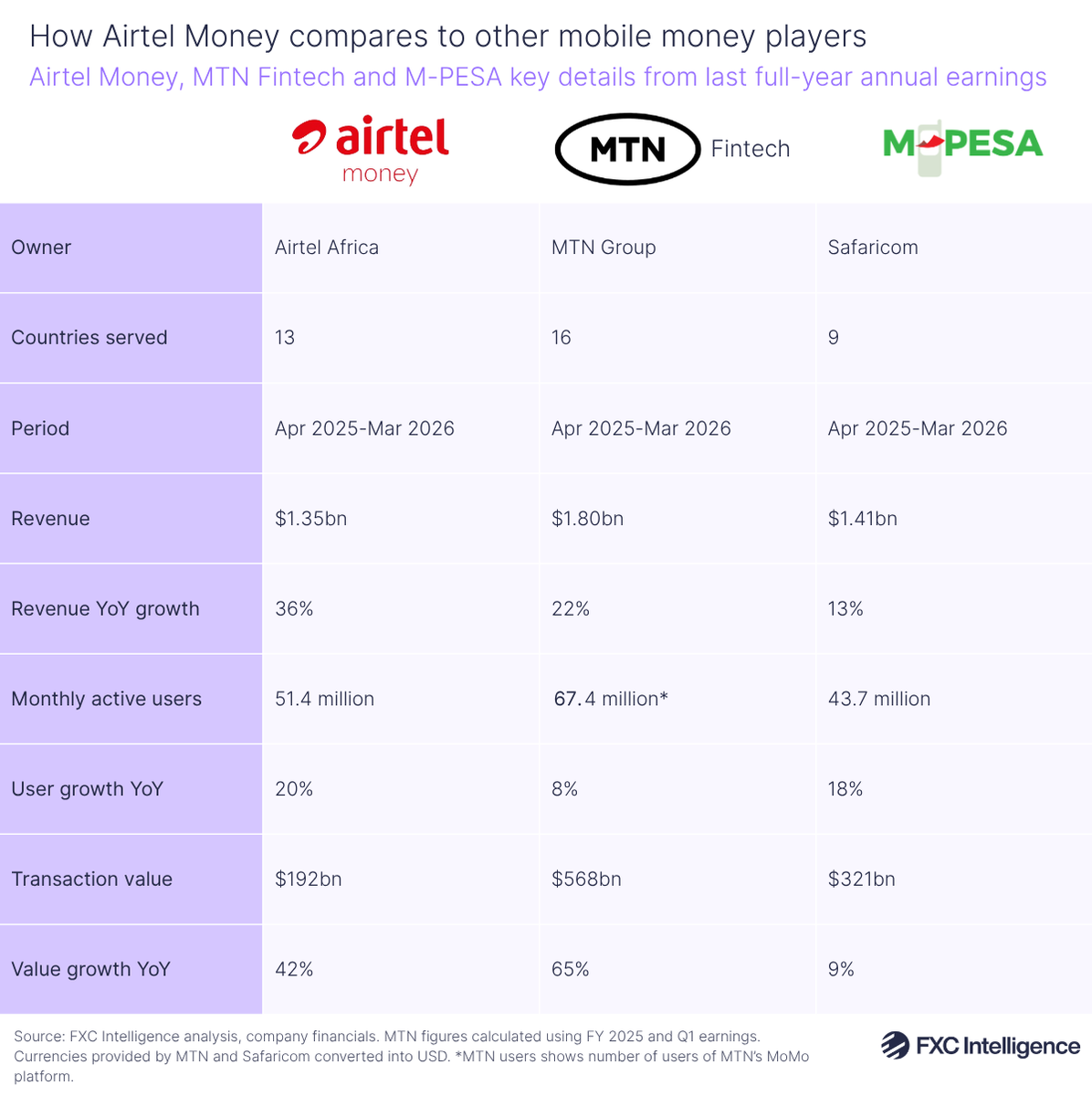
Two of the big players in the space are MTN, which has a fintech division offering similar mobile money services to Airtel Money through its flagship product MoMo, as well as M-PESA, the mobile phone-based payments service launched by Safaricom and Vodafone in Kenya. These players serve an array of different markets in Africa with some overlap, though their relative size indicates the scale of the mobile money opportunity and where Airtel Money sits in it.
Comparing the financials of these two players against Airtel Money’s FY 2026 period (spanning April 2025 to March 2026) finds that Airtel Money sat slightly behind both in terms of revenue, though was in the middle in terms of users, with 51.4 million in March 2026, versus 67.4 million for MTN’s MoMo and 43.7 million for Safaricom. However, across both of these metrics Airtel Money has seen higher growth rates over the period, with revenue rising 36% versus 22% for MTN Fintech (the division under which MoMo reports) and 13% for M-PESA, while the number of monthly active users rose by 20%, versus 8% for MTN and 18% for M-PESA.
Airtel Money has also seen solid growth in transaction value, which rose by 42.2% to $192bn, faster than M-PESA’s transaction value growth of 8.9% to KES 41.68tn ($321bn) though slower than MTN’s 65% growth to $568bn.
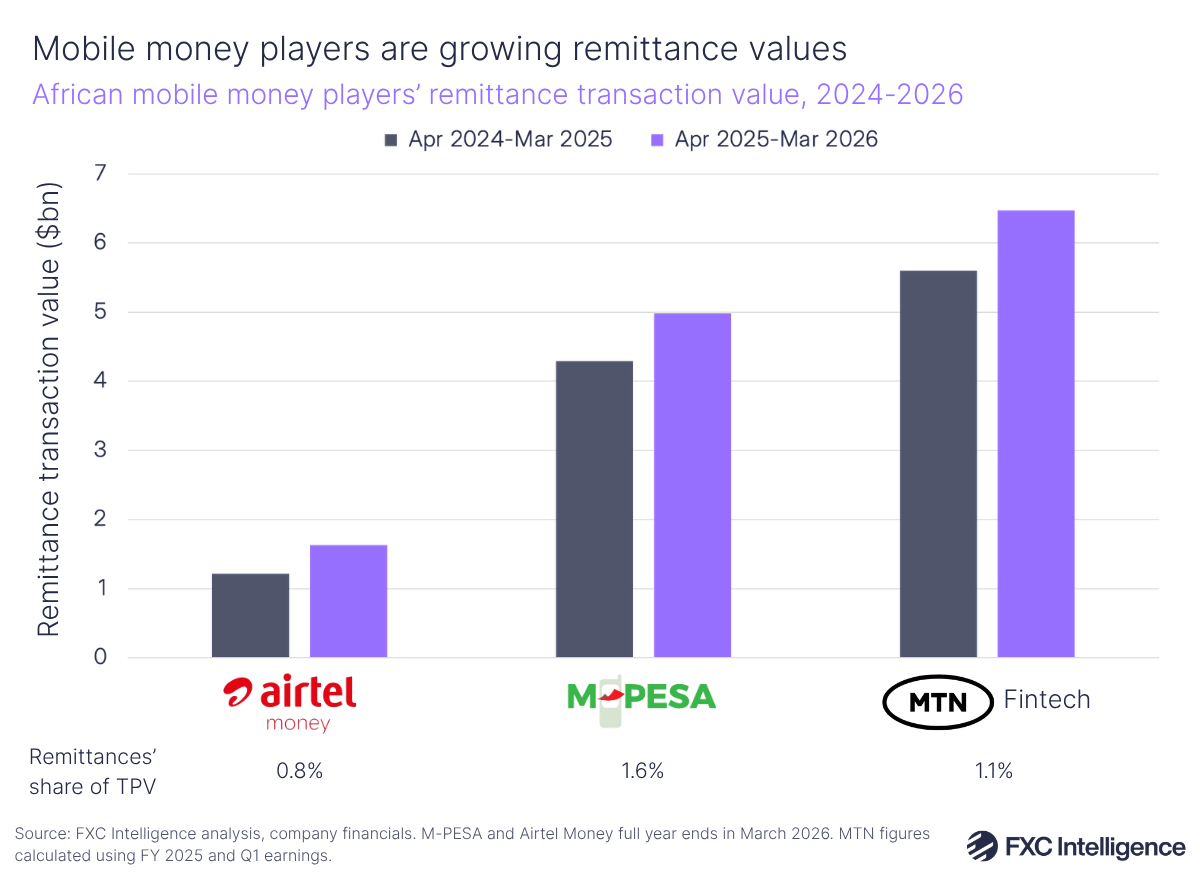
In terms of how cross-border fits into the mix, the three players see slight differences in remittances’ overall share of TPV, but remittance transaction amounts have risen over the same period from April 2025 to March 2026.
M-PESA Global is M-PESA’s service enabling registered customers to send and receive money from countries around the world, with partnerships including Western Union, MoneyGram, Ria, WorldRemit, Remitly and others. The company saw transaction values rise 16.2% to KES 647.5bn ($5bn) in the financial year ending March 2026, accounting for approximately 1.6% of its total transaction value.
Meanwhile, MTN Fintech noted that remittances rose by 21.1% to $6.1bn in its FY 2025 earnings. Calculating the period from April 2025 to March 2026, its remittance transaction value grew by approximately 15% to $6.5bn, accounting for 1.1% of its transaction value.
Against both of these players, Airtel Money saw faster remittance transaction value growth, rising 34% to $1.6bn, though this accounted for a slightly lower share of its overall value at 0.8%. With the company seeking to increasingly grow its customer base and increase its distribution network through new partnerships, this could have the additional impact of driving remittance transaction values.
While MTN does not break out revenues related to remittances, M-PESA saw an 18% rise in revenue to KES 4bn ($31m) in FY 2026, which is higher than Airtel Money’s amount reported for the last 12 months ($17.4m), though still accounts for a smaller share of its wider revenues.
In short, the competitor landscape confirms that although remittances form a small part of the overall offering for telcos, they are consistently growing as adoption grows. Alongside Airtel Money, both M-PESA and MTN continue to pursue integrations to expand their cross-border partnerships and build out into new markets. For example, in May M-PESA partnered with Thunes to enable seamless payments for customers in Uganda and China, while MTN’s fintech arm announced a strategic partnership with Ant International to rebuild and expand MoMo across Africa.
Why Airtel Money’s IPO is significant for cross-border payments
Airtel Money continues to see its biggest opportunities as being in financial inclusion, particularly focused on regions that continue to rely on cash and don’t have the infrastructure to conduct financial transactions. The company has a specific focus on Sub-Saharan Africa, which remains a key area for remittances.
In particular, Airtel Money wants to drive adoption among more than 75 million Airtel telecoms subscribers who don’t yet use mobile money, as well as drive the use of its app, which it says generates five times the average revenue per user than feature-phone customers.
The company claims this will continue to grow as demand for mobile finance solutions grows. Airtel Money says that according to GSMA data, smartphone penetration was roughly 51% in Sub-Saharan Africa in 2023, with this projected to rise to 81% by 2030. However, across the 13 countries the group serves, only 20-25% of adults have a bank account, compared to approximately 87% in developed markets according to data from the World Bank.
For the cross-border payments industry, the growth of Airtel Money and other players in the space reflects the importance of mobile wallets as being the last mile in many payments. As telcos continue to grow their fintech segments, this reflects the growing importance of wallet operators as partners for the remittance firms and payment providers sending money into the region.