
Western Union has shared its Q1 2026 results, in which revenue remained flat, with the company citing a difficult macro environment as a major challenge.
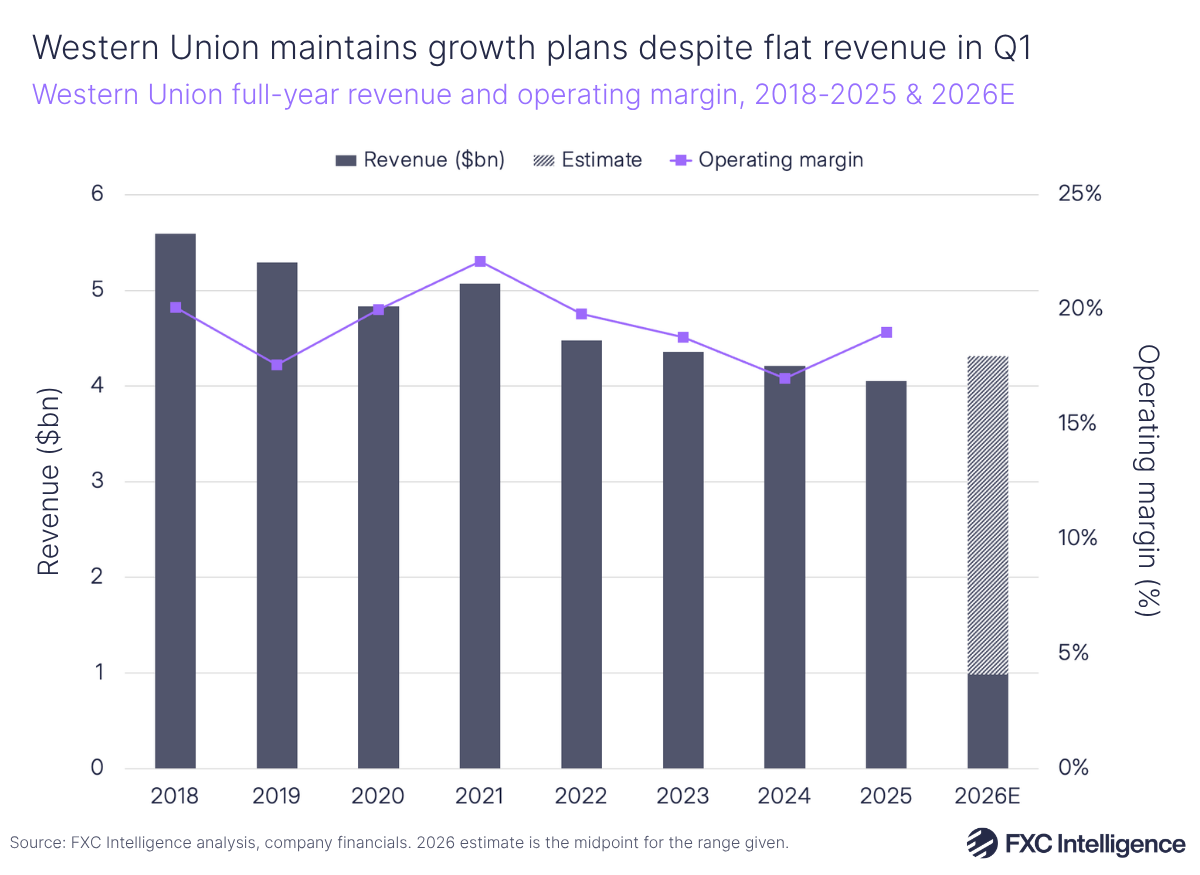
As part of Western Union’s three-year Beyond plan to drive full-year revenue growth, reaching around $5bn in 2028, the company plans for 2026 to become the first year it achieves FY revenue growth since 2021. However, revenues in Q1 2026 stayed at the same level as the previous year, indicating that the company requires a strong end to 2026 to stay on track with these plans – particularly as global economic pressures persist.
During its latest earnings call, Western Union detailed how it plans to return to growth, including accelerating its cost efficiency programme, completing its acquisition of Intermex, leveraging AI and advancing its digital asset strategy.
Here, we take a look at Western Union’s Q1 results in more detail and explore developments in the company’s major strategies and plans to drive revenue growth.
Western Union’s Q1 2026 results
Western Union’s revenue in Q1 was $982.7m, remaining largely flat YoY ($0.9m less than in the same period in 2025). This was mostly impacted by a slowdown in the company’s North America retail business, which was offset by strong growth in Consumer Services and Branded Digital.
Meanwhile, Western Union’s operating margin decreased to 13% on a GAAP basis in Q1 – a decline from 18% in Q1 2025, which the company attributed to a range of factors including foreign currency loss and seasonal dynamics associated with its travel money business. Despite this, it expects many of these factors to reverse in the coming quarters.
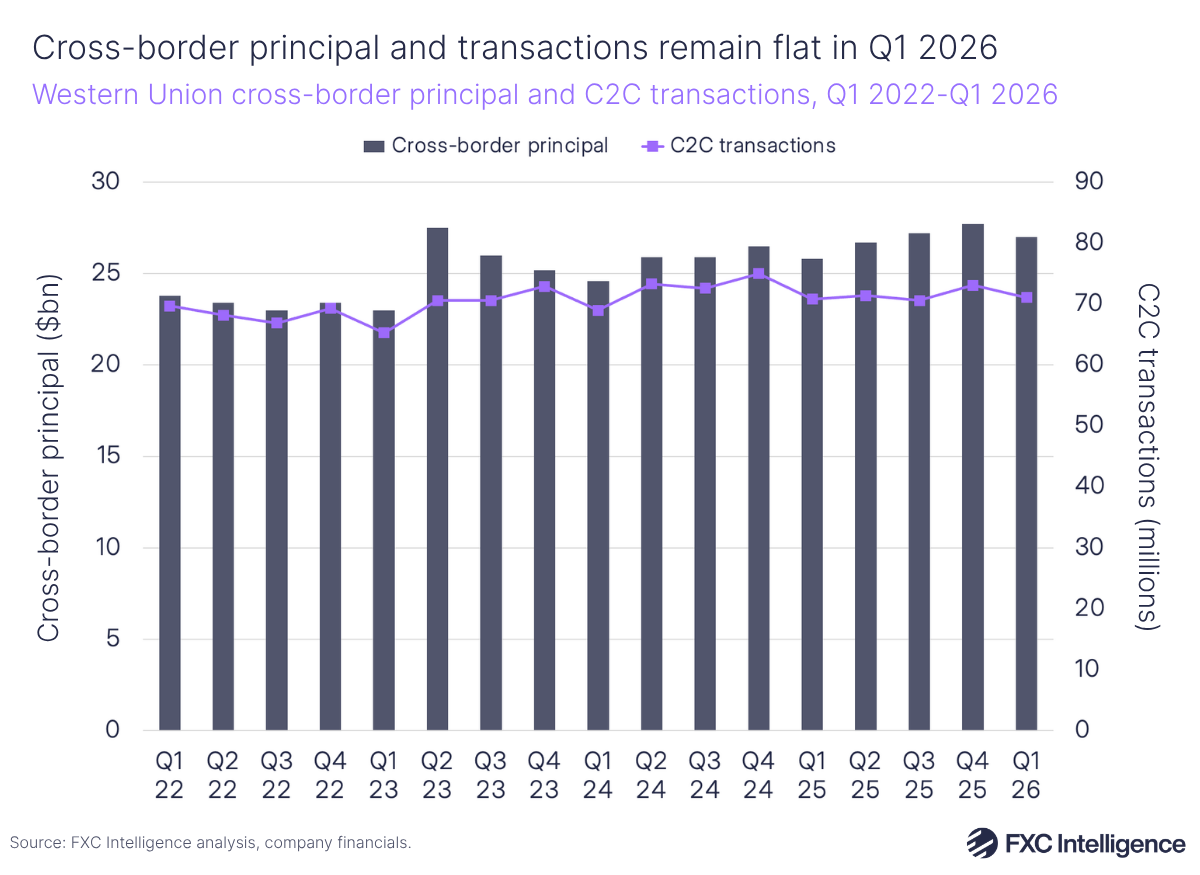
Consumer money transfer (CMT) revenue fell 3% to $845m, while Western Union saw CMT transactions increase to 71.1 million, a small rise of 30 basis points compared to Q1 25. During the earnings call, CEO Devin McGranahan explained that continuing uncertainty surrounding US immigration policy remains a headwind for its US retail business – a significant factor behind “meaningful declines to markets” including Mexico, Ecuador and Guatemala.
The company remains optimistic however, having seen adjusted quarter-on-quarter CMT revenue growth for North America of 300 basis points and 500 basis points for Latin America and the Caribbean, while McGranahan noted that corridors including US to Ecuador and Guatemala are now performing “better” than last summer – although not all corridors have improved. As a result, the share of CMT revenue from North America declined 4% YoY to 35%, while the share from the EU and CIS increased 3% and the MEASA region’s share rose 1%.
Despite challenges, Western Union’s cross-border principal – the total money sent in cross-border transactions – grew 5% to $27bn, which McGranahan said speaks to the resilience of its customer base.
Consumer Services revenue, consisting of online bill payments, travel money, insurance and prepaid cards, increased 24% YoY in Q1 to $137.3m on a GAAP basis. Western Union attributed this growth to the expansion of its Travel Money business, including its acquisition of Eurochange Limited – which completed in April 2025 – and its bill payment business generating higher revenues.
How is Western Union advancing its digital-first capabilities?
As part of its ongoing digital transformation efforts, Western Union remains focused on growing its branded digital revenues, which rose 9% YoY on a GAAP basis, while branded digital transactions grew 21%.
This comes as part of the company’s strategy to reduce reliance on revenue generated by retail remittances, while increasing the share of revenue generated by its Digital and Consumer Services segments – a plan outlined during its investor day in November 2025.
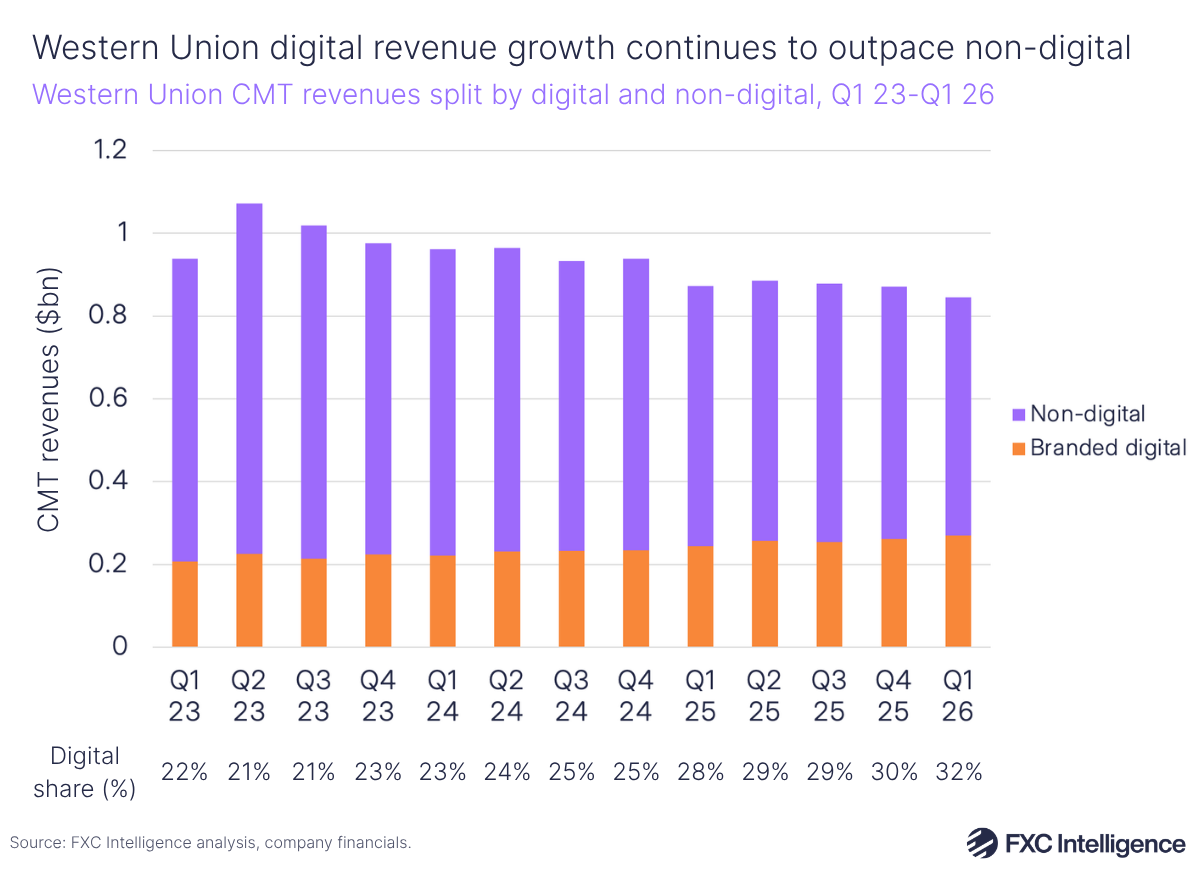
In response to the slow start to the year, Western Union is now accelerating its operational efficiency programme, which will look to improve vendor efficiency, realise gains from the imminent Intermex acquisition and leverage AI to improve efficiencies and reduce the need to increase the size of its workforce.
McGranahan explained that AI usage is already beginning to benefit Western Union, with the company integrating it into aspects of its service operations, tech development and marketing functions.
Aside from scaling investment in AI, Western Union is also modernising its platforms and digital capabilities by launching its own stablecoin pegged to the US dollar, USDPT, in May, while the company’s first partner on its Digital Asset Network should go live this week. Through this network, users will be able to off-ramp digital assets into physical local currency using Western Union’s retail network.
As the company expands its digital offerings and capabilities, McGranahan discussed the continued importance of its physical retail presence, particularly because those stores enable it to cross-sell its various digital services to consumers. “Our owned retail network in New York City had the strongest performance on our Prepaid offering as the remittance tax came in, because it’s our own employees who are helping the customer understand the value of the prepaid product with the remittance tax,” he explained.
The money transfer company is also planning to launch a USDPT stablecard later this year, which will enable consumers to hold value in the stablecoin and spend it globally.
Acquisitions bolster Western Union’s capabilities and reach
Acquisitions have also become a key part of Western Union’s growth strategy, taking opportunities to strengthen its footprint in high-value regions and expand its capabilities and services.
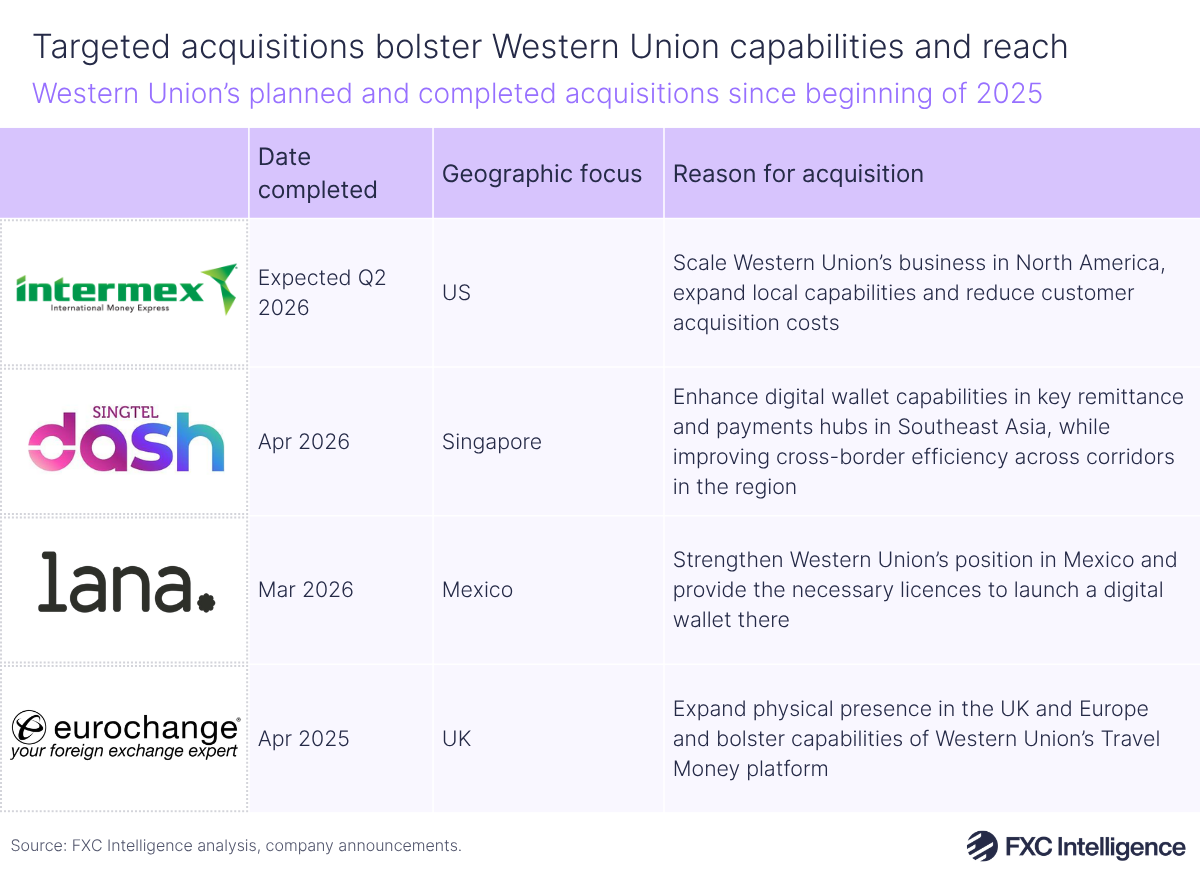
It expects to complete its acquisition of Intermex, first announced in August 2025, before the end of Q2 2026. Through this, it plans to make use of Intermex’s large agent network in the US to expand its capabilities and presence in the country.
McGranahan also discussed Western Union’s acquisition of Eurochange, the UK-based foreign exchange company, which it completed in April 2025. He explained that the move has expanded the company’s physical footprint and strengthened its ability to service outbound travellers in the UK.
Western Union’s digital wallet network has also benefited from acquisitions completed in recent months. In March, the company closed on the acquisition of South America-focused Lana, which gives it the licence required to launch its digital wallet in Mexico and strengthen its wallet-to-wallet capabilities locally.
“It will also enable us to build on the success we have seen with our receive strategy in Argentina and Brazil, where we have a meaningful portion of our inbound remittances ending up in our own digital wallets in those countries,” added McGranahan. ”This allows us not only to save on commission expense, but potentially opens up new revenue streams for the company. We believe bringing a wallet to Mexico has the potential to change the way we do business in the country by enabling our two-sided network.”
In April, Western Union also officially acquired Dash, Singtel’s digital wallet business in Singapore, in a move that enhanced its capabilities in Southeast Asia, while supporting its longer-term plan to expand its Asia-Pacific network.
Establishing a new operating model and modernising operations
Western Union is also shifting its focus to growing its market share in various parts of the world, partly through acquiring companies in these regions, while also making a change to its global operating model.
“Our strategy is focused on growing share in higher-growth markets where, for various historical reasons, we do not have our fair share of the market,” explained McGranahan. “Vietnam fits this perfectly, where it is a $15bn inbound remittance market where we have only mid-single-digit market share.”
As part of the Beyond strategy, Western Union is also beginning to establish a regionalised model, moving away from keeping all of its major strategic and operational decisions in its Denver headquarters. According to McGranahan, Western Union is currently growing its operations centre in Manila, the Philippines, which will become the primary operating centre for the APAC region.
While the company has not yet been able to ensure consistent revenue growth in recent years, efforts to modernise its operations, embrace new technologies and regionalise its operations could see it improve cost efficiency and enhance its agility across the globe. Given its position as one of the largest money transfer companies globally, this could see Western Union reassert itself globally and increase its market share in targeted regions worldwide – particularly if economic challenges surrounding the US reduce.