
Despite ongoing efforts to ensure that financial regulations are more closely aligned between US states, significant differences remain – making money transfer companies more likely to base their operations out of some than others. In a new report, we explore which states are home to the most money transfer companies and consider why significant differences exist state-to-state.
Money services businesses (MSBs) in the US are required to register with the Department of the Treasury. These include any financial businesses which offer money transmitter or currency exchange services, are check cashers or issuers and sellers of traveler’s cheques and money orders. Banks or institutions registered with the Securities and Exchange Commission (SEC) or the Commodity Futures Trading Commission (CFTC) do not have to register.
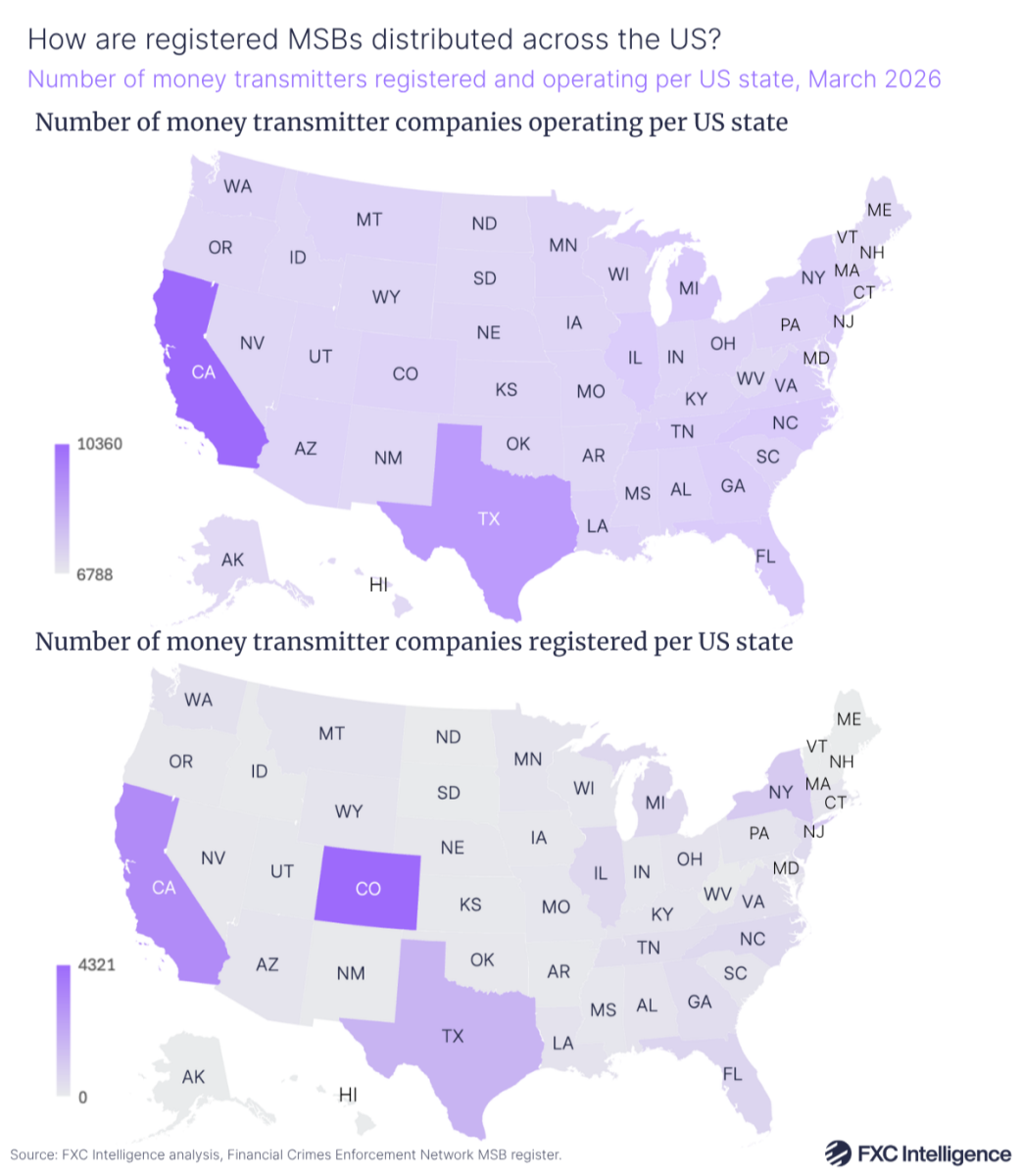
We analysed the Financial Crimes Enforcement Network (FinCEN) digital register of these MSBs, focusing specifically on businesses that offer money transmitter services, finding that while the number of these MSBs operating in each state is distributed fairly equally, the number of them registered in each is not.
In this report, we explore which US states and territories (including the District of Columbia and Puerto Rico) house the largest number of registered MSBs offering money transmitter services and consider the primary factors behind key differences between states.
Where are the most money transmitters registered and operating in the US?
After analysing the FinCEN digital register of these MSBs, we found that the number of businesses operating in each US state does not necessarily correlate with the number of them registered in each state.
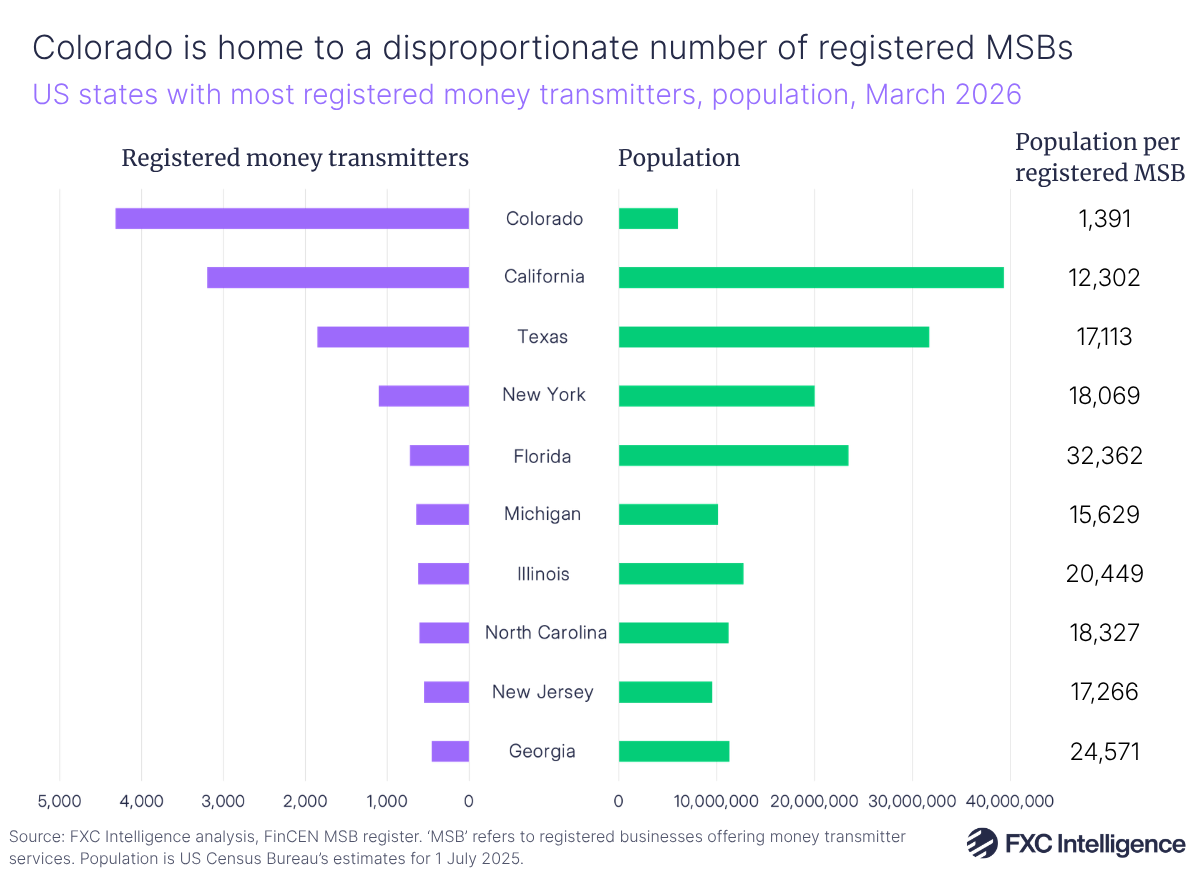
Each MSB has to register with a specific address, which is often the company’s headquarters or primary offices. As of 23 March 2026, more money transmitters are registered in Colorado (4,321) than any other state, followed by California (3,199), Texas (1,853), New York (1,107) and Florida (725).
At the other end of the spectrum, we found that there are fewer than 100 MSBs that offer money transmitter services registered in 14 US states or territories, with the fewest in Maine (9), Alaska (6), Hawaii (3) and Vermont (0).
Each of the MSBs must also detail all of the states and territories that they offer their products and services in. After analysing the FinCEN register, we found that many of those that offer money transmitter services often operate in a number of different states – with many covering all 50.
This creates a different picture compared to the number of registrations per state, with the difference in number of operating money transmitters far less pronounced between states. California (10,360), Texas (9,406), Florida (8,303) currently have the most MSBs offering money transmitter services operating in each. However, Colorado, which has more money transmitter registrations than any other state or territory, ranks 13th for the number of MSBs operating there, with 7,934. New York, which ranked fourth for number of registrations, ranked 11th for number of operating MSBs, with 8,054, despite having the fourth-largest population.
Maine (7,635), Vermont (7,630), Alaska (7,624), Hawaii (7,613) and Puerto Rico (6,788) are the states or territories with the fewest number of registered MSBs currently operating in each.
Do FinCEN numbers align with state populations?
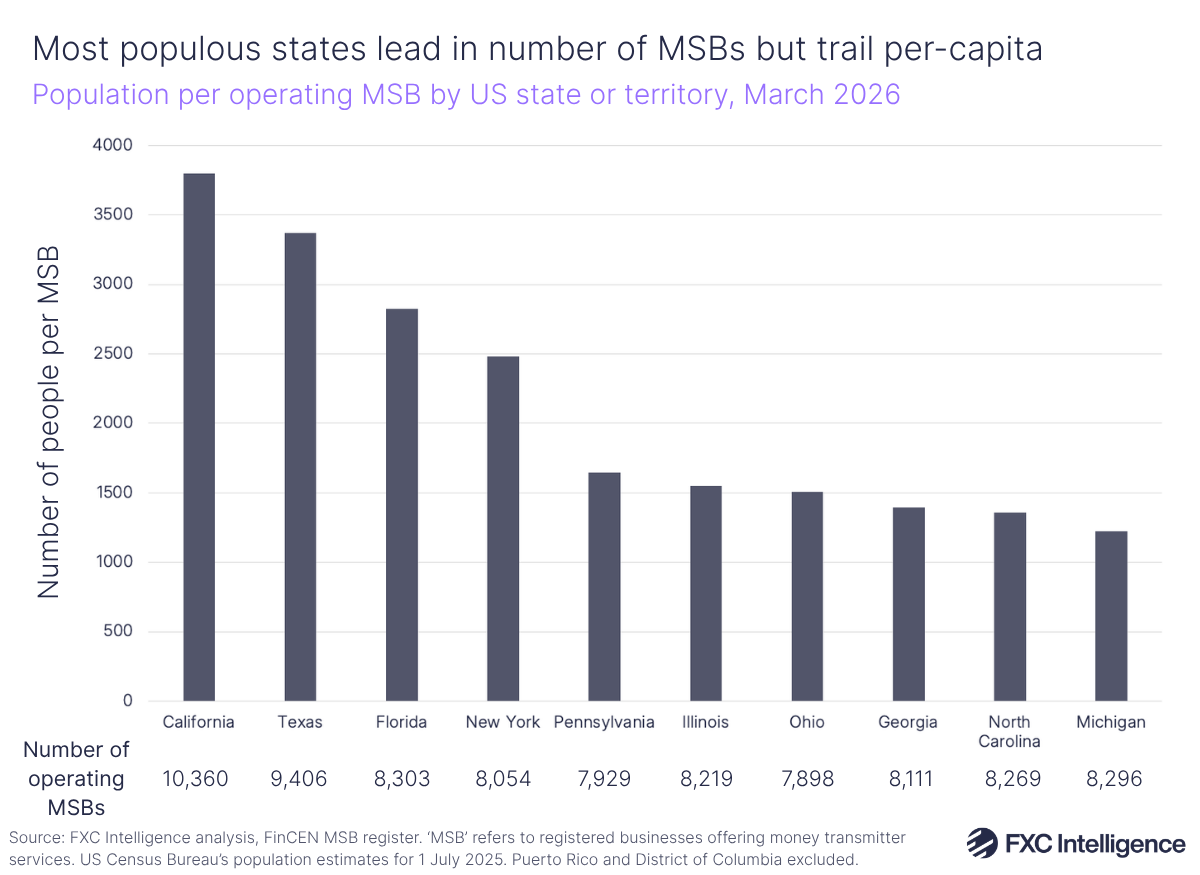
There are several factors that explain why the number of money transmitters registered and operating in each state or territory varies so significantly. When looking at where the largest number of money transmitter businesses currently operate, the four most heavily populated states (according to the US Census Bureau) made up the top four – California, Texas, Florida and New York.
Despite this, these four states also have the largest number of people per operating MSB that offers money transmitter services. The region containing the fewest number of operating money transmitters is the self-governing island Puerto Rico, which has 6,788 – although this only equates to around 469 people per MSB.
Wyoming has the fewest number of people per operating MSB, with a population of 588,735 and 7,747 MSBs that offer money transfer services operating there – 76 people per MSB. Because differences in the number of money transmitters operating per state are small and largely tracked with the respective population of each state, the six US states with the smallest populations made up the six states with the fewest number of people per registered money transmitter.
Although a trend does exist between the number of MSBs operating in each state and their populations, it is less clear when considering the number that are registered in specific states. While the four most populated states – California, Texas, Florida and New York – made up four of the five states with the most registered money transmitters, Colorado, the state with the most registered, is only the 20th most populated state or territory.
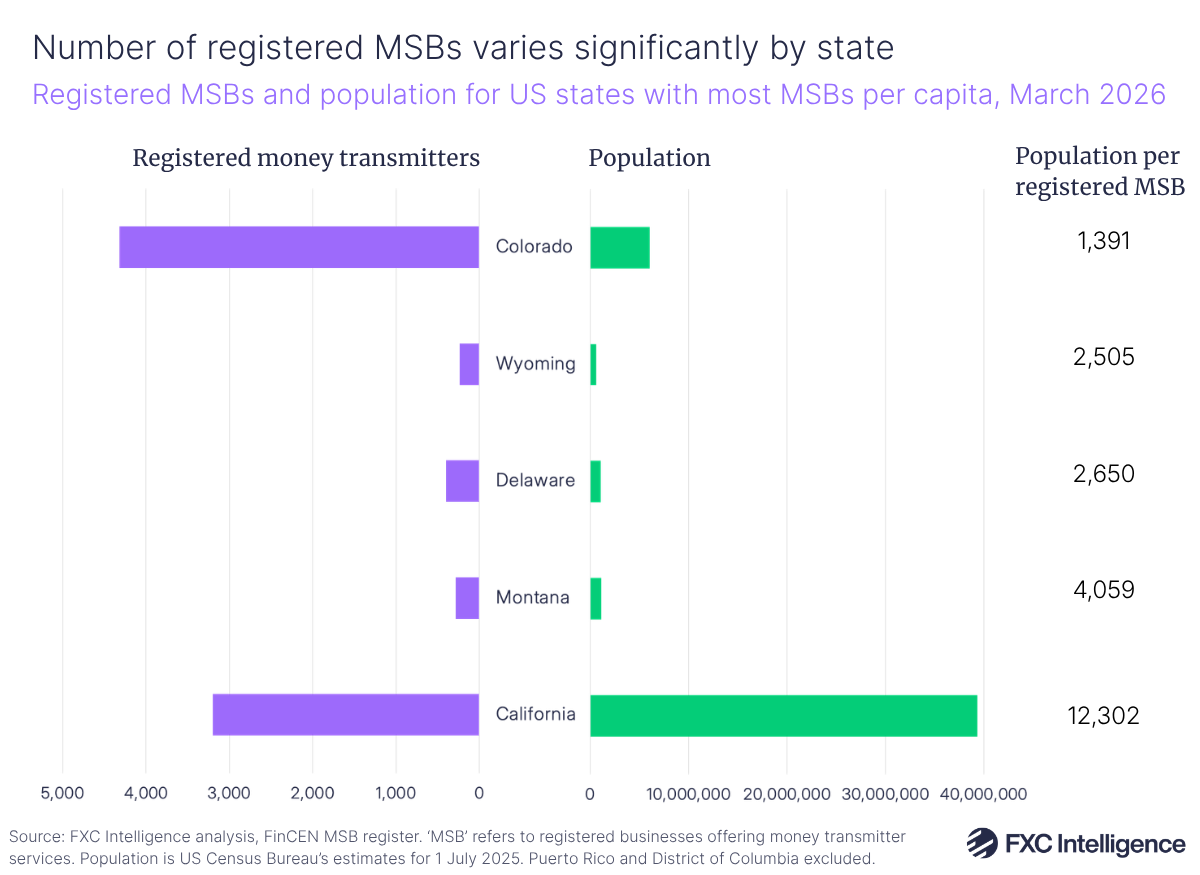
Excluding Vermont, where no businesses offering money transmitter services are currently registered, Colorado has by far the fewest number of people per registered MSB, with 1,391. Wyoming, which has the smallest population of the states and territories considered, has the second-lowest population per registered MSB, with 2,505.
Why do registrations differ so much by state?
While California has stringent requirements for prospective businesses trying to obtain an MSB licence, it still has the second-largest number of MSB registrations. This is likely driven by the impact of Silicon Valley, which is home to a huge proportion of venture capital and startup companies in the US.
Equally, Texas’ high number of registrations could also be tied to its large, diverse population and position as a major remittance hub via the Texas-Mexico border, suggesting that a high concentration of MSBs are located there to enable cross-border transactions. Similar factors are at play in New York, which also has a significant immigrant population and acts as a major hub for financial services.
However, the factors driving Colorado to have more money transmitters registered there than any other state or territory listed in the FinCEN register are less immediately clear. The western state has over 1,000 more registrations than California, despite having a population less than one-sixth of the coastal state.
One major factor is the impact of global money transfer giant Western Union, which has ties to Colorado dating back to 1863, when the Pacific Telegraph Company, which eventually merged into Western Union, built a line from Denver to Julesburg – enabling people in the area to send telegraph messages. Since 1995, the company’s global headquarters has also been located in Colorado, moving from Englewood to Denver in 2018. Primarily, this long-term presence would have increased the size of the money transmitter talent pool, with the company significantly investing in the local infrastructure and talent. It likely also led to the Colorado Division of Banking becoming one of the most specialised and experienced state regulators in the country, while more law and compliance firms would have grown around Western Union, specialising in money transfer and remittance laws – making Colorado a more attractive location for new MSBs.
How does legislation impact where MSBs register in the US?
Colorado has also made efforts to become a more attractive location for crypto and blockchain-based companies, specifically through legislation and regulation.
When analysing MSBs based in Colorado on the FinCEN register, we found that 22% of registrations in the state are tied to a single address for a PostNet branch, a packing and shipping business enabling individuals or businesses to rent a ‘virtual mailbox’. This service gives the user a physical address where they can receive mail and view it online.
We found that the majority of MSBs that are registered at this address have declared that they have no physical branch locations, indicating that they are online-only businesses. After analysing various groups of these companies, it appears a large proportion of them are cryptocurrency-based businesses.
In 2019, the Digital Token Act was also passed in Colorado, aiming to make the state more attractive to crypto and blockchain-based businesses by providing exemptions from certain state securities laws. In 2024, this Act was repealed as Colorado prepared to introduce the Money Transmission Modernization Act (MTMA), which it introduced in 2025.
The MTMA was designed to be implemented nationwide at the state level to modernise the supervision and regulation of money transmitters, while increasing consistency between different states. However, this Act includes optional provisions for virtual currency regulations that Colorado opted to not adopt. This may point to why Colorado ranks first in regard to the number of money transmitters registered in the state, but 11th for the number of them operating across each state. The impact of these changes to its legislation is yet to be seen, although as regulations surrounding money transfer companies and virtual assets become more standardised, disparity between state registrations may reduce in the long-term.
Similar effects also appear to be taking place in the likes of Wyoming, which is home to the fewest number of people per operating MSB and the second-lowest population per registered MSB. In 2024, it became the first US state to legally recognise Decentralised Autonomous Organisations (DAOs), specifically to make it easier for blockchain-based companies to register there.
Colorado also offers the Job Growth Incentive Tax Credit, an incentive that gives businesses a Colorado state income tax credit of up to 50% of the Federal Insurance Contributions Act tax paid by certain businesses per net new job created. This will also likely lead to businesses choosing to locate themselves and register in Colorado.
As the US attempts to bring all of its state regulations into closer alignment, it is unclear how this could impact where money transfer companies choose to register and operate. But for now, the states that offer the best incentives for new companies will likely continue to grow the number of these companies that choose to locate their business there.