From boosting productivity to enabling payments for new commerce channels, companies in the cross-border payments space saw a significant uptick in their discussion of artificial intelligence in 2025.
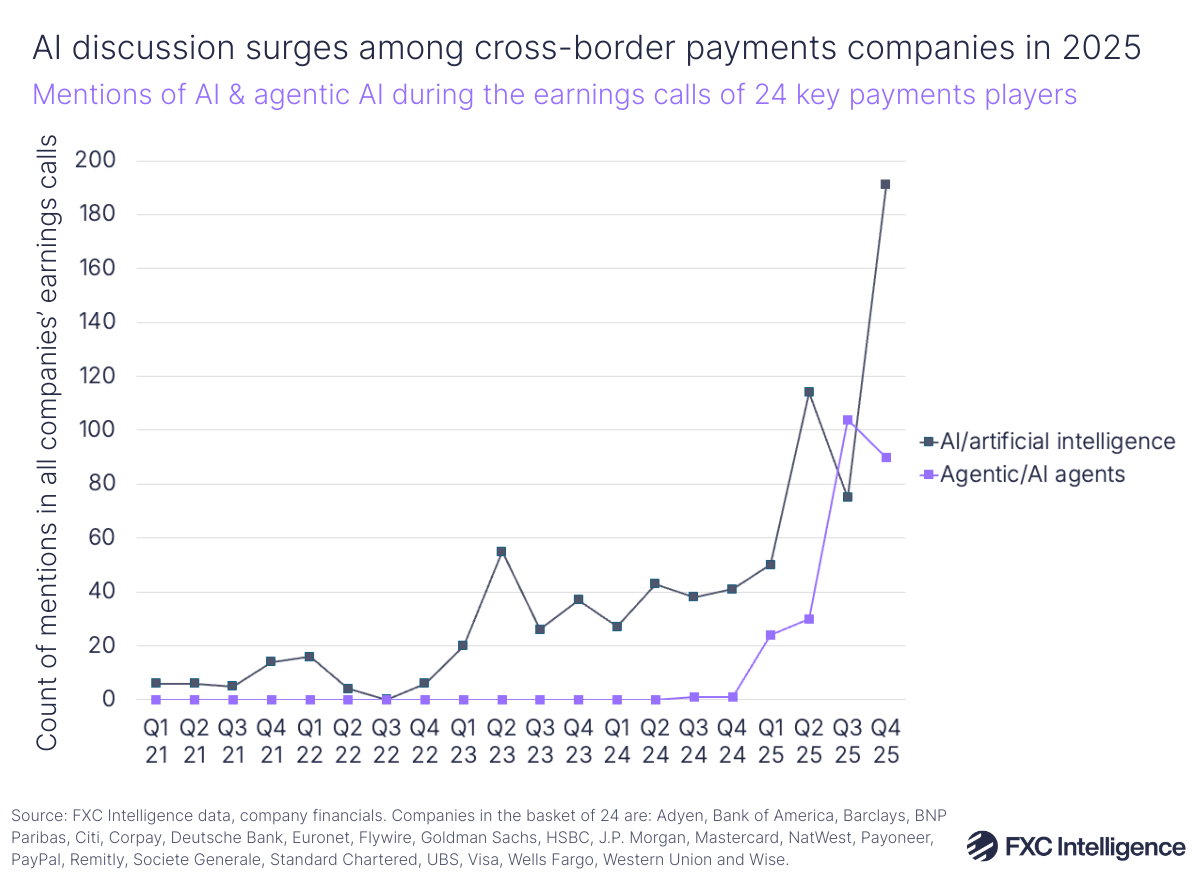
We analysed the earnings calls of 24 companies in the cross-border payments space – spanning consumer money transfers, B2B payments, banks and more – to find out how many times the terms ‘AI’, ‘artificial intelligence’, ‘agentic’ and ‘AI agent’ appeared. Mentions of AI increased significantly YoY across the earnings calls covering 2025, and particularly Q4, with some companies introducing entirely new strategies around the technology.
The most common themes that cropped up in relation to AI were improving productivity and efficiency. Some businesses noted the significant impact that generative AI and agents are having or may have in reducing costs, speeding up product development and assisting with their sales processes. Banks in particular – such as Bank of America, NatWest and Barclays – outlined how AI was speeding up product deployment and enabling software developers to work faster.
Some companies are specifically rebranding their businesses as being AI-first, while others are highlighting the benefits specifically for money movement. Remitly, for example, noted that upgrading its fraud detection model had driven “record low” transaction losses in Q4 2025, while AI-enhanced treasury optimisation has driven continuous improvements to FX costs. Another key word was “personalisation”, with several companies such as Adyen explaining how AI-driven data analysis would help drive better customer experiences.
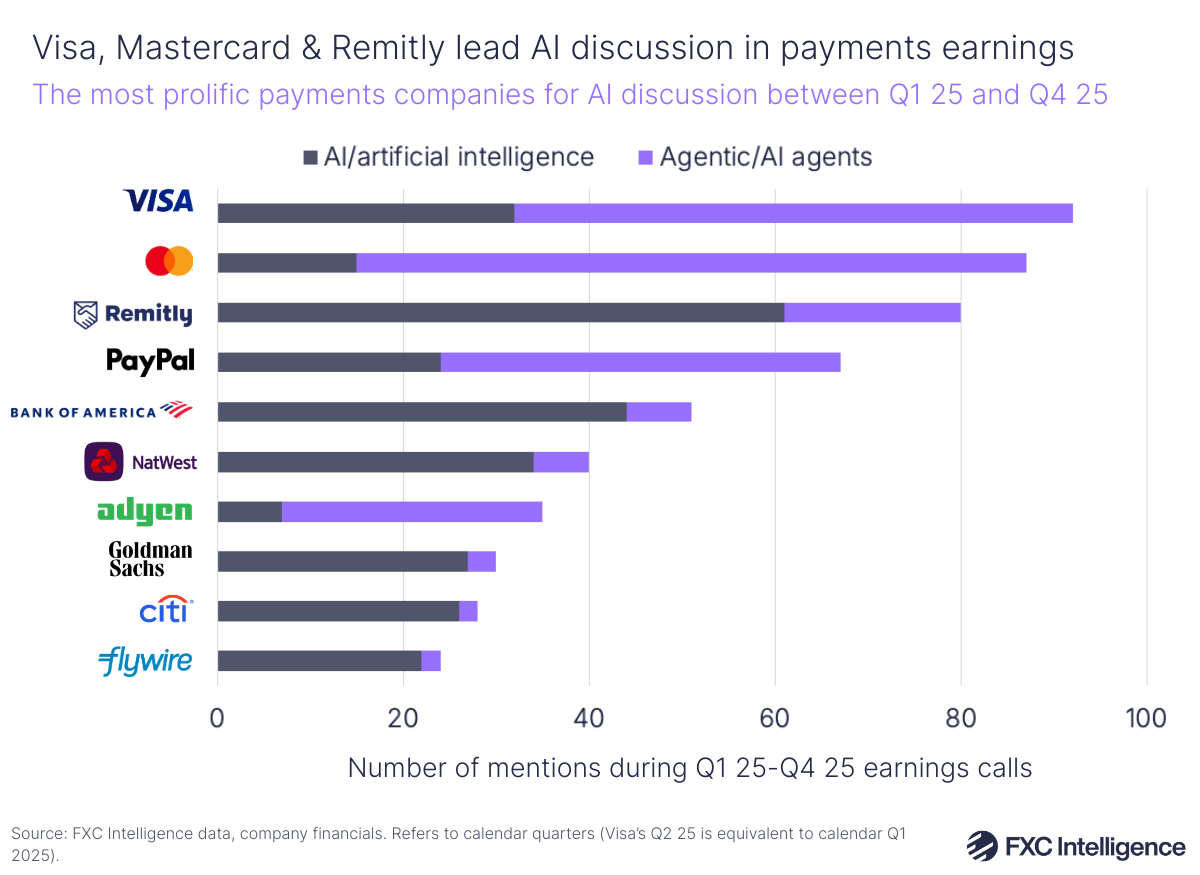
Meanwhile, agentic commerce – the concept of AI-powered agents making purchases on behalf of consumers and businesses – was a major topic for key processors in the space, with Visa, Mastercard and PayPal all having launched specific products in this area, and Adyen working with its merchant clients to develop agentic as a “new sales channel”.
However, agentic AI is also reportedly having other benefits for the industry. Natwest said in its Q4 earnings that AI agents can “execute complex banking workflows” on behalf of customers. In the money transfers space, Remitly said that in 2026 it would use agentic technology across multiple areas, including improving productivity, streamlining operations, lowering fraud risk, improving customer satisfaction and speeding up product development and decision-making.
Meanwhile, Western Union noted that as agentic AI is changing where and how consumers go online to shop, it is in turn looking to change its marketing strategy “to align better with the kind of emerging landscape for digital customer acquisition”. Multiple companies also noted the potential for AI in marketing in Q4, with Visa highlighting its first large-scale campaign created using generative AI tools for the Olympics and Paralympics.
While almost all businesses highlighted some form of potential for AI, others exercised caution, mentioning that as the landscape shifts the right steps need to be taken to protect consumers and businesses. For example, HSBC Group Treasurer Faisal Yousaf said during the bank’s Q4 earnings that it sees “huge opportunity” in AI, but stressed that in addition to embracing momentum behind the technology it was necessary to be ‘aware of the risks as well’.