
All money transfer companies use digital advertising to promote their brand, highlight promotions and showcase their services. However, there is no one-size-fits-all formula that guarantees success, with each company employing a range of different methods to try and stand out from the competition.
As many money transfer and remittance-focused companies across the globe increasingly embrace digital offerings, competition to acquire new customers is also ramping up. But not every company is targeting customers in the same way.
Digital marketing and advertising has become a key pillar for companies of all sizes to increase their brand awareness and attract new customers. Amid this, companies are opting not just to commit varying proportions of their revenue into marketing, but whether that marketing investment goes more into traditional methods of advertising, via the likes of billboards or TV adverts, or focuses on building a reputation through social media accounts.
But digital advertising has become a constant, particularly because it offers greater levels of flexibility, more precise and real-time data, and is more easily scalable for businesses compared to more traditional methods.
In this report, we look at Meta’s ad library to analyse the similarities and differences between digital adverts created by money transfer companies.
Which money transfer companies display the most digital ads?
We looked into all of the adverts currently active in the US for eight person-to-person money transfer companies; looking into the types of content used by each – including the different languages used; the specific countries or corridors named; whether they utilised videos or images; and the key phrases or themes referenced within the ads.
The eight money transfer companies focused on were: MoneyGram, Remitly, Ria Money Transfer, Paysend, Taptap Send, Western Union, Wise and WorldRemit.
At the time of our analysis, across these companies, there were a total of 1,077 ads currently active in the US across social media platforms Facebook, Instagram, Facebook Messenger and Threads, as well as distributed across a range of third-party mobile apps and websites via Meta’s Audience Network offering.
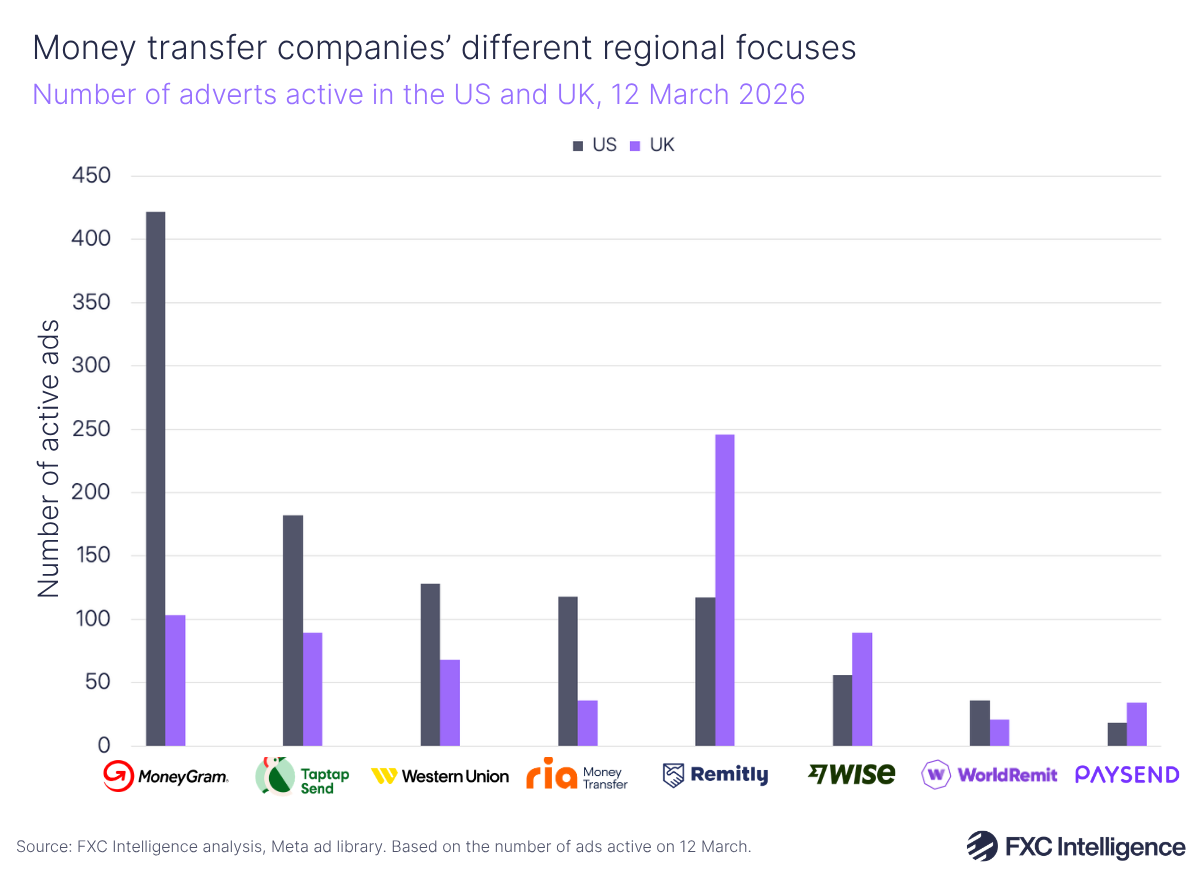
Of the ads analysed, MoneyGram accounted for the highest share of ads overall, with 422 currently active in the US in total. Taptap Send came in second with 182 active ads, closely followed by Western Union, Ria Money Transfer and Remitly with 128, 118 and 117 ads respectively. Paysend had the fewest number currently active (18).
It is important to note that companies target other markets more aggressively, with some money transfer providers that have fewer active ads in the US putting their marketing spend into more ads in other parts of the world. For example, three of the companies we analysed currently have more digital ads active in the UK: Remitly, Wise and Paysend. For Wise and Paysend, this may be linked to them being headquartered in the UK, and hence where they have greater brand awareness and deeper regulatory integrations. For US-based Remitly, this may be a sign of its efforts to expand its influence further across the globe, particularly targeting digital-first regions via digital advertising.
How are different languages used in advertising?
Targeting ads to specific groups in the US was common across all of the money transfer companies analysed. While companies use a wide range of methods to achieve this, all of them primarily use a variety of languages to address different groups.
However, the number of languages selected for use in digital ads was not consistent amongst the money transfer companies analysed. Unsurprisingly for adverts active in the US, English was the language that featured the most – present in 56% of ads. Spanish emerged as the second-most used language, used in 32%.
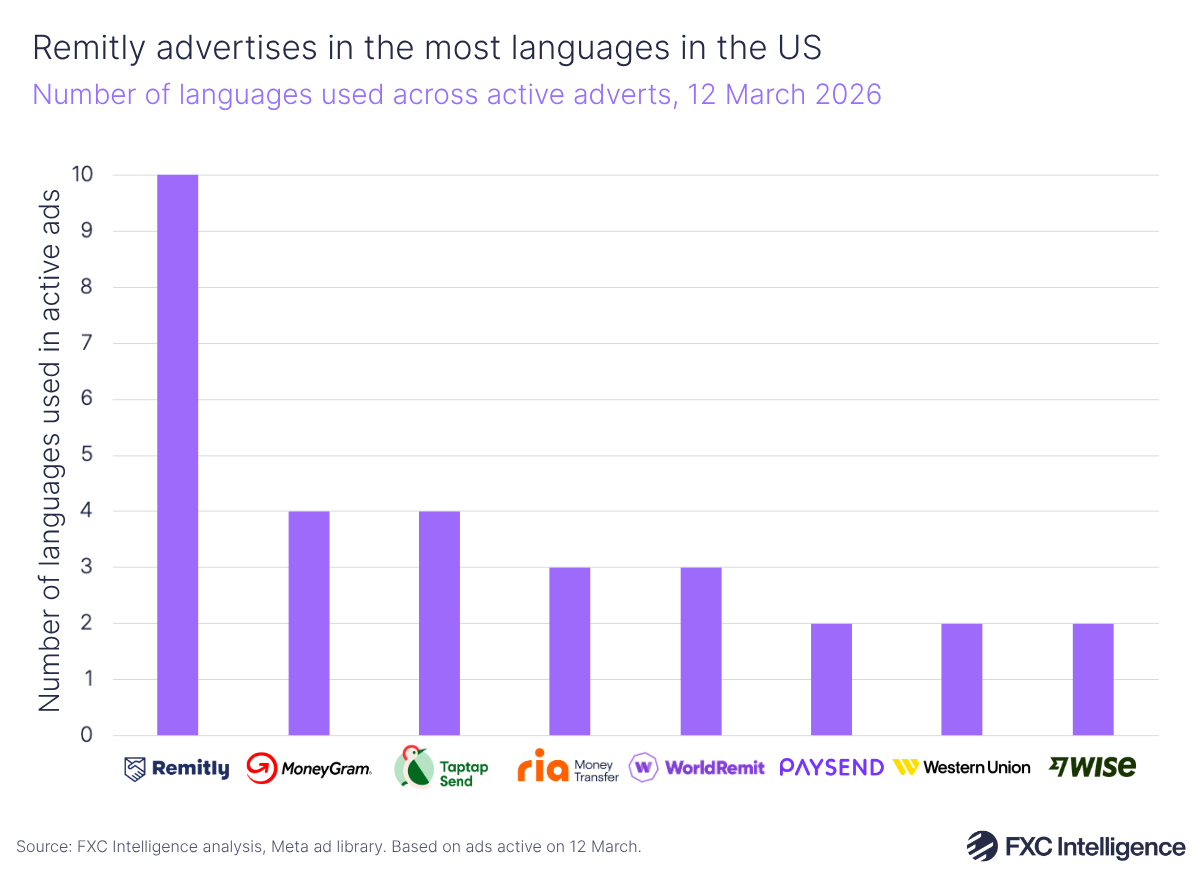
Two companies, Western Union and Wise, only posted ads in English and Spanish, the two most spoken languages in the US. Meanwhile, Paysend only posted ads in Spanish and Portuguese in the US, likely because the company is focused on acquiring customers sending remittances to Latin America.
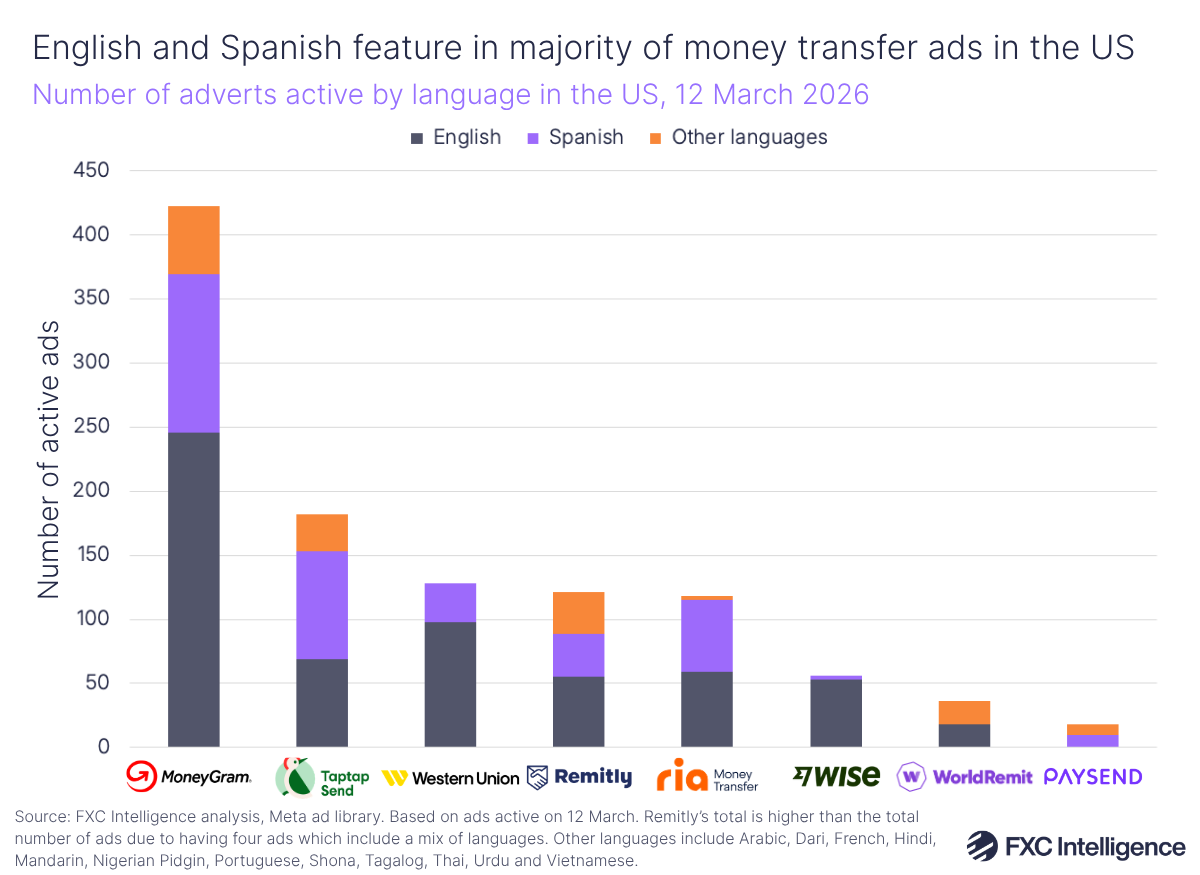
Other languages used were Arabic, Dari, French, Hindi, Mandarin, Naijá (Nigerian Pidgin), Portuguese, Shona, Tagalog, Thai, Vietnamese and Urdu. Of these, Arabic featured in the most ads (5%), used by MoneyGram in 30 ads and by Taptap Send in 23.
MoneyGram, Remitly, Ria Money Transfer, Taptap Send and WorldRemit all posted ads in at least three separate languages. Overall, Remitly used the most languages (10) and was the only money transfer company analysed to advertise to Thai, Vietnamese, Mandarin, Urdu and Naijá-speaking consumers. It also posted ads in French, Portuguese and Tagalog. Remitly also had four active ads which mixed Spanish and English sentences into one ad, specifically targeting bilingual consumers.
WorldRemit was the only other company to advertise in Tagalog, with 13 of its 36 active ads using the language, which is most regularly spoken in the Philippines; a further five were in Shona, a language primarily used in parts of southern Africa. Taptap Send was the only company to advertise in Hindi, using it to promote transfers to India in six ads.
How are money transfer companies tailoring ads to different consumer groups?
Many languages were used by companies to advertise sending money to specific countries, targeting smaller groups that send remittances to family and friends located across the globe. For example, all WorldRemit ads featuring Tagalog specifically referenced sending money to the Philippines, while the same was true for its ads using Shona, which all referenced sending money to Zimbabwe.
When collecting data on the number of times a country is used, only mentions in the text in each ad were counted – we did not include mentions in the accompanying graphic or video. While we found that MoneyGram often doesn’t mention countries in the text, it did regularly in the attached media. Many of the company’s ads reference enabling consumers to send money to “over 200+ countries & territories” but would attach videos about sending money specifically to the Philippines, Jamaica or Mexico, among others, via the MoneyGram app. In some cases, the media also references sending money to specific cities, such as Idlib in Syria, or to souks (local covered marketplaces), again in Syria, in a selection of ads. This trend remained for many of the company ads analysed.
MoneyGram CMO Lamia Pardo broke down the importance of tailoring digital marketing campaigns to local groups, saying: “Remittance is deeply personal, so marketing has to be local. That means speaking the right language, reflecting culture and leaning into native content trends on the platforms where different generations spend their time. Whether customers prefer digital transfers or cash pickup, they’re all on social media, and relevance is what builds trust”.
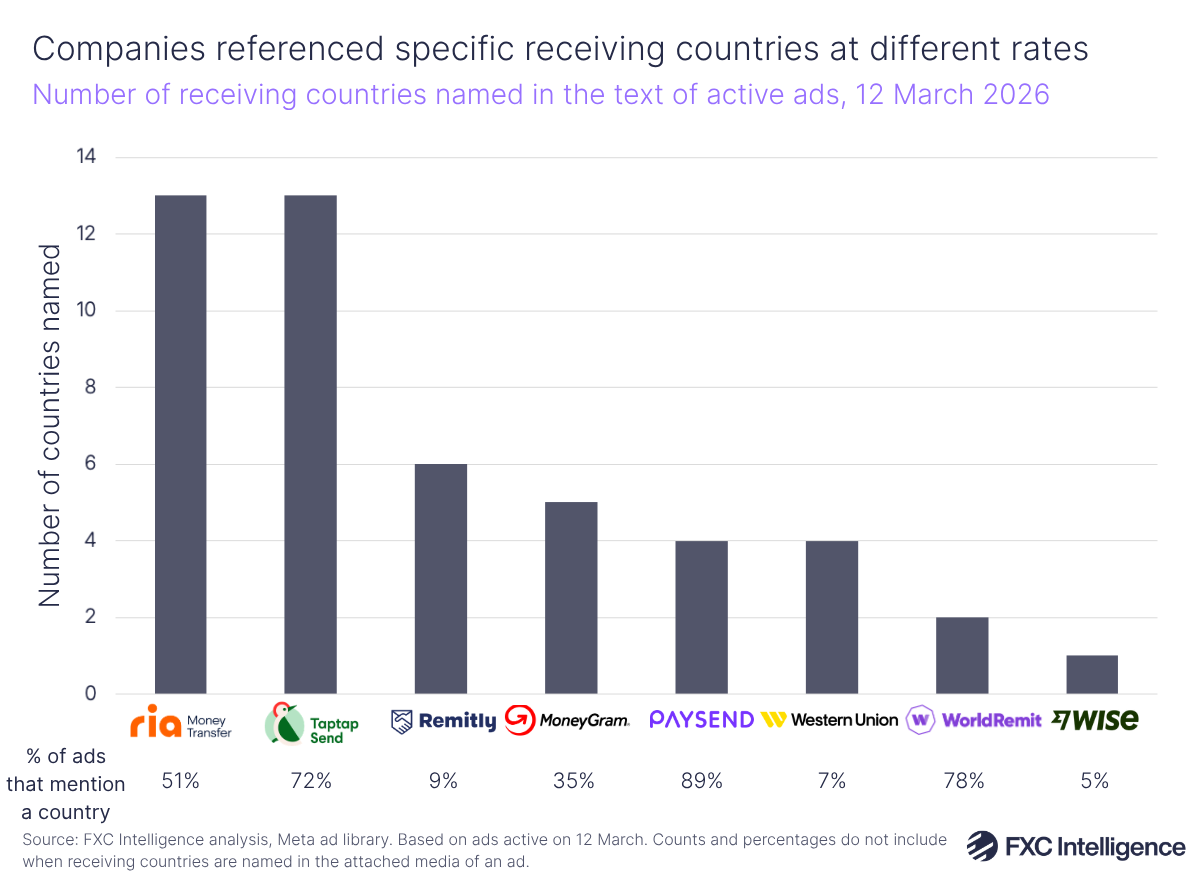
Ria Money Transfer and Taptap Send mentioned the largest number of receiving countries in ads in the US, referencing 13 different countries each. However, these types of ads occurred at different rates between both companies. Ria Money Transfer advertised transfers to these countries across 60 (51%) of its 118 ads, with some countries such as Senegal, Haiti and Guatemala only appearing in the text in one ad while key remittance receiving countries from the US, including Mexico (10) and Colombia (9), were targeted more heavily. Taptap Send specifically referenced countries in 131 (72%) of its 182 ads.
At the other end of the spectrum, Remitly, Western Union and Wise all referenced specific receiving countries in the text of fewer than 10% of digital ads in the US. As was the case with MoneyGram’s ads, specific countries or currencies were sometimes referenced within the images and videos attached to the ads; although these companies also regularly posted ads that focused on their overall money transfer capabilities, promotions for new customers and positive customer reviews.
What techniques are money transfer companies employing in their ads?
While ad content such as a focus on sending remittances to specific countries was common across all of the providers analysed, the formatting of these ads saw a range of approaches.
Short videos are a key part of many of the ads for every company analysed. The focus of these ranged from individuals speaking about the benefits of sending money via a specific service to using viral trends or video formats, including street interviews or ‘get ready with me’ style videos.
Of the companies analysed, Paysend had the highest proportion of ads that included a video, with 89%. While it had the fewest number of videos live overall, 16 of its 18 active ads contained one, highlighting a preference for short-form videos over images.
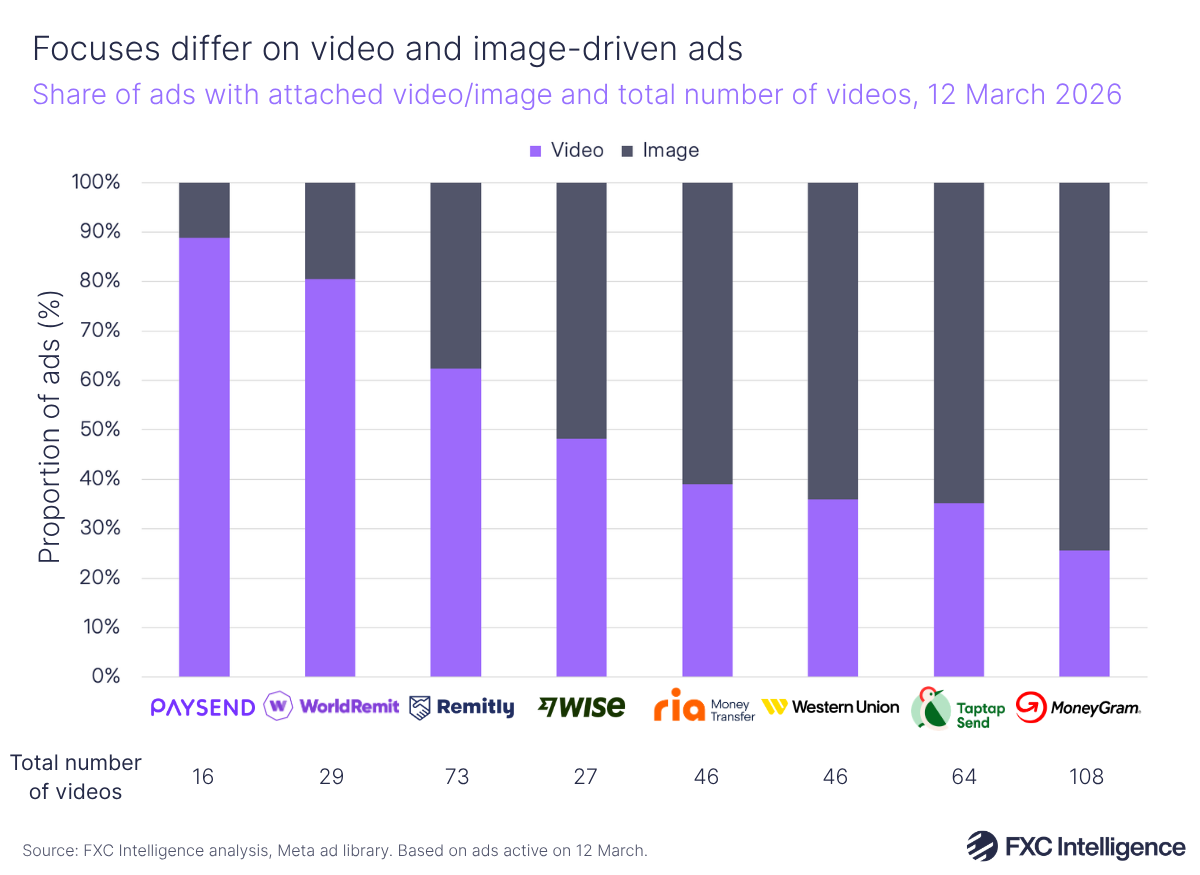
Although MoneyGram boasted the highest number of videos ads in total, they represented only 26% of its active ads, with the company largely preferring to use images containing striking imagery with a short amount of text, such as a Mexican peso banknote being shredded, accompanied by the text: “Don’t waste $$ on slow transfers”. Western Union, which also had a higher proportion of image ads than videos, takes a different approach, with its signature yellow branding present on every image used in its advertising and containing more information in the media than the text. Across many of the images attached to Taptap Send ads, the focus is often on the company’s offering or app, although it does have some images that take a similar approach to Western Union.
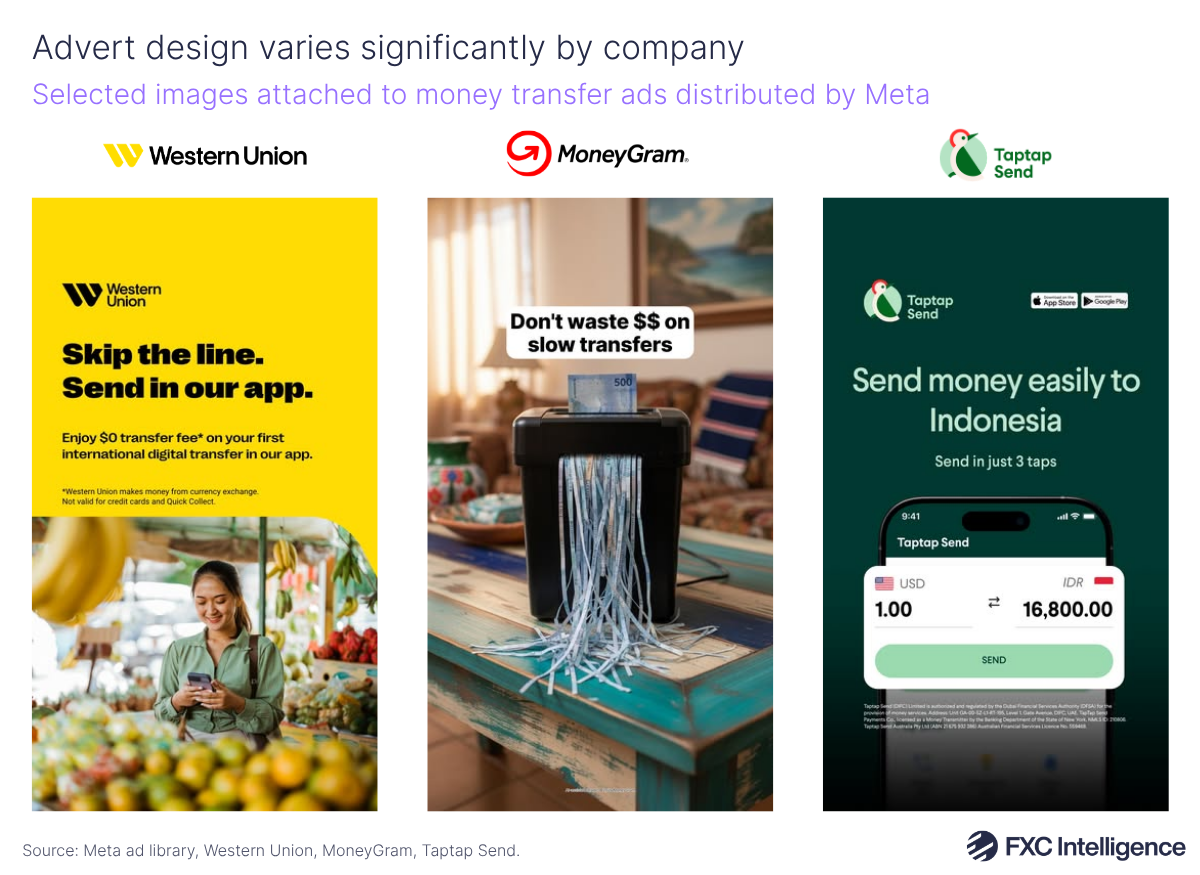
Within both the text and the attached media, one of the most common focuses of the ads was promotions for new customers on their first transfer. All of the companies analysed posted ads that promoted no transfer fees on a customer’s first transfer, saving money on fees or avoiding the 1% federal tax on cash-based remittances in the US by using their digital offerings.
Wise, which was one of the few companies that didn’t advertise no fees on a first transfer, instead focused on the ability to save “up to 70% on fees” when using its service. It also included short videos of people explaining that offers of “no fees” aren’t always as they seem, suggesting that some banks increase costs by inflating fees associated with the exchange rate – highlighting Wise’s transparent rates.
Some of the money transfer companies chose to highlight partnerships with other companies or entities to promote their brand. Through its partnership with the Mexican Football Federation, Ria Money Transfer has produced ads containing short Spanish-speaking videos with the Mexican men’s national team striker Raúl Jiménez to promote its services. Meanwhile, Western Union is taking advantage of its partnership with Visa to offer the chance to win tickets to the FIFA World Cup 2026 when using its prepaid Visa card to make purchases for a limited time.
With our analysis taking place in the lead up to Eid, which marks the end of Ramadan, we found that some companies specifically related the celebration to their promotions. Western Union promoted its $0 transfer fee offer on first international transfers to help people’s family members abroad celebrate Eid. Ria Money Transfer also posted an ad related to an initiative it is running, sending a Ria-branded food truck to different global locations for iftar during Ramadan.
Not all advertising via Meta focused only on consumers. Remitly advertised its business transfers in 55% of its active ads in English at the time of our analysis, aligning with the company’s plan to shift its focus toward more higher-value transfers.
However, due to the highly flexible nature of digital adverts, we expect them to change quickly over time as brands respond to new trends and data. As of 12 March 2026, only 8% of the ads active were posted in 2025, with no active ads being posted prior to August 2025. The remaining 92% were posted in the 11 weeks between the start of 2026 and when we collected the ads – of which the majority (79%) were posted in February and the first 12 days of March.