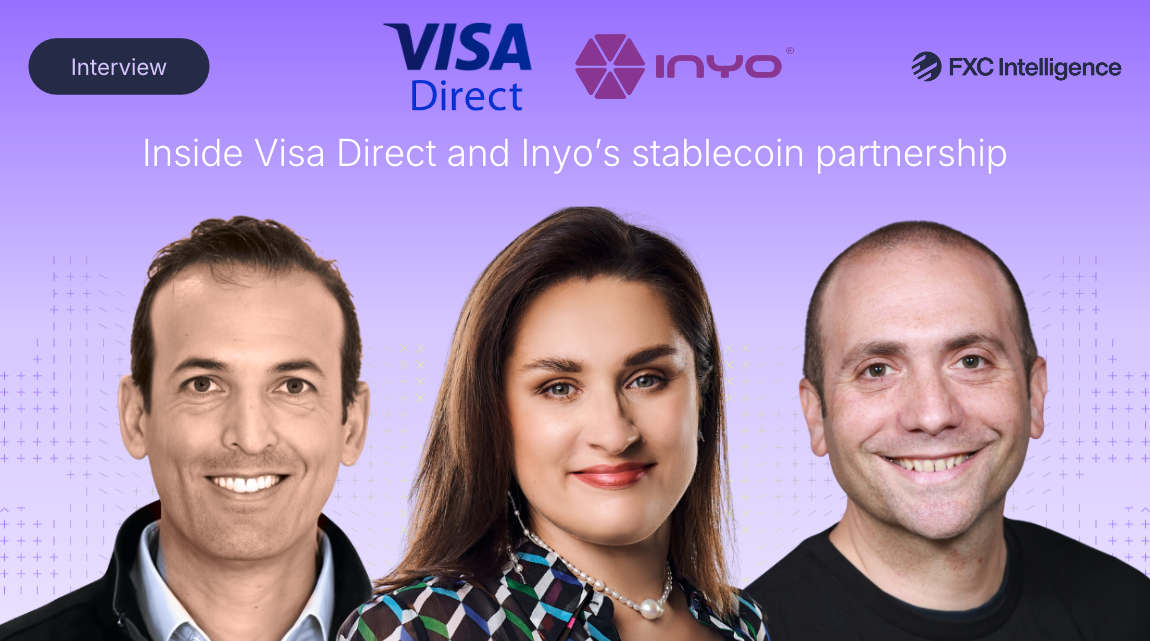


Visa has taken the next step in using stablecoins to move money globally, having launched stablecoin pre-funding to Visa Direct with infrastructure provider Inyo Global. We spoke to Vira Platonova, Global Head of Visa Direct, and Daniel Cohen, President at Inyo Global, at Money20/20 US in Las Vegas about the deal and what it delivers for businesses and end customers.

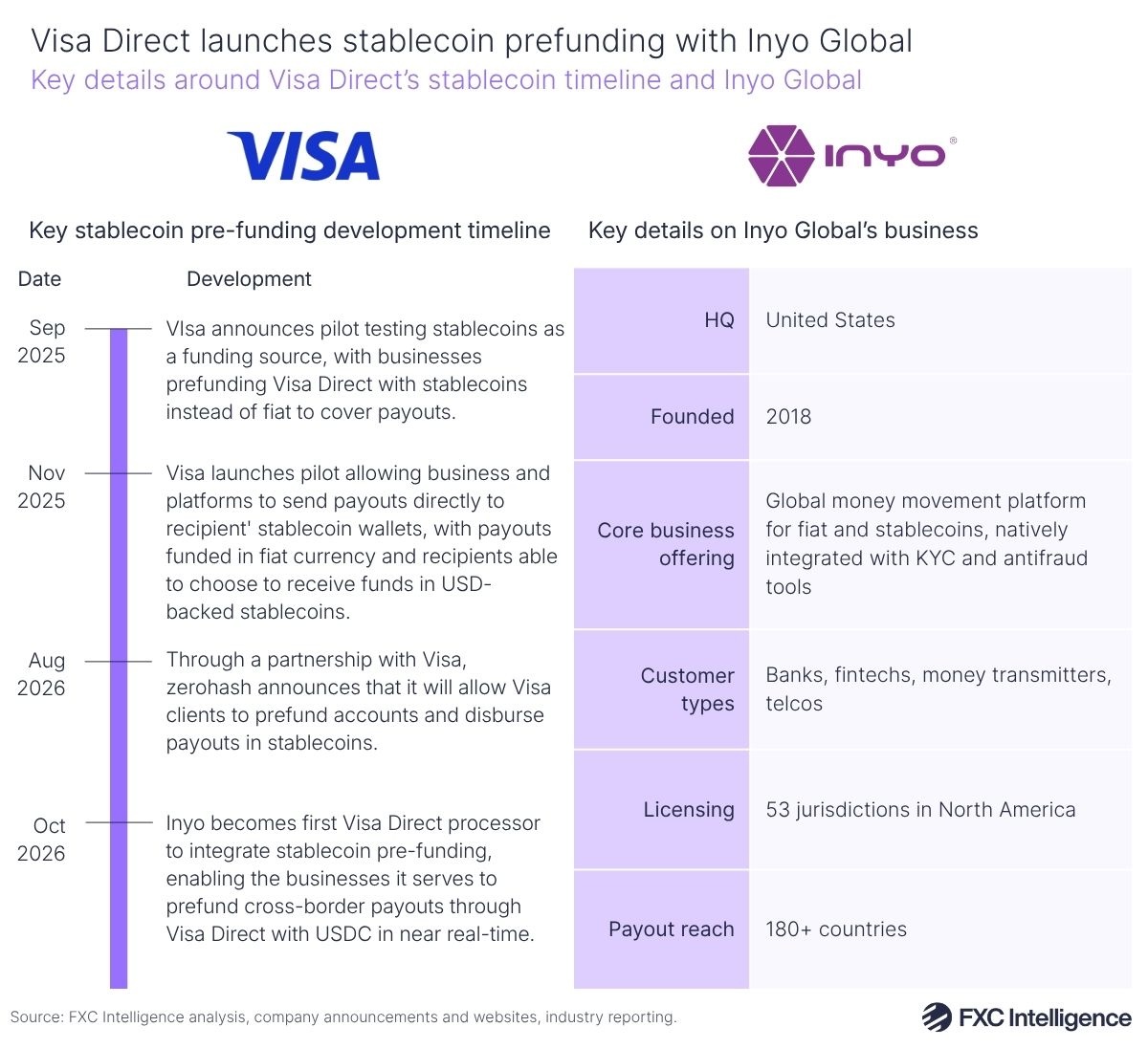
Last week, Visa Direct announced a major milestone in its move to powering stablecoin money movement for businesses. Visa’s real-time money movement platform has integrated stablecoin pre-funding services with Inyo Global, a payments infrastructure provider that serves money transmitters, banks and payments businesses.
With the new integration, Inyo Global’s business clients will now be able to pre-fund cross-border payouts made via Visa Direct with USDC in near real time, through blockchains that run 24/7. This bypasses the need for these businesses to fund balances for payouts using fiat currency, which relies on bank transfers that can be delayed by cut-off times or holidays. The move bolsters Inyo Global’s existing platform, which allows businesses to onboard users, accept payments and send domestic and international payouts across more than 180 countries through Visa Direct.
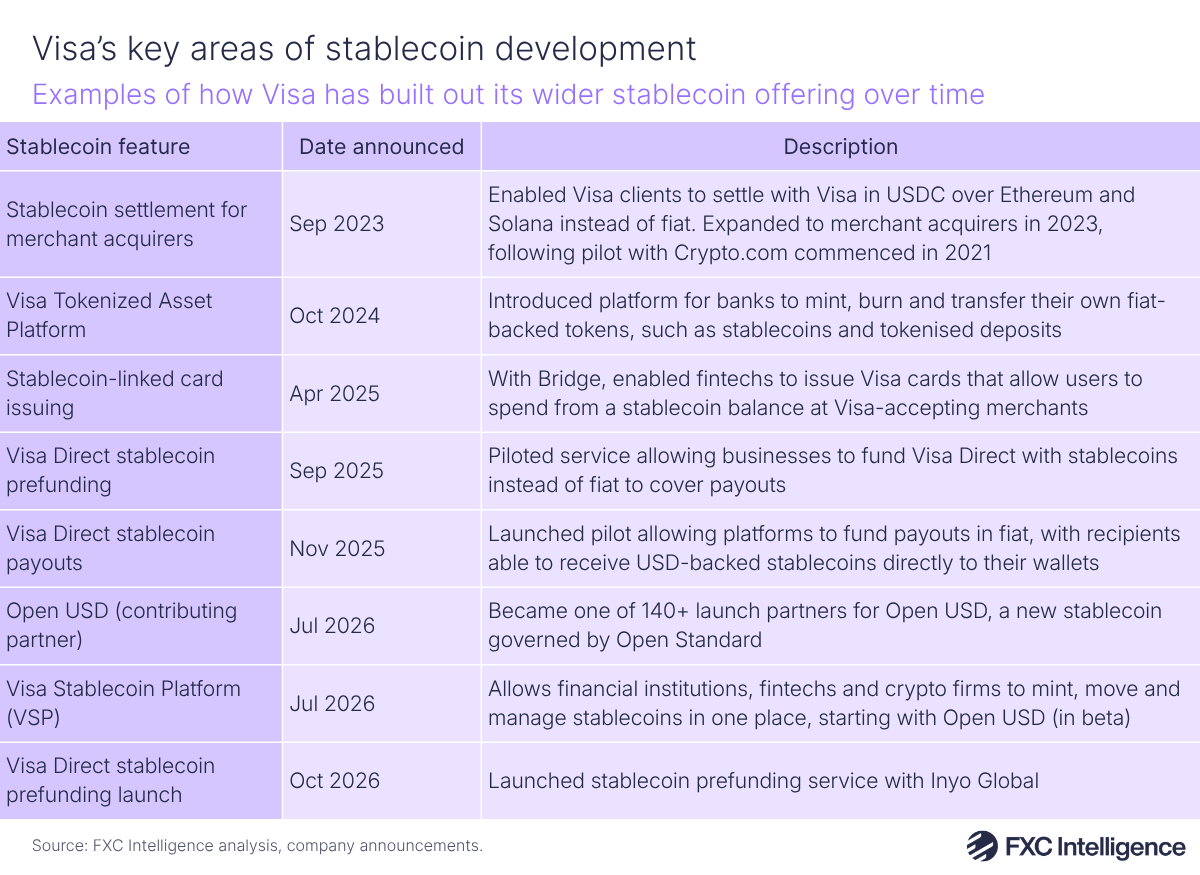
For Visa Direct, the announcement marks its launch of stablecoin pre-funding for Visa Direct from pilot stage to commercial deployment, with Inyo Global being the first enabler of the new offering. Visa Direct has launched a stablecoin pre-funding pilot in September 2025, followed by a separate pilot in November 2025 allowing clients to send USD-backed stablecoin payouts directly to recipients’ stablecoin wallets.
Visa has also been active elsewhere in stablecoins this year, having launched Visa Stablecoin Platform in July 2026 to enable businesses to mint, move and manage stablecoins, starting with the consortium-backed Open USD.
To find out more about why this latest development matters, we caught up with Vira Platonova, Global Head of Visa Direct, and Daniel Cohen, President at Inyo Global, at Money20/20 USA in Las Vegas. You can watch our conversation in the video here, or read the full transcript below.
How stablecoins enable real-time money movement
Daniel Webber:
Daniel, Vira, a pleasure to be with you here today. Let’s go back to first principles. How do stablecoins come into money movement, and what does this mean from the end-customer side?
Daniel Cohen:
Let’s take an example of a customer. Daniel goes in on Friday afternoon to send $100 to his grandmother in Guatemala. That’s a cross-border payments transaction. Now, what happens if he goes in and places the transaction – at a retail store, an app or a website that he’s using – and there’s no money in that account? The transaction will be stopped and won’t actually reach Guatemala. So, that’s a problem for the ecosystem; there’s a lot of friction there in cross-border payments. That’s the problem that consumers and end-users face.
Now, how do we solve a problem like that? We need to have money available so it flows when the financial system is closed over weekends, holidays or whatever it might be. So, we’re looking at all this friction in the system and we’re saying, “What can be done to ameliorate this situation?”. One of the things that we’re looking at is technology and stablecoins together with Visa.
Stablecoins allow you to operate 24/7, 365 days a year. That transaction that Daniel was doing to Guatemala shouldn’t be stopped if there are stablecoins there in that pre-funded account so that it can flow at any time. That’s just a brief description of the problem and what we’re doing to help solve these points of friction.
Moving from pilot to production on stablecoin pre-funding
Daniel Webber:
Vira, there’s been a lot of pilots in this area and this is the first time this is really going into production. Talk us through how that journey has come together, and what makes this ready to take this to the whole ecosystem?
Vira Platonova:
You are absolutely right saying that it was quite a long period of experimentation and testing, and now we’re really moving to production when we talk about money movement – moving money through the Visa network using stablecoins.
Inyo is our partner with which we launched the first real production money movement pre-funding use case. We believe that this use case is actually one of the most important, and actually painful, for B2B customers and all types of clients to resolve.
As Daniel said, it is so important that you provide a money movement experience instantly and money should not stop anywhere on the path to the final destination. Stablecoins are resolving this pain so well.
Why Visa Direct chose Inyo Global to launch stablecoin pre-funding
Daniel Webber:
Why was Inyo the right partner to launch this project?
Vira Platonova:
We actually have a lot of projects with Inyo, and Inyo was one of the first to actually come and talk to us about the future of stablecoins in North America, but also globally. So [it was their] readiness [and] ability to pass through implementation and this testing period, which is always a little bit bumpy when you start new things.
Inyo did it so smoothly and well. This is our first launch announced, and now they can [enable] every client of theirs to settle through a stablecoin, USDC, when they do money movement on Visa rails.
Daniel Webber:
Daniel, tell us more about Inyo’s suite of offerings. As Vira said, you’ve been doing multiple things together.
Daniel Cohen:
Inyo is a processor with Visa and Mastercard. We have terminals or point-of-sale, but are focused specifically on the money movement segment. We’re able to do everything from end-to-end with no intermediaries.
We can do a domestic transaction for money movement or a cross-border transaction for money movement with no intermediaries, and that’s key. When we look at a use case like this with Visa, using and finding those points of friction, being an enabler of the Visa Direct products, we’re able to implement those for our clients or for anybody in the market that is looking to move money from point A to point B in a fast and convenient way. That’s why we’ve partnered with Visa Direct.
So, in the example, Daniel wants to send $100 to Guatemala. If the system is shut down over the weekend, what we’re doing is moving stablecoins, which are available 24/7, 365 days a year, into the Visa Direct wallet so the transaction can go through. Normally, if the bank is closed or we can’t pre-fund that transaction, in this instance we’re using stablecoins to fund that transaction so it can run at all times.
Then, we turn the transaction over to Visa Direct, which are the rails that are trusted by the industry and by the market to deliver those funds on behalf of Daniel to wherever they’re going. That’s our partnership. We’re Payment Card Industry (PCI) Level 1. We can take the funds in using a Visa debit card, and then flow the transaction to wherever it needs to go.
Visa Direct’s impact on Inyo Global’s business
Daniel Webber:
What has made Visa Direct a really good partner for something like this?
Daniel Cohen:
First of all, the brand and the trust. You hear a lot of people talking in the payment industry about trust, but Visa is a huge brand with a really good reputation in the market. Everybody trusts Visa. Also, just the scale and the institutional volume that Visa is moving creates a lot of confidence for the customers.
That’s why we value the partnership with Visa and Visa Direct, because what we’re doing is partnering with the scale, the institutional knowledge and the compliance. We’re operating within a regulated framework to try this in the pieces where there’s the most friction. We don’t want to break the carriage; we want to go slowly and figure out that everything’s working, and Visa’s the perfect partner with which to do that.
How Visa Direct targets seamless payment experiences
Daniel Webber:
Vira, within the next year, what are some of the key trends that we should be thinking about for global money movement, particularly from the perspective of Visa Direct?
Vira Platonova:
We’re talking, for example, about stablecoins. Stablecoins are not some magic pill that will resolve all the issues of money movement. It’s just one of the ways we will enable smoother, sometimes cheaper and more instant money movement.
Our key goal is that the end consumer gets a better experience without changing the method of payment or the money he receives or pulls from. Most importantly, with the change of the experience, the trust remains at the same level, as Daniel said, and even higher. That’s what our role is as Visa, and also [adding] controls – everything related to AI enablement for fraud, behavioral analytics and all this stuff that we will embed under the platform of money movement, which makes this experience very different.
I anticipate that in a year’s time, people will probably move money without even thinking about the word “move”. They will just initiate the payment, focusing on bringing value to the family or buying a gift for their parents. They will not think at all [about] how they execute these transactions. They will trust that it will be more and more instant, more and more secure, and definitely built on agentic rails.
Inyo Global’s focus on the end-to-end transaction
Daniel Webber:
Daniel, in the world of money movement, people sometimes break all the transactions down into just the collections or the payout, but one of the ways that you think about it is as a whole end-to-end transaction. Talk me through what that means, from Inyo’s perspective.
Daniel Cohen:
We talked about the consumer perspective; I want to talk about the business or client perspective. If I’m a client coming into money movement, I need to take money in and I need to take money out. If I want to charge a Visa debit card or I want my user to pay me with a Visa debit card, I need to go out and find someone who can acquire that transaction. I need an acquirer or merchant services; I need a terminal or I need a payment link or I need an iframe. I need to be able to collect the money.
Then, I need to run compliance, I need licensing, I need a regulatory perspective, so I turn to a company in the industry. Then I need a payout. I can’t connect to Visa directly if I’m not a licensed entity.
So, what we’re providing together [is this]: as an acquirer, we help them by giving them access to acquire the payment, but we’re also providing the regulatory and compliance framework. We’re running against all the important sanctions lists, [ensuring compliance] with the Office of Foreign Assets Control (OFAC) and all these good things that are required to keep the US financial system safe.
Then we’ve connected to Visa and all the payment rails that Visa offers, whether that’s to bank accounts, wallets or push-to-Visa cards around the world. So really, it’s an end-to-end solution. Clients can come to us, and we have one API that can enable money in, money out, fiat, stablecoins – whatever those clients need to facilitate the full end-to-end transaction with no intermediaries.
How AI can boost compliance and decision making
Daniel Webber:
Daniel, what do you think is important for people to think about over the next year?
Daniel Cohen:
There’s a lot going on in payments. We’re walking around the show and we’re seeing a lot of trends. One thing becomes clear: technology is evolving very quickly with artificial intelligence and all the things that the agents and the machines can do. What becomes key is data. Data becomes extremely critical.
I always tell my kids when we ask ChatGPT or Claude a question that it’s about the prompt; it’s not about the response that’s driving our access to data. Over the next year we’re going to see a lot of very positive impacts in our industry. Our ability to do compliance has exponentially improved using technology. Our ability to analyse data, to capture this data and make informed decisions to improve money movement for our clients, for businesses that are coming to Visa and Inyo and saying, “I need to move money somewhere, and I need to make sure that it’s fast, safe, and efficient”. So, we’re going to see massive improvements in our ability to run all of that.
Compliance continues to be the most important thing for both organisations. We’re going to run compliance on every transaction. As a differentiator, we’re also running compliance on the sender and on the receiver, and Visa is also doing that in that flow. That’s what becomes really, really important.
Moving forward, we’re going to see us operating within the regulatory framework to make it faster and better, and to use the data that we have to make smart decisions around compliance. At the end of the day, all of this is to make our clients’ lives easier, to make the end-users’ lives easier so money can move faster and more efficiently.
Why data remains critical for cross-border payments
Daniel Webber:
Where do you think FXC Intelligence, as a data company, can really help the industry over the next year?
Daniel Cohen:
One of the key things is that users are using data. They open apps and they’re comparing prices very easily these days. So, knowing how to price correctly becomes critical. End-users are saying, “I’m going to go to this company, I’m going to send money here [or] I’m going to send money there. How do I make informed decisions?”.
So, for you as a company thinking about data, it’s again the prompt of that data in the technology that becomes critical. We need to know that that data has integrity, that it’s true, that it’s trustworthy. Think about the data that Visa has, probably more data than any other financial company in the system. Think about the data that you have. It’s critical to make sure that businesses are running well and that consumers can make the proper decisions.
Vira Platonova:
We used to say that data is the gold of the future, but it is actually the gold of today. I agree with Daniel: the right prompt makes the difference, the right agent makes the difference. It’s not enough to have different types of data, it’s very important to trust the data and to still be able to judge its quality and the conclusions that it makes.
For me, the future is in the data and bringing the quality of data to a totally different level than we have even today, which we are working on 24/7.
I want to add one last thing: When I travel across borders, there are so many questions from institutions and people: How will stablecoins come to our world? How will they change our world? They are looking for their particular use cases. This is our mission as Visa: not to bring a specific stablecoin, but to enable our rails, together with our partners, to make money movement easier and more secure. That’s the answer to how stablecoins will enter the world of money movement: through our platforms and through our partners.
Daniel Webber: Daniel, Vira, congratulations on the announcement. Great to talk to both of you.
Vira Platonova and Daniel Cohen:
Thank you.