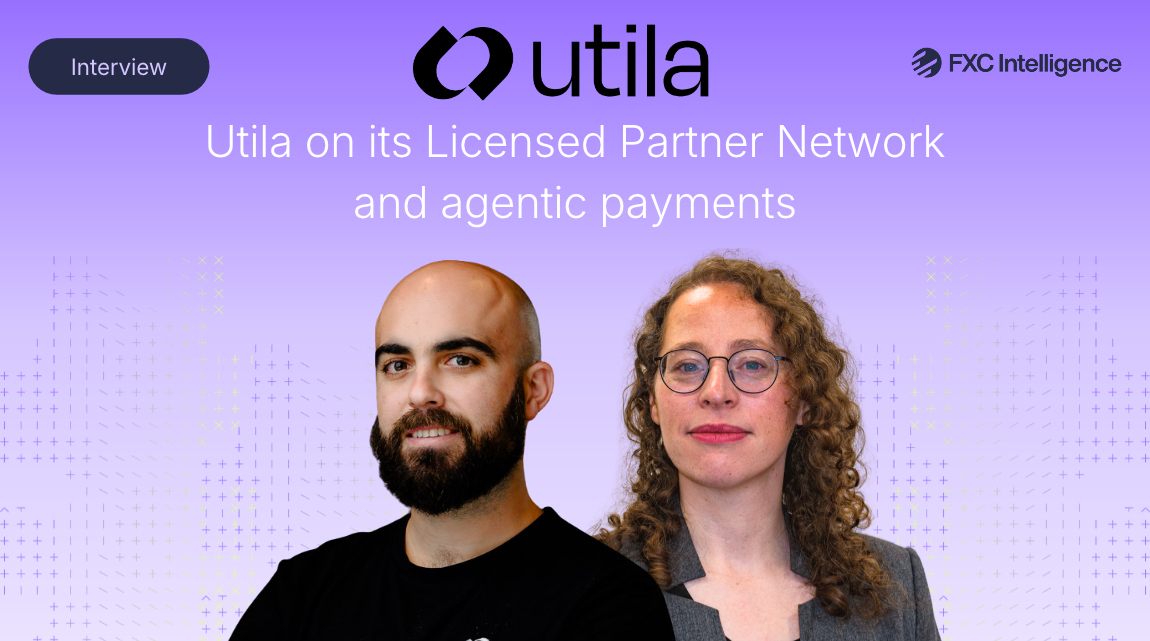


As financial institutions increasingly explore the possibility of leveraging stablecoin rails, Utila is helping players launch stablecoin payments before securing their own licences. We sat down with CEO Bentzi Rabi to discuss these efforts, agentic payments and emerging trends in the space.
Digital asset infrastructure provider Utila, which enables organisations to move money globally using stablecoins, has handled more than $500bn in transactions across its platform since it was founded in 2022.
In September, Utila launched its Licensed Partner Network, connecting fintechs that lack the required licences to launch their own stablecoin products with regulated partners. Through this offering, Utila’s unlicensed clients can offer stablecoin payment, custody and payouts via a network of licensed players.
At launch, the network had four launch partners: B2B stablecoin infrastructure provider Fipto, crypto payments infrastructure company CoinGate, digital asset custodian Balance and financial infrastructure platform Surus – covering the EU and North America. The company also plans to expand the network with additional partner providers, which should lead to broader geographic coverage in the future.
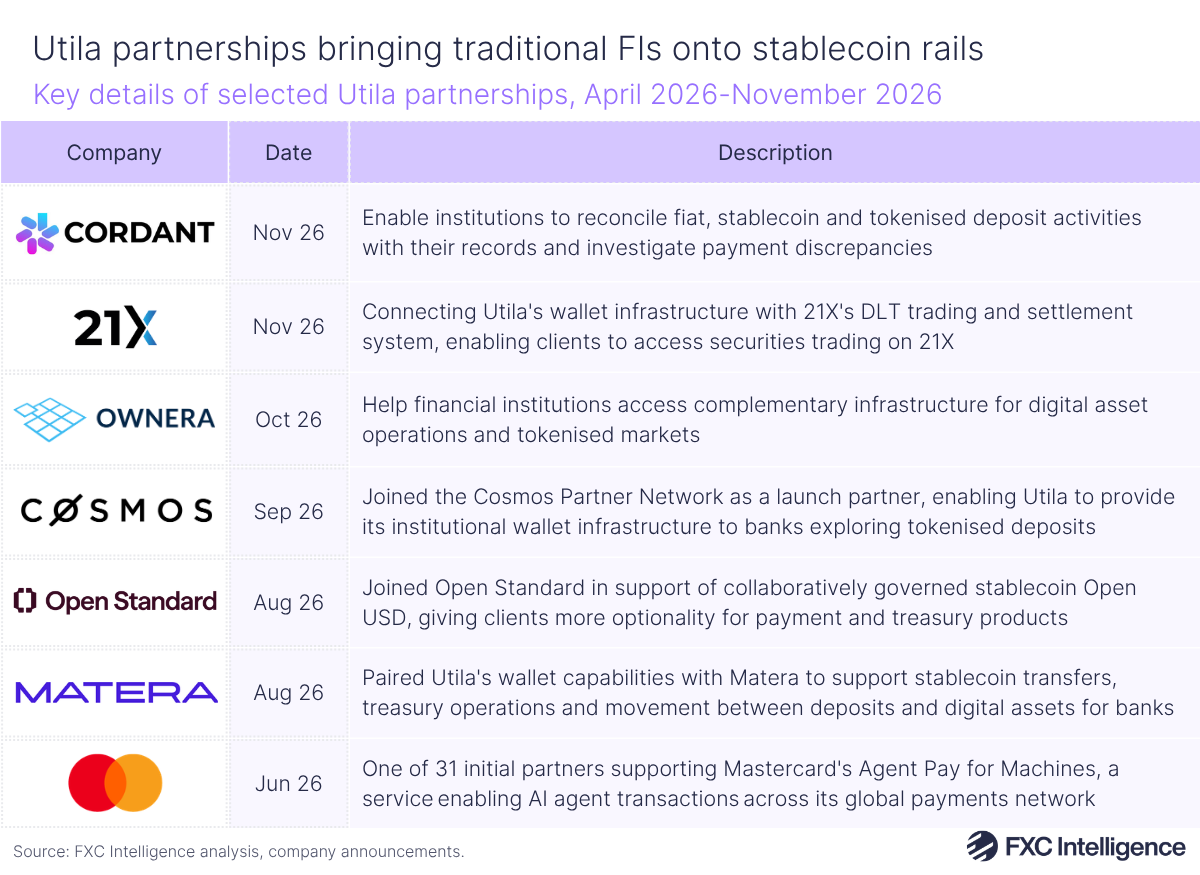
Utila has also moved into agentic payments, having been named as one of 31 initial external participants in Mastercard’s Agent Pay for Machines, which enables AI agents to transact across multiple payment types including stablecoins and cards.
We sat down with Bentzi Rabi, Co-founder and CEO of Utila, to discuss the Licensed Partner Network, agentic payments, the company’s evolution and industry trends.
How is Utila’s Licensed Partner Network supporting fintechs?
Lucy Ingham:
In September, Utila launched its Licensed Partner Network covering the EU, Switzerland, the US and Canada. Which markets come next, and to what extent is licensing still the biggest blocker for fintechs launching stablecoin payments?
Bentzi Rabi:
Yeah, so first of all we see that when fintechs want to enter the space, they don’t only need wallets. In many cases, besides liquidity and AML, they also need licences. We also see some situations where they plan to get a licence in the future, but they want to build something today. In some situations they don’t plan to have any licences and they want a partner to provide the necessary licences.
But the problem they would usually have is that when they get their own licence or, for example, begin doubling down more on stablecoins, they need to rebuild their entire infrastructure.
That’s why we built this Licensed Partner Network, because we are saying, “Hey, even if you don’t have the right licences today or you don’t want to get them at all, you can already start working with Utila”. We will provide you with the necessary licence using a third party. If in the future you get your own licence, you can still keep the same infrastructure and just bring your own licence, which is a very appealing solution for them.
We started from where we see the most demand, which is mainly North America and Europe, so we work with a few MiCA-licensed partners, as well as a few QCs and MTL holders in North America. Probably the next focus region for us will be LatAm, where we are seeing more demand, as well as the UAE and some areas in APAC.
Utila anticipates a changing customer mix
Lucy Ingham:
Exciting – lots of options then to go ahead. Which kind of industries, companies and corridors are driving your cross-border demands and what are their main concerns and priorities?
Bentzi Rabi:
It’s interesting, because at the beginning of Utila, most of the clients who came to us were actually in emerging markets. When it comes to these markets, they are moving to stablecoins because they actually solve a real problem that they have. They don’t have any other option, right? They don’t necessarily have access to banking, to US dollars, and cross-border is pretty big in these areas.
I would say that in these cases we’ve been seeing many PSPs, fintechs, neobanks, OTC desks and liquidity providers coming to us. Right now we’re seeing an interesting shift, so while volumes in emerging markets are still the main volumes that we see in Utila, we are starting to see traditional banks and fintechs coming to us. So for them, the reason is different. It’s not that they have a problem they need solving like those in emerging markets. For them, there is a more efficient way to move money globally, right? And they’re saying why shouldn’t they do it? They actually understand that stablecoins are a better product than what they have today. So for them, the reason is different.
I expect to see a shift in the volumes and probably next year it will even become more 50/50 between these players and the emerging markets, but for now emerging markets are still the main volume drivers that we see.
Agentic transaction volumes remain nascent
Lucy Ingham:
You now also support AI agent-based transactions. Are clients running agent-initiated payments in production yet and what has to be solved before agents move money cross-border at scale?
Bentzi Rabi:
Agentic payments is a very promising use case. To be honest, we mainly see it in the news and people talk about it, but we don’t see any significant actual volumes. We see some initial volumes – we have one or two clients who are doing something in this area and we are also supporting the agentic standard – so we have already started doing some work there.
I think that the main blocker is education. I think most organisations feel very comfortable using AI to write emails and reach out to people, but when it comes to spending money, I think the CFOs and treasury managers need better education on how to do it in the right way. In my opinion, that’s the main blocker today, because the infrastructure is already there and it’s just about feeling comfortable with actually giving an agent the ability to buy things for you.
Lucy Ingham:
A follow-up to that: there are often times when people will experience payments in their consumer life and then expect that later on to come to the business world. Do you see that kind of trend happening with agentic payments?
Bentzi Rabi:
Actually yeah, I think people are more open to try things with their own money and see how it goes. I think this also applies to AI. I myself started using it personally and then said, okay, we should use it at Utila as well. So I think especially when you want to move this kind of technology into organisations, it takes more time.
There is a CISO, there are integrations you need to build, there are potential compliance risks, etc. I don’t currently use AI agents for procurement but I can definitely see myself doing it actually.
What’s next for the stablecoin infrastructure market?
Lucy Ingham:
It’d be fun to revisit that one in a year or two. So how will the stablecoin infrastructure market change as banks and larger payment firms move from pilots to production? Do you see bundled or more modular providers winning more?
Bentzi Rabi:
When banks and payments companies started working and experimenting in this space, they asked what kind of things they needed. First of all, do they want to build something? Not right now. They often want to find a solution that can get them there fast, actually prove that there is something there. In the later stage they want to build, right? So they were prioritising at the beginning working with a bundled provider, meaning a provider that already comes with the wallets and the AML and the liquidity and the licences, so BVNK, Bridge, Zero Hash and Noah, for example. There are multiple players there.
But as these fintechs and banks see their experimentation actually going well, they often decide to own the infrastructure and build their own. They understand that usually these bundled solutions are good for the short period of testing, but in the longer term, for every kind of organisation, at the end of the day, it’s a margins game. It’s about flexibility and they must have their infrastructure. So longer term, I think most of them will go to the unbundled approach, but in the shorter term, we still see many of them starting at least with the bundled approach.
Lucy Ingham:
Brilliant. I think that’s everything. Thank you so much for your time.
Bentzi Rabi:
Same here, thank you.