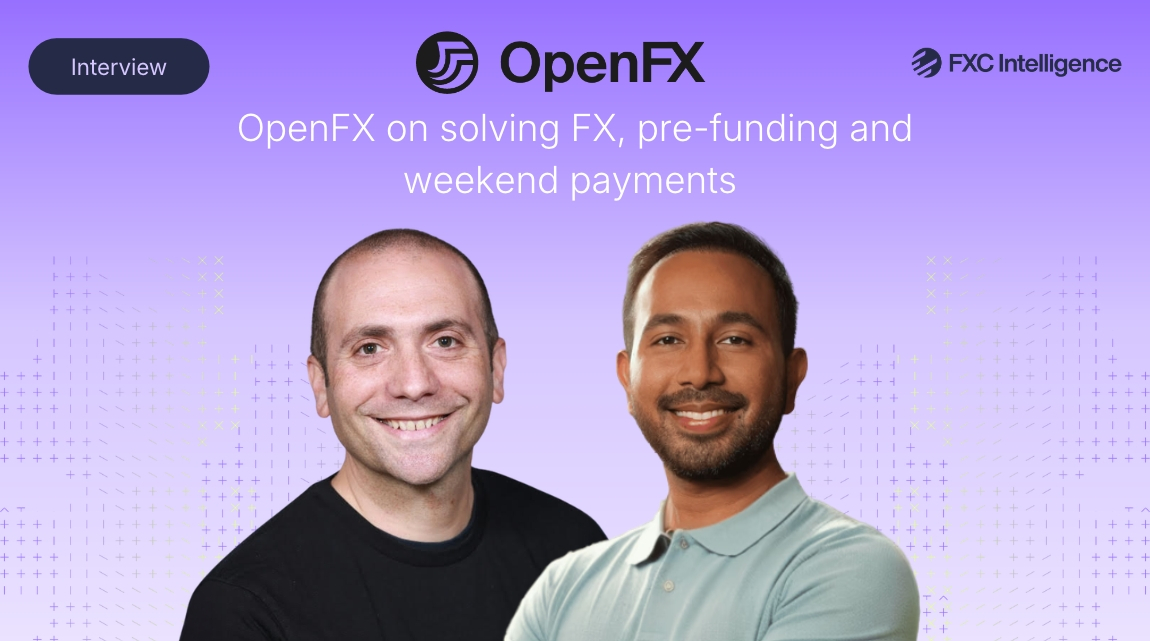


Cross-border payment infrastructure provider OpenFX plans to build infrastructure to enable payment providers and fintechs to move money anywhere globally quicker and cheaper. We spoke to Founder & CEO Prabhakar Reddy about the company’s recent rapid growth and future plans.
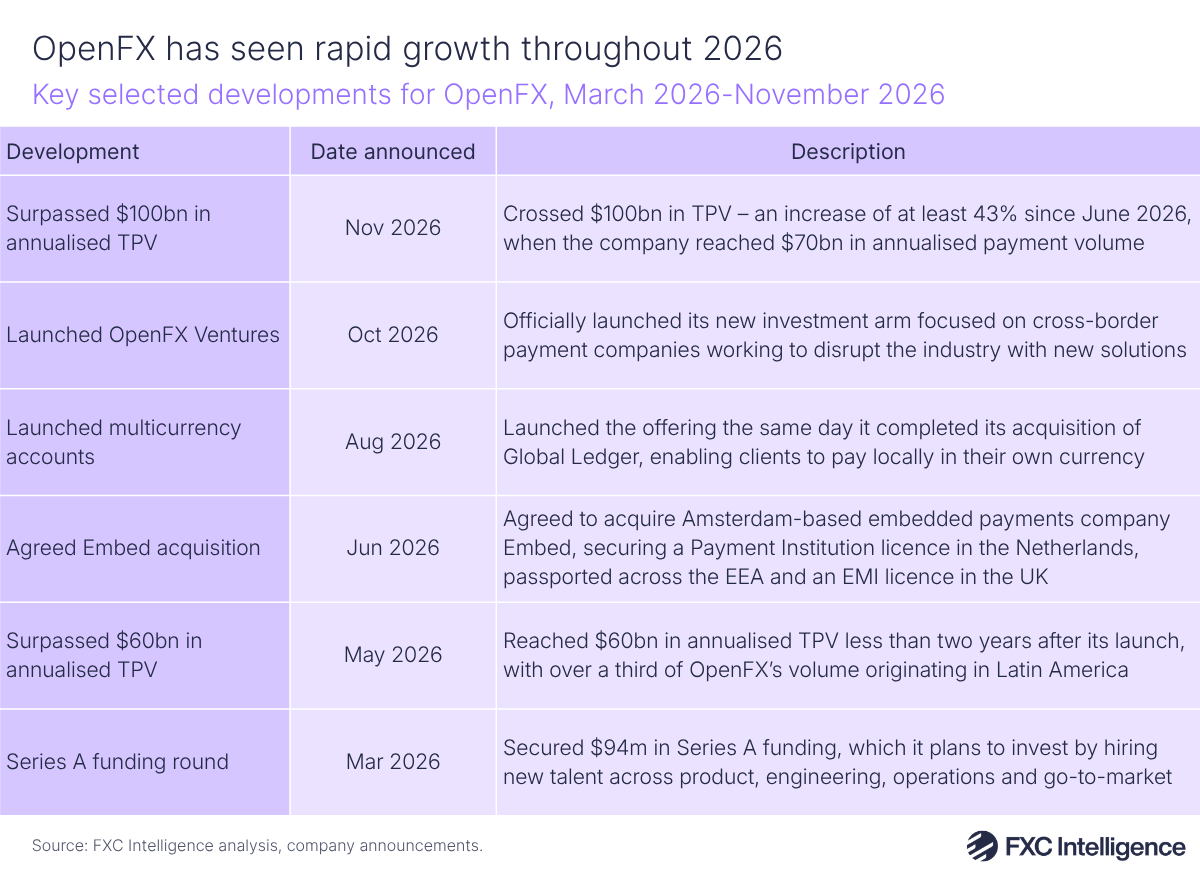
Infrastructure provider OpenFX, which recently surpassed $100bn in annualised total payment volume (TPV), is building out its global real-time settlement network, which bypasses the correspondent banking system – a solution it hopes will eventually replace outdated international payment systems.
By providing an always-on platform that aims to provide significantly faster settlement than the industry standard alongside real-time tracking and reporting, the company plans to enable businesses to move money globally faster and cheaper than traditional methods.
In August, OpenFX officially launched its own multicurrency accounts: named USD accounts that enable users to send and receive money internationally from over 100 countries via ACH, Fedwire and Swift. The move came after the company completed its acquisition of Global Ledger, which built the banking layer for multicurrency business accounts. OpenFX also has plans to add more currencies to the offering in the near future.
In October 2026, OpenFX also launched a new investment arm focused on emerging cross-border payments companies – OpenFX Ventures. Following the launch, the company plans to invest in companies aiming to disrupt the industry by building solutions in areas currently underserved by correspondent banking.
To find out more about OpenFX’s recent developments and future plans, we sat down with Founder and CEO Prabhakar Reddy, discussing the biggest pain points that remain in cross-border payments and how the company plans to solve them.
OpenFX’s business growth
Daniel Webber:
Prabhakar, a pleasure to be here with you today. It’s been six months on from the Series A and a lot’s been going on with the business – why don’t you bring us up to date?
Prabhakar Reddy:
Great question. Excited to be here, Daniel. It’s been a long time coming since we’ve chatted. A lot of good things have been happening at OpenFX in the last six months. Since we last spoke, our business has grown multifold. We went from being live in six regions to almost 15 now. We’ve expanded from one product to three products. We’ve just announced our multi-currency accounts today. Our third-party payouts product is live as well.
Very importantly, our team is now about 210 people split across seven different geographies and time zones. When you’re serving a global market and customers go all the way from Alaska to Australia, you have to have a team that is spread across the world. We’ve got some core hubs, so a lot of good things in the team, a lot of good things on the product, and a lot of good things on geographical expansion for us.
Reducing friction in cross-border payments
Daniel Webber:
Let’s go to some of the fundamentals. I think you previously said that it’s not the stablecoin part that’s broken, it’s some of the FX parts. Talk us through how OpenFX has been trying to solve the FX piece.
Prabhakar Reddy:
Fundamentally, a stablecoin is a digital dollar that moves on-chain. You can move a stablecoin from country A to country B to country C whenever you want. It’s just an on-chain transfer. There’s no meaning to it unless you can actually convert from fiat into stablecoin and then stablecoin into fiat, and that’s where all of the friction comes in. That’s what I mean by the FX piece.
If you want to go from Brazilian real to a stablecoin, you can use a local exchange. But if you want to do that at a scale of $50m or $100m, you can’t do this in crypto exchanges. You can do $50,000, maybe $100,000 at best. So that’s where the FX piece comes into the picture.
We try to solve the first mile and that last mile while bridging the intermediary stuff and removing the correspondent banking infrastructure and simplifying it through seamless connectivity. At our core DNA, we are infrastructure providers. We make markets for, in this example, BRL to dollars. We make markets for it very efficiently and effectively. Convert those dollars into stablecoins programmatically – whatever is the cheapest, fastest stablecoin. Let’s say we need to move that to Hong Kong. That moves back – the stablecoins move to Hong Kong, get converted back to dollars and dollars to HKD again.
Bridging all of these things seamlessly and getting that done in a couple of minutes, as opposed to T+2, T+5, and doing that programmatically 24/7/365 without having any humans involved again, because you throw people into the problem and suddenly things slow down. Because our goal as a company is to make money move in minutes and eventually in seconds, right? So trying to do all of this 24/7/365 while moving $100bn a year, that has been what 2026 has been for OpenFX.
Streamlining pre-funding and finding benefits for customers
Daniel Webber:
Let’s talk about pre-funding and how you really try to streamline that. I think that’s one of the key measures of success in all of this.
Prabhakar Reddy:
That’s a great point, and we realise that this is the largest pain point for most fintech companies.
If you look at Money20/20 today, all of these early-stage fintech companies that you see around us, the only way they’ll compete against the legacy fintech players – the Revoluts and the TransferWises of the world – is by actually growing their balance sheet, because those companies have large balance sheets, and they pre-park capital across and they mimic real-time payments by actually having pre-funded capital.
But now if you’re building a new-age remittance company, a new-age neobank, how much capital can you raise from VCs and how much can you dilute yourself to compete, do the same thing all over again? So that’s where we came in about three years ago and said we’re going to go after these Series A to Series D fintechs across payment gateways, neobanks, remittances, etc and give them the ability to compete aggressively with legacy players without having to pre-park capital.
Because if we can go do the same thing that I just told you about – we can go from BRL to HKD in a matter of 20 minutes and do that 24/7 – then now this remittance company doesn’t need to pre-park HKD on the other side. They can come to OpenFX and give us pounds or pesos or dollars or euros or BRL and collect whatever currency they want on the other side on demand. So now you remove the pre-parking need, that company can blitzscale and focus on distribution and getting customers and creating a great experience for them. Suddenly you can blitzscale your business, you’re getting wholesale FX rates, you’re getting real-time payments. That ICP and the PMF that we found in the last three years is what scaled OpenFX.
Daniel Webber:
What other things have you found that have really made a difference to these businesses?
Prabhakar Reddy:
Excellent question. The fundamental business principles are very similar to any other business. Take Amazon, for example. What is Amazon’s USP? Amazon offers a wide selection of items that you can buy at very good rates and offers very fast delivery.
What people want is price and speed. If you give a very good price, but terrible speed – you give T+3, T+5 – people don’t want it. So what we found is that we need to do both and do it programmatically without humans getting involved.
Globally, if you’ve dealt with any fintech desk, OTC desk or market maker in this FX space, they do everything via Telegram, Slack and WhatsApp – including very large companies like Stripe. If you want to deal with some last-mile remote emerging nation, you actually have to pick up the phone and say, “Hey, I’ve collected XYZ Malawi dollars. Can you convert this to US dollars and give it to me at the end of the week?” and sit on that risk for a week.
If you can make that programmatic, where they can do it in real time – just they’ve collected XYZ currency, convert that and send it back to their parent company – without any humans involved, that is a magical experience. So it’s not just any single one piece; it’s a sum of all parts that we’ve created that gives a magical experience to our customers.
Agentic payments and weekend liquidity
Daniel Webber: Where do you feel agentic payments are going to have an impact?
Prabhakar Reddy: Look, I’m a big believer that we’ve not even started seeing the kind of demand we’re going to see over the course of the next decade in terms of what agentic workflows and agents are going to do to the existing payments infrastructure.
Today, agents are just using credit card infrastructures to make payments. But when agent A needs to pay agent B, they need to do small microtransactions for use cases that we have not even imagined.
We recently launched our venture capital arm, OpenFX Ventures, so I get to see a lot of fascinating new pitches. I saw one startup with one very interesting and unique idea, which said: “If you believe that in the next 10 years, all cars are going to be self-driving cars, if every car is self-driving, will all cars travel at the same pace and speed? The answer is no. If one self-driving car wants to overtake another self-driving car, how do you do that? You need to basically have a self-driving car almost bribing the self-driving car in front of it with micropayments to get out of the way and go overtake.” But the current infrastructure doesn’t allow you to make micropayments effectively.
If you’re paying 3.95% per transaction, it just doesn’t scale. So how do you do it in fiat or whatever currency you want? If you landed from Dubai and you’re doing this in the US, are you going to go through an FX conversion and do all of this and take T+ something? That doesn’t scale either.
So how do you enable real-time conversions at scale? Agents are going to just blow up how much volume happens. All of the FX infrastructure that exists today, payments infrastructure that exists, is built for human time scales. You can process two transactions of $1m each by the end of day, batch processing. But if you want to do a million transactions of $2 each, everything that has been built breaks. Thinking ground up as to what infrastructure is required 10 years from now to support these kinds of use cases that we are backing is what fascinates us because that forces us to think how can we build for scale? How can we build for resiliency, microtransactions and large-scale transactions? How do we build trust across both sides as well? I don’t think anyone is thinking about these things at scale – that’s what excites us and that’s what we’re building towards.
Daniel Webber:
Can we just pick out one point that we get asked about a lot: weekend liquidity. How do you help people get back into fiat on the weekend?
Prabhakar Reddy:
A lot of people are not even aware that the global FX markets just shut down on Friday 5pm. I was actually surprised a few years ago when I was looking at this market and I was speaking to one of the large banks and they told me they have no way of servicing any flow on weekends – there are no FX rates.
So we actually built ground-up infrastructure for what is an index price on the weekends. So a lot of our fintech customers now wrap OpenFX’s APIs to create the pricing oracle for what weekend pricing is. How do we do that? Honestly, we make the markets. We understand two sides of flow. Because we are seeing over $100bn of flow every year, we know what kind of flow per region, per currency and we actually take the macro factors into consideration. So why do we not just spread a little bit more on the weekend so that there’s a buffer kept and then we do a very good job of delivering? Because if you’re going from stablecoins to dollars and dollars into fiat and you’re making the markets on the dollar-fiat side, you can deliver the fiat on the other side. So that’s what we do.
OpenFX Ventures’ multi-pronged strategy
Daniel Webber:
Let’s talk about OpenFX Ventures, which you mentioned earlier. What are you hoping to achieve from that?
Prabhakar Reddy: It’s a two-part play. One is supporting every fast-growing customer of OpenFX. Because when you’re going after these seed to Series D fintech companies and you get all their data on their business model, their KYC information, who they’re collecting money from, how much money they’re holding, who’s converting effectively, who they’re sending to – we actually build a 40-page memo on every customer of ours because I’m a former VC myself, and we prepare these deep theses on who our customers are. We understand their business model deeply and we realised we should absolutely put a cheque in all our companies because now we’re an index of everybody in this market. So that’s one.
Second, it’s more of a selfish play to just learn where the market’s going, because there’s no way for us to stay on top of what’s happening in transportation payments, for example. But you back somebody, catch the next use case. We’re like AWS. We don’t care what gets built tomorrow. Netflix can build on top of us, somebody can build Uber on top of us, somebody can build Tinder on top of us. We just want to support our infrastructure. But as long as we put a small cheque into them and we see their growth, and we can basically back their growth, it’s fantastic. We’ve also built an M&A arm now because companies that are not doing well but we see they have great teams, we can bring them into OpenFX and basically launch new business units with them. So it’s a multifold strategy.
Predicting cross-border trends
Daniel Webber:
What do you see changing the most in the industry over the next year?
Prabhakar Reddy: In one year’s time, I think it’s going to be an absolute given that money moves seven days a week. No such thing as 9-to-5. I think equity markets are moving to 24/7. It’s time that the FX markets also move to 24/7. Crypto markets have always been 24/7.
We are forcing the world towards that at OpenFX, because now when you power all these new-age fintech companies and the legacy ones to move money 24/7, we’ve had very large banks come to us saying, “All we want from OpenFX is once all the traditional infrastructure shuts down, we want to plug into you, and from Friday 5pm to Monday 9am, we want to move money through you.” We’re like, “Sure, let’s start there”. So I think it’ll be a foregone conclusion.
So for us as OpenFX, one year from now, I think today we will do a very good job in certain corridors that are going to expand. We do a very good job with collecting and holding money. We do a very good job of converting and sending the money. The seamlessness of that across about 35 to 40 different corridors is what you’re going to see at OpenFX. We’re going to double on the corridors we cover. There’s going to be a lot more licences, so a lot more regulated in a lot of jurisdictions, so we’ll be able to offer a lot more services. We’ve got some new product lines coming up that I cannot talk to you about yet, so we’re very excited about that.
Daniel Webber:
What’s not going to change in this coming year?
Prabhakar Reddy: That’s a good question and while it’s unfortunate and I’m not happy about it, I think we are still going to keep talking about all the nitty-gritty nuances of stablecoins and licences.
If I send you a text message right now from my iPhone to you, you just get it. You and I don’t talk about, “I sent you a text message. Now this text message went through some data centre, then went to Apple servers, then went to an underwater sea cable, and then went to a data centre on the other side, then went to the phone on the other side of the world, and got encrypted and decrypted.” We don’t talk about all of that. It’s just like, we send you a text message. We don’t talk about money like that. So I don’t think that’s going to change in the next year, but my hope is that in about three to four years, we talk about money the same way we talk about text messaging, right?
Advancing global money movement
Daniel Webber: Is there anything else you would like to talk about that we haven’t already had a chance to cover?
Prabhakar Reddy: I started this company, OpenFX, with one single vision: to make money move like data. So if we succeed in doing what we set out to achieve, my goal is that today roughly $9-9.5tn of money moves every day. In about five years’ time, I see that almost 10x-ing to almost $100tn a day. If we do a good job, we’re going to expand the entire market.
It’s like taking postal-era infrastructure from 1970, where people have to send a post from a postbox, which goes to a central post office the next day and reaches them in three to five days. Money moves like that. If it jumps out of that ecosystem to the text messaging ecosystem, the market is going to just 1,000x. You don’t go from a million posts a day to two million SMSs; you go to a trillion SMSs.
So my belief and my wish with what we’re doing here is that the global money movement expansion happens, commerce explodes through this micropayments infrastructure that we are creating, especially as we enter this world of AI. So, looking forward to creating a world where money actually does move like data 24/7/365.
Daniel Webber:
Prabhakar, thank you.
Prabhakar Reddy: Thank you, Daniel.