

Paysend has made big moves in 2026, with a rebrand focusing on its shift from consumer money transfers to offering payments infrastructure for businesses. We spoke to Group CEO Ben Chisell about the company’s evolving strategy, stablecoins and what’s next for the industry.
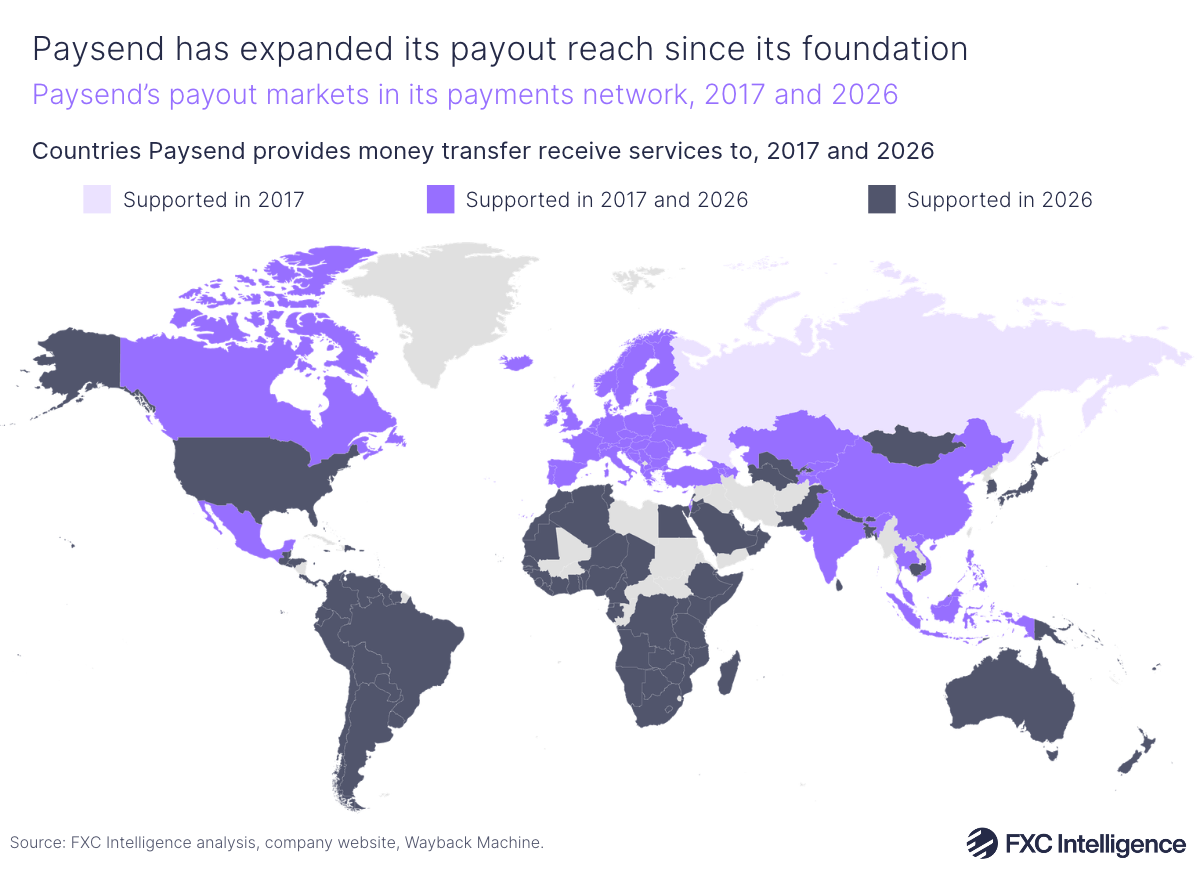
Earlier this year, Paysend launched a global rebrand that now sees the company focusing on providing payments infrastructure for enterprises. Over the last nine years, it has evolved from being a card-to-card consumer transfer provider to serving B2B payments, and now has a network with more than 25 billion digital endpoints across over 170 countries.
Paysend has served over 12 million customers as of June 2026, and it continues to grow the reach of its network through a series of successful partnerships. In its Q3 2026 enterprise update, the company noted that it had grown its volume processed through Visa Direct by 65% YoY, with over $10bn processed annually across its network. It is currently extending into Central Asia and the Caucasus through new partners, and it has received in-principle approval to establish a licensed presence in the UAE. Earlier in the year, the company began supporting direct payouts into China through Alipay and WeChat Pay wallets.
Stablecoins have also joined Paysend’s offering, with the company partnering with BVNK in March to integrate stablecoin-based settlement into both its Consumer and Enterprise lines. In the same month, Paysend also began enabling banks and fintechs to convert stablecoins into local currency, enabling real-time payouts to bank accounts and wallets, through a partnership with infrastructure provider Nodu.
Group CEO Ben Chisell, who took up the role last September, is now overseeing Paysend’s push into the infrastructure space as it increasingly serves enterprises. We spoke to Ben about how the company’s strategy has evolved, where stablecoins fit into the mix and what next year holds for the cross-border payments industry.
Paysend’s evolving strategy
Daniel Webber:
Ben, a pleasure to be here with you today. You’re a year into the CEO role, talk us through how the strategy for Paysend has evolved.
Ben Chisell:
The thing that was most important before is making sure that our product strategy is very focused on solving real, meaningful problems for customers, not just doing what everyone else is doing. We already built a really strong consumer remittance business, but in doing that, we have a lot of partners, and we know exactly what problems they have.
We’d already started to invest in connectivity to our network through other remittance providers and payroll businesses, offering instant settlement capability to customers, and then some other things that we’ve launched recently.
I’ve not really changed that strategy since I became CEO. It’s more like doubling down on that strategy and making sure that we don’t get distracted, making sure that we don’t leave the investments in those things until we really get the sign of product-market fit, which means: customers love the product, it’s really easy to sell the product to them, they continue using it and we make money from it. We already had that with our consumer business. Even just before I became CEO, we found product-market fit with the enterprise product offering as well.
What’s changed for me since I became CEO is that I have a little bit more decision-making power to decide exactly where the focus is. The buck stops with me, and that’s actually something I really like. There’s no politics, there’s just problems, and you decide to solve the problem or you decide to accept the problem. It’s quite liberating in a way, but I really enjoy that accountability.
I see more opportunity for us to invest in some new areas in 2027. We’re finalising our strategy at the moment and getting our product launches this year done, and there’s lots more to come next year.
Chart data
| Year | Revenue | Operating loss |
|---|---|---|
| 2020 | $44.4m | -$11.4m |
| 2021 | $75.8m | -$33.5m |
| 2022 | $66.9m | -$59.5m |
| 2023 | $63.6m | -$44.7m |
| 2024 | $98.3m | -$16.7m |
| 2025 | $140.1m | -$2.2m |
Shifting Paysend’s focus to enterprises
Daniel Webber:
How have you evolved the strategy as you’ve moved from serving remittances to enterprises too?
Ben Chisell:
For me, having a strategy that feels organic is very important. What do I mean by that? You come across problems that you have yourself, that other people have and then you build a product around that. Through building a consumer remittance business – a scaled one, a profitable one – that meant we had to really optimise our liquidity management and our payment messaging orchestration.
We have so many partners, like 100 payout partners around the world, ranging from fintech banks to other fintechs. We work a lot with them for everything to do with exchanging settlement messages to reconciliation files. Through doing that, we’ve just optimised the hell out of everything using AI. We know the problems that they have are exactly the same problems we have, so then we just decided to build products around those things.
We didn’t suddenly decide, “We don’t like being a consumer business, we want to be an enterprise business“. We just want to be a technology business that builds products to solve big problems for people. Problems that we know really well, problems that we have a defensive moat around if we win. Through doing that we just started investing in these areas that happen to be for other businesses like us in the enterprise space.
Through the last year, we decided to rebrand to something that’s a bit more agnostic of any particular segments, and just something where we put our network at the front of everything. We built the world’s biggest digital payment network and we’ve got our technology at the forefront. We’ve automated the hell out of everything with AI and we’ve got a number of different products that serve different people.
It feels to me like it’s almost the tipping point where, given the profile of business that we are today, we just happen to become a global technology business rather than a consumer remittance one.
Where stablecoins fit into Paysend’s mix
Daniel Webber:
Talk me through where digital assets and potentially stablecoins start to come into your mix now.
Ben Chisell:
I’ll first say where it’s not. We really don’t see much demand at all for consumers for sending stablecoins at the moment. There are use cases, but the way I like to build products is to pick a problem where, if you solve it, it’s going to be on the front page of a newspaper. Just launching stablecoin payouts to some country, it’s been done right? It’s not interesting.
We try to find these areas where there’s a real problem to solve. For us, it is just cross-border settlement. It’s a massive, massive market, $200tn of settlement every year, and it’s a pain for people to manage. So much money is trapped in pre-funding accounts around the world, and for cross-border businesses the FX costs are still as high as they’ve ever been. Even when you bring stablecoin into it, you’re just swapping FX costs for on-ramp and off-ramp costs. You swap correspondent banking partners for stablecoin issuers. It doesn’t fundamentally solve the problem.
By acknowledging all of the complexity and then, use case by use case, automating and optimising every single one of them, we’re now finding that, increasingly, the percentage of our pre-funding is settled instantly, which gives us that money back for investing in the growth of our business. We’re not optimising for stablecoin; we’re optimising for that metric: percentage of pre-funding that’s instant.
From starting our journey on that, let’s say six months ago, we were prototyping things, but we weren’t really making progress on that specific metric. Now we’re at something where the goal is to be almost 100% coverage of instant settlement by the end of the year. But you have to do that use case by use case. It’s not something where you can go to someone and just use their product because it’s going to solve every one of these things for you.
I think that this kind of very methodical approach that we’ve taken is very soon going to get us into a place where we can scale the business without having anything holding us back on the liquidity management side of things.
Solving the last mile in cross-border payments
Daniel Webber:
If you use stablecoin to help shrink that pre-funding need, eventually it still needs to get out through the fiat ecosystem at the end. How are you thinking about solving the last mile?
Ben Chisell:
There’s a lot of partners that can solve that for you, but they can only do it in a very limited number of countries, probably even one.
The key is to build relationships with them, and what does that mean? It means they have to accept stablecoin, it means they have to have connectivity themselves or through a bank into the instant settlement scheme, and they have to have liquidity. The key is finding partners that have those things, and then having the technology stack where you can plug them all in and orchestrate all of that messaging with them without any human intervention.
There are solutions for the last mile, but you have to solve them one country at a time and to do that, you have to have a fully orchestrated, automated technology stack. Partnerships is the short answer, but you’ve got to pick the right partnerships and have the right technology to plug them into.
What will (and won’t) change in cross-border payments
Daniel Webber:
What do you think is going to change and not change over the next year in the industry?
Ben Chisell:
AI is going to have a very meaningful impact on the whole industry, but I think the way it’s going to have an impact is quite different than people think. What I see is that it allows you to completely transform how your business works internally. But again, you can’t just believe the hype. AI is a technology, but you have to apply that technology in every single one of these use cases one by one.
What that’s meant for us, for example, is, you know, we went through a journey of trying an AI customer service agent solution. It worked reasonably well. It was incredibly expensive; it was like three times as much money to resolve a customer query than it would have been with a human. So then we built it ourselves using open-source models, and we created essentially a small army of customer service agents with different training and got them to compete against each other to be the best: who could resolve questions the most accurately? Who had to escalate to their manager the least least often? And who could resolve the issues most cheaply from a token cost perspective?
We’ve got to a point where now, I’d say maybe 20% of our customer service contacts are handled completely automatically with no human intervention at all, with full customer satisfaction. We’ve made that coverage within about three months of launching and we’ll probably be 60% by the end of the year.
We’ve got hundreds of these use cases across the company, but every one of them has to start with: what’s the very specific problem you’re solving? What’s the right way to solve the problem? And then actually solve it, and don’t let go of it until you’ve measured that you’ve solved the problem properly.
For businesses that really take that approach, AI is going to completely transform how they work. All manual operational stuff can be completely eliminated in the next 12 months, but you have to take the non-glamorous, non-sexy approach to it, which is to solve the customer’s problem and work hard.
I think there’s also going to be a lot of companies who don’t take that approach, that buy multi-year, multi-million-pound contracts with people who claim to solve the problem for them, and then they’ll quickly realise that they don’t solve the problem for them and now they have a very large committed cost that can actually put their business at risk.
AI is going to have a very serious kind of impact, but not in the way that people think. What’s going to happen at the end of the tunnel is businesses that are incredibly healthy businesses: great profitability, great growth, lean operations, excited team, really innovative. On the other hand, you’re going to get companies that have a load of costs and don’t know what to do, and start to [see] trouble. AI is going to be a catalyst for the winners winning faster and the losers losing faster.
Why data is crucial and how to use it
Daniel Webber:
We’re a data company. How do you see the importance of data in this industry?
Ben Chisell:
Obviously, very important. The scientific method is important: What’s your hypothesis? How do you measure that? What experiment do you want to run? What’s your success criteria? Drawing a formal conclusion and then repeating that loop all the time.
We’re now in a place where lots of companies have lots of data. Lots of people in those companies have access to lots of data, but if you don’t have the right governance, the right thought process, it’s just chaos. People just throwing numbers around and not really being structured in how to use them.
We’re very focused on what our objectives are. What are our key results? What are the definitions of those key results? How are people measuring those key results, and when are people looking at them? And what are the rituals that they have in their daily work where they’re actually using them to make decisions.
We’ve had an abundance of data for quite a long time, but we’ve been incredibly rigorous. Every single person in the company has a metric. Every one of those metrics has lineage, has specific definitions. Everyone has an owner. It feeds into their performance reviews. It feeds into their daily work. It’s not just data anymore, it’s been implemented into workflows.
The thing that’s made the biggest change for us is that data feeds into the workflow of every single one of the Paysend team every single day, ranging from pricing to registration success rates, to the sanction hit rate for our global API payouts, to the number of funding failures for a business funding instant settlement accounts.
It’s actually something that I’m very excited about, that it’s made a complete transformation in how the team works. The icing on the cake for me is the way that we can use AI agents to go and answer questions as well. But again, if you have this AI agent, you still have to have the right thought process, you still have to ask it the right question and you still have to interpret the data in the right way as well.
So, again, it makes the good people even better, because they can answer questions much faster, but they’re still thinking about the data in the right way. But it also creates a lot of data slop, as well. “AI agent, can you make some analysis for me?” and then [they] just send it to their manager without looking at it. So it has both of those effects.
With data or AI, a lot of these things come back to: it makes the superstar-level talent even better and it sometimes makes the average talent worse.
Daniel Webber:
Ben, thank you very much for the time. A pleasure to talk with you.
Ben Chisell:
Thanks very much.