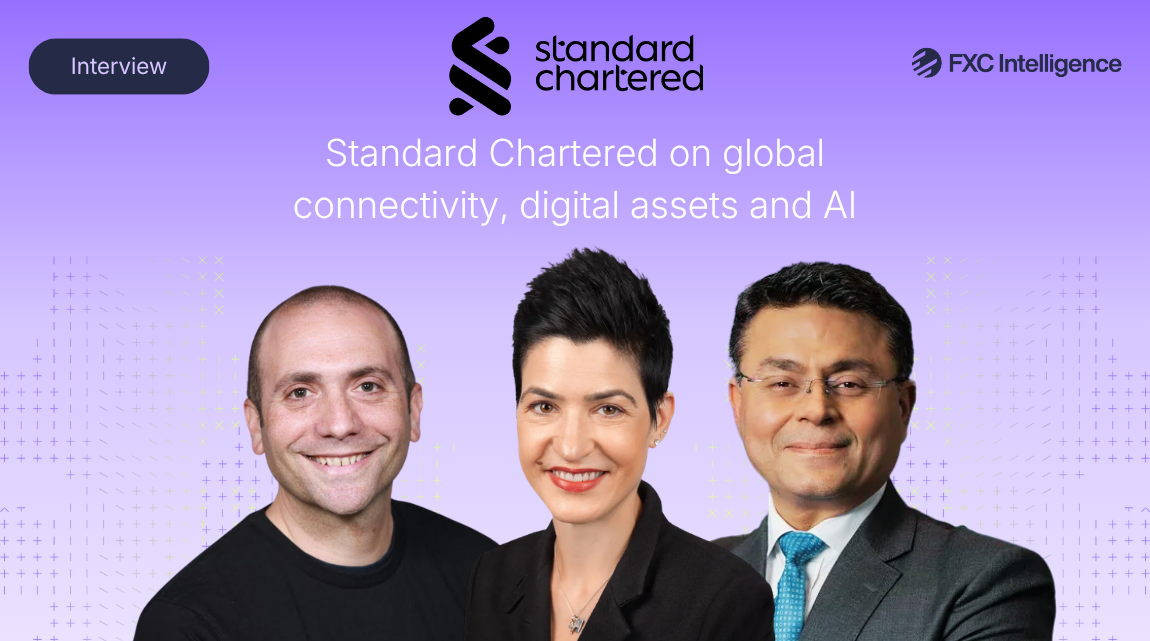


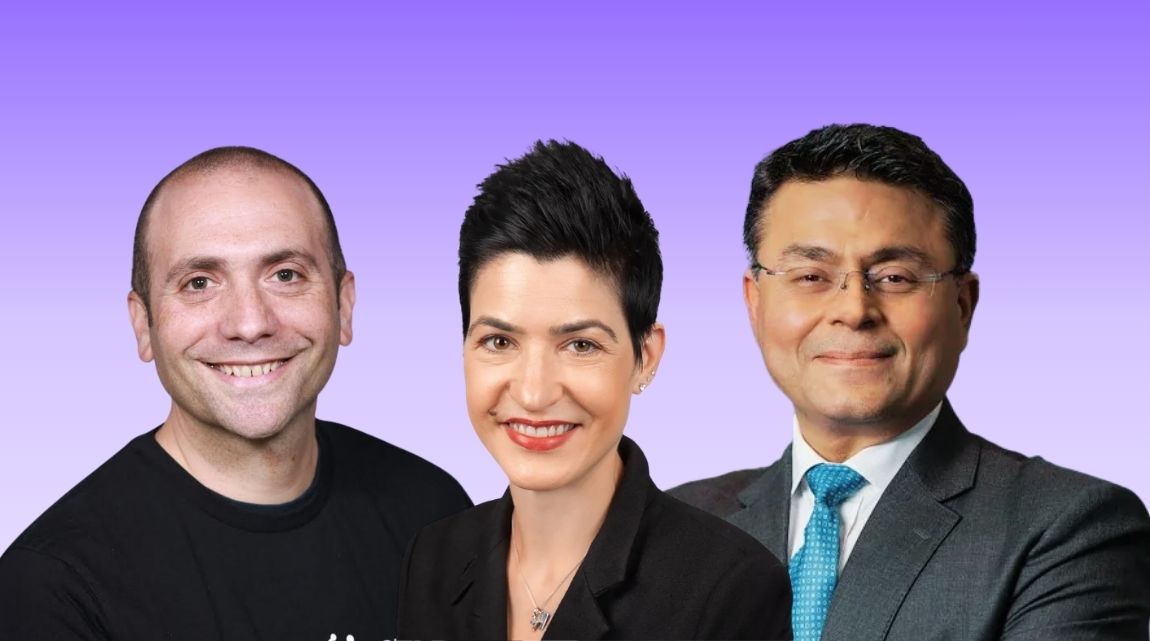
Standard Chartered remains focused on cross-border payments, leveraging digital assets and AI to improve its global connectivity for clients. We spoke to Standard Chartered’s Mandy DeFilippo, CEO, US, Europe, MEA and Pakistan, and Dhiraj R. Bajaj, Global Head, Financial Institution Sales, Transaction Banking, at Money20/20 USA in Las Vegas about how the bank weighs up its next moves, alongside evolving client needs.
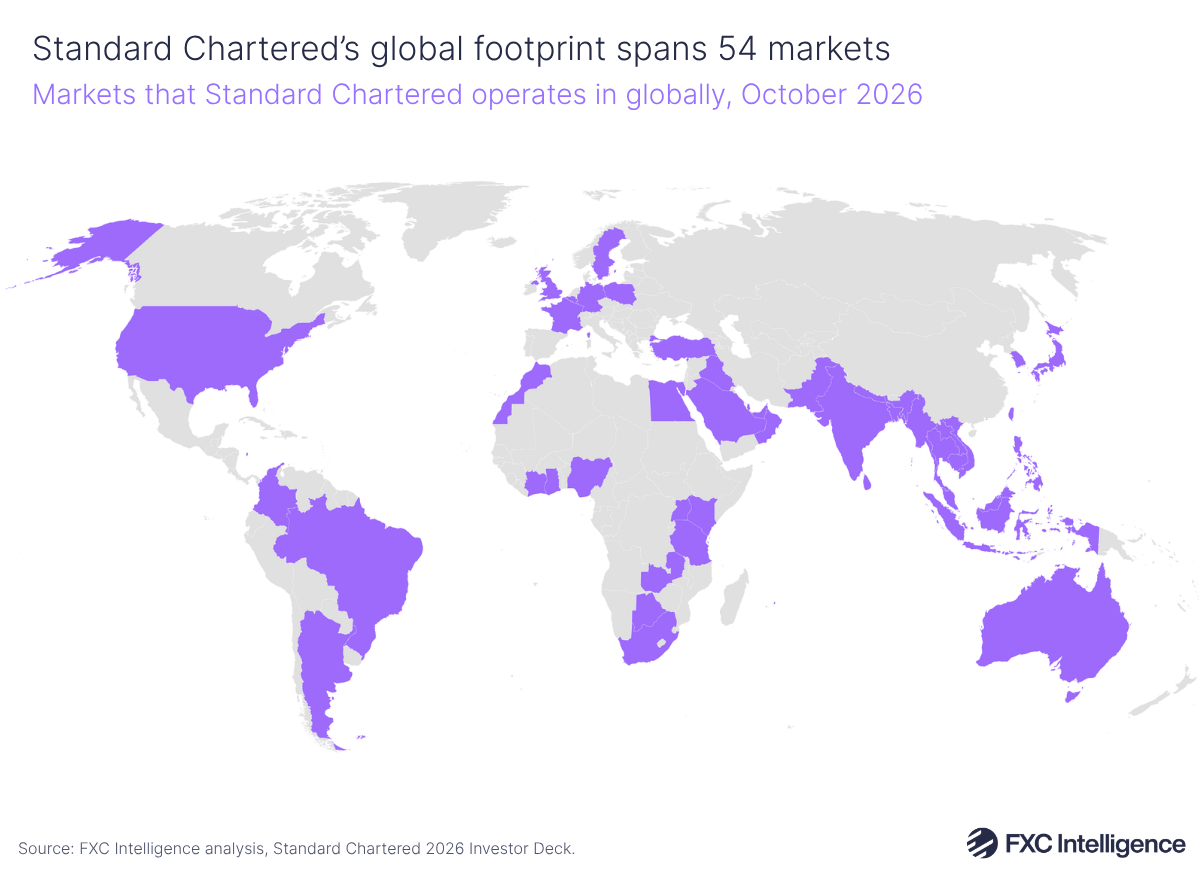
Standard Chartered has positioned itself as a global ‘super-connector’, connecting a range of high-growth and emerging markets spanning Asia, Africa and the Middle East with several more established economies in Europe and the Americas.
With a presence in 54 markets, the global bank is increasingly developing its digital asset capabilities, leveraging stablecoins and tokenised deposits to enable faster, more transparent and always-on cross-border trade for its clients.
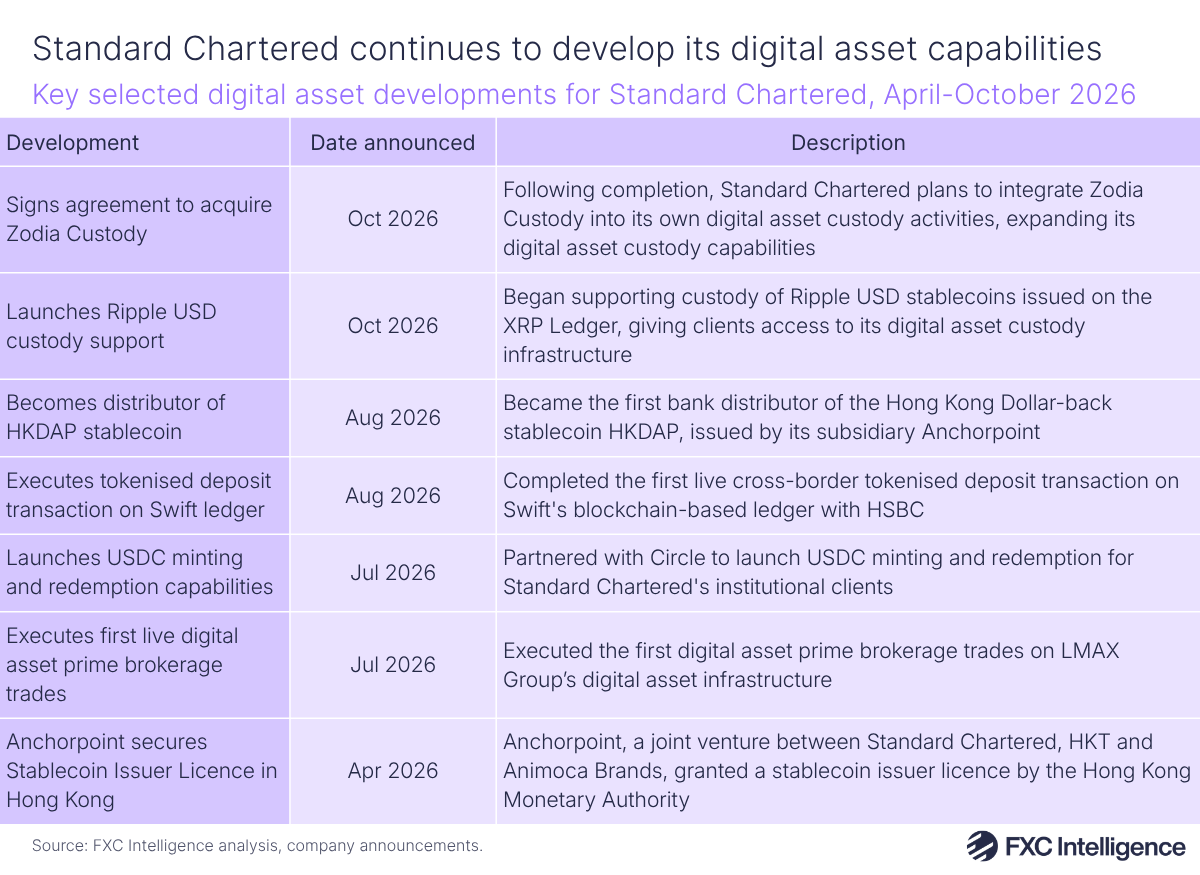
Standard Chartered continues to bolster its capabilities in this area, announcing a wide range of developments in recent months alone. Last week, it signed definitive agreements to acquire digital asset custodian Zodia Custody, having seen its initial offer accepted in May. Following the acquisition, Standard Chartered plans to integrate Zodia Custody’s activities into its own digital asset custody, financing and securities services business.
The bank also remains at the forefront of digital asset testing and developments for trade globally, completing the first interbank cross-border tokenised deposit transaction on Swift’s blockchain-based ledger with HSBC in August, saying the development highlighted the potential for digital assets to enable an increasingly 24/7 global economy.
As digital assets become more commonplace across the global economy, it is becoming increasingly important for banks like Standard Chartered to position themselves between fiat and digital asset flows.
We sat down with Mandy DeFilippo, CEO, US, Europe, MEA and Pakistan, and Dhiraj R. Bajaj, Global Head, Financial Institution Sales, Transaction Banking, to explore how Standard Chartered is positioning itself between the fiat and digital asset ecosystems.
Standard Chartered’s role as a global super-connector
Daniel Webber: Standard Chartered often describes itself as a super-connector bank – it’s across Asia, Africa, Europe, the Middle East, the whole world. What does your cross-border payment strategy look like today?
Mandy DeFilippo: Thanks, Daniel. What we see is the world is becoming more connected, more complex and more cross-border. So, clients need a bank that can help them navigate that complexity and that cross-border context. That’s where Standard Chartered is differentiated. We’re a super-connector, cross-border bank; we operate in 54 markets around the world and we really connect our clients all across that network.
Because we’re so active in many of the world’s most dynamic markets, we see trends that are emerging in the industry at times earlier than others and digital assets are a great example of that.
We started in digital assets 10 years ago because our clients in many cases had use cases to bring us from some of those dynamic markets that really provided something that satisfied and served a need for them doing cross-border payment flows, especially in areas where there may not be traditional payment rails. So, we really feel well equipped to navigate these circumstances.
Dhiraj R. Bajaj: Mandy used the word super-connector – we have a very unique presence in 54 markets; we clear around 40 currencies. As a super-connector, we’re connecting the West to the East. At the same time, we’re building a lot more optionality in terms of rails for our clients.
We’ve seen the super-connector effect between us being a very strong bank on the fiat payments along with being a bank that is connecting fiat to the digital asset ecosystem that’s coming through. Lastly, I would say what we really bring to the table on our cross-border payment strategy is our ability to provide liquidity and FX in different corridors, our key markets, which is a key differentiator for our clients in this segment.
How are client needs evolving worldwide?
Daniel Webber: Dhiraj – I think you have some great insight here – how have you seen your clients’ needs evolving and how are you responding to that?
Dhiraj R. Bajaj: Sure. There’s definitely a lot of evolution in terms of the needs that we’re seeing from our clients in this segment linked to external factors such as geopolitics and shifting supply chains. We’re seeing a lot of demand for last-mile, real-time payments in different geographies; not all of them are cross-border, but those that are getting cross-border are getting a lot of demand. We’re seeing a lot of interest in optionality on rails. We’ve had Swift traditionally, we moved to APIs and we are seeing a lot more on blockchain, so that’s the other development that’s coming through.
The third piece that we’re seeing is with money moving at the speed of light, there’s a lot more focus on security: controls, security, cybersecurity, because as money moves faster, if there is an error, money is gone. We’re working towards all three of these in terms of using our unique footprint, our last-mile connectivity and our long-standing presence in each of these markets to support our clients for cross-border payments.
Daniel Webber: Mandy, anything you would add to that?
Mandy DeFilippo: I think the one thing to underline is we really are seeing clients now asking for speed and asking for real-time execution. And I think that’s something that we’re always focused on delivering for our clients.
Leveraging different digital asset solutions by use case
Daniel Webber: If we move to focus on digital assets, Standard Chartered has really been an early adopter and now sits at the forefront of the space. Talk us through how you see your digital asset strategy.
Mandy DeFilippo: Our vantage point is our network, right? We’re operating in 54 markets around the world and we use client use cases in digital assets to lead us to product development and developing solutions for the markets as they evolve. So now what we’re seeing is people asking for lots of different solutions all at the same time as digital assets develop. So it could be tokenised, it could be stablecoin, could be other types of solutions, and it could be digital payments or, frankly, fast payments in traditional currency. We see all of that all at the same time.
What’s interesting for us is we now can make digital assets, whether it’s tokenised assets or stablecoins, we can make that interoperable with fiat and really deliver to the client what the client needs without the client specifying what it is. It’s really about allowing the use case to select which one we go with, rather than pre-deciding what is needed by the market. And I think that’s the direction of travel that we see.
If you think about what is going to scale digital assets, to me, it’s three things: you’re going to need interoperability, you’re going to need all the solutions to be able to operate all at once or at least seamlessly to kind of mimic the cross-border flows that we see in traditional payments now.
You’re also going to need legal certainty, people are going to need to understand the legal framework that applies, so that they understand what they own and when something actually finally settles, that’s very important.
Then the third thing I think we’ll need is KYC information and transparency because we see KYC and AML compliance is something that regulators are continuing to focus on, and it’s going to need to be delivered by whatever system we emerge with as all of this develops.
What role is AI playing at Standard Chartered?
Daniel Webber: Dhiraj, let’s move on to AI, which can very much overlap with digital assets. How is Standard Chartered approaching this piece of the puzzle?
Dhiraj R. Bajaj: Sure. We’re in conference season and I don’t think there’s any conference I’ve gone through without discussing digital assets and AI, because there’s a lot of linkage there. If you see how it’s evolving, with money becoming more programmable and also with the movement of money becoming easier, there is definitely a role for AI in this whole segment.
When you look at programmable money, talking about agentic payments in the future, you’ll have agents on the client side and you might have agents on the bank side, in terms of processing these payments. But in the fiat payment space, I definitely see AI being very helpful from an operational standpoint. There’s a lot of fragmentation on payments, volumes will increase when it’s easier to move money and AI can be a massive tool for banks and other financial institutions for payment processing, repairs, monitoring, all our regulatory obligations and reporting.
The fact is, when money is moving 24/7, you will rely upon AI solutions for the same parts I spoke about before: payment processing, monitoring, etc. So that’s where we’re focusing our efforts: how AI can help us in this whole payments process.
How is Standard Chartered positioning itself between fiat and digital flows?
Daniel Webber: The vast majority of flows remain in fiat despite the changing of rails and digital assets coming in. Where do banks sit in this ecosystem going forward, and where does Standard Chartered sit within that?
Mandy DeFilippo: It’s a great question. The role of banks in the future of markets and a digital market is really something that we think a lot about. I believe that banks will absolutely have a role in a world where money and markets are digital. If you think about it, the reason for that is simple.
Banks are essentially the police of the financial system today. We operate in a regulated environment, we have licences, we have compliance, a lot of infrastructure that has been built up towards acting in that role. When you think about what it takes to deliver money from A to B securely, banks have been doing that for a long time. Clients are still going to want to be able to trust the system when it’s digital, just as they do today with a traditional system, and banks are really the only players that can provide that trust.
In the near term, as I was saying earlier, clients are going to send payments through an expanding mix of products and services. To remain relevant, banks are going to have to coordinate that infrastructure and be able to become almost payment architects and navigate that landscape. I believe that banks will ultimately continue to win trust by being able to really deliver the system the way it is delivered today. This is about people’s money. It’s not optional. And I think because of that, in order to get people to use the system, they need to be able to trust the system.
Daniel Webber: Dhiraj, anything you want to add to that?
Dhiraj R. Bajaj: I think we go back to the word super-connector. Where do we fit in? We’re going to sit right in between the fiat payment ecosystem and the digital asset ecosystem, so that’s one.
In addition, we will always be there for regulated financial institutions, providing underlying risk management, liquidity that is required 24/7, as well as the FX, because all of that has to fit into that ecosystem. The third piece is that there will be different use cases for whether it is fiat payments or whether it is digital asset payments, and they will in the future coexist. Banks like us will sit right in between, serving clients on both sides.