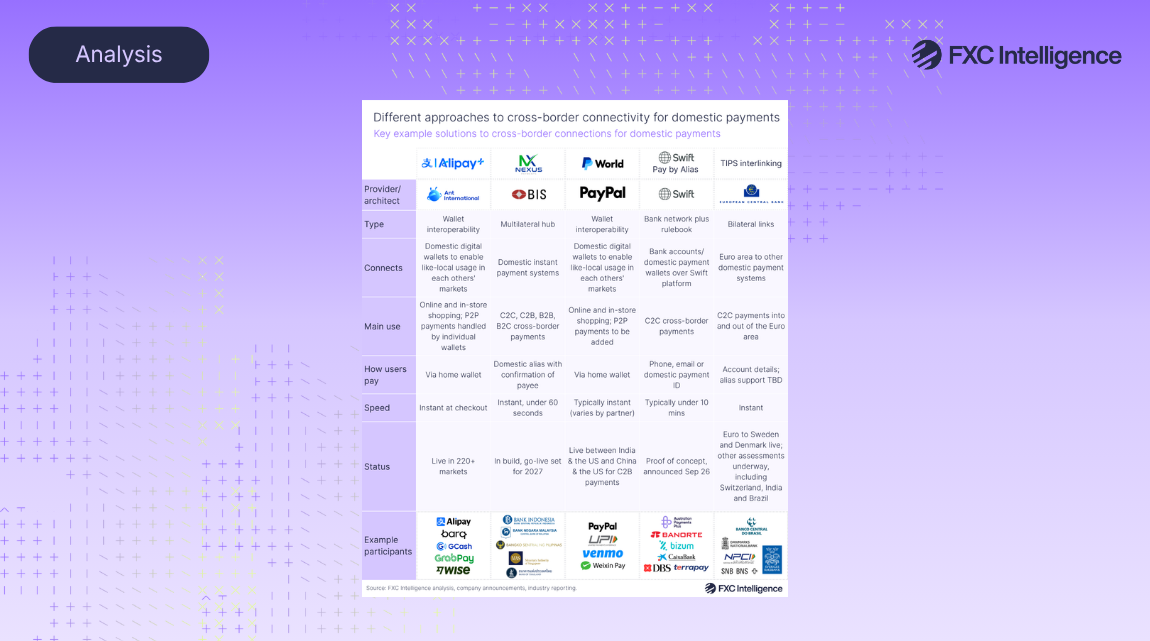

Ant International has launched an overhauled full-stack payments platform, built on AI and blockchain infrastructure, as it sets its sights on global money movement in and out of Asia. We caught up with Gary Liu, CEO of Ant International’s merchant payment brand Antom, to find out more.

Ant International has undergone considerable change over the last few years. Having begun life as the international business unit of Chinese domestic payments and technology giant Ant Group, it established itself as a separate, independent entity just two years ago in 2024.
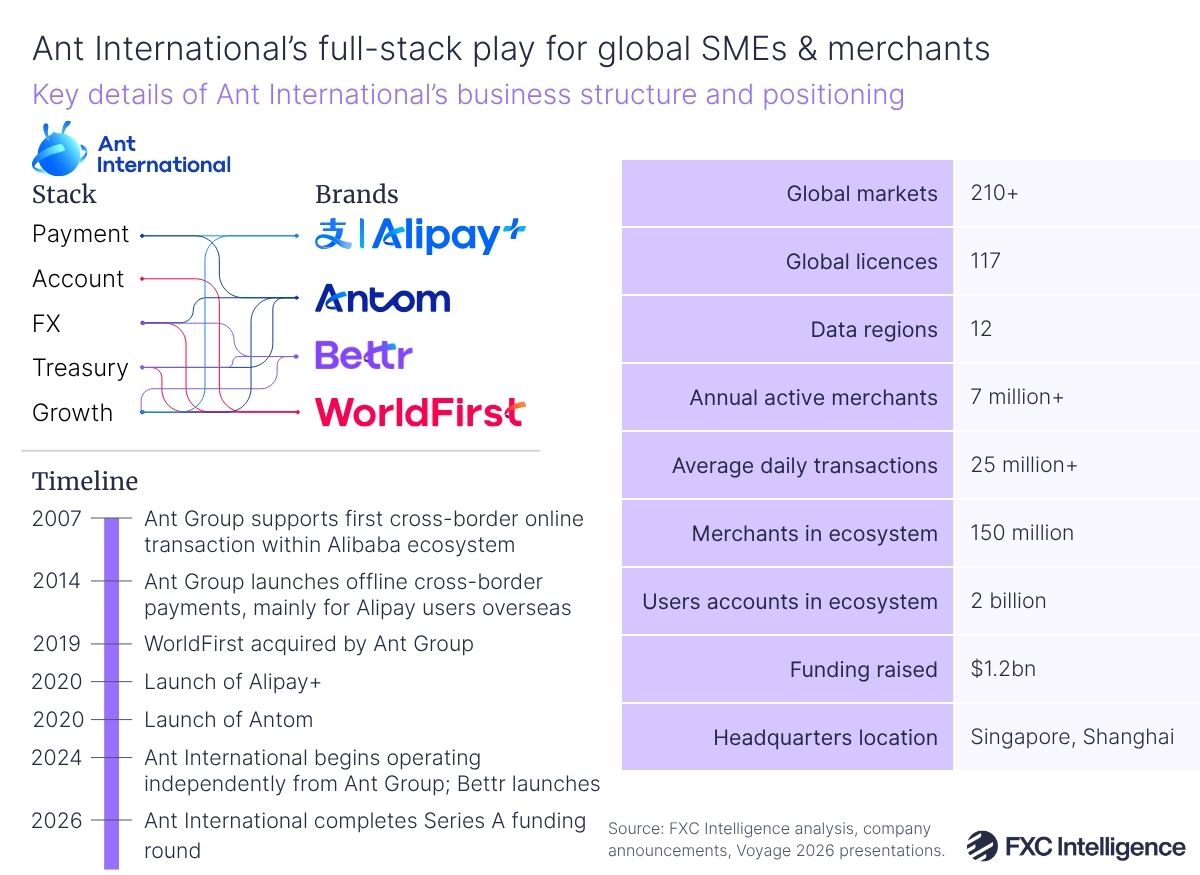
This saw it bring together the 2020-founded cross-border digital wallet solution Alipay+ and 2019-acquired B2B payments provider WorldFirst, alongside newly established brands such as the merchant payment services provider Antom and the embedded finance brand Bettr.
Today it is a key name in the Asian cross-border space, underpinning the cross-border capabilities of some of the world’s most-used digital wallets and online brands, with more than two billion user accounts across the wallets and banking apps it connects and 150 million merchants in its ecosystem.
It is also increasingly centring its technological capabilities. Earlier this year it raised $1.2bn in a Series A financing round that positioned it as a key provider of cross-border payments and agentic commerce solutions, with the proceeds set to be used to support its global expansion and continued technological development.
September provided the first in-depth look at how the company is developing since it announced the funding round, with the holding of Voyage, its flagship annual event for customers, partners and executives. This year held in Shanghai, the event saw Ant International announce a wide range of products and solutions as part of its new “industry-first, AI native, end-to-end full financial stack” that aims to simplify processes and target pain points for its customers.
“We are a problem solver for merchants,” says Gary Liu, CEO of Antom and SVP of Ant International. “We want to understand where in the value chain that things break.”
Against the backdrop of Voyage, we caught up with Liu to learn more about Ant International today and how the company is thinking about growth and its place in the global payments landscape.
Ant International: Four units, one company
While initially the four units of Ant International were largely distinct in terms of positioning and customer base, over time they have become increasingly synergistic and cross-pollinating; something that Liu says has “always been the intention”.
“Antom is not a standalone business. We should look at Ant International as a whole,” he says.
While it has a growing presence globally, the company caters not only to global enterprises but particularly to SMEs and merchants in Asia across its four brands. This sees Alipay+ serve as a unified wallet gateway to support broad payment acceptance for merchants; Antom provide merchant payment and digitisation services; Bettr provide embedded finance solutions for businesses and institutions, with a strong focus on micro, small and medium enterprises (MSMEs); and WorldFirst provide global account and treasury management services.
“We’re not a card scheme, we’re not a bank, we’re not necessarily a payment provider,” adds Liu. “We are a full-stack provider: we have payments, we have accounts, we have treasury FX.”
This was reflected in the messaging at the Voyage event, where the merchant-focused attendees were showcased solutions from across the Ant International portfolio, with a particular focus on Antom’s merchant payment solutions and WorldFirst’s treasury payment solutions.
Speaking in his keynote address at the event, Ant International CEO Peng Yang furthered this narrative, framing the company as “one of very few players in the industry” to cater to the sector with such scale and breadth.
“We don’t just have the core competencies for each of these parts. We also have the scale, the real impact and are creating real value in the industry,” he said.
AI as infrastructure: Ant International’s model-based approach
Underpinning much of Ant International’s offering today is a significant technology investment, including solutions based on both blockchain and AI. This has seen the company develop a number of foundational solutions that are now serving as infrastructure for key products.
On the AI side, rather than developing a broad, single large language model that can be applied to different areas, Ant has instead developed a number of more lightweight, specialist non-language models that are tailored to different applications.
“While LLM models digest all the human languages, our data points are very different. They are structured, they are sparse and most importantly, they are weakly semantically correlated,” explained Dr Tianyi Zhang, Chief Trust & Security Officer, Ant International, during a talk at the Voyage event. “You cannot easily plug your data into a large language model and expect excellent performance: we have to reinvent the foundation.”
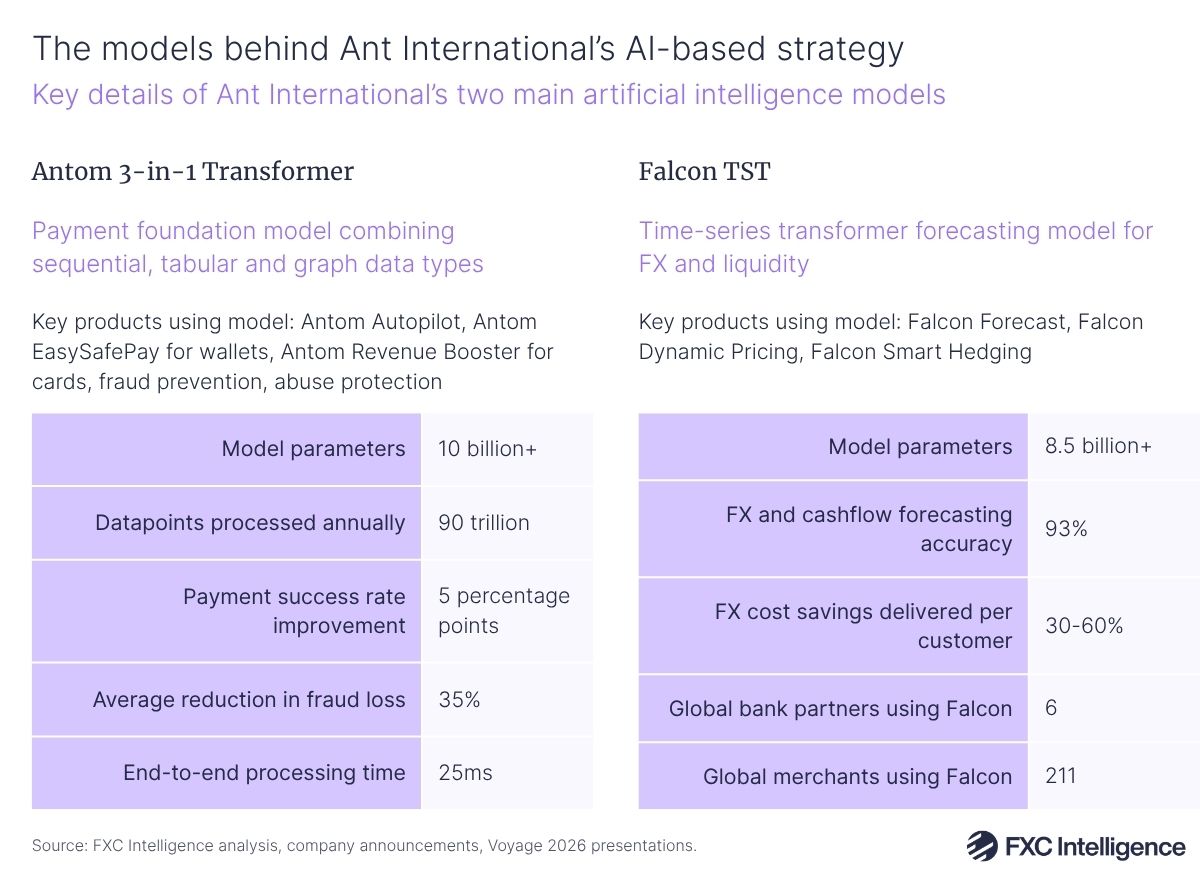
While it reports running 1,800 different neutral network models as part of its offering, the company’s latest full-stack solution is built primarily on two foundation AI models: Antom 3-in-1 Transformer and Falcon TST.
Antom 3-in-1 Transformer is a payment foundation model that is trained on Ant’s own transaction history. The name refers to the three types of data it handles simultaneously: sequential data, i.e., the order of a user’s transactions over time; tabular data, i.e., the spreadsheet-style risk dimensions maintained by payment companies; and graph data – the relationships between different entities, such as seller to buyer, clicks to checkout or device to location. This combination of capabilities enables it to be used for a range of payment-related activities, including payment optimisation, fraud and risk management and dispute handling.
Meanwhile, Falcon TST, or time-series transformer, is a forecasting model that takes numeric data series that move over time – such as cash balances, FX rates or transaction volumes – and predicts how they will move next. This has allowed Ant to apply it to a number of key solutions, including Falcon Forecast, which predicts cashflow liquidity and FX; Falcon Dynamic Pricing, which enables local currency pricing; and Falcon Smart Hedging, which monitors FX exposure and builds hedging strategies.
“Right now, the real blocker for better productivity is no longer the intelligence of the model: the model actually is smart enough,” says Liu. “It is the context that you provide to the model, and the knowledge base that you have accumulated, so that the agent knows exactly what it needs to do.”
As a result, Ant also regards the data it trains its models on as a strong competitive moat.
“This model is trained on over 90 trillion data points annually and it keeps growing, because it’s not our first day doing payments,” says Liu of the company’s 3-in-1 Transformer model. “We’ve been doing payments over the past decade, and accumulated so much real-world data that supports the training of this particular model.”
With a wide array of products across its platform, the ability to sell multiple solutions to the same customer is central to Ant International’s strategy. However Liu also highlights that it gives the company the option of using certain aspects of the business as loss leaders as part of the wider revenue attraction and retention strategy.
“We look at the whole value chain on how we’re able to monetise, so we might be willing to consider using one service as a customer acquisition tool in order to monetise the others, as long as Ant International overall benefits,” he explains.
He cites the relationship between Ant’s cross-border payments and its hedging solution as a key potential example of this. The company’s AI-based FX demand forecast model Falcon relies on payment data to ensure it is accurate, with greater accuracy translating into lower costs for Ant to deliver its hedging service.
“So the benefit we’re able to get from the cost reduction in our hedging and our FX significantly outweighs the amount of payment fees and margins we can get.”
Agentic interactions and AI support
The company’s foundation models underpin over 100 products across Ant International’s four brands as part of its AI-based financial stack. For parts of this, much of the impact and presence of AI is felt in terms of operational and efficiency improvements. For example, Ant reports 3-in-1 Transformer having driven an average increase in payment success rates of five percentage points and a 35% reduction in average fraud loss.
However, the company also has highly visible AI as part of its payments stack, with AI agents forming a central part of how its clients engage with its products. Merchant customers using Antom, for example, can use the company’s agents for activities such as onboarding and integration, chargeback and dispute handling and subscription configuration, as well as ongoing monitoring of promotions and other activities, with customers at the Voyage event shown a variety of live demos of these features in action.
This has translated into significant adoption, with the company reporting that 89.5% of its merchants have begun using Antom AI agents over the past year, with 81.4% of Antom merchant payment tasks being executed by AI.
Meanwhile, WorldFirst enterprise customers can use agents to view, query and engage with their global network of accounts and subsidiaries via the Money Map feature, as well as access hedging solutions based on forecast market behaviour and requirements through an agent connected to Falcon Smart Hedging. Provided in partnership with key banking partners such as Citi and Standard Chartered, this is designed to optimise when companies need to engage in FX hedging, with the company reporting typical FX cost savings of between 30% and 60%.
Central to the company’s strategy around using AI is that it is not about “going all in” on the technology to achieve radical step-changes, but about fine-tuning existing processes to remove key pain points.
“We still see 90% of the opportunities being in existing optimisation: the majority of our focus is on how we use AI to optimise the existing tasks,” explains Liu. “That’s where we spend most of our resources; we want to help our merchants out.
“At the same time, we are doing all the things that we should be doing on the agentic side, the new tasks, where the main focus is how we motivate our merchants to embrace it, because nobody today is thinking from a merchant’s perspective.”
Enabling AI to make payments
Beyond this, Ant International is also focused on supporting AI providers themselves, with tailored solutions through WorldFirst and Antom. This includes supporting their billing and other operational needs, where Liu cites the company’s local payments support as a key point of appeal.
“We offer them a wide range of payment methods that support recurring payments across the markets, like PayPay in Japan and various wallets in Southeast Asia,” he says. “We also support Pix Automático, which is a subscription recurring payment in Brazil, etc., whereas other providers might only offer a subset of what we offer.”
He also cites the company’s capabilities around fraud protection and abuse handling, while another key area is enabling agents themselves to make payments, and supporting the broader ecosystem around this.
This has seen the company evolve several of its key products to be agentic-native, as well as develop its Alipay+ Agentic Mobile Protocol, which already connects to leading acquirers including Adyen, Nuvei and Worldpay. The company is also collaborating with Visa and Mastercard to develop a know-your-agent (KYA) interoperability framework.
The Voyage event also saw Ant International announce WorldFirst for Enterprise Account for Agent (AFA), which it describes as the “world’s first truly agentic account for businesses”. This is designed to provide an agent-friendly alternative to the human process for corporate expense approval and management, shifting the focus from who is being authorised to what the activity is being authorised for.
“It doesn’t really matter who the agent is, it matters what the task is and if the delegation matches that particular task, so the way that you verify transactions becomes totally different,” adds Liu.
Tokenised deposits: Blockchain adoption at scale
While AI is key to the company’s renewed offering, blockchain also plays a quieter but important role, with Ant International having taken significant strides in tokenised deposit-based blockchain technology.
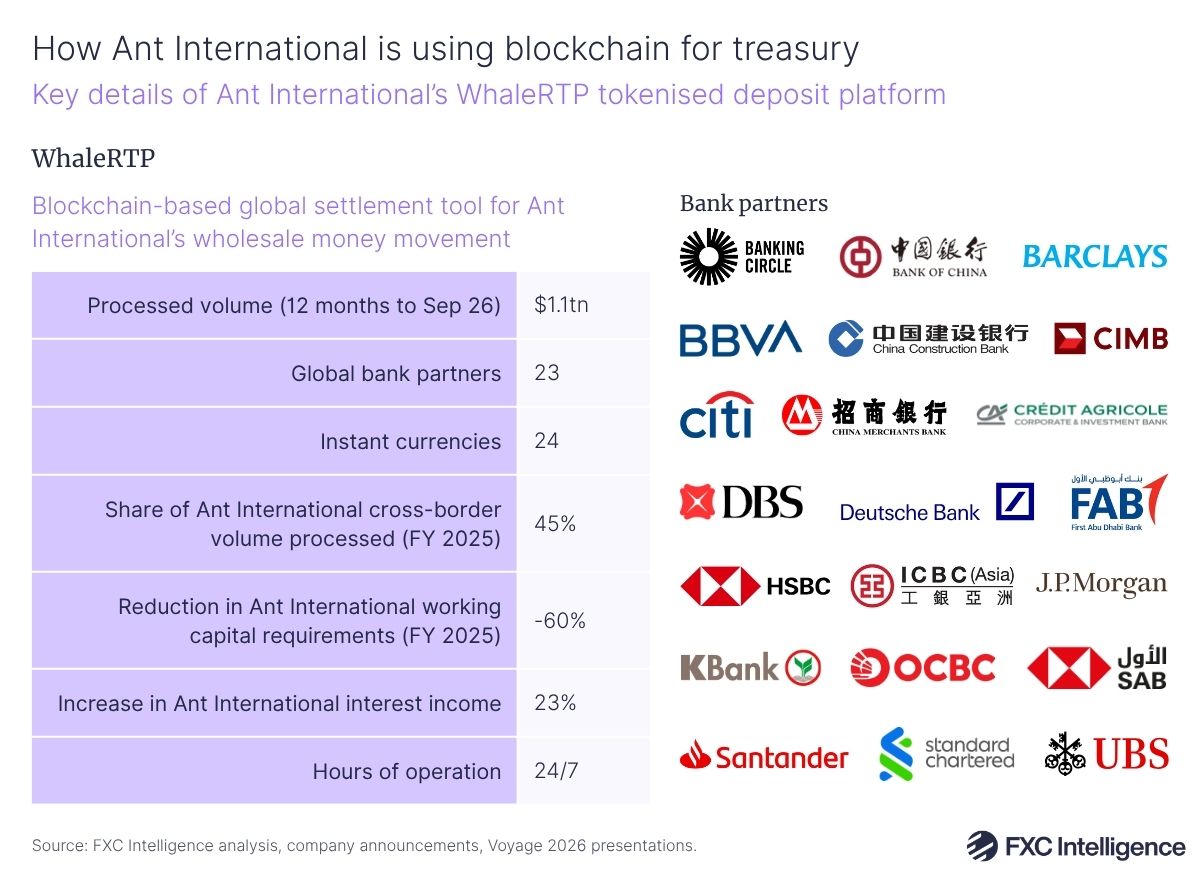
This has seen it develop WhaleRTP, a blockchain-based global treasury and liquidity management solution. First developed in 2019, this has grown to see participation from 23 leading financial institutions, including Barclays, DBS, HSBC, J.P. Morgan and Standard Chartered, with the latter, for example, using the platform to tokenise Ant International deposits in HKD, CNH and USD.
“This is essentially an interoperable blockchain-based global settlement infrastructure that we built together with many banks,” explains Liu.
“Most of the significant global infrastructure banks are our partners, and this is where we enable cross-border and domestic settlement on a real-time basis 24/7.”
Ant International reports that in 2025, WhaleRTP processed 45% of its cross-border volume and cut its working capital requirements by 60%, as well as driving a 23% increase in interest income. Over the last 12 months, Ant also reports that approximately $1.1tn has been processed on WhaleRTP.
While the blockchain platform serves primarily as a treasury management solution for the company, it has also paired this with its Falcon Forecast AI capabilities in the form of its Whale Pooling product for WorldFirst enterprise customers. This enables the company to offer intelligent on-demand pooling, which it says removes the need for pre-funding and trapped funds found with traditional “schedule-driven” pooling approaches.
However, while it uses the infrastructure to cater to individual customers, it has opted to keep its blockchain activities on a wholesale basis rather than at the retail level.
“Everything is between banks and licensed institutions. We feel comfortable that if we move a tokenised asset on this blockchain within a group of institutions who are already fulfilling their AML obligations before they bring the money onto our chain, then there will be far fewer AML issues, KYC issues for us,” explains Liu.
“So that’s why everything that we do at the current level with tokenised assets, with blockchain, is very much on a wholesale basis, and the purpose of that is to enable 24/7 real-time money movement around the world.”
Building leadership in Asia
With its broad base of solutions, cross-border capabilities and strong focus on merchants, Ant International is increasingly drawing comparisons to Stripe. Without directly commenting on this, Liu is keen to stress that despite its increasingly international presence, the company is still highly Asia-focused.
While it is particularly strong in serving Chinese merchants expanding globally, the company has coverage in the majority of markets across APAC, with Liu highlighting that it is “pretty well covered” across the continent.However, he still sees particular potential for development in Southeast Asia.
“If you look at Southeast Asia, there hasn’t really been a sizeable multi-region SaaS player. You don’t see a local Square, so to speak, that is winning in every single market in Southeast Asia. We hope that we can play that role.”
The company continues to grow globally as part of its focus on supporting its customers in doing the same.
“We just got licensed in Brazil; we just got licensed in the UAE; we are working hard to bering our solutions to Turkey and Saudi Arabia,” says Liu, adding that for the foreseeable future the focus remains on supporting Asian flows into and out of such international markets.
“We want to position ourselves as Asia’s champion: if you’re a company in Asia, wanting to grow both in the region and globally, we want to be there to support you. Or if you’re a company that operates outside of Asia, headquartered outside of Asia, we help you to address your Asia growth opportunities.”