Standard Chartered has published its Q3 2026 earnings, seeing its quarterly operating income increase 14% YoY on a constant-currency basis to $5.8bn. This growth was partly driven by continued strong performance in its Corporate & Investment Banking (CIB) arm, which contains the majority of its cross-border revenue.
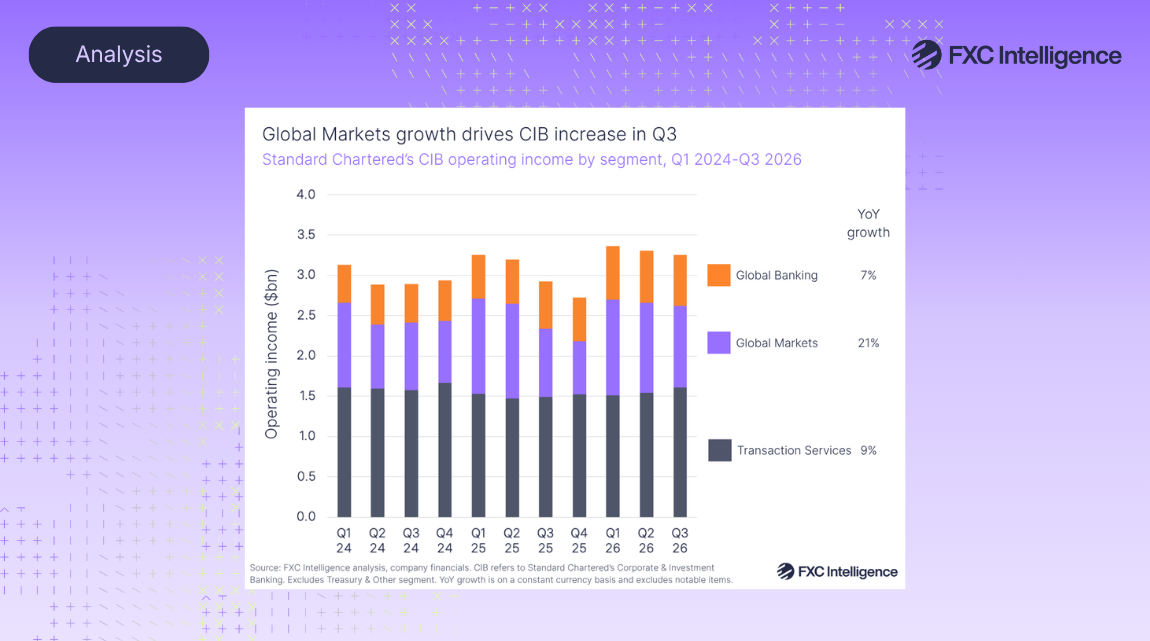
Chart data
| Quarter | Transaction Services | Global Markets | Global Banking |
|---|---|---|---|
| Q1 24 | $1.61bn | $1.05bn | $0.47bn |
| Q2 24 | $1.59bn | $0.80bn | $0.49bn |
| Q3 24 | $1.57bn | $0.84bn | $0.48bn |
| Q4 24 | $1.67bn | $0.77bn | $0.50bn |
| Q1 25 | $1.53bn | $1.18bn | $0.55bn |
| Q2 25 | $1.47bn | $1.18bn | $0.55bn |
| Q3 25 | $1.49bn | $0.85bn | $0.59bn |
| Q4 25 | $1.52bn | $0.66bn | $0.55bn |
| Q1 26 | $1.51bn | $1.19bn | $0.66bn |
| Q2 26 | $1.54bn | $1.12bn | $0.65bn |
| Q3 26 | $1.61bn | $1.01bn | $0.63bn |
| YoY growth | 9% | 21% | 7% |
Standard Chartered’s CIB division, which typically accounts for around 60% of the bank’s overall operating income, saw a 16% constant-currency increase to $3.4bn. Within this, Transaction Services – which has traditionally accounted for the majority of cross-border volumes – saw income increase 9% to $1.6bn, driven by pricing discipline in payments and liquidity products. Meanwhile, Global Banking grew 7% on a constant currency basis to $631m.
Global Markets saw the fastest growth within CIB, seeing its income increase 21% to $1bn, with CFO Manus Costello noting this was driven by “broad-based growth across products”. This was also driven by 21% growth in Flow income – day-to-day income generated by the bank’s Global Markets business – which itself benefited from increased client activity across FX, commodities and credit. Treasury & Other accounted for the remaining $142m of CIB operating income in Q3.
Following a strong quarter, Standard Chartered raised its guidance for FY 2026, now expecting net interest income to increase by around 4% YoY and total income growth to sit above the 5-7% growth range it outlined in Q2.
CEO Bill Winters also discussed ongoing geopolitical challenges, explaining that while Standard Chartered has not been majorly impacted by pressure originating in the Middle East, it is continuing to manage related risks. Winters also shared that, as the bank’s Fit for Growth multi-year programme aiming to boost productivity and profitability comes to an end, it will continue to automate its processes going forward – with the introduction of new AI tools set to support this plan.