

OpenPayd has seen significant growth this year as it expands into the US and approaches a public listing. We caught up with CEO Iana Dimitrova to find out more about the company’s global strategy and how the wider money movement space could evolve next year.
Payments infrastructure platform OpenPayd continues to ramp up its business in 2026. The company recently brought MSB USA into the main OpenPayd group to gain 43 state money transmitter licences in the US, and is aiming to complete its planned listing on the Nasdaq market through a proposed SPAC merger.
OpenPayd’s offering combines both fiat and digital assets into a single accessible API for payments providers, with solutions spanning international and domestic payments, accounts, wallets, FX and stablecoins trading, open banking services and more. The company has grown its reach to span international rails across more than 180+ countries, as well as 70+ domestic rails.
According to figures the company provided to the SEC in October, OpenPayd projects its revenue for FY 2027 (ending in April 2027) to rise by approximately 28% YoY to $93m, driving an EBITDA margin of 17%. Corporate client growth has driven annualised transactions to more than 43 million in October 2026 (i.e. counting the prior 12 months), with annualised transaction volumes of more than $360bn and annualised revenue of $107m.
OpenPayd has also seen growing digital asset volumes since launching its stablecoin infrastructure in 2025. Stablecoin orchestration revenue rose from $0.5m to $3.9m in H1 2027, accounting for approximately 8% of OpenPayd’s total H1 2027 revenue, which rose by 43% to $47.5m. Stablecoin orchestration also accounted for 32% of its revenue from new customers onboarded in H1 2027, highlighting the role stablecoins are playing in attracting new business.
OpenPayd’s growth aligns with its continued push for global expansion, with the US addition building on licences in Europe, the UK, Canada and South Africa. We sat down with OpenPayd’s CEO Iana Dimitrova to find out what the US will unlock for the business, its strategy and how technology could push further gains for the industry going forward.
OpenPayd’s position in the market
Daniel Webber:
Where does OpenPayd sit in the market currently?
Iana Dimitrova:
OpenPayd sits squarely at the intersection of traditional payments and banking services on the one hand and regulated digital assets on the other hand.
We’ve developed a platform that combines any and all services that a business may need in order to move and manage their money on a global scale. In other words, that is payment accounts, local and international payments, treasury management services, conversion services. And today, we offer all of the above in both fiat and digital assets.
Chart data
| Financial year | Revenue | EBITDA margin |
|---|---|---|
| FY 2023 | $18.9m | -43% |
| FY 2024 | $38.8m | 21% |
| FY 2025 | $56.6m | 21% |
| FY 2026 | $72.7m | 17% |
| FY 2027E (estimate) | $93.0m | 17% |
How OpenPayd is approaching US expansion
Daniel Webber:
OpenPayd now has over 40 licences in the US. How are you thinking about launching and growing in the US market?
Iana Dimitrova:
We’re super excited to be coming to the US. OpenPayd is a provider of global infrastructure for financial services and of course, the US is the next immediate priority on our roadmap. We have a lot of our existing customers that are sitting and waiting for us to go live and to go to market with us here in the US.
We have been historically investing in our licence infrastructure; this is one of the two main pillars of our business, and coming to the US and getting the money transmission licences has always been part of the plan. Now we’re working towards building the infrastructure in terms of connectivity to the local payment rails so that we can offer an equivalent level of service to our customers in the US as we do outside of the US and globally.
OpenPayd’s business growth
Daniel Webber:
Can you provide some numbers that give a sense of scale for the company?
Iana Dimitrova:
Today, OpenPayd services more than 1,300 corporate customers and we process over $300bn of payments volume on an annualised basis, in terms of payments in and out of our system.
The business is profitable and cash-flow positive; today, we deliver over $100m of annual recurring revenue and we continue to grow consistently quarter-on-quarter, as we have been over the past few years.
Chart data
| Financial year | Volume | Transactions |
|---|---|---|
| FY 2023 | $22bn | 5m |
| FY 2024 | $52bn | 15m |
| FY 2025 | $100bn | 23m |
| FY 2026 | $176bn | 30m |
Evolving the customer mix
Daniel Webber:
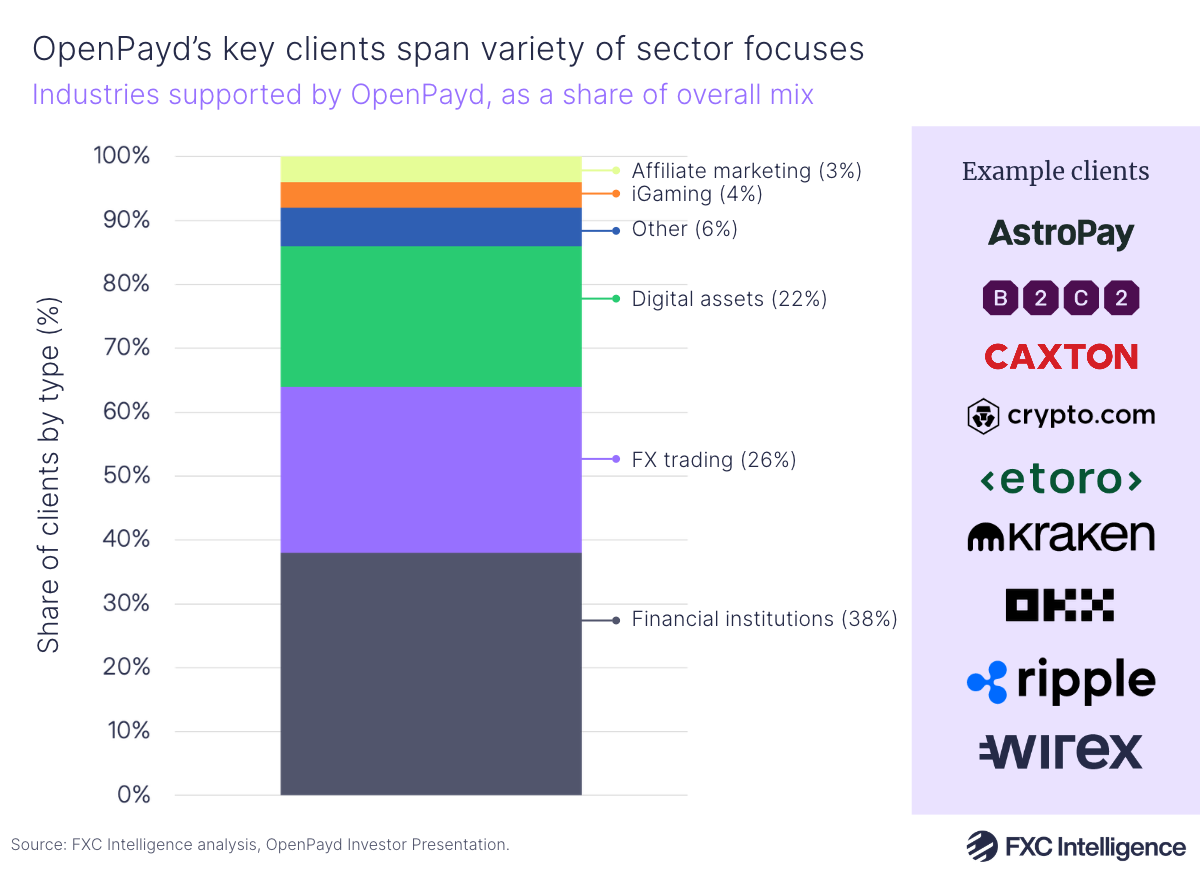
Let’s talk about customer mix. OpenPayd started more in the digital asset-native and crypto-native businesses, but it’s very much evolving now to a broader customer set. Talk us through where you see that customer mix evolving, and will the US change any of that?
Iana Dimitrova:
OpenPayd was really born out of pain and necessity, because historically businesses have been severely underbanked or debanked. A while ago, when we started the company, we set out on a mission to help digital businesses grow. One of the main obstacles for that was the lack of proper banking, the lack of proper payment services.
Historically, when you think about companies and industries that have been debanked, digital assets, of course, comes to mind. This is where we as a business started with some of our early customers like eToro and SwissBorg, and we helped them really not just get access to proper banking and payments, but to rationalise and improve how they think and execute their payment processing needs.
The thing that you need to understand about OpenPayd and our infrastructure is that it is industry-agnostic. On the one hand, we are rails-agnostic: we support fiat as well as blockchain/stablecoin-related payments. But also, we’re industry-agnostic. As we can see, the institutional adoption of stablecoins for cross-border payments is really growing by the day, and therefore we’re ideally positioned to actually service that demand and those needs, and help businesses expand globally wherever they may want to go next.
How global money movement could change in 2027
Daniel Webber:
How do you think global money movement is going to continue to evolve in the next year?
Iana Dimitrova:
First of all, we’re seeing a once-in-a-generation structural shift in how financial services are being delivered. This is very much, on the one hand, driven by the utility of blockchain technology. On the other hand, we’re seeing the advent of both programmable money and agentic payments.
Therefore, I think what’s really important, first of all, is for infrastructure providers like ourselves to be well ahead in terms of the capabilities that they develop so that they can support the need for both programmable money and agentic payments that we’re now seeing from businesses all over the world. That is something that we at OpenPayd have been working on and developing from day one. Our platform and our products are really built with programmable money in mind from day one.
Where agentic payments could have an impact
Daniel Webber:
Which use cases are best suited to agentic payments?
Iana Dimitrova:
I think anything and everything is open to agentic payments right now. In reality, any payment instruction – and that could be for a local payment, that could be for an exchange, for any treasury management services – could be outsourced to a third-party agent.
Therefore, the way that we think about it is: what is the infrastructure that we need to have in place, and what are the controls and the checks and balances that we have to embed into the infrastructure that we offer to our customers, to be able to then go and execute those payment transactions in the way that they choose to do that, whether that is through third-party agents or otherwise? We’re very much focused on the infrastructure and the controls around that.
How OpenPayd orchestrates payments using its network
Daniel Webber:
Is there anything that you feel you’d like to help explain about OpenPayd that maybe people don’t always understand? The blurring of digital assets and fiat is not natural for everybody, because people often come from one or the other.
Iana Dimitrova:
OpenPayd is a provider of infrastructure for businesses to enable businesses to move and manage money globally. But if we take one step back and try to simplify what that means, we help take the pain out of payments for businesses.
In other words, our job is to make sure that when we get a payment instruction to move value from point A to point B, we are in a position to orchestrate; in other words, dynamically route and choose the most efficient channel, whether that channel is a local payment rail in fiat or involves the injection of a stablecoin inbetween, or any other network in order to execute a transaction and an instruction in the most cost-efficient, fastest and most reliable way.
The way to think about us really is [as] a platform that is connected to virtually all relevant fiat payment rails and currencies, and also all of the main networks, so that you as a business don’t really have to think which way to go. You simply give that instruction. [Whether] you want to move value from point A to point B or you want to hold custody, our job is to choose dynamically in real time the best way for you to do that.
The reason why we’re different and unique in the marketplace is because we have built a very comprehensive infrastructure in terms of fiat rail connectivity, because the need for local collections and local disbursements in fiat is not disappearing, at least not anytime soon. We have that last-mile fiat connectivity that allows us to settle and execute those payment instructions in real time, 24/7, which is pretty unique in the marketplace.
OpenPayd’s public listing and next steps
Daniel Webber:
Is there anything else you’re excited about in the industry?
Iana Dimitrova:
We’re obviously very excited to bring the company to the public markets. We are excited to share the journey of OpenPayd with the wider public, and we’re also excited about the next phase of growth, because we really see the listing on the Nasdaq exchange as only the beginning of our journey.
We were just starting with building. We’re very excited to expand in the US, to build infrastructure in the US. We’re looking at the Middle East and the Far East, as a lot of our customers are there and there is significant demand for local capabilities coming in the region. Really, we’re incredibly excited to bring the company to the public markets and really be in that pole position to become the global leader in financial services infrastructure.
Daniel Webber:
Iana, thank you very much for the time today.
Iana Dimitrova:
Thank you so much.