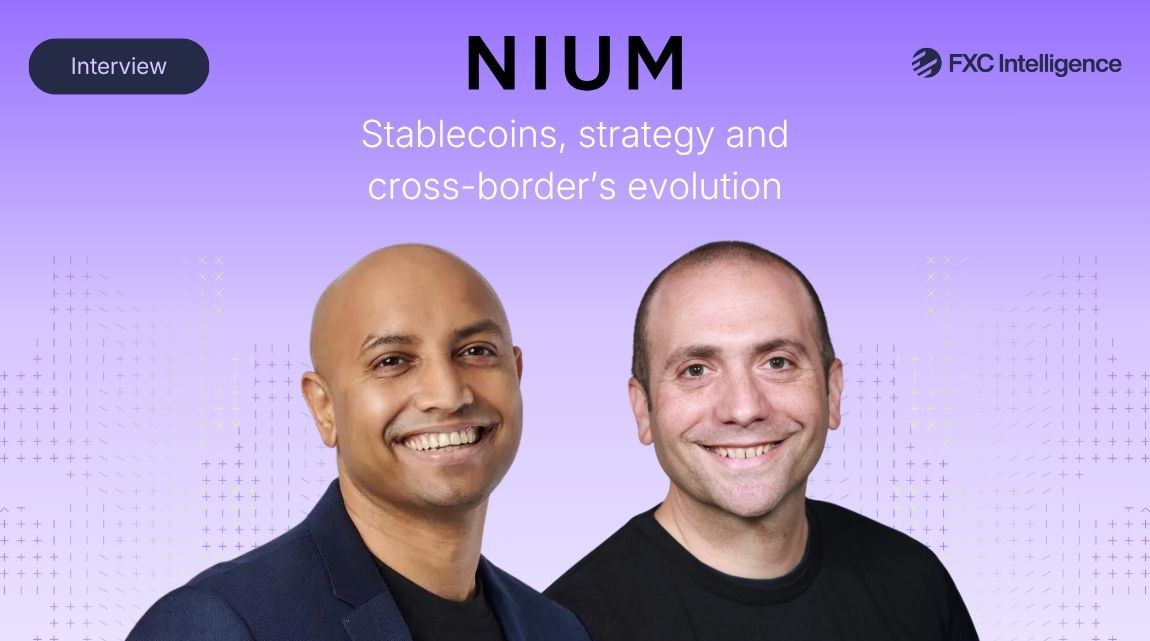


Founded in 2014, Nium has grown to become one of the most significant infrastructure players in the cross-border payments space, and is now spearheading a stablecoin-led evolution. We sat down with CEO Prajit Nanu to explore the company’s growth ambitions, its stablecoin strategy and how it is differentiating from competitors.

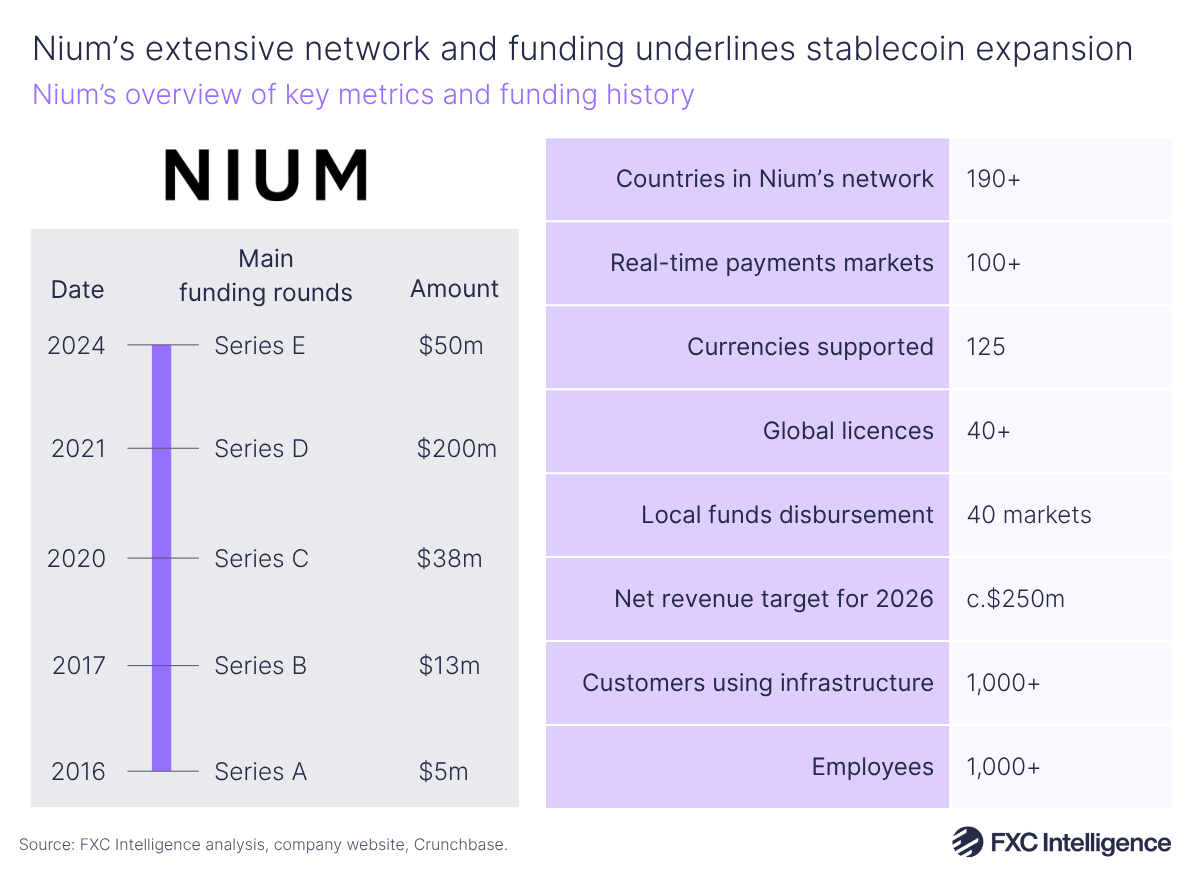
Infrastructure remains crucial for driving gains in speed and efficiency in a vastly complex cross-border payments industry. Targeting this need, Nium has emerged as a significant specialised provider of payment infrastructure services to financial institutions, platforms, enterprises and travel companies, with coverage across 190+ countries.
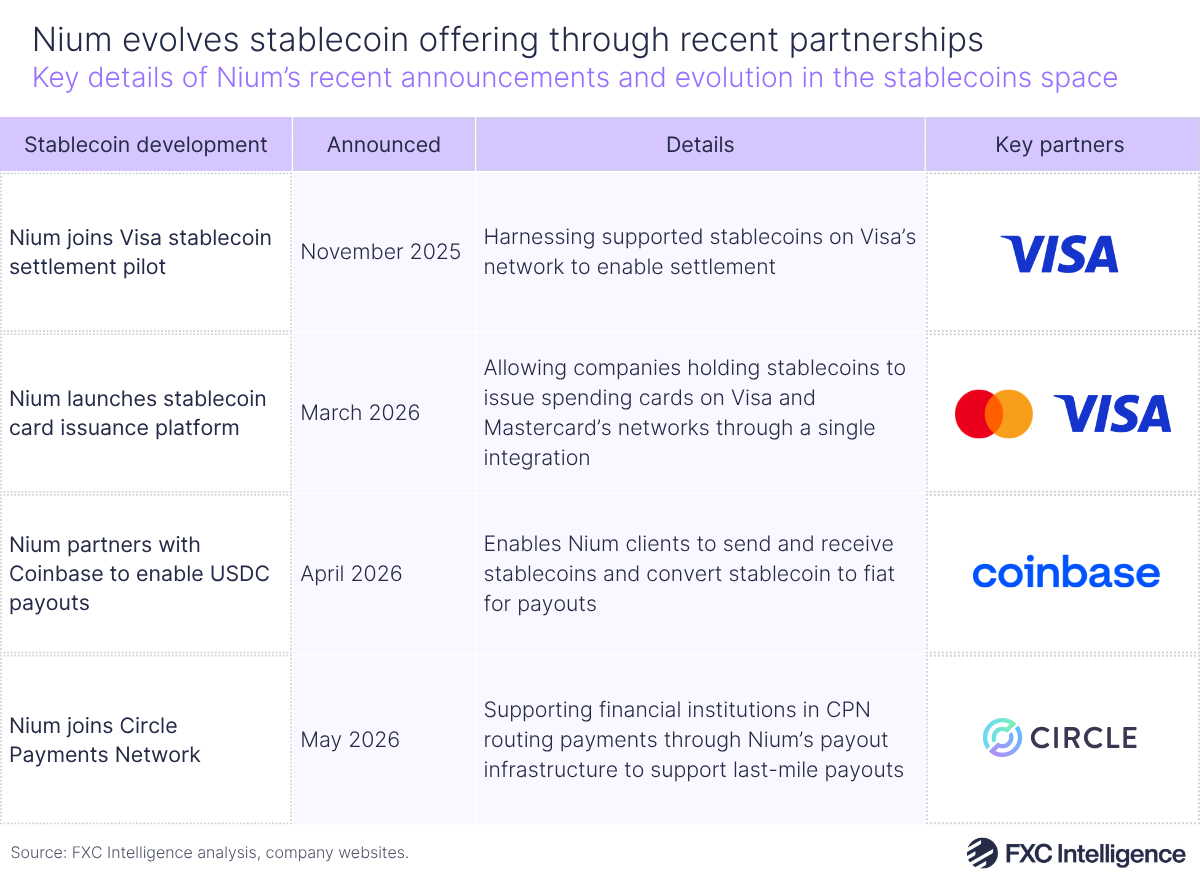
Dual-headquartered in Singapore and San Francisco, US, Nium has built an extensive product set spanning multicurrency accounts, card issuance, payouts, FX and account verification, and the company is now stepping much more boldly into the digital assets space, having launched its own stablecoin card issuance platform in March 2026.
The company has also launched new partnerships with Coinbase and Circle, joining the latter’s Circle Payments Network in May to combine that company’s USDC settlement capabilities with Nium’s own global payments network to speed up the last mile of stablecoin payments.
During Money20/20 Europe, we sat down with Prajit Nanu, CEO of Nium, to discuss how the cross-border payments industry has evolved, where stablecoins fit into the company’s strategy and what’s next for its growth. You can watch our full interview with Prajit, or read the written Q&A, below.
Stablecoins drive cross-border evolution
Daniel Webber:
Prajit, a pleasure to be here with you. Congratulations on being one of our Top 100 most important companies in the sector. Tell me how you’re seeing the industry now and how that’s different to how you saw it a few years ago.
Prajit Nanu:
The energy is very different. One of the biggest changes that is happening in our industry is this whole introduction around stablecoins. For a long time, people wondered: what’s the real use of blockchain and what’s the real use of all these chains?
Now, I think we have a strong product in stablecoins, which is becoming more and more relevant. Stablecoin used to be a crypto product and now it’s getting very mainstream, so I think that’s a big piece.
We, as Nium, are well positioned in this space. Crypto bros, as I call them, still go and speak to a CFO in a language that the CFO doesn’t understand. When we go and speak to a CFO, we are like, “Hey, what do you care about? Do you want the payments to land fast or do you care about the price?”. Accordingly, we will use fiat, stablecoins, Swift, local payments, whatever mechanism, but that’s invisible for the CFO.
That’s what we’ve been trying to change: tell us the outcome you want to focus on and we will drive what is needed at the backend to get it done.
Nium’s positioning in a competitive market
Daniel Webber:
There are other players in the space, it’s competitive, but you’ve really grown to be a big presence. What would you say is the positioning of Nium now?
Prajit Nanu:
It’s a great question, we think about it very frequently. In fact, when I speak to a lot of our customers and prospects, the thing they always tell me is, “Prajit, whatever the majority of you guys say, it’s exactly the same thing. Sometimes you’re sharing some customers as well”.
We’ve really focused very hard to differentiate. One key way where we differentiate is that we are a payments-focused company that is focused on cross-border payments. This is something that we do and this is the only thing that we do. We don’t do acquiring, we don’t do any of those aspects. We are a specialist in cross-border payments. That’s one very big differentiator.
We don’t spray and pray; we focus on three verticals: marketplace and platforms; banks and fintechs; and travel. That’s all we do. And the reason we only focus on these three is because we have a right to win in these three elements.
And the third thing is, across every stack, we are the only one who’s qualified to do C2C, C2B, B2C and B2B payments. Because a lot of people actually think the core infrastructure they’ve built can be used to send a B2B payment that is $100,000. Actually, it doesn’t work. They will have banks stopping them, creating requests for information (RFIs) and so on.
Some people think that, “Oh, we can use it for C2C payments”, which is like $300, right? Our average ticket size on our platform is much higher than the majority of our peers because of our ability to go across these use cases using our licensing infrastructure, and we can disburse money onto a card or a bank. Last year, we issued 41 million virtual cards for single-use virtual payments.
How faster payouts increases revenue for businesses
Daniel Webber:
What are the needs that are most resonating with the customers that you can really serve at the moment?
Prajit Nanu:
We’re flipping the story of cross-border payments or payouts in a different way. Today, payouts is considered a cost centre. They’re like, “Oh, it costs us to send money to a creator or merchant payouts, etc”. But we are now flipping the story, saying we believe that there is a causation related [to this], where if you pay somebody faster, you are actually getting more business.
For example, if you’re a food gig economy worker, if you are paid instantly after every delivery or after every ride, there are more drivers and riders who show up, which increases the revenue for the brand. So, we are now saying don’t think of payouts as a cost centre, think about how it leads to revenue.
We are working on that causation analysis. I should be able to put out a report very soon on what we believe because we’re speaking to various [parties], from content creators to gig economy workers to various industries, where paying someone faster is actually increasing top-line revenue for customers.
Inside the multi-trillion dollar stablecoin opportunity
Daniel Webber:
You’ve been very active in the digital asset space recently, with partnerships with Circle and Coinbase, and you’ve said that you think 50% of Nium’s flows may eventually be processed in stablecoins. Tell us how you’re thinking about stablecoins and where they fit in.
Prajit Nanu:
I actually spoke about this in a joint event we had with Circle. A lot of people are talking about stablecoins as a consumer remittance use case. I don’t think it’s a consumer remittance use case. Today there is about $30tn stuck in nostro/vostro accounts across the globe. And guess what? On those nostro accounts, you don’t make a yield. So, if you made 3.5% on $30tn, that’s a trillion dollars back for the economy to spend. I think that’s the biggest use case.
When I say that we will move 50% of our flow on stablecoins, it’s everything related to treasury because today a lot of banks we work with still accept US dollars to be delivered to them, and today I have to use a wire mechanism to send it. Tomorrow, there’s a way I can instantly settle stablecoins, which will enable me to have faster access to liquidity and so on. So, I’m pretty confident. A trillion dollars back in everyone’s pocket across the globe will be great for everybody.
Nium’s view on tokenised deposits and blockchains
Daniel Webber:
How do you think about the tokenised deposits space? Because that’s now being talked about as another way to engage with digital assets.
Prajit Nanu:
It’s a great point, Daniel. I believe there’s not one size fits all. I think it’ll be multiple of these products. You have tokenised deposits, you have stablecoins. It’s not that there’ll be one product which will work.
We started in 2015, and guess what? 10-11 years later, you still have cheques in the US. You still have ACH, you still have FedNow, you still have RTP. I believe that all mechanisms will continue to build and thrive. I don’t think it’s a winner takes all at all. Some banks like J.P. Morgan and Citi have been big proponents of tokenised deposits. But do I really see a use case today that is coming through? They’re talking about it, I haven’t seen it in real life, but it will happen.
I think the future is not one; you will have stablecoins, tokenised deposits and everybody will have something on blockchain. Blockchain also needs to solve so many things. The privacy blockchains are emerging, and for enterprises, we need some bits of privacy. Imagine it’s like putting up your bank statement online. Yes, you cannot figure out whose it is, but people can start figuring things out. So, I think the future is a mix of all of this with a strong layer of privacy built in so that enterprises are not worried about their data online.
How can companies like Nium differentiate as cross-border payments evolves?
Daniel Webber:
How do you think companies like yours and others will try to differentiate themselves in the cross-border payment space as it evolves over the next five years?
Prajit Nanu:
We’re spending a lot of time and energy on real-time connections. So we believe that the more hops you add between you and the receiver creates more cumbersomeness associated with it. We’re spending a lot of time on that. We do a lot of work on financial institutions, which struggle around nested flows.
Crypto has this great concept called a Travel Rule because you’ll know where the money has come from. We’re creating something similar for nested flows in fiat payments to have full visibility of where the money has been, because it could be that you’re the third layer in the payment and it’s a fourth-party flow, but maybe the second party is somebody nobody likes. So, is there a way to stop it? Today there’s not, but once we launch what we’re talking about, you will.
Our differentiation is more on specific smaller things on execution versus fundamentally something different. Because fundamentally, we still go to the CFO and say, “What’s the use case you’re trying to solve?” because there’s nothing else to engage on. But behind the scenes, we’re saying we want to be more direct, we will create these Travel Rules, we are creating a better compliance layer.
We recently put a marketplace live on our platform. We onboarded a thousand sellers in less than 24 hours. It’s incredible. If I had to do this two/three years ago, it would have taken me a month or more to onboard a thousand sellers. Now we’re able to do it in a day. I think that’s what’s going to happen, much faster and more seamlessly. The future is not saying one thing, but it’s these small things that will create the differentiator.
Banks’ evolving role in cross-border payments
Daniel Webber:
How will banks’ role continue to evolve in the sector?
Prajit Nanu:
I’ve been a very vocal proponent and mostly hated by banks for saying this. I think banks will exit most of the retail payment systems and use infrastructures like us to build on it, and banks will focus on what they are extremely good at, which is lending, corporate deposits, etc. If I had a crystal ball and look at it 20 years from now, I’ll see fintechs will own the transactional layer and banks will own the relationship, the yield and all those layers so that you have a mix of both of them thriving.
Where will Nium be in five years?
Daniel Webber:
What’s your aspiration for Nium in five years’ time?
Prajit Nanu:
I think in five years’ time, it is for us to be able to do a billion dollars of net revenue. That would excite me the most. Everyone believes going public is a part of the journey, but I think it’s the start, not the end of a journey. It’s like a pit stop to refuel the car, I don’t think it’s a milestone. For me, the milestone is a billion dollars of revenue.
We are like a quarter of the way there. In the next five years, we have the ability to jumpstart much faster. So, my focus right now is: how does Nium become a billion-dollar net revenue [company]?
How FXC Intelligence supports Nium
Daniel Webber:
You’ve known FXC Intelligence for a long time. How do you think about the role we play in the sector?
Prajit Nanu:
The world requires the validation part and I think FXC does that extremely well, with the amount of data you guys understand. Even for something like [the Top 100] awards, you will have spent time understanding, researching and spending time with firms because that’s what you guys do.
In our space, especially because everybody looks and smells the same, I think there is a need to differentiate and that’s what you guys bring to the table. Whenever somebody tells me, “Oh, how do I understand?”, I sometimes send people your way saying, “Speak to these guys because they speak to various players in the market”.
Daniel Webber:
Thank you. Prajit, it’s been a pleasure talking to you today. Congratulations again on your award.
Prajit Nanu:
Thank you.