
Following a strategic review started earlier this year, OFX has agreed a proposed acquisition deal with Equals’ private equity owners that would take OFX private. We dig into the details and what could be driving the acquisition in this report.
On 23 July, money transfer provider OFX announced a preliminary agreement with a consortium of funds made up of TowerBrook Capital Partners and J.C. Flowers & Co. (the majority investors), together with Railsr shareholders — which owns B2B financial platform Equals — for an all-cash acquisition of OFX. The deal values the equity of the company at A$247m ($172m) based on July exchange rates), with an enterprise value of A$233m ($162m).
The agreement is still subject to Equals confirming due diligence and entering debt finance arrangements, which it expects to do in the coming weeks, as well as both Equals and OFX obtaining internal approvals. It would see OFX shareholders receiving A$1 ($0.70) cash per OFX share, implying a 9.2X enterprise value (EV)/EBITDA multiple for the company based on its FY 2026 results (spanning the 12-month period to March 2026).
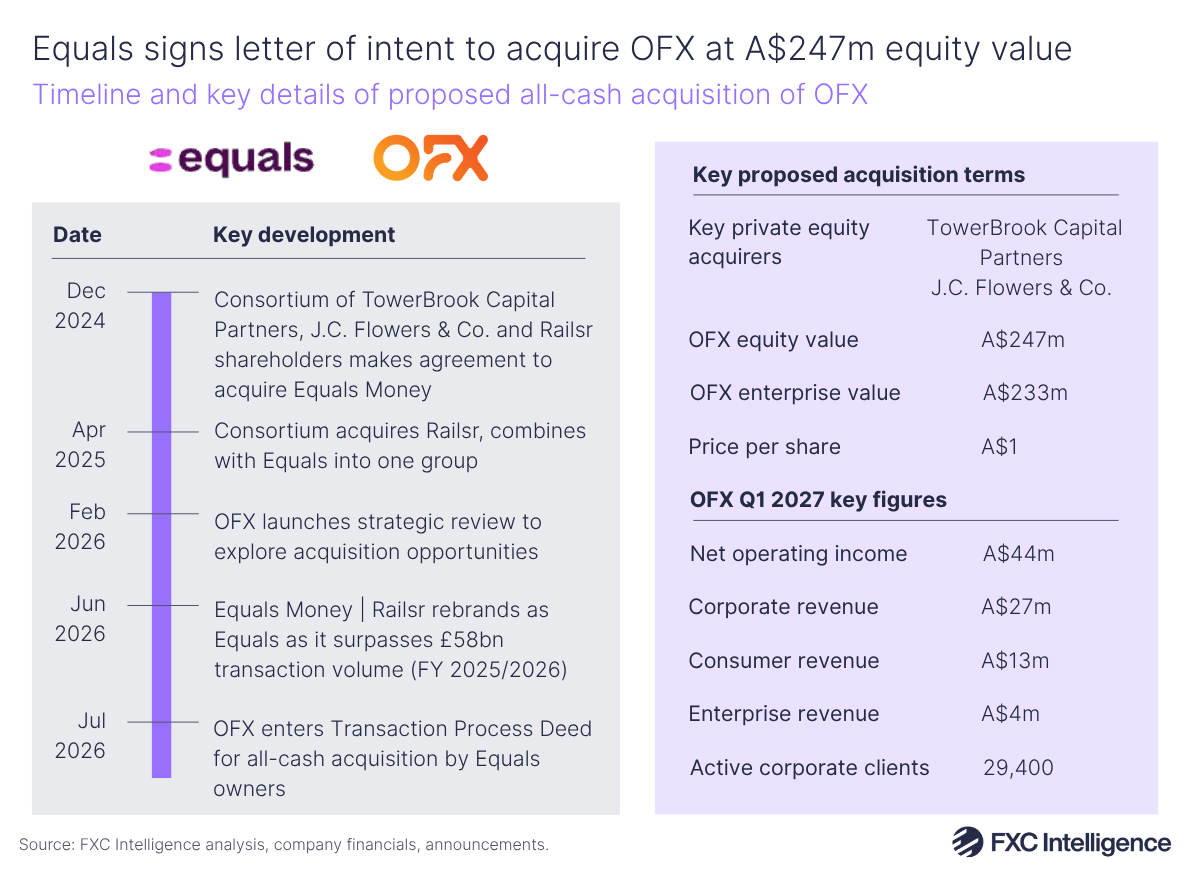
The potential acquisition will be the latest major shift for Equals Group, which over the last few years has seen a shift in revenues towards its services solution, before itself being acquired by the same private equity firm leading this deal in January 2025. In August of the same year, the company was merged with another financial platform, Railsr, with the resulting combined company being officially rebranded under the Equals moniker in June of this year.
For OFX, the acquisition is a substantial development as a series of macro challenges continue to affect the performance of one of the industry’s more significant money transfer providers. Alongside the deal announcement, the company gave a trading update for Q1 2027 (spanning calendar Q2 2026), in which it noted declines in transaction volumes but also saw continued growth in non-FX revenues as it migrated clients onto its New Client Platform (NCP).
In this report, we’ve explored the figures behind the potential deal, and why it is important.
OFX’s share price jumps on potential acquisition news
For OFX, the proposed share price consideration of A$1 per share represents a substantial leap from OFX’s share price of A$0.48 on 4 February 2026, the day before OFX announced a formal strategic review in response to increased inbound acquisition interest. At the time, the company noted that FY 2026 had seen lower transaction volumes driven by “low business confidence” across OFX’s major markets.
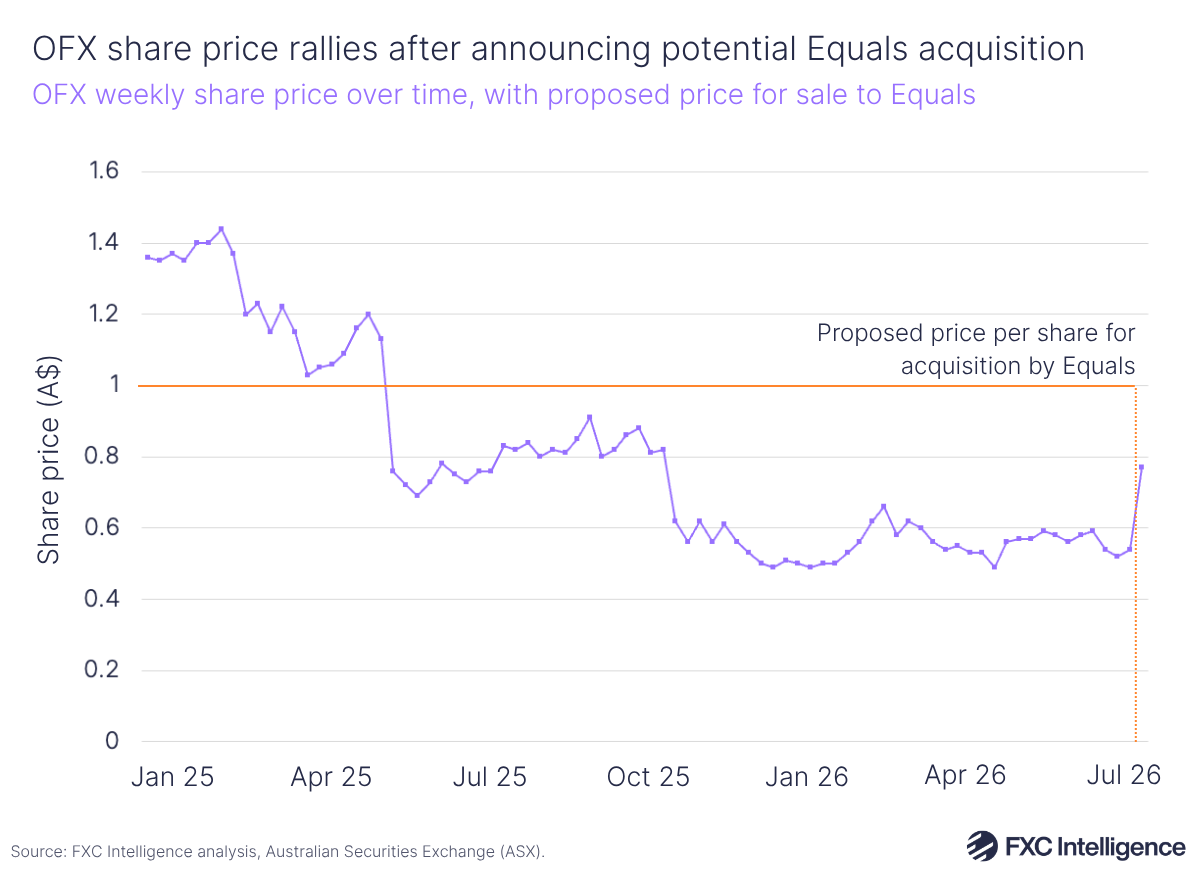
OFX’s daily share price at close rose by 69% to A$0.81 after it made the announcement about the Equals acquisition, marking the highest closing share price it had seen since October 2025. However, this remains significantly lower than the company’s share price when it initially opened on the Australian Securities Exchange in October 2013 (A$2.56).
In its Q1 2027 trading update (spanning calendar Q2 2026), OFX noted that its net operating income (NOI) had risen by 1% QoQ, but was down by 20% versus the previous year. Despite seeing some larger-value transactions in June 2026, the company said that business confidence had remained subdued given geopolitical uncertainty and an unfavourable interest outlook.
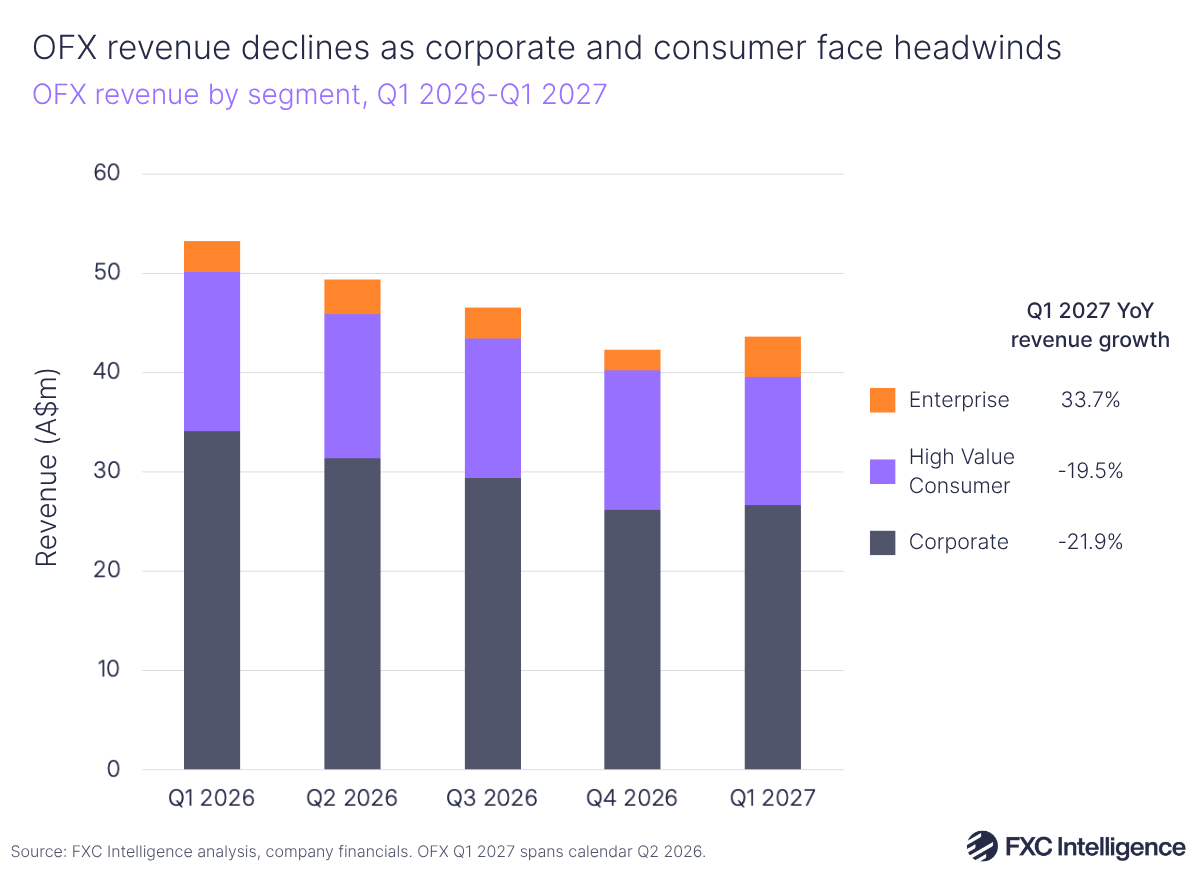
OFX splits its revenue into three core streams, with the largest being Corporate – spanning business clients using its platform for cross-border payments, FX risk management, corporate cards and also non-FX products. The company’s High Value Consumer stream builds upon the company’s original consumer focus and is now pitched at individual clients making large-value transfers.
Finally, Enterprise is OFX’s smallest but fastest growing stream, referring to the white-label solutions and technology integrations it offers to clients that want to use its money transfer network to enable cross-border payments (e.g. corporate customers, B2B2B and B2B2C clients or high-value consumers).
In Q1 2027, Corporate remained the biggest segment but declined 22% YoY in revenues to A$27m, with active clients down 7% YoY. High Value Consumer saw a YoY decline of 20% to A$13m, with transaction volumes declining by 5% QoQ, though OFX did note that cross-currency average transaction values increased by 2% QoQ. Meanwhile, Enterprise saw substantial growth, up 34% YoY and 95% versus the previous quarter to $A4m.
These figures follow a trend in decline for OFX, which noted falling Corporate and High Value Consumer revenues in both its FY 2025 and FY 2026 results.
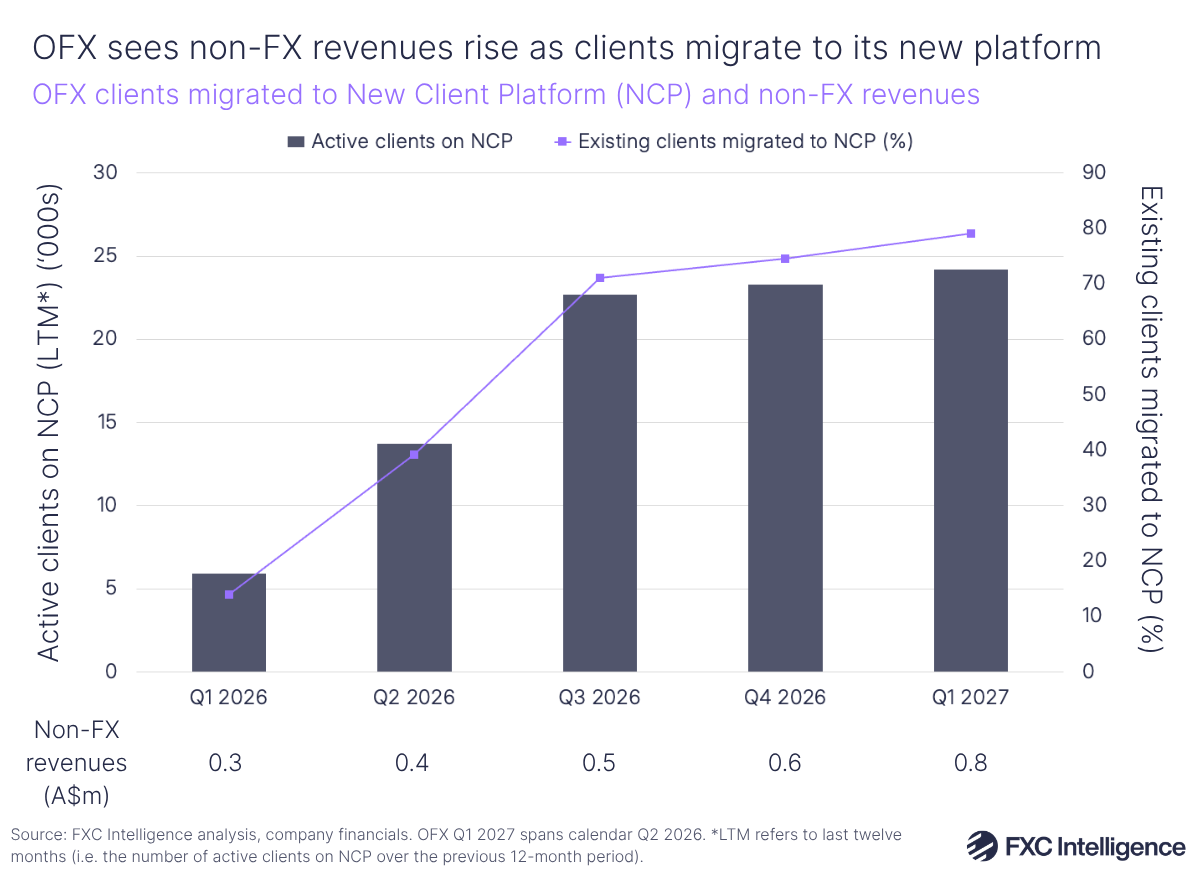
Though macro challenges have affected the company’s volumes, the company has continued to make progress on its ‘OFX 2.0 transition’, having migrated many of its clients onto NCP – its digital financial operations infrastructure designed for corporate and enterprise clients. A key impetus of this has been increasing the revenue that OFX receives from its non-FX products, including its card and subscription services.
OFX has migrated over 24,000 of its active clients onto NCP, up 313% YoY and now accounting for 79% of its existing client base. This is helping to drive the adoption of non-transfer related products, with the company noting that it has grown non-FX revenue by 195% YoY to A$800,000, rapidly outpacing rises in other areas.
Based on calculations derived from QoQ growth figures provided by OFX, the company saw approximately 256% YoY growth in its Pay by Card segment, where the company acquires fees from businesses making payments using cards. However, the largest share of the mix (approximately $345m) comes from Cards, referring to card issuing services, which grew by 176%. Meanwhile, Subscription services – referring to paid tier plans giving businesses access to its Global Business Account and additional services – grew by approximately 155% YoY.
Compared to its core business lines, the overall share of revenue taken by non-FX services remains very low, but it is a signal of OFX’s shift to offset volatility that is affecting transaction volumes. It also reflects a trend that we’ve seen across other money transfer providers (e.g. Wise) as companies increasingly tap into value-add services to businesses to bolster their revenues and retain customers.
In the press release accompanying the trading update, CEO and Managing Director of OFX Skander Malcolm said that the “the positive momentum in non-FX revenue supports a return to growth in Group NOI for FY27”.
Equals’ rebrand and acquisition journey
The Equals that exists now has been the culmination of 20 years of acquisitions and rebrands, but is primarily built from two companies: Equals Group and Railr.
Equals Group traces its origins back to money transfer provider FairFX, which was founded in 2007 and listed publicly in 2014 as FairFX Group, before being renamed Equals Group in 2019. It built out a suite of services through acquisitions, including FX provider CityForex, banking rails specialist Card One and merchant acceptance-focused Roqqett, as well as adding a European payments licence through a takeover of Oonex.
Meanwhile, Railsr was founded in 2016 as Railsbank, a developer of embedded services enabling money movement and banking for fintechs, spanning virtual cards, international transfers, accounts and pen banking. After a series of funding rounds, it was eventually saved from bankruptcy through an investment deal by a consortium (Embedded Finance Ltd) led by D Squared Capital in March 2023.
Shareholders in Railsr, led by D Squared Capital and Moneta, then moved to acquire Equals Group as part of a consortium including TowerBrook Capital and J.C. Flowers & Co., with the goal of merging Equals and Railsr into one company. The Equals deal was announced in December 2024, while the consortium completed its full acquisition of Railsr in April 2025.
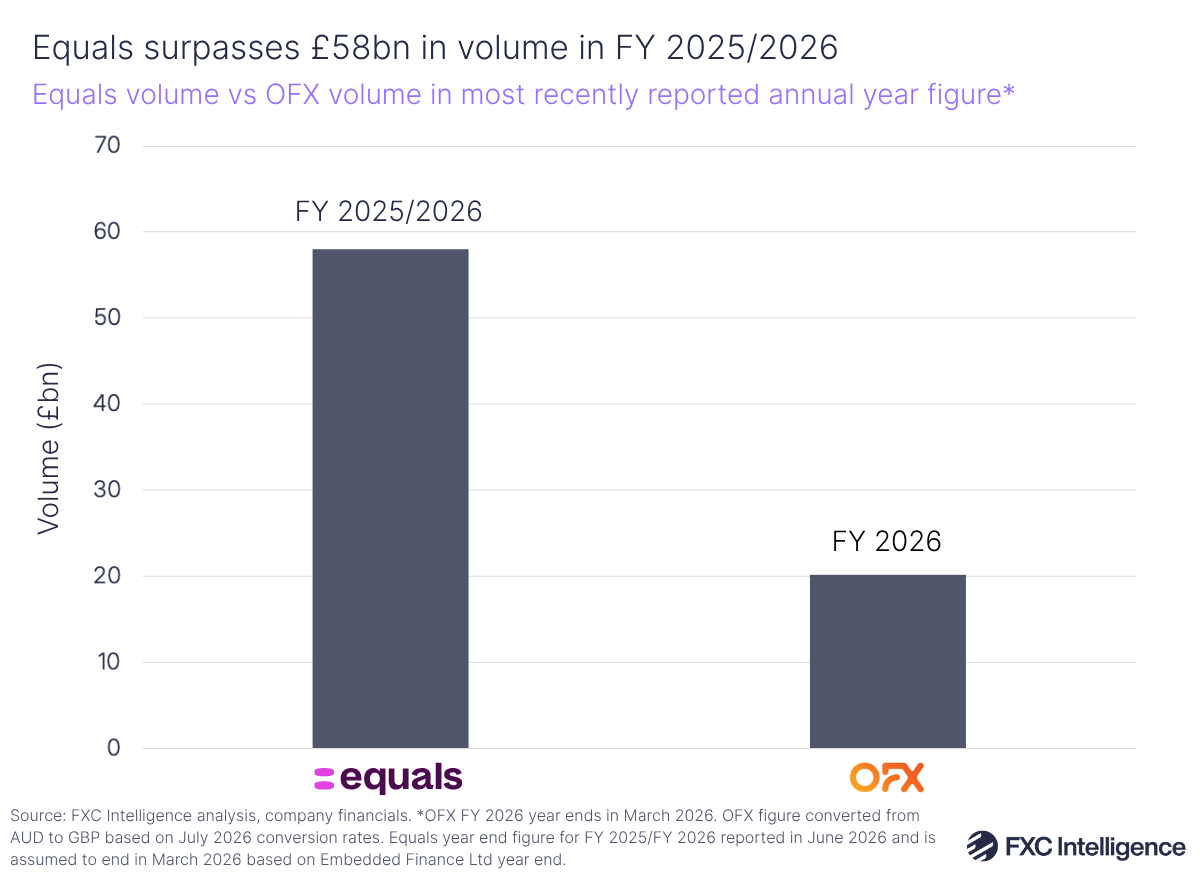
The companies were immediately merged, combining Equals’ offerings across multicurrency accounts, FX, corporate cards and financial solutions with Railsr’s embedded finance, banks-as-a-service and cards-as-a-service infrastructure solutions. Then, in June 2026, Equals Money and Railsr officially rebranded as Equals, and reported that the combined company had surpassed £58bn in transaction processing volume in the financial year for 2025/2026 (likely ending in March 2026, based on Embedded Financial Ltd’s previous financials, though not clarified by the company).
The move to create one combined company focused on payments infrastructure reflects a shift in the industry from servicing B2B and corporate payments and financial needs to creating APIs and platforms that allow banks and fintechs to do this themselves, therefore capturing a much larger share of a rapidly growing B2B payments market.
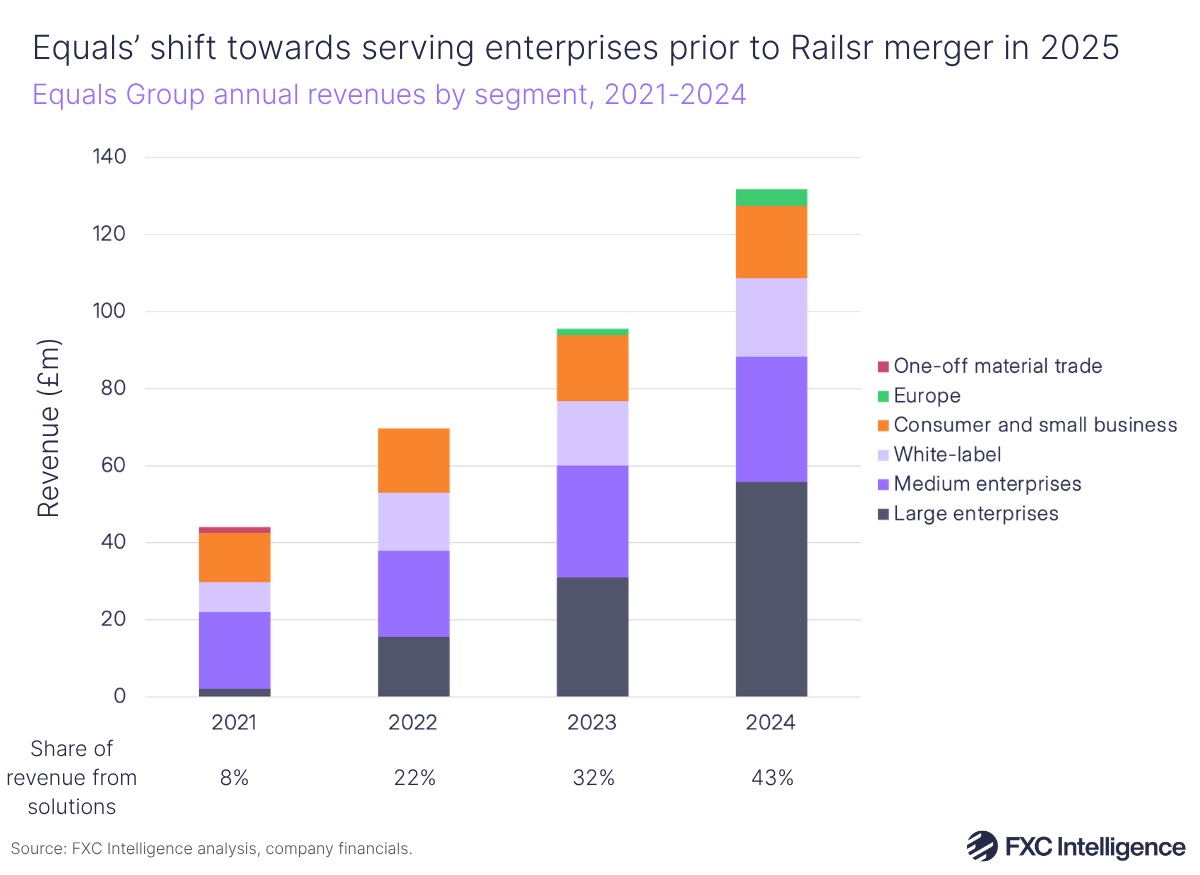
The acquisition of Equals Group took the company private, with the company not yet having shared its accounts on Companies House for 2025. However, its annual figures up to 2024 highlight that Equals was already seeing a significant shift towards serving larger enterprises through its solutions.
In its FY results for 2024, Equals Group reported 38% revenue growth to £132m, with 86% of this coming from B2B revenues and 43% coming from large enterprises (i.e. its Solutions segment), driven by the company’s flagship company Equals Money.
Mapping these figures historically, large enterprises revenue accounted for just 8% of the company’s mix in 2021, showing the extent to which this customer type has grown in importance for Equals Group over time.
What are the potential opportunities from the acquisition?
With the Equals rebrand completed, the question now is how OFX might fit into the new company. Both companies have not yet commented extensively on the strategy behind the deal, and will likely have more to say when it is finalised. However, the products and market coverage of the companies signals some overlaps as well as gaps that could be particularly beneficial to Equals.
Over the last decade, OFX has shifted its focus away from consumer money transfers and towards enabling B2B payments and associated financial offerings. This puts many of its products and services in alignment with those offered by Equals, including its offerings around global business accounts and its white-label payments services for enterprises.
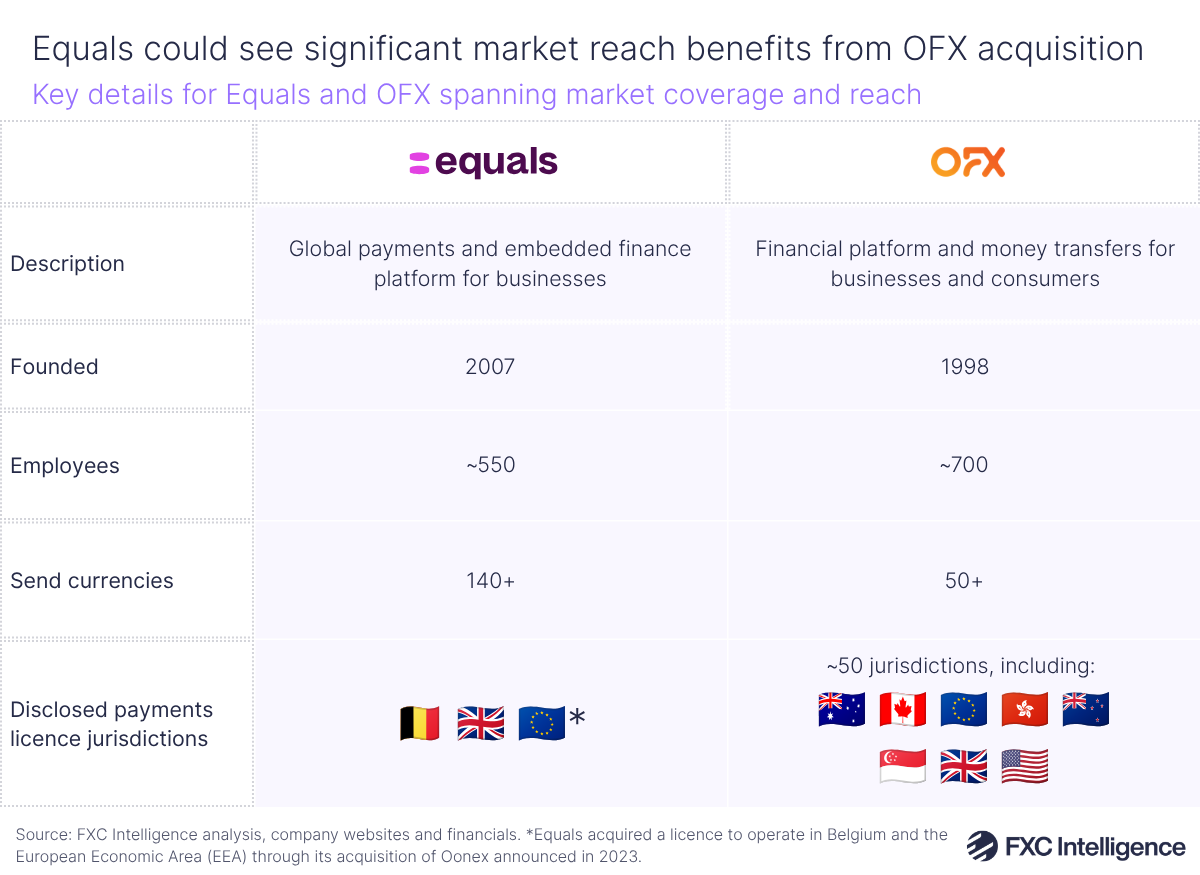
Where OFX may add significant value to Equals is in its extensive payments licences and money network globally. Equals says that it holds a variety of payments licences and scheme memberships covering the UK and Europe (including through Railsr subsidiary Payrnet), and has typically been focused on supplying payments to Europe.
OFX, meanwhile, currently holds licences in around 50 jurisdictions, with offices in Australia, the US, UK, Ireland, New Zealand, Singapore and Hong Kong. This extensive network could therefore significantly extend the reach of Equals into new markets.
The benefits to OFX itself are explicit in the significant valuation increase on its share price as well as the potential to grow the company’s EBITDA during a period when it has faced macroeconomic headwinds.
Next steps in the acquisition process
Under the Transaction Process Deed signed on 23 July, Equals has told OFX it has substantively completed due diligence on the deal and it is working through debt financing arrangements, according to OFX’s announcement, which is expected to happen in the coming weeks.
Both companies will also need to acquire internal approvals before the acquisition; OFX needs shareholder approval and it has also enlisted an independent expert to conclude if the acquisition would be in the “best interest of OFX shareholders”. While OFX has given Equals a four-week exclusivity period, one of its conditions is that “no superior proposal” emerges. If these conditions are met, Equals would acquire 100% of the shares of OFX.
The potential OFX deal happening so soon after the consolidation of Equals and Railsr provides some key signals about the cross-border market. In particular, competition and pressure from stock markets is driving some companies in the space to pursue private ownership. Equals CEO Ian Strafford-Taylor had said prior to the company’s own acquisition that competition in payments and the “considerable investment” required to “stay ahead of the game” drove it to pursue private ownership. Similarly, OFX launched its strategic review after it concluded its long-term value was not reflected in its share price.
Though OFX is focused on a different customer base, in some ways its acquisition reflects Western Union’s recent acquisition of Intermex, which saw its share price fall after transaction volumes fell across its core markets.
The deal also highlights the growing push from the industry towards offering infrastructure and embedded solutions to the industry to capture a much larger share of the B2B cross-border opportunity, a growing theme we are seeing not just across acquisitions but in how companies are approaching their payments strategies.