

Corpay has delivered another strong quarter, with Corporate Payments revenue growing by double digits YoY on the back of strong cross-border sales. We sat down with Mark Frey, Group President of Corpay Cross-Border Solutions, to discuss key drivers and the company’s future.
Corpay has beat earnings expectations in Q3 2026, delivering an 18% YoY increase in revenue to $1.4bn with an EBITDA margin of 53%. The company also saw organic revenue (excluding macro effects and including the impact of acquisitions and divestitures) grow by 11%, marking its sixth consecutive quarter of growth in this metric.
Investors responded well to Corpay’s earnings, with the company’s closing stock price growing 7% the day after results and remaining significantly higher than previous years.
Corporate Payments, Corpay’s segment focused on B2B spend management and cross-border transactions, remained a key driver for growth in Q3 2026, driven by a combination of strong volume, new sales and the impact of acquisitions. Corpay is streamlining its portfolio to focus on a smaller number of businesses, which are bigger and faster growing, as well as integrating acquisitions to enhance its offering.
The company continues to report a strong earnings boost from investments in other companies, including its stake in accounts payable specialist AvidXchange as well as its acquisition of UK-based FX specialist Alpha. Corpay has now fully integrated Alpha’s cross-border corporate payments business and is using it to expand its multicurrency account product to corporates in new geographies.
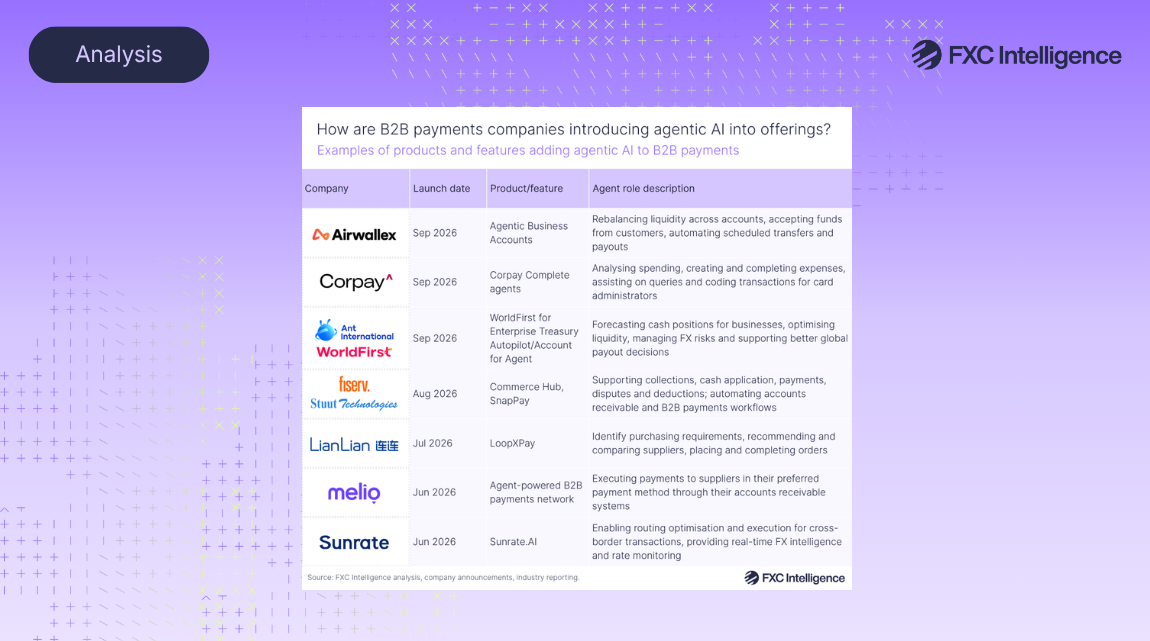
On the technology side, Corpay has started to move some of its cross-border volume onto private blockchain rails, though it is focused more on tokenised fiat. During the earnings call, Corpay CFO Peter Walker said the company was seeing the majority of its tokenised currency volumes moving through J.P. Morgan’s Kinexys platform, though the company is “not seeing a lot of volume on the stablecoin side”. It has also developed a proprietary “Super Dealer” agent that analyses and recommends cross-border hedging solutions to clients.
We sat down with Mark Frey, Group President of Corpay Cross-Border Solutions, to explore the key drivers behind Corpay’s ongoing growth journey, as well as how its approach to digital assets and AI is boosting its offering for clients.
Corpay’s revenue growth drivers in Q3 2026
Daniel Webber: Mark, a pleasure to be with you as always. Another really good set of results, with strong revenue growth for Corpay Payments overall, profitability and strong EBITDA margins. Take us through what’s been driving that.
Mark Frey:
Yes, another very solid quarter, a beat and raise for Corpay overall, led by both halves of the Corporate Payments business. The spend management card business, as well as the cross-border business, are continuing to run nicely and boast really solid growth numbers and sales numbers in both parts of Corporate Payments, and really becoming the strength overall of the franchise.
At the same time, the vehicle mobility payments business is picking back up and getting to a high single-digit grower, and even the lodging business is now a single-digit grower for us again, and certainly contributing to the overall growth we’re seeing across the franchise.
I think the big news for the business – and something that we’ve been talking about for some time now, so it’s not really a change – is the continued migration or evolution of the business more towards a Corporate Payments franchise. We’re continuing to expand that capability, have taken that corporate payments playbook and taken it across the Atlantic to the UK and Europe in terms of the spend management and the cards piece, and we’re continuing to build out our geographic expansion in cross-border as well. We’re really pleased about the overall pace of change and how we’re able to continue to drive growth even as the business scales.
Corpay raises FY projections after strong Q3
Alongside its revenue growth, Corpay saw EBITDA rise by 17% YoY to $734m, driving an EBITDA margin of 53.1%, slightly lower than 53.5% last year. On an adjusted basis (adding back legal expenses, restructuring and other deal related costs), the company’s EBITDA also rose by 17% to $794m, giving an adjusted EBITDA margin of 57.4%, compared to 57.7% in Q3 2025.
Chart data
| Year | Revenue | EBITDA margin |
|---|---|---|
| 2021 | $2.83bn | 53.9% |
| 2022 | $3.43bn | 51.6% |
| 2023 | $3.76bn | 54.2% |
| 2024 | $3.98bn | 53.0% |
| 2025 | $4.53bn | 51.8% |
| 2026E (revenue estimate) | $5.35bn | — |
As a result of its strong growth in Q3 and improved expectations for Q4, Corpay raised its total revenue expectations to be between $5.34bn and $5.36bn (up from $5.29bn-5.33bn), equating to 18% growth at the midpoint.
Corporate Payments remains the biggest mover for Corpay’s total revenue and is close to becoming Corpay’s biggest segment, accounting for 41% of revenue in Q3 2026, up from 35% last year.
Chart data
| Quarter | Vehicle | Corporate | Lodging | Other |
|---|---|---|---|---|
| Q1 24 | $482.5m | $259.2m | $111.3m | $82.4m |
| Q2 24 | $498.1m | $282.2m | $122.4m | $73.0m |
| Q3 24 | $494.7m | $313.9m | $134.0m | $86.6m |
| Q4 24 | $485.7m | $337.5m | $120.9m | $90.3m |
| Q1 25 | $474.3m | $345.1m | $110.2m | $76.0m |
| Q2 25 | $512.0m | $387.3m | $119.8m | $82.9m |
| Q3 25 | $538.3m | $405.9m | $127.0m | $101.3m |
| Q4 25 | $559.1m | $466.6m | $112.5m | $110.1m |
| Q1 26 | $563.9m | $503.9m | $111.0m | $82.2m |
| Q2 26 | $580.2m | $548.7m | $123.2m | $86.7m |
| Q3 26 | $579.8m | $571.3m | $131.1m | $99.7m |
| Q3 26 YoY growth | 8% | 41% | 3% | -2% |
Where is Corpay targeting global expansion?
Daniel Webber:
What’s the current geographic split of the business and where do you see opportunities for expansion?
Mark Frey:
If we look at the cross-border business in particular, we have three big geographies of North America, EMEA and APAC. EMEA is just slightly bigger than North America ultimately, so both of those franchises are about 35% and then 40%, respectively, of the overall business, and APAC is 25%.
We’ve got lots of geographic expansion planned for the latter part of 2026 and early into 2027, with an expansion into Dubai planned, an expansion into Hong Kong, continuing to build out our footprint across continental Europe. So an expansion with sales offices in a number of local markets and something that we’ve had a lot of success with and has really sort of powered our growth over the last number of years, and we will continue to execute upon.
And then looking at expansion in the Americas as well, expanding our capability into Mexico and Brazil is on the plan for 2027, and something that we think is a very attractive market ultimately. We continue to pursue geographies where we think that the mid-market space for corporates, fintechs and also private markets customers is underserved by the Tier 1 banks and certainly the local national champion banks. We’ve identified a number of geographies where we think that’s the case, where our playbook works well, and we will continue to expand into those markets.
Corpay grows global reach
Corpay continued to see faster growth in non-US geographies in Q3 2026, with two of its largest markets, the UK and Brazil, growing by 31% and 24% respectively, while Other markets grew by 27% YoY, versus 9% for the US. Overall Corpay’s non-US revenue accounted for 55% of total revenue in Q3 2026, up from 51% the previous year.
Chart data
| Quarter | US | Other | Brazil | UK |
|---|---|---|---|---|
| Q1 22 | 59.8% | 15.2% | 13.0% | 12.0% |
| Q2 22 | 61.3% | 14.9% | 13.0% | 10.8% |
| Q3 22 | 62.5% | 15.2% | 12.2% | 10.1% |
| Q4 22 | 60.7% | 16.2% | 13.5% | 9.6% |
| Q1 23 | 57.0% | 17.5% | 13.5% | 12.0% |
| Q2 23 | 56.4% | 18.6% | 13.3% | 11.7% |
| Q3 23 | 57.8% | 16.6% | 13.8% | 11.8% |
| Q4 23 | 56.0% | 17.2% | 15.3% | 11.5% |
| Q1 24 | 54.0% | 17.2% | 15.8% | 13.0% |
| Q2 24 | 52.0% | 19.1% | 15.3% | 13.6% |
| Q3 24 | 52.7% | 19.4% | 14.1% | 13.8% |
| Q4 24 | 52.9% | 19.2% | 14.6% | 13.3% |
| Q1 25 | 50.4% | 18.9% | 16.2% | 14.5% |
| Q2 25 | 49.1% | 22.0% | 15.4% | 13.5% |
| Q3 25 | 49.0% | 21.8% | 15.6% | 13.6% |
| Q4 25 | 46.6% | 22.4% | 15.9% | 15.1% |
| Q1 26 | 43.1% | 23.9% | 16.7% | 16.3% |
| Q2 26 | 44.9% | 23.8% | 16.2% | 15.1% |
| Q3 26 | 45.1% | 23.4% | 16.4% | 15.1% |
| Q3 26 YoY growth | 9% | 27% | 24% | 31% |
Corpay also launched its Corpay Complete spend management platform in the UK this year, and expects this to reach over $1bn in annualised volume exiting Q4. Corpay President and CEO Ronald Clarke said that the company expects to see more spend management revenue in geographies outside of the US, both organically but also through potential acquisitions.
Correspondent banking opportunities in a shifting payments landscape
Daniel Webber:
Let’s expand on how correspondent banking is changing. Traditionally it was very much Swift and the Tier 1 banks, but that’s not the case anymore. Building on the geographic piece, but also the use cases, talk us through how you’ve built out that capability.
Mark Frey:
Correspondent banking with a key focus on cross-border payments has been a key part of our franchise going back a number of years. Certainly that’s what we do for our corporates, but we have a big franchise that exists within the fintech community of startups through to more mature organisations, and then financial institutions right through the value chain, from the Tier 1 money centre global financial institutions that use us for FX liquidity and payments in certain core corridors – particularly to the Southern Hemisphere and emerging markets – but also the fact that we provide major currency correspondent banking clearing solutions, leveraging our own rails in US, euros, sterling and other major currencies.
We see this as a fast-growing part of our business where we leverage the breadth of our rail capability, whether it be in-region, in-country, low-value payment capabilities; Swift connectivity, of course; but also stablecoin and privately permissioned blockchain, which is increasingly a big part of the business. That allows us to effectively move money 24 hours a day, 7 days a week, even on weekends, and is a capability that some of our fintech partners and banks are really leaning into.
Corporate Payments volumes rise though take rate declines
Corpay’s Corporate Payments segment saw revenue rise 41% to $571m, greatly outpacing other segments, while on an organic basis revenue grew by 18%. The company continues to see strong performance across spend management and cross-border sales, which rose by over 25% YoY on an organic basis. Overall, Corporate Payments revenue grew 43% to $1.6bn in the first nine months of 2026, with acquisitions contributing approximately $224m.
Calculated against depreciation and amortisation, Corporate Payments also saw EBITDA rise by 40% to $284m, giving a margin around 50%. This also accounted for a higher share of Corpay’s total overall EBITDA in Q3 2026 at 39%, up from 32% last year.
Chart data
| Quarter | Revenue | EBITDA margin |
|---|---|---|
| Q1 25 | $345.1m | 46.2% |
| Q2 25 | $387.3m | 48.4% |
| Q3 25 | $405.9m | 50.2% |
| Q4 25 | $466.6m | 44.3% |
| Q1 26 | $503.9m | 46.1% |
| Q2 26 | $548.7m | 46.8% |
| Q3 26 | $571.3m | 49.7% |
As Corpay grows its B2B payments division, it continues to see the effect of increasingly serving large enterprises on its take rate. The segment’s spend volume rose by 45% to $95bn, giving the company a revenue net per spend $ (i.e. take rate) of 0.6%, down slightly from 0.62% the previous year.
During the earnings call, Clarke added that Corporate Payments growth has been driven by strong retention in the business (close to 95%, versus 92% for the wider business) alongside growing sales, and the company is also monetising spending more through the addition of debit cards and paid ACH services, with Corporate Payments organic revenue growth seeing a one-off 100 basis point lift in Q3 2026 as a result of these initiatives. He said that approximately 80-85% of the spend volumes moved for clients is not monetised, and the company continues to look at ways to improve this.
Chart data
| Quarter | Spend volume | Take rate |
|---|---|---|
| Q1 24 | $34.7bn | 0.75% |
| Q2 24 | $40.1bn | 0.70% |
| Q3 24 | $40.7bn | 0.77% |
| Q4 24 | $45.2bn | 0.75% |
| Q1 25 | $47.8bn | 0.72% |
| Q2 25 | $55.7bn | 0.69% |
| Q3 25 | $65.6bn | 0.62% |
| Q4 25 | $78.2bn | 0.59% |
| Q1 26 | $81.8bn | 0.62% |
| Q2 26 | $94.6bn | 0.58% |
| Q3 26 | $95.3bn | 0.60% |
How blockchain speeds up treasury for fintechs
Daniel Webber: There’s been a big focus recently on how you can reduce some of the liquidity needs and improve the treasury side for many of these fintechs, whether it’s out-of-hours or whether it’s using digital assets. How are you helping that type of customer?
Mark Frey:
I think it’s well understood now in the industry that one of the key benefits of stablecoin usage is that after-hours pooling of liquidity and being able to enhance the operational function and the liquidity footprint of treasury operations.
We’re really leaning into privately permissioned blockchain as the means by which to do that as well. So, having to avoid the “stablecoin sandwich” of fiat on-ramping onto the chain and then having to off-ramp into another fiat account, we’re just using privately permissioned blockchain to move money in much the same format, so that it is 24 hours a day, 7 days a week, after-hours, and doesn’t require that the same pooling of liquidity that has to sit in fiat accounts.
It results in a much more efficient working capital position for our clients, allows us to move money when the money needs to move, as opposed to when the accounts can be funded, and can be done so extremely cost-effectively as well, more cost-effectively than moving funds by Swift.
We really see this as the future of treasury liquidity planning and payment processing. It’s something that we’ve leaned into pretty hard over the last number of quarters and is becoming a significant portion of our overall payment share.
Multicurrency accounts drive real-time transactions
Daniel Webber:
The multicurrency account is now very embedded into your product suite – talk us through the impact this is having on Corpay.
Mark Frey:
Our business has certainly evolved from one that was very FX and payment-centric to now being able to provide real-time current transactional accounts to our customers in a whole host of geographies around the world, where by and large they are connected to local in-country schemes, so that we can clear funds via SEPA or Faster Payments or ACH or the equivalent, and Swift ultimately.
This has become a way that we can move money programmatically in and out of these accounts. We can move money 24 hours a day in and out of these accounts, and it becomes a very effective basis to plan and manage cash across a business. Particularly for our corporate customers in a particular geography that want to open accounts quickly in a short space of time, where we can use the recyclable KYC information that we have for an organisation to open up accounts for them in multiple jurisdictions around the world. We do that for our fintech partners, our corporates and our private markets customers.
The fund that wants to establish an account in Belgium or Luxembourg and needs to open up that account as quickly as possible, where speed, execution and the ubiquitous access to our platform is a key part of the value proposition.
How Alpha is adding new capabilities for Corpay
Daniel Webber:
Alpha is now embedded in Corpay and it had some different products and customers that it was targeting. How is this coming together for your business?
Mark Frey:
We’re really pleased with the Alpha acquisition in general. The thesis was spot on in terms of what it would add in terms of capability to the business. It significantly enhances the alternative banking solutions that we can provide and the real-time accounts in more geographies.
The front-end technology that Alpha’s customers had access to [in order] to leverage those accounts around the world has now been embedded into the core operational process of the broader Corpay franchise, so we can make that technology available to our customers everywhere. We’ll be turning that on in Q1 next year.
And certainly, just the talent that we’ve been able to add to the organisation from Alpha, which was a large, capable player in the space, has certainly been a big part of the thesis of what we wanted to add – not just the technology and the capability, but the humans that exist in the business, and [they are] certainly a welcome addition. It has really accelerated our growth in EMEA in particular, where Alpha was geographically quite capable and strong, and has added a lot more size and depth to our business in the EMEA region.
Corpay’s new AI-powered agent for FX analysis
Daniel Webber:
Tell us about your new “Super Dealer Clone” agent and what it brings to the business.
Mark Frey:
It is a really cool product that we’ve been working on for some time now with a whole group of our most talented dealers in the business, leveraging AI-based tools, our proprietary models and our data to comb through our overall portfolio, identify opportunities and take advantage for our customers with market movements where they’re perhaps underhedged in certain durations, and where we can reposition the risk that they have on the books to make recommendations to them and add a lot more scale to the business.
What we’re really doing is leveraging AI to speed up a lot of the analytical work that a dealer typically does in terms of risk management planning for our customers. monitoring portfolios and managing their risk so that we can run the analysis in real time, come up with real-time recommendations that are then reviewed by the dealers and then positioned so that we can put ideas in front of customers more readily and on a faster basis.
Historically, it was the case that if you do all the analytical work, you might be able to analyse three or four customers’ portfolios in a given day and put solutions in front of them for trade execution or for them to evaluate. Now we can do that across dozens of customers in real time, instantaneously, leveraging this capability.
So it is pretty exciting in terms of just how much more efficient it makes our team. It allows us to pressure test scenarios very efficiently across rates, commodities and FX as well, which are all part of our product suite, and just gives our team much more in terms of tools and capabilities that they can leverage to effectively service their clients.
So, we’re really excited about it. We think it is a bit of a competitive edge in the marketplace in terms of our ability to run the analytics and come up with scenarios that we really think make sense for our clients. It’s something that we’ve been leveraging with great success over the past couple of quarters, and we’ll continue to invest in it going forward.
Daniel Webber:
Mark, thank you.
Mark Frey:
Thanks very much.