
Banks have been subject to significant projections around AI, but not everything has been proven out. We examine what major banks have publicly shared about AI productivity – and where claims aren’t yet backed by evidence.
As anyone who works in the sector will know, the past year has seen AI dominate discussion among banks to an extent not yet reached by other parts of the payments sector. While artificial intelligence has been a focus of discussion across all parts of payments, particularly as a tool to improve productivity and – in theory – increase revenue per head, this focus has been particularly intense in banks, where it has far outstripped focus on stablecoins, the other topic of the moment.
While artificial intelligence saw a sharp increase in discussion during payments industry earnings in 2023 and 2024 after the emergence of generative AI large language models such as ChatGPT in late 2022, discussion and focus on AI has continued to climb in among major banks.
Analysis of the earnings calls of 13 major banks between Q1 2024 and Q2 2026 shows that AI was mentioned nine times more in the banks’ combined Q4 2025 earnings calls than in the equivalents in Q4 2024, while AI also saw more than 2.5 times more mentions in Q2 2026 than in Q2 2025. US-headquartered banks have been among those with the highest rates of AI discussion, with Bank of America, JPMorganChase and Goldman Sachs seeing the most mentions in the most recent call.
Chart data
| Number of mentions of AI (count) | Bank of America | JPMorganChase | Goldman Sachs | Citi | NatWest | Deutsche Bank | BNP Paribas | Wells Fargo | HSBC | Barclays | UBS | Societe Generale | Standard Chartered |
|---|---|---|---|---|---|---|---|---|---|---|---|---|---|
| Q1 24 | 0 | 0 | 7 | 0 | 0 | 0 | 2 | 0 | 0 | 0 | 0 | 0 | 0 |
| Q2 24 | 4 | 1 | 6 | 1 | 1 | 0 | 9 | 7 | 0 | 0 | 0 | 0 | 0 |
| Q3 24 | 1 | 3 | 0 | 0 | 0 | 0 | 0 | 0 | 0 | 0 | 8 | 0 | 0 |
| Q4 24 | 0 | 0 | 4 | 3 | 1 | 0 | 2 | 0 | 2 | 0 | 2 | 0 | 0 |
| Q1 25 | 1 | 1 | 4 | 3 | 1 | 0 | 0 | 0 | 0 | 0 | 1 | 0 | 0 |
| Q2 25 | 17 | 2 | 10 | 5 | 3 | 0 | 0 | 4 | 5 | 0 | 3 | 0 | 0 |
| Q3 25 | 12 | 9 | 6 | 12 | 1 | 0 | 0 | 1 | 0 | 0 | 2 | 5 | 2 |
| Q4 25 | 13 | 8 | 6 | 6 | 30 | 0 | 17 | 1 | 18 | 16 | 7 | 3 | 5 |
| Q1 26 | 20 | 13 | 8 | 12 | 2 | 14 | 4 | 2 | 1 | 0 | 7 | 0 | 0 |
| Q2 26 | 27 | 24 | 23 | 12 | 11 | 11 | 9 | 5 | 4 | 3 | 2 | 0 | 0 |
However, while discussion is increasing, is banks’ increased focus on AI translating into results, and if so, what use cases have the highest potential to be replicated in the broader payments industry? We analyse the earnings calls and other public announcements of major banks to identify which use cases are being adopted for AI, and what impact, if any, is being felt from the initiatives.
Are banks seeing productivity gains from their use of AI?
The range of use cases that banks are applying AI to is extremely broad, with many reporting having several hundred use cases live, and many more in development. However, there are a core range of use case categories that appear consistently in how banks discuss their applications of artificial intelligence.
On the sales and client management side, all the banks we reviewed made use of the technology in some form to support commercial processes, typically either by assisting with the preparation of sales pitches or other client presentations, or otherwise supporting with the assistance and support of existing clients. Meanwhile, AI tools to support consumer customer services are well established across banks, although many have made significant advances to these as the technology has progressed.
As well as being long-established for fraud and KYC-related applications, banks are also extending the technology’s use for risk and auditing-related use cases and growing adoption in the operation and routing of payments infrastructure.
More broadly, writing and analysis has become increasingly automated using AI, while markets and trading teams are also deploying the technology in pursuit of productivity gains. Meanwhile, engineering and technology departments are integrating AI into engineering departments to provide code writing or auditing assistance.
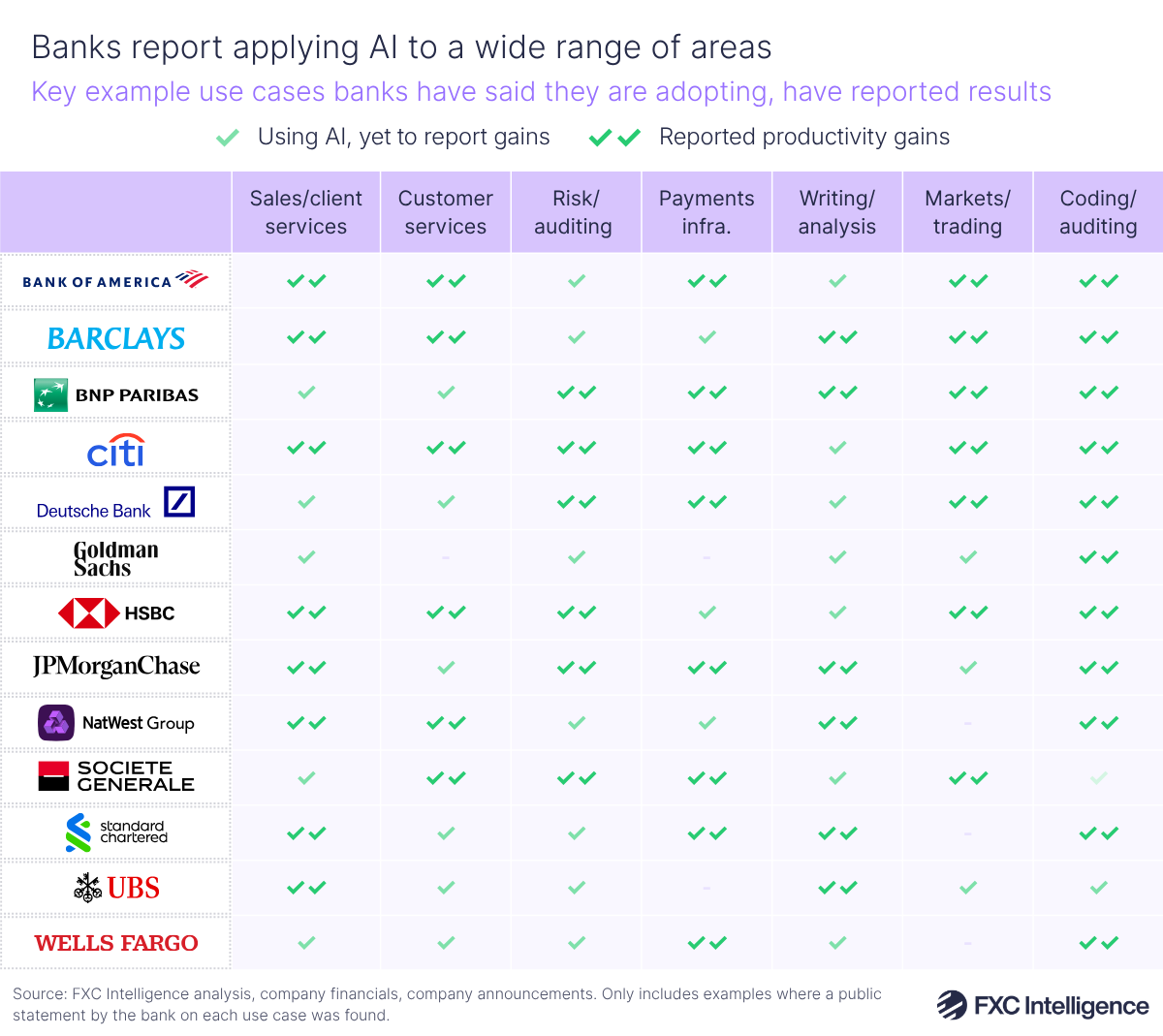
While productivity and related benefits are often the underlying thesis of AI adoption, the extent to which its deployment across different use cases has translated into genuine, reported productivity gains ranges significantly.
Coding, for example, sees the most consistent reporting of tangible metrics resulting from AI adoption, while other areas such as writing and analysis are mentioned but often without numbers to back up their use.
While this may indicate that coding is the area currently delivering the most clear-cut AI-based gains for banks, the reality may be more complex as banks often select data points that best fit a wider narrative, and frequently do not disclose nuanced information about a particular task or use case. Coding, for example, may be an easier story to fit into earnings calls and investor presentations than other more nuanced use cases, or may otherwise be a metric that is easier to track than other, less directly quantifiable use cases.
Chart data
| Use case | Banks who report adopting use case | Banks who have shared data on realised productivity gains |
|---|---|---|
| Coding/code auditing | 13 | 11 |
| Sales/client services | 13 | 8 |
| Writing/analysis | 13 | 6 |
| Risk/auditing | 13 | 6 |
| Customer services | 12 | 6 |
| Payments infrastructure | 11 | 8 |
| Markets/trading | 10 | 7 |
The AI applications with the highest productivity gains for banks
Even where banks do report productivity enhancements delivered by AI adoption, it is very unusual for this to be delivered in such a way that numbers from one bank’s project can be clearly and consistently compared against another. While gains are often expressed either in terms of the percentage of a given task or in terms of minutes or hours saved, the information is rarely complete enough to normalise this into man hours.
Banks will sometimes mention a reduction without giving a sense of how long the original task took, or give a clear measure of time reduction without making it clear how regularly this task is required or how many people undertake it. As a result, we are some way from providing clearly comparable measures of man hours saved by particular AI use cases.
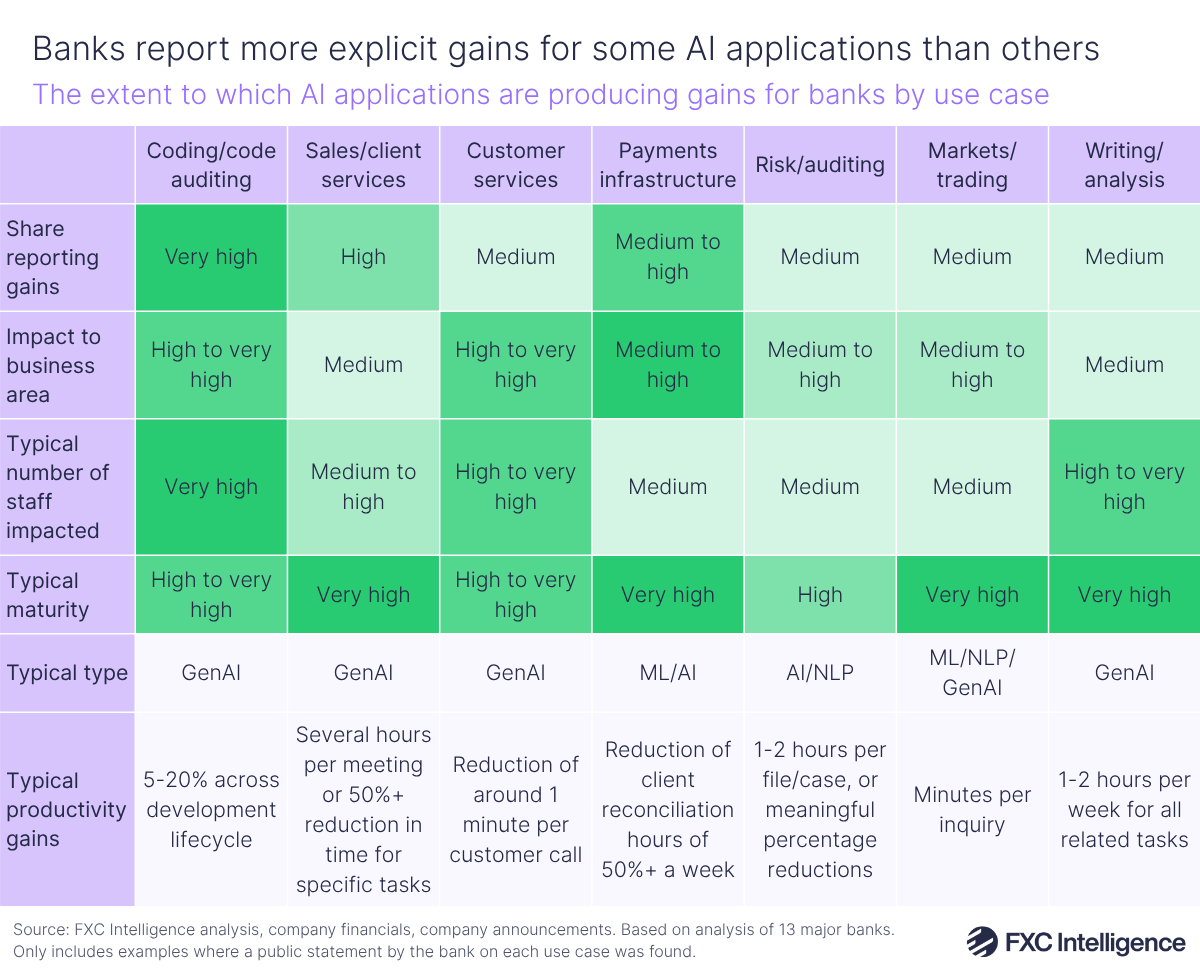
Nevertheless, while direct numeric comparisons are hard to make, we have attempted to normalise the different data shared to give a sense of the relative impact of different applications. This saw us not only identify how frequently banks share quantitative data around a use case, but also the relative impact to the business area, including how many staff the use case involves. We have also noted the type of AI involved, as while some applications involve the most modern large language models and generative AI (GenAI), others involve more longstanding natural language processing (NLP) and machine learning (ML) technologies.
Productivity gains from AI coding in banking
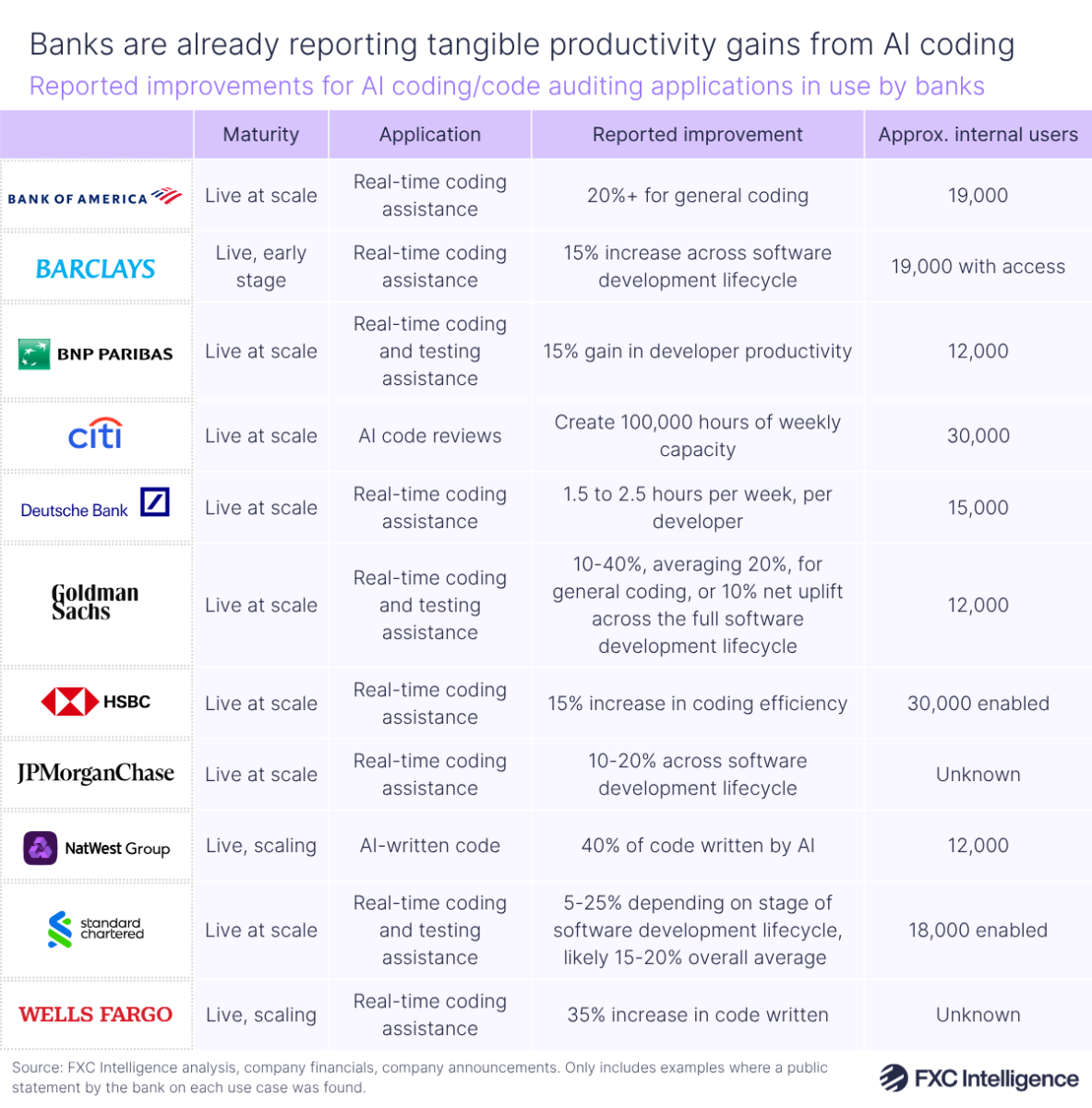
Across these measures, coding remains the most adopted use for AI technologies that banks have shared, generating quantifiable benefits equivalent to between 5% and 20% of the development lifecycle and typically being adopted by thousands or tens of thousands of employees at each bank. Crucially, across each bank the applications are mostly similar, with the technology being used to support coding and code reviewing in much the same way at different companies.
This use case is also likely to be one of the most replicable across payments more broadly, with gains seen by banks framing a reasonable target for related non-bank companies.
Banks’ use of AI for client and customer services
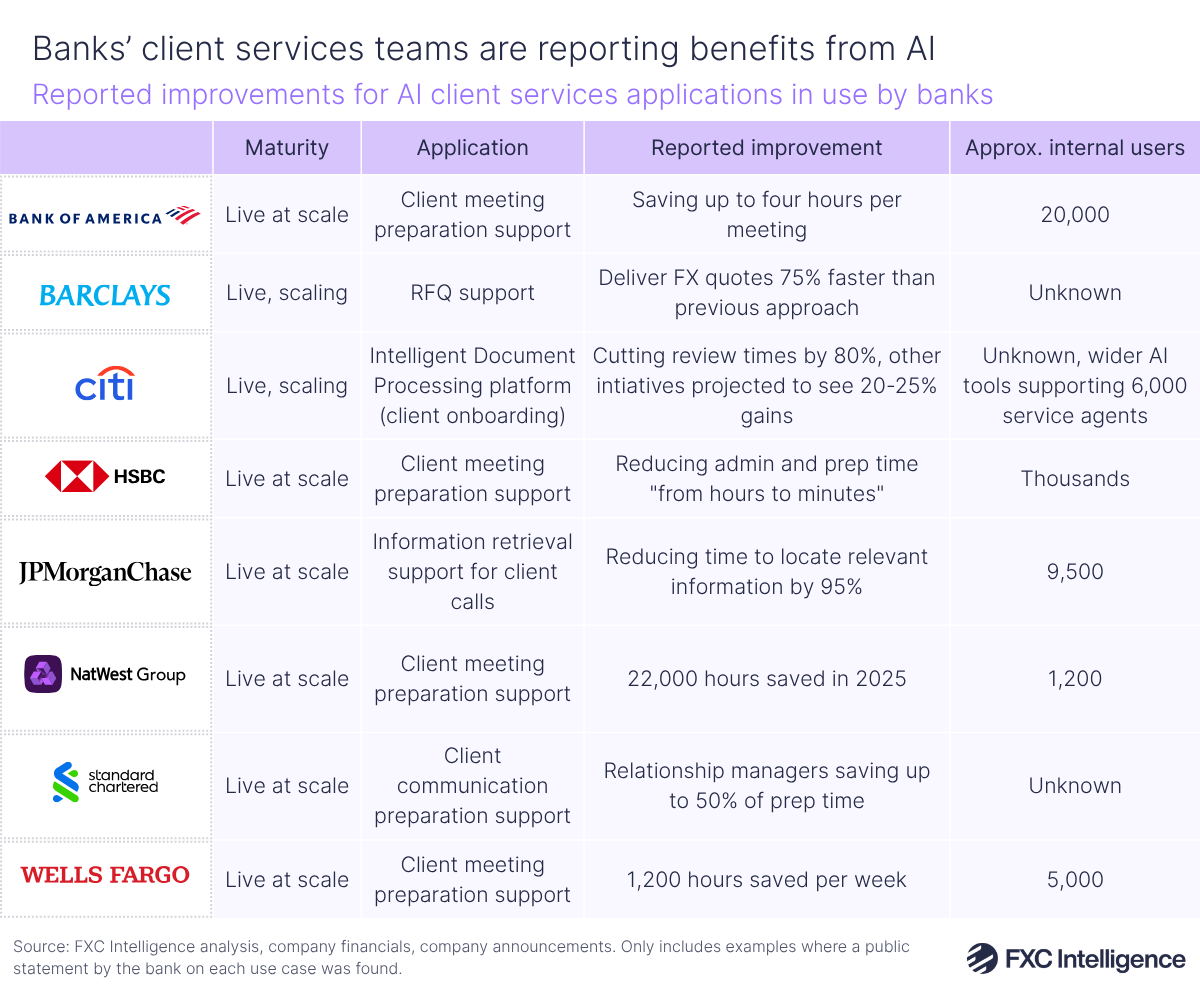
Arguably the next most effective application of AI in banking is in client services settings. While applications in this area are more varied than in banks’ technology departments, they commonly see AI tools harnessed to handle administrative tasks surrounding sales and client support activities, including preparing for meetings, supporting request for quote (RFQs) submissions or aiding in the retrieval of information for client calls. Some banks such as Citi also report success using AI to speed up the client onboarding process.
Although not impacting quite as many users as coding, the number of impacted employees is typically in the thousands, with significant gains reported per task, albeit without a clear sense of the overall time saved for each employee.
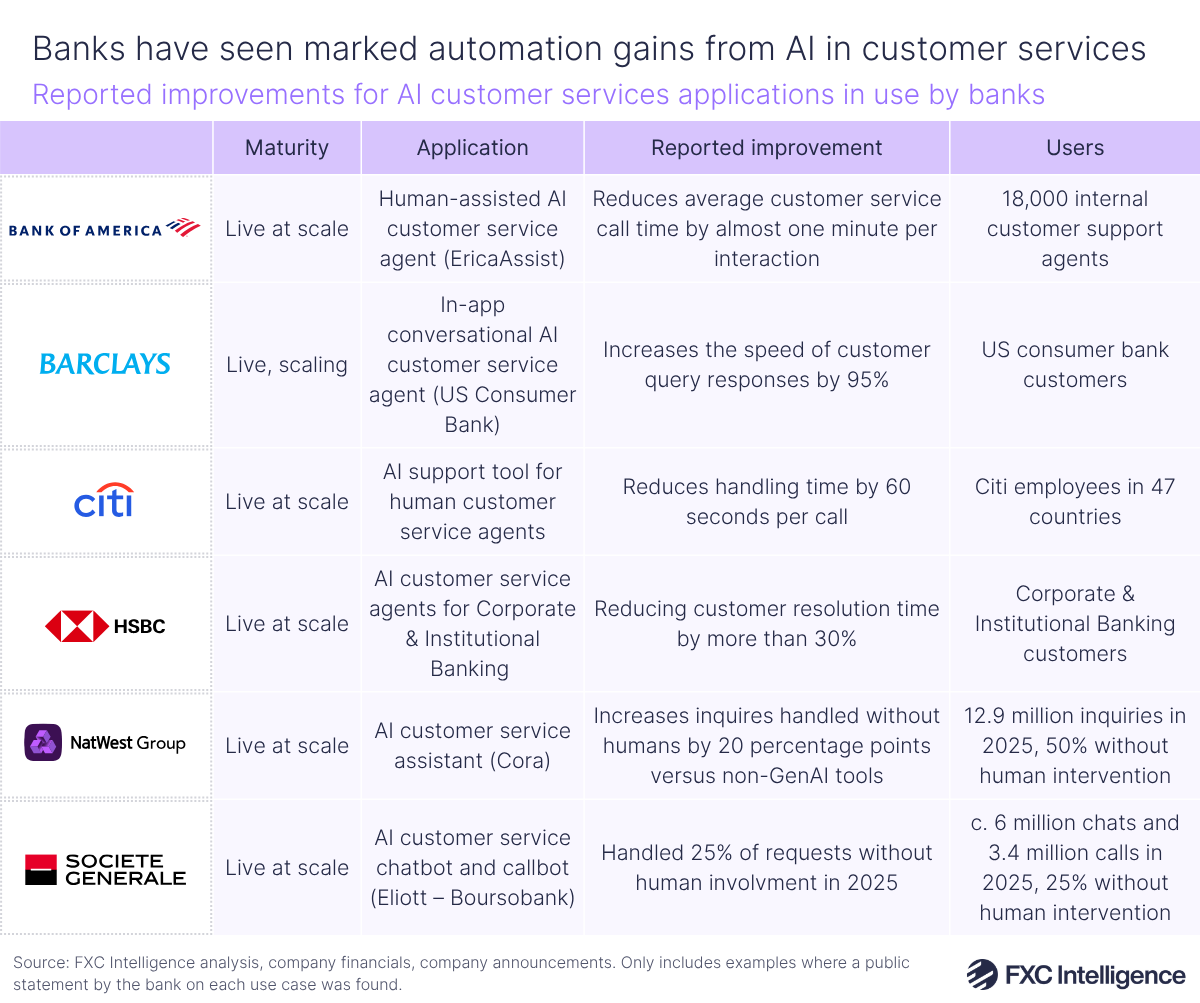
While most client services applications have typically emerged very recently, customer service applications, which are typically more directly customer-facing, often have deeper roots, starting life as basic chatbots before evolving into more sophisticated GenAI-enabled tools.
While many are used to completely remove the need for human involvement in many inquiries, others – such as Bank of America’s EricaAssist – are designed to support human workers while they are providing customer support. Although the impact is often hard to compare across banks, improvements typically take the form of reduced time to resolve inquiries, with the number of interactions in a given year in some cases reaching the millions.
Bank payments use cases for AI
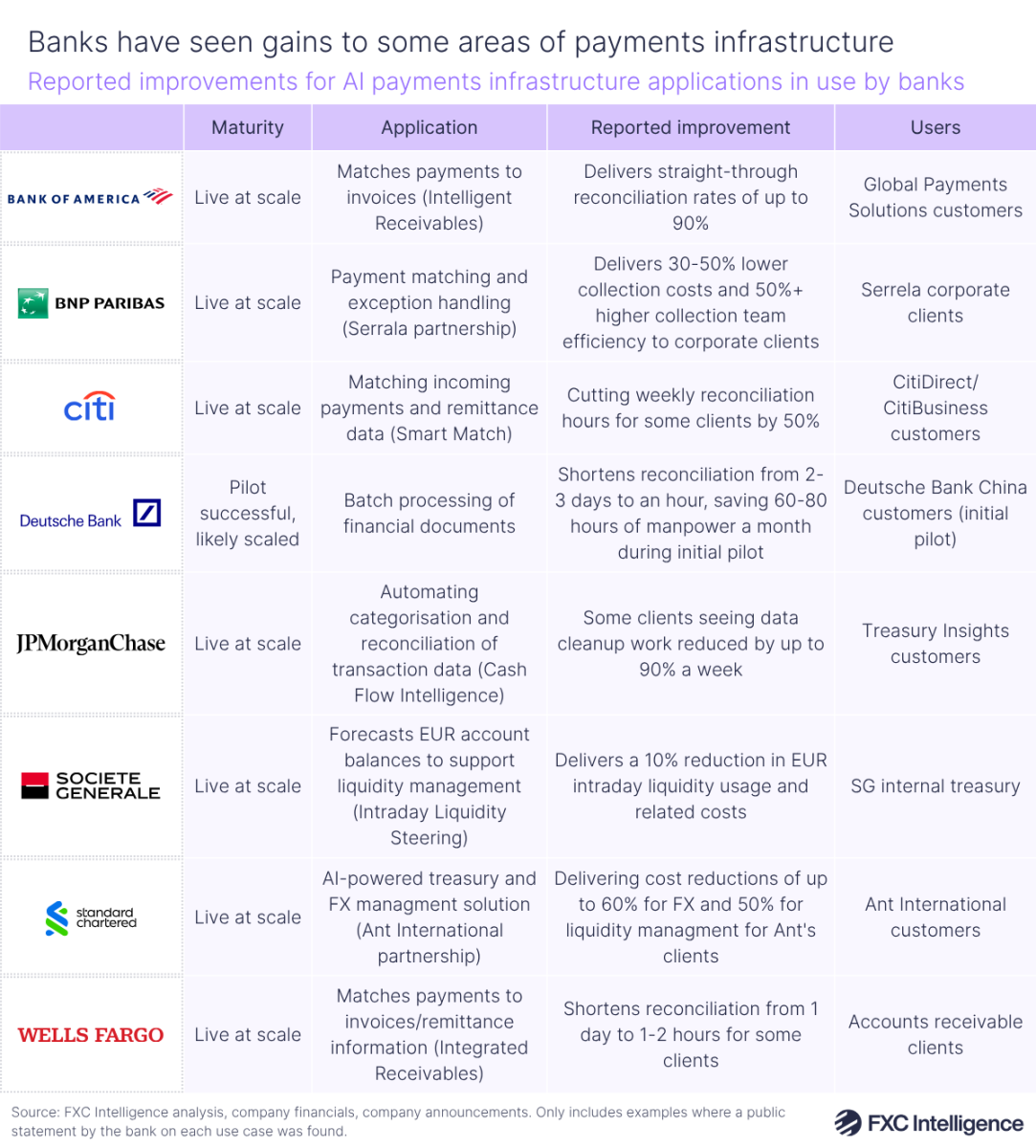
While it is likely that banks are deploying AI more broadly in their internal payments processes, the technology’s reported use in payments infrastructure settings largely concentrates in intelligent payments reconciliation and receivables. Bank of America, BNP Paribas, Citi, JPMorganChase and Wells Fargo have all shared gains from client-facing tools in this area, which typically provide sharp time reductions to reconciliation processes versus previous approaches.
However, this approach typically relies on older NLP/ML technologies, and the majority of these solutions have been live for several years, although some banks do still include them in recent profiles of the improvements they are seeing from AI. Even where banks are using AI for other payments infrastructure-related use cases, such as Societe Generale’s EUR forecasting, this is a more mature use case based on established ML technology and so is unlikely to present as many new insights for other payment companies as use cases involving newer AI solutions.
AI’s risk and auditing impact for banks
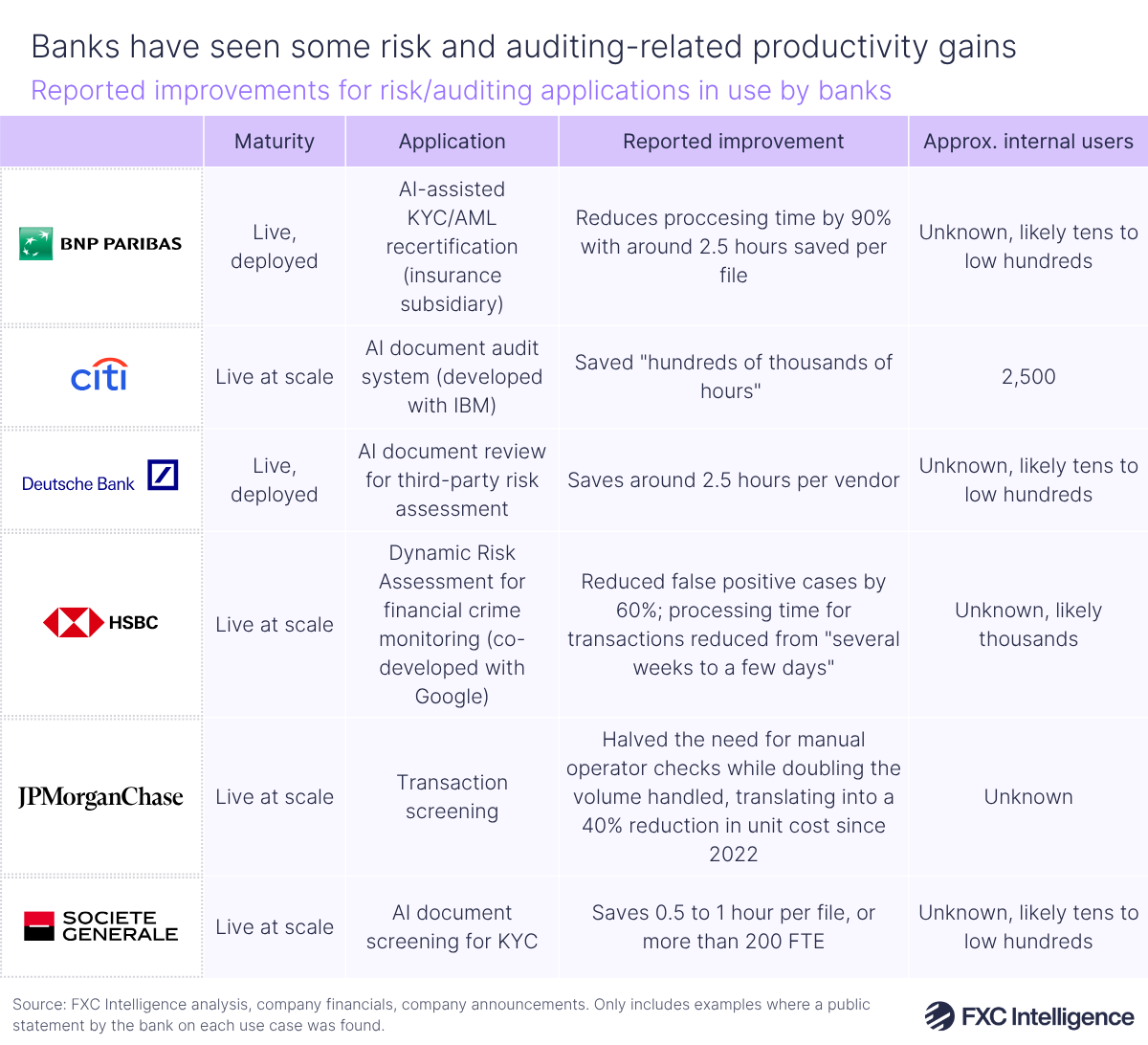
While AI has been embedded into fraud and other compliance-related applications for decades, its more recent applications related to risk and auditing largely relate to document review.
The technology is now being widely used to review documents for a host of KYC-related applications, with very pronounced gains per document that can stack to significant man-hour increases depending on the scale of the project. While this area may be minor compared to some in terms of the number of individual employees involved, the extent of the automation of this task is very high, making it a meaningful benefit for relevant departments.
How banks are using AI in markets and trading
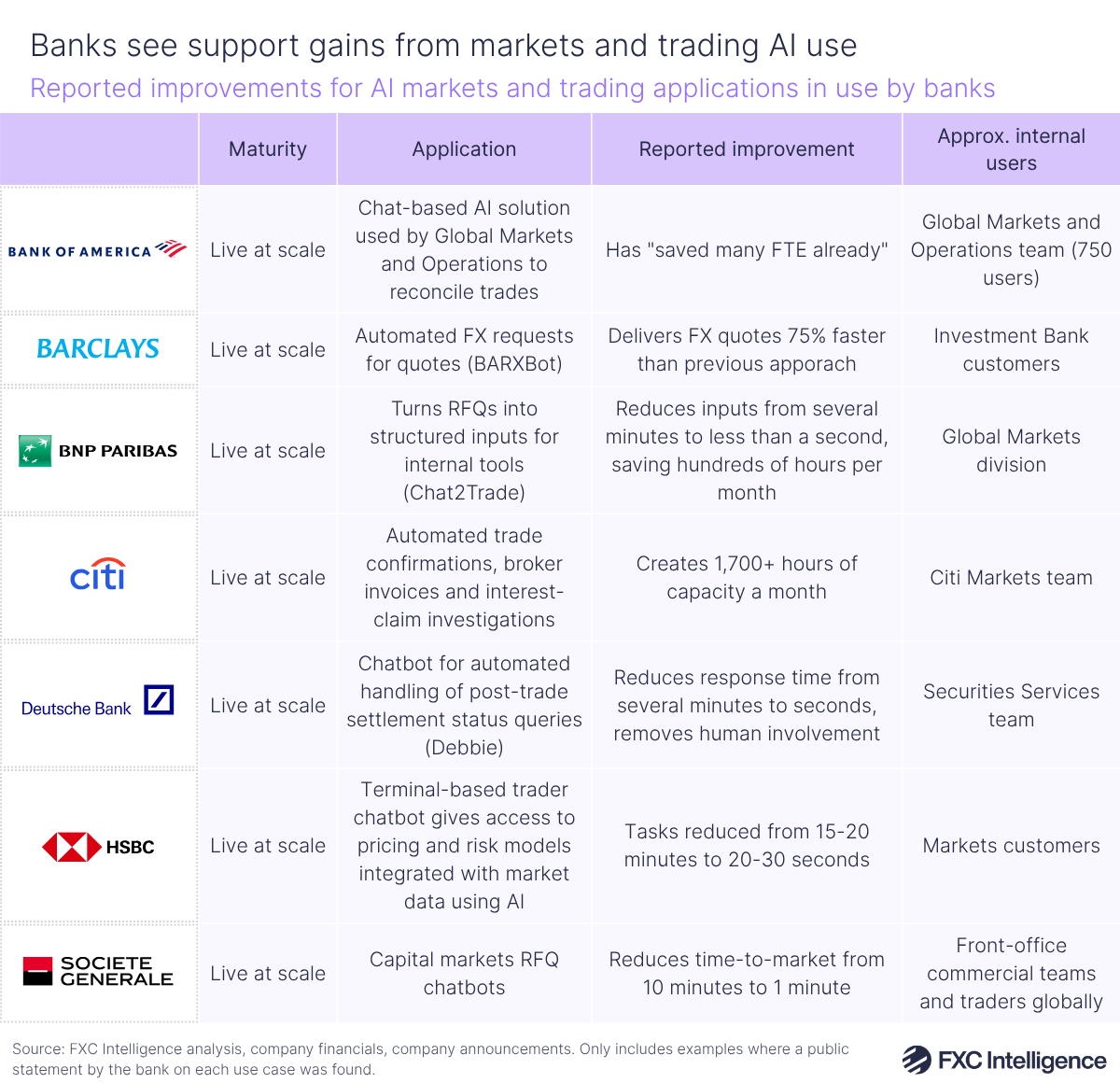
While some applications see AI largely take over operations, reducing human involvement to more challenging cases or more complex activities, others focus on peripheral frictions. Many of the markets and trading applications showing an impact are arguably in this area, with banks using the technology to automate RFQs, reconcile trades or provide automated updates on the status of a trade.
These applications are largely focused on removing administrative and support tasks for Global Markets teams, typically cutting minutes of individual actions that scale to significant numbers across the course of a working year.
How much are banks seeing a writing impact from AI?
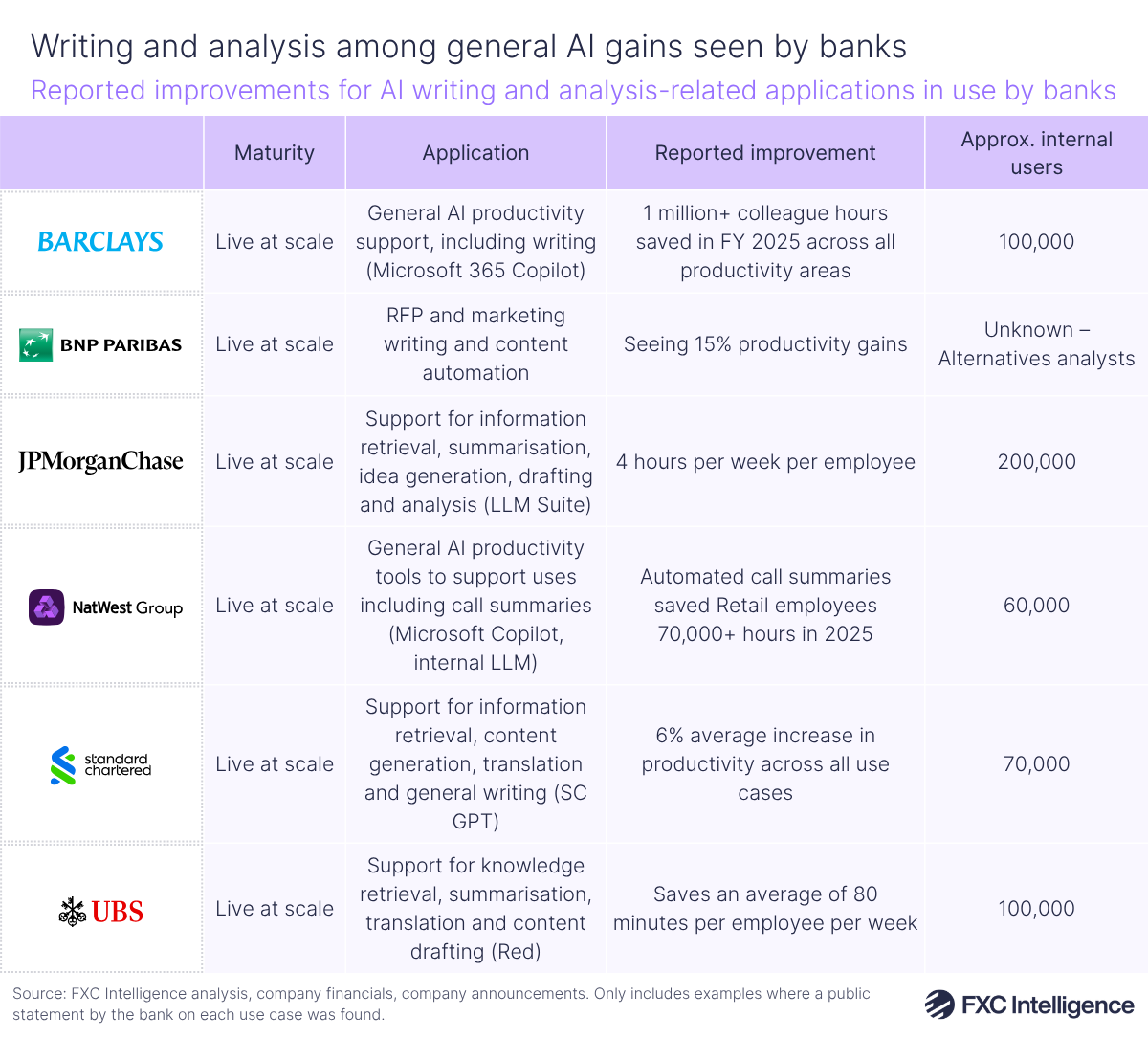
While most bank applications of AI are largely focused on a particular business function or department, writing and analysis is notable for the breadth of its use. Multiple banks highlight the adoption of tools to support a wide range of writing and analysis-related applications, including information retrieval and summarisation, idea generation, drafting and analysis.
These are typically delivered either via in-house branded tools or externally supplied products such as Microsoft Copilot, with the number of employees using the tools in the tens or even hundreds of thousands. However, while a number of banks have reported gains using these tools, these are some of the vaguest and least comparable of any we have identified, with companies often citing percentage gains in productivity without clarity about the length or frequency of the tasks being performed.
Where information is shared more granularly, it often covers all use of such tools, for example UBS’s reports on its in-house LLM Red, which it says saves an average of 80 minutes per employee per week.
It’s clear that banks are seeing writing and analysis-related gains from AI tools, however despite sharing specific metrics, banks have not provided tangible enough information to successfully assess how much of an impact these tools have on this kind of work at scale.
Is AI impacting banks’ profit and loss reporting?
Behind much of the AI narrative at banks, payment companies and beyond is the idea that AI adoption can drive productivity gains, which in turn can reduce costs. However, there is little to suggest that banks have yet seen meaningful financial improvements as a result of AI adoption.
Almost no metrics related to AI adoption shared by banks include specific financial numbers, either in terms of increased revenue or costs saved. Notably, few banks have reported YoY reductions in operating costs since AI began to see increased earnings call focus in Q2 2025 – Societe Generale is the only bank to see consistent reductions over this period.
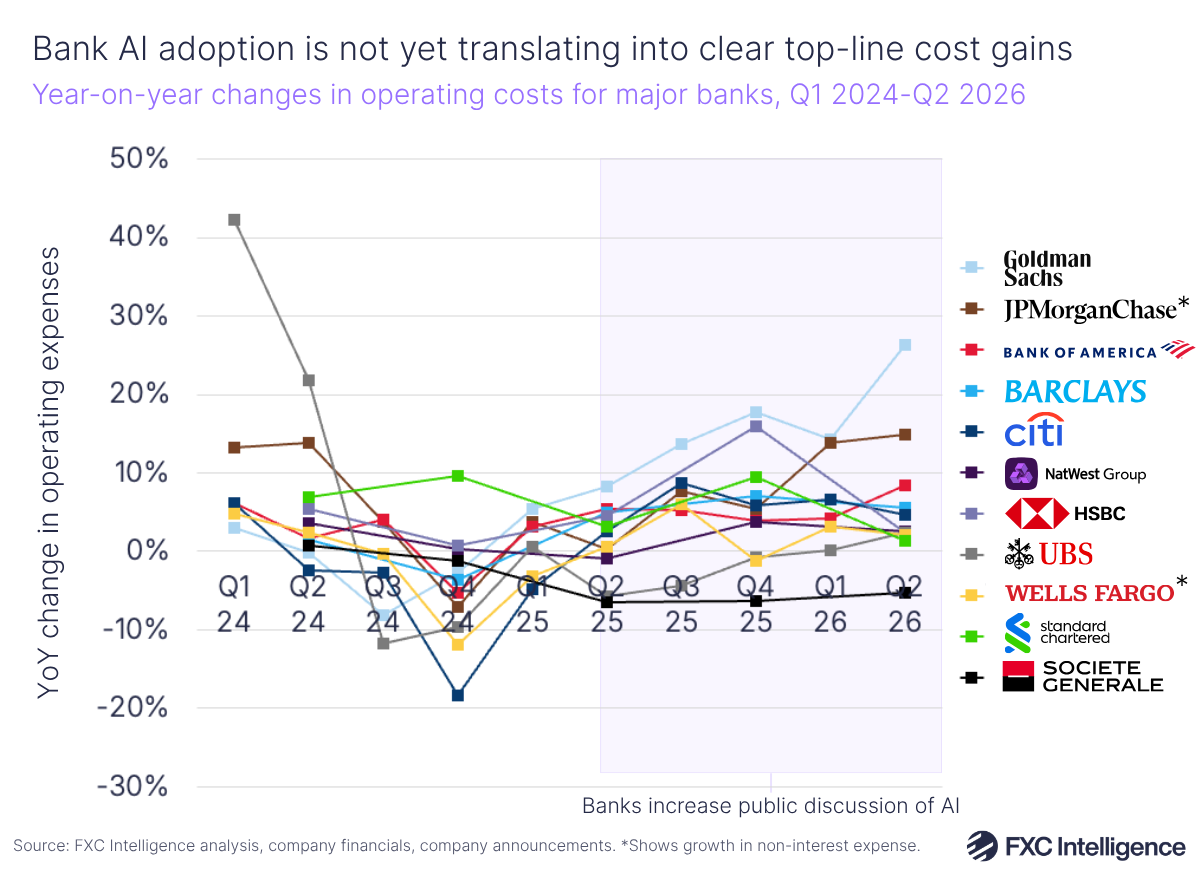
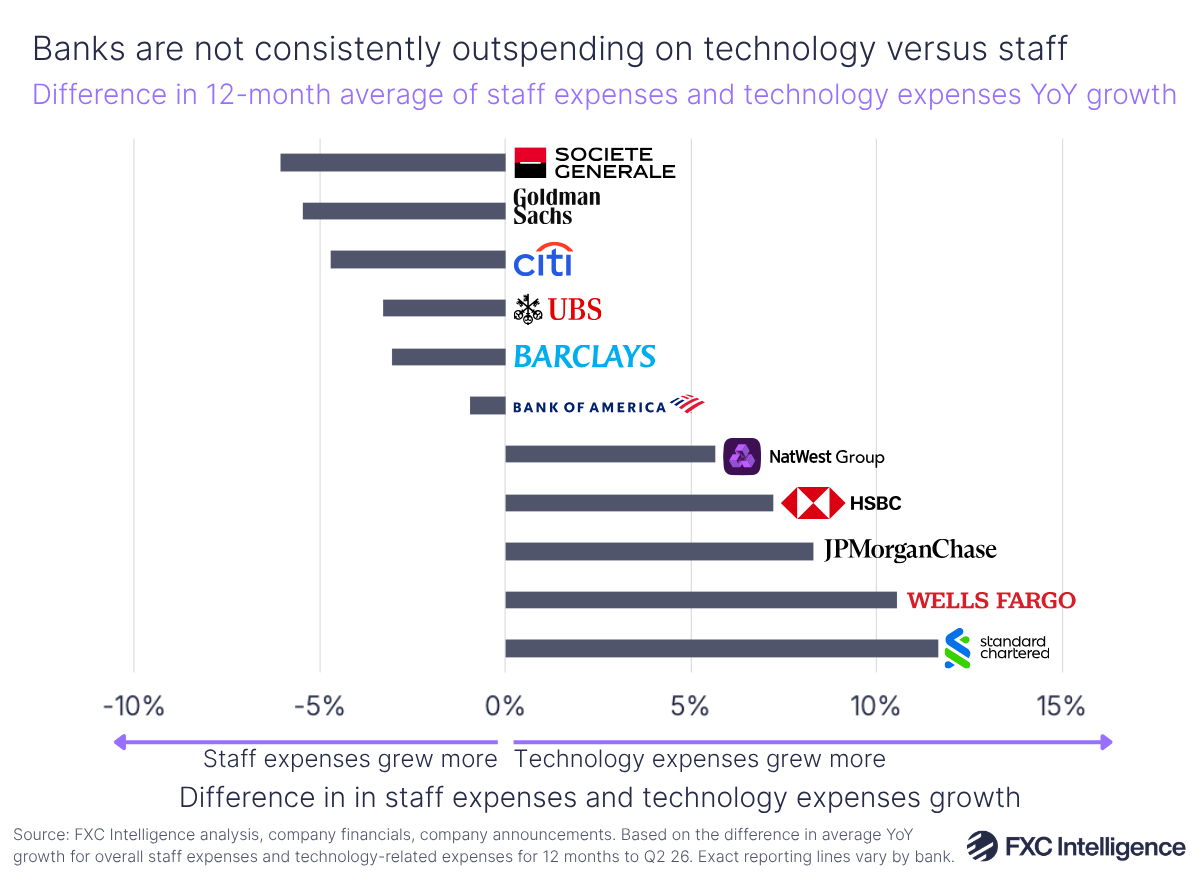
The lack of top-line reductions in expenses could be because the costs are moving from employees to infrastructure expenditure, with tokenomics being a growing concern for many banks. However, there is little evidence that this is consistently occurring at major banks.
Looking specifically at the YoY growth in expenses related to software and other non-employee technology costs versus the growth in those attributed to staff, only around half the banks who reported this data either half-yearly or quarterly saw technology grow ahead of staff. However, where technology did outpace staff costs, the differences tended to be more pronounced than where staffing led technology. There was also a lack of clear correlation between banks who have been more vocal about AI and spending more on technology, although with in-house development, as well as the use of consultancies, also being a strong focus, this is not always going to clearly show up in one reporting line versus another.
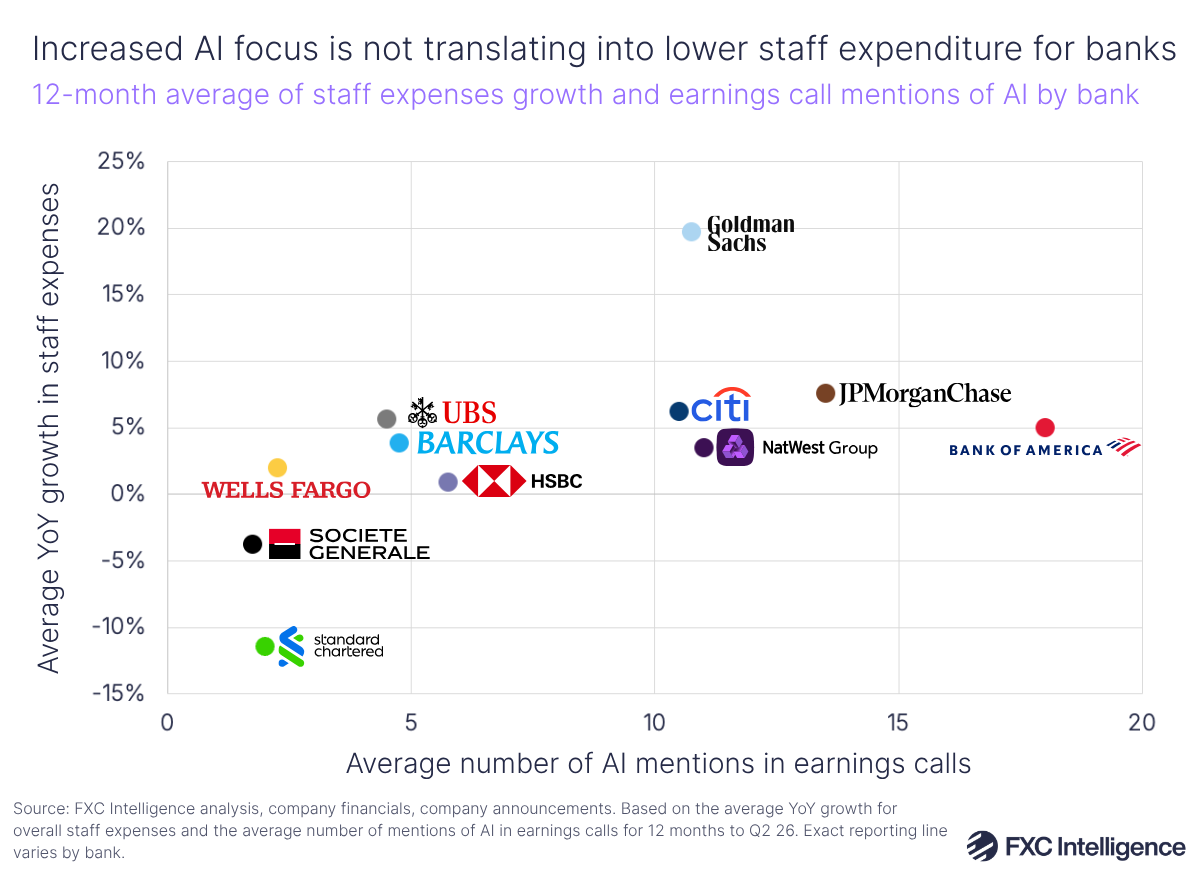
One area that has shown interesting results is in the relationship between discussing AI in earnings calls and average YoY growth in staff expenses over the past year. Here there is a small but noticeable relationship, with increased discussion typically correlating with increased growth in staff costs. This may reflect increased hiring of more expensive AI specialists, or may be due to wider investment that includes an AI focus.
With AI projects often playing a role in multi-year strategic plans for banks, it is unlikely we will see meaningful financial impacts for some time, but it does serve as a note of caution for any companies expecting more immediate financial returns from AI initiatives.
Proving out AI’s impact: Future challenges
It is notable that while there are some areas that AI is seeing consistent, measurable impacts, these are largely restricted to either support roles or supporting tasks. AI has yet to directly touch core banking areas at significant scale in a manner banks feel comfortable reporting externally, and little has been shared to indicate whether and how this may change in the future.
Additionally, there is a notable divide between the two types of impacts AI is having. For some tasks, including client services and coding, the technology provides ongoing assistive support, freeing up employees to do more with their time or work on more complex or interesting projects.
For others, it largely automates work that once required extensive human involvement, creating a one-time productivity bump that once achieved will become table stakes from which to build future efforts. This kind of gain is why some areas see gains achieved several years ago still get mentioned in AI reports, but are not likely to show up on a financial sheet more than once.
For banks, AI is beginning to have a very meaningful impact on some areas of the business, but there are still others where its involvement is only peripheral. Whether that will change, and whether AI will ultimately act as a one-time replacement or an ongoing supportive tool, remains to be seen. The difference between the two may ultimately prove vital in understanding the longer term effects of AI for the industry and how to build sustainable strategies in a post-AI landscape.
Critically, however, while AI adoption is still relatively nascent, so is AI reporting. To truly engage with and champion AI use, banks need to report gains in a more consistent and quantifiable manner, tied to business-level staff hours rather than abstract percentage improvements. And when this becomes a standard part of industry reporting, it will be clear how AI’s impact is truly being felt.