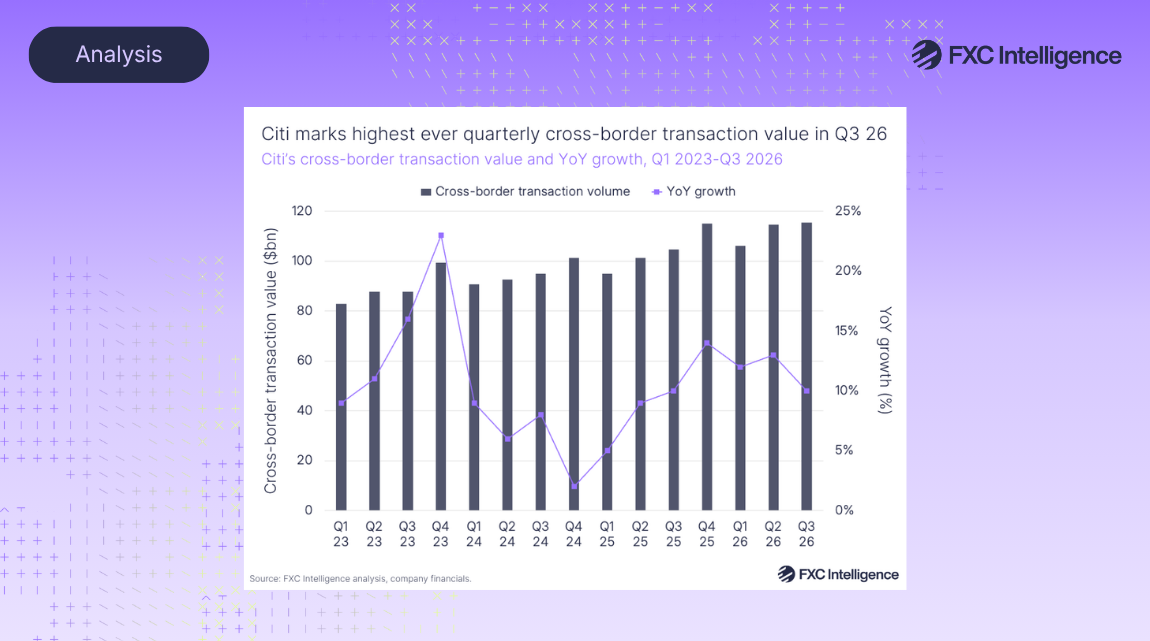
Citi continued to report strong cross-border growth in its Q3 2026 earnings, in which the US bank saw its total revenue rise by 8% to $23.8bn.
Chart data
| Quarter | Cross-border transaction value | YoY growth |
|---|---|---|
| Q1 23 | $83.0bn | 9% |
| Q2 23 | $87.8bn | 11% |
| Q3 23 | $87.8bn | 16% |
| Q4 23 | $99.4bn | 23% |
| Q1 24 | $90.7bn | 9% |
| Q2 24 | $92.7bn | 6% |
| Q3 24 | $95.0bn | 8% |
| Q4 24 | $101.3bn | 2% |
| Q1 25 | $95.1bn | 5% |
| Q2 25 | $101.3bn | 9% |
| Q3 25 | $104.8bn | 10% |
| Q4 25 | $115.2bn | 14% |
| Q1 26 | $106.3bn | 12% |
| Q2 26 | $114.6bn | 13% |
| Q3 26 | $115.5bn | 10% |
Citi’s cross-border transaction value metric includes FX payments processed through the bank’s Worldlink and Cross Border Funds Transfer platforms. This figure rose by 10% YoY to $115.5bn in Q3 2026 – the highest ever quarterly total for this metric – matching its growth rate from the previous year. Citi’s wider Services division, which contains its Payments unit, grew by 15% overall to $6.6bn and accounted for 28% of Citi’s revenue overall in Q3.
Sitting under Services is Citi’s Treasury and Trade Solutions (TTS) segment, which contains integrated cash management, trade services and finance services – including cross-border payments. TTS revenue rose by 16% to $4.9bn (74% of Services revenue). As part of this, non-interest revenue, which includes revenue earned from fees related to cross-border transactions, grew 12% to $1.2bn, driven by strong activity and engagement across corporate and commercial clients.
During this quarter, rising interest income on customer balances also helped propel TTS growth. Net interest income for TTS rose by 18% to $3.7bn, driven by higher average deposit balances and deposit spreads. Average TTS deposits rose 17% to $867m during the quarter.
At the end of September, Citi announced a collaboration with Swift that allows its bank clients to access multiple cross-border instant payment markets through a single account structure. It also expanded Citi Token Services – its blockchain-based infrastructure enabling 24/7 instantaneous cross-border payments through tokenised deposits – to Japan and the UAE, adding to its existing market set of Hong Kong, Singapore, the UK, Ireland and the US.
CEO Jane Fraser said that tokenisation remains the area within digital assets that the bank is most excited about as it targets instant movement but also interoperability between traditional fiat and stablecoins. By comparison, she said that Citi is seeing less activity on stablecoins, where the bank is seeing more complexity around compliance, accounting and tax when it comes to moving money around the world. Fraser added that digital asset custody is expected to go live later this year and bolster its recently launched Custody+ suite of real-time solutions.
Finally, Fraser shared some figures on how AI was helping cut costs and boost efficiency for Citi. She said that AI had increased the speed of product launches by 30-40% and helped the bank bring work back in-house, reducing its tech vendor spending by 30% YoY. Citi has changed or is in the process of changing around 100 manual processes to leverage AI and automation, and said that AI tools being used in its Services segment have improved response times for clients by 21%, reflecting similar automation gains seen from other banks in the industry.