Western Union has reported its Q4 2025 and full-year results, with macroeconomic headwinds continuing to impact the company’s bottom line. Here, we take a look at its latest results and how it plans to achieve growth by adapting its strategy and utilising stablecoins and digital wallets.
Western Union’s Q4 2025 revenue declined 5% YoY to $1bn, while the company’s consumer money transfer (CMT) revenue also fell 7% in the quarter to $872m. The company’s operating margin increased to 18% on a GAAP basis, representing a slight increase from 17% in Q4 2024, which the company attributed to continued cost discipline.
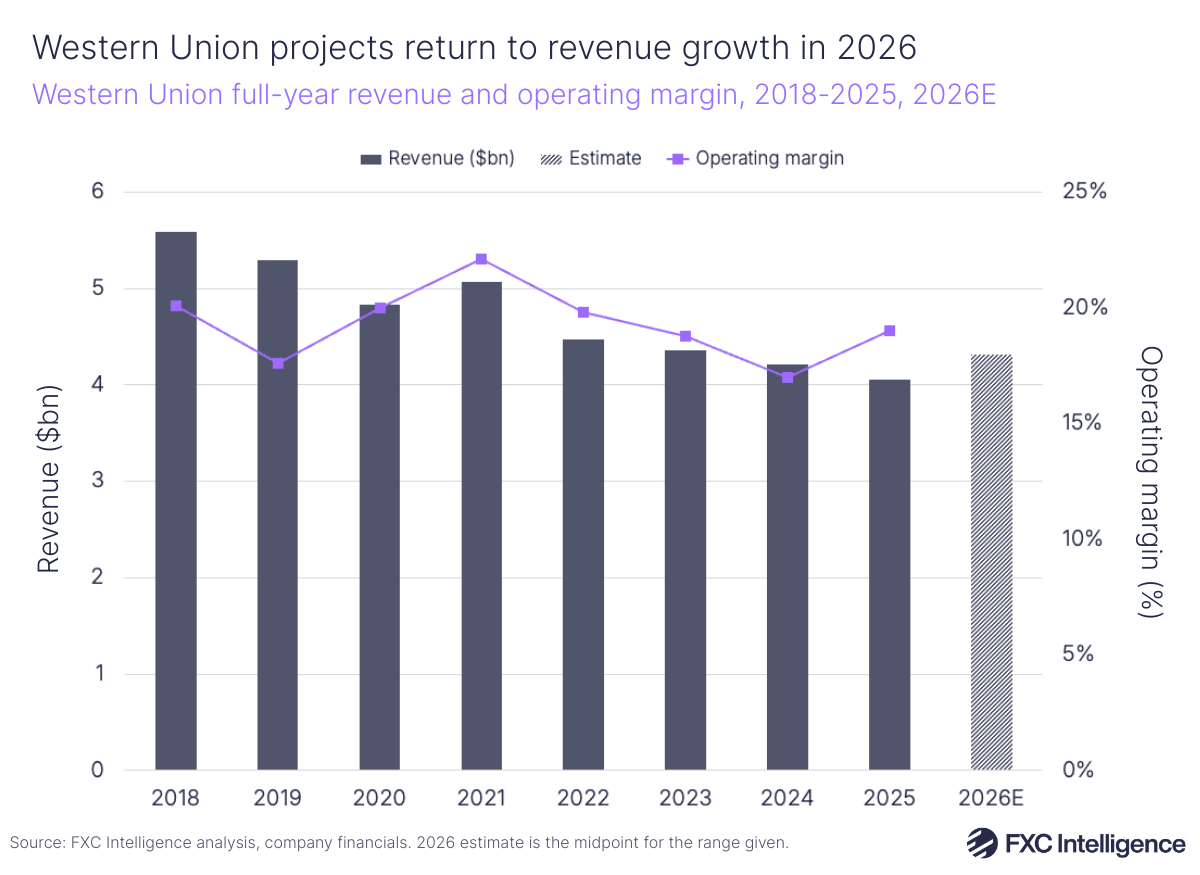
This performance contributed to overall decreases in both metrics for Western Union over the full year, with total revenue falling 4% to $4.1bn and CMT revenue falling 8% to $3.5bn. CFO Matthew Cagwin attributed these drops to macroeconomic headwinds that particularly affected the company’s retail business in the Americas.
However, branded digital revenues rose 7% YoY for both Q4 and the full year, while branded digital transactions increased 13% in Q4 and 12% in 2025 overall. Meanwhile, Consumer Services revenue – which includes online bill payments, travel money, insurance and prepaid cards – rose by 32% for the full year, increasing its share of total revenue to 13% in 2025, up from 10% in 2024. This growth closely aligns with Western Union’s efforts to diversify its revenue mix, with plans to reduce reliance on retail remittances and increase the share of revenue generated by its Digital and Consumer Services.
Western Union CEO Devin McGranahan also provided an update on the company’s digital asset strategy during the earnings call, explaining that it had minted its first US Dollar Payment Token (USDPT) and successfully moved it between its treasury department and its agents’ wallets. He discussed plans to launch a USDPT ‘stable card’ in “more than a dozen” countries in 2026 in partnership with Visa and stablecoin infrastructure provider Rain, which would enable users to hold balances in stablecoins – particularly targeting countries experiencing high levels of inflation and local currency volatility.
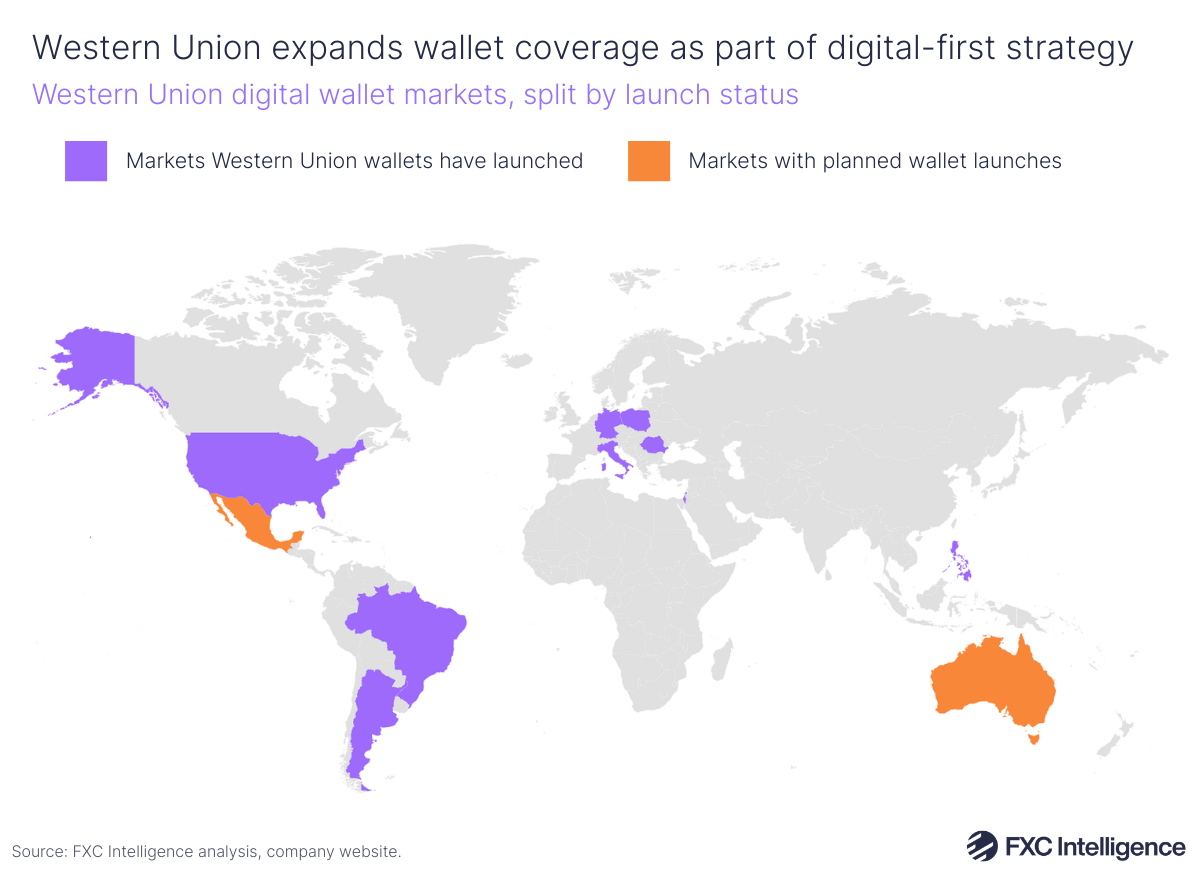
Vigo Money, Western Union’s multicurrency mobile wallet app for the US, has now onboarded over 30,000 users to date, with around 2,000 weekly active users. In Brazil, it has onboarded around 20,000 customers to its local wallet offering since its launch in May 2025, seeing around 5% of all inbound transfers to the country into the wallet in January. Similarly, in Argentina, the company reportedly sees around 17% of all inbound remittances to its wallet. McGranahan shared that the company has plans to launch wallets in Australia and Mexico in the future, while looking into expanding existing wallet capabilities in Singapore, the Philippines and Israel.
Western Union expects to see full-year revenue growth for the first time since 2021 in 2026, with guidance projecting revenue growth of 5-8%, inclusive of its acquisition of Intermex – with expectations that this will be completed in Q2 2026. This outlook places total revenue between $4.3bn and $4.4bn, aligning with the company’s Beyond strategy, which it first outlined in November and projects revenues returning to around $5bn in 2028.