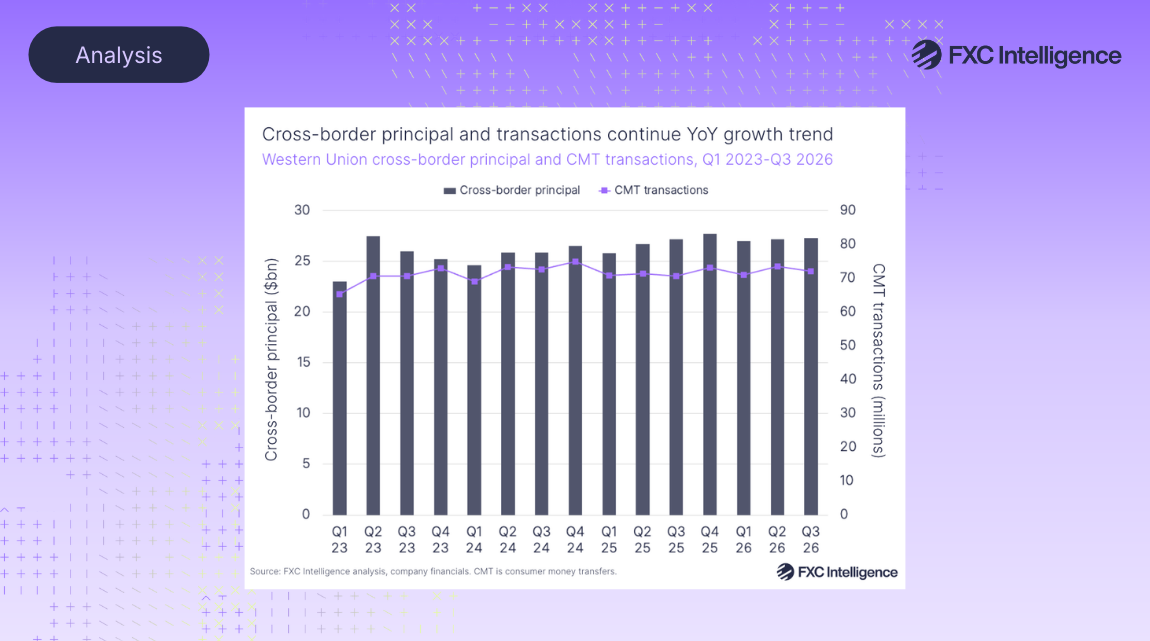
Western Union has reported its Q3 2026 results, seeing a 2% YoY fall in both overall revenue to $1bn and Consumer Money Transfer (CMT) revenue to $857.2m. However, the money transfer company continues to see rapid growth in its digital business.
Chart data
| Quarter | Cross-border principal | CMT transactions |
|---|---|---|
| Q1 23 | $23.0bn | 65 |
| Q2 23 | $27.5bn | 71 |
| Q3 23 | $26.0bn | 71 |
| Q4 23 | $25.2bn | 73 |
| Q1 24 | $24.6bn | 69 |
| Q2 24 | $25.9bn | 73 |
| Q3 24 | $25.9bn | 73 |
| Q4 24 | $26.5bn | 75 |
| Q1 25 | $25.8bn | 71 |
| Q2 25 | $26.7bn | 71 |
| Q3 25 | $27.2bn | 71 |
| Q4 25 | $27.7bn | 73 |
| Q1 26 | $27.0bn | 71 |
| Q2 26 | $27.2bn | 74 |
| Q3 26 | $27.3bn | 72 |
Despite the slight decline in CMT revenue, CMT transactions grew 2% YoY to 72.1 million, while Western Union also reported 1% growth in its cross-border principal – the total amount sent in cross-border transactions – to $27.3bn.
Digital growth remains the headline for Western Union, with the money transfer giant seeing branded digital revenues increase 8% to $274.3m, driven by a 21% rise in branded digital transactions. Branded digital now accounts for 32% of CMT revenues, up from 29% in Q3 2025, as well as 45% of CMT transactions. During the Q3 earnings call, CEO Devin McGranahan explained that digital growth was particularly supported by strong growth in Western Union’s Middle Eastern digital business, where it continued to see “meaningful transaction growth” in Saudi Arabia.
Chart data
| Quarter | Branded digital | Non-digital | Digital share (%) |
|---|---|---|---|
| Q1 24 | $0.22bn | $0.74bn | 23% |
| Q2 24 | $0.23bn | $0.73bn | 24% |
| Q3 24 | $0.23bn | $0.70bn | 25% |
| Q4 24 | $0.23bn | $0.70bn | 25% |
| Q1 25 | $0.24bn | $0.63bn | 28% |
| Q2 25 | $0.26bn | $0.63bn | 29% |
| Q3 25 | $0.25bn | $0.62bn | 29% |
| Q4 25 | $0.26bn | $0.61bn | 30% |
| Q1 26 | $0.27bn | $0.57bn | 32% |
| Q2 26 | $0.28bn | $0.59bn | 32% |
| Q3 26 | $0.27bn | $0.58bn | 32% |
Western Union’s digital growth comes in part through the company’s Beyond strategy, which is aiming to reposition it as a digital-first provider of remittances and other financial services. McGranahan noted that the company has made progress across all of the “five key pillars” of this strategy, having accelerated the relocation of its Americas regional operating centre from Costa Rica to Guatemala, which it says should help generate more than $25m in savings for the company.
Western Union also underwent a restructuring resulting in 500 fewer full-time employees and completed the integration of AI into its treasury funding operations, technology engineering, its customer care Q&A function and HR support.
USDPT, Western Union’s USD-pegged stablecoin, has reportedly reached $20m in circulation as the company moves towards building a near-instant, always-on stablecoin settlement layer between it and its agents. By the end of the year, Western Union also plans to launch Receiver Redirect, a new digital asset service enabling recipients to hold funds as USDPT in a Western Union wallet or spend them using the company’s Visa-powered Stablecard offering.
Western Union also updated its guidance for FY 2026; assuming the acquisition of Intermex completes on 10 November, it expects its adjusted revenue to sit between remaining flat and 1% growth. Excluding the acquisition, it expects a small YoY decline in its organic business of 1-2%. Despite difficulties in 2026, McGranahan reiterated the company remains confident that it can “improve performance” going forward.