This week, Visa reported its earnings for Q3 2026 (spanning calendar Q2 2026), in which the company saw net revenues rise by 14% to $11.6bn while payments volumes grew 10% to $4tn. As part of this, the company reported specific insights around Visa Direct, its real-time money movement solution for banks, fintechs and other organisations.
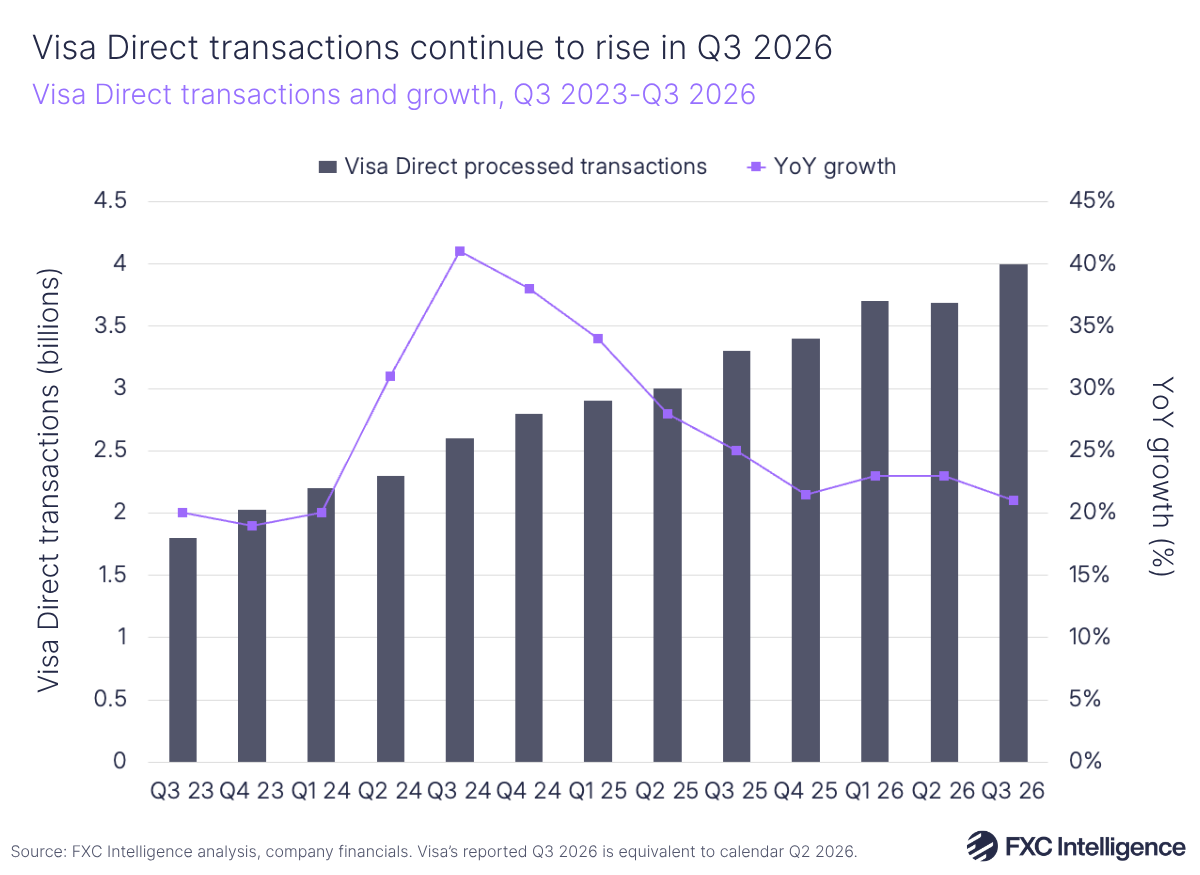
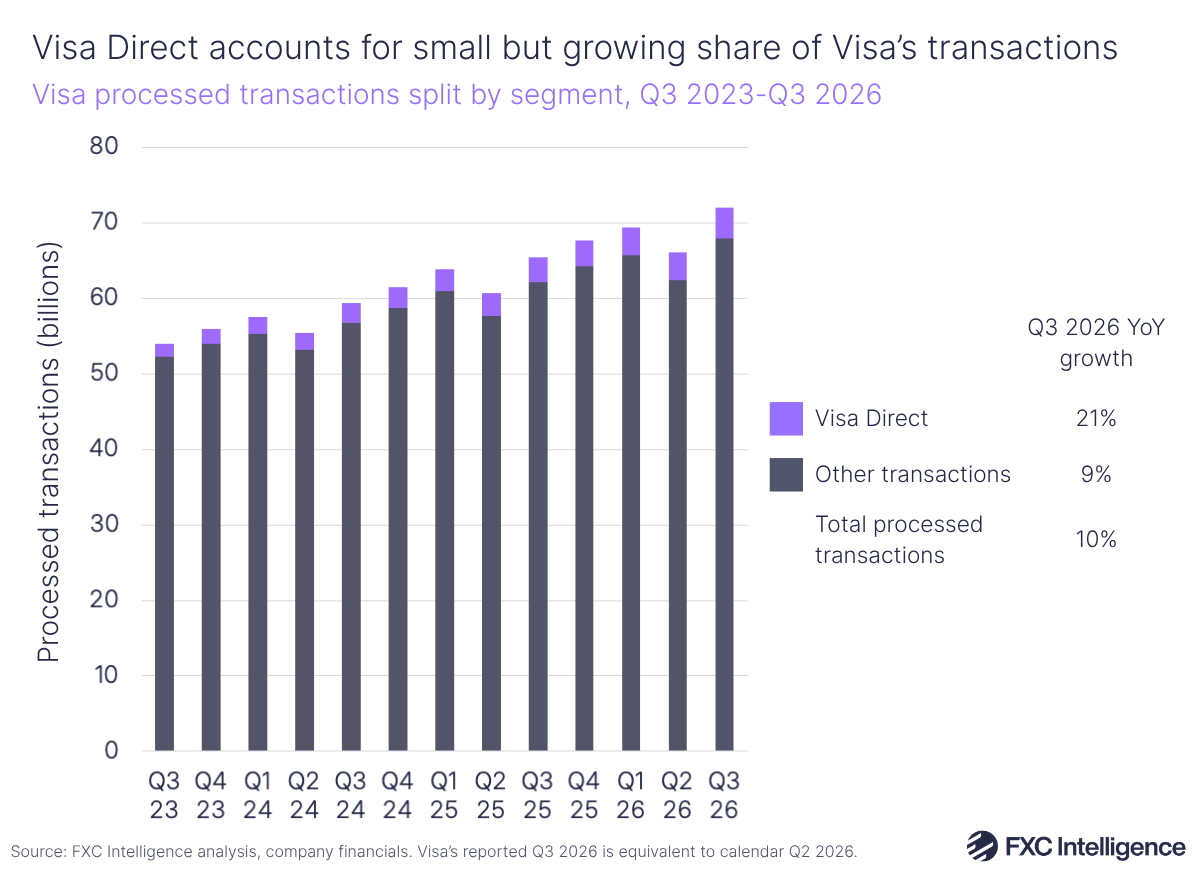
Visa Direct saw transactions grow 21% YoY to four billion, with CEO Ryan McInerney citing continued strength in both domestic and cross-border volumes. Across Visa’s overall businesses, processed transactions grew by 10% YoY to 71.7 billion, which was a key driver for consumer payments revenue alongside payments volume growth.
Visa Direct transactions have continued the trend of growing at a faster rate than processed transactions overall. Though they still only account for around 6% of Visa’s total processed transactions, roughly the same as in Q3 2025, this share has gradually grown over time, up from 4% in Q3 2024 and 3% in Q3 2023.
Overall, Visa noted that revenue for its Commercial and Money Movement Solutions (CMS) segment – which contains Visa’s Cross-Border, Visa Direct and B2B Connect products – grew by 17% YoY, with the company seeing 13% YoY commercial payments growth.
The company is continuing to make and expand significant partnerships that are driving Visa Direct volumes both for local and international transactions. For example, it noted an expanded partnership with DoorDash, which has used Visa Direct for payouts in the US, Australia and Canada and is now implementing a dedicated direct-to-card service to help power a specific banking and rewards program for its staff.
Visa also noted a deal it made with Grupo Aval, representing four banks in Colombia, to enable Visa Direct transactions, as well as support commercial card issuance for small businesses.
How Visa Direct fits into Visa’s wider cross-border volume growth
Overall, Visa saw cross-border volume grow 13% YoY in Q3 2026 in constant dollar terms, and 12% excluding intra-Europe. This was driven partly by a 16% rise in cross-border ecommerce (referring to the company’s card-not-present excluding travel volumes). This was the fastest growth rate in this metric since Q1 2025 and was driven by retail strength, including the timing of promotional shopping events.
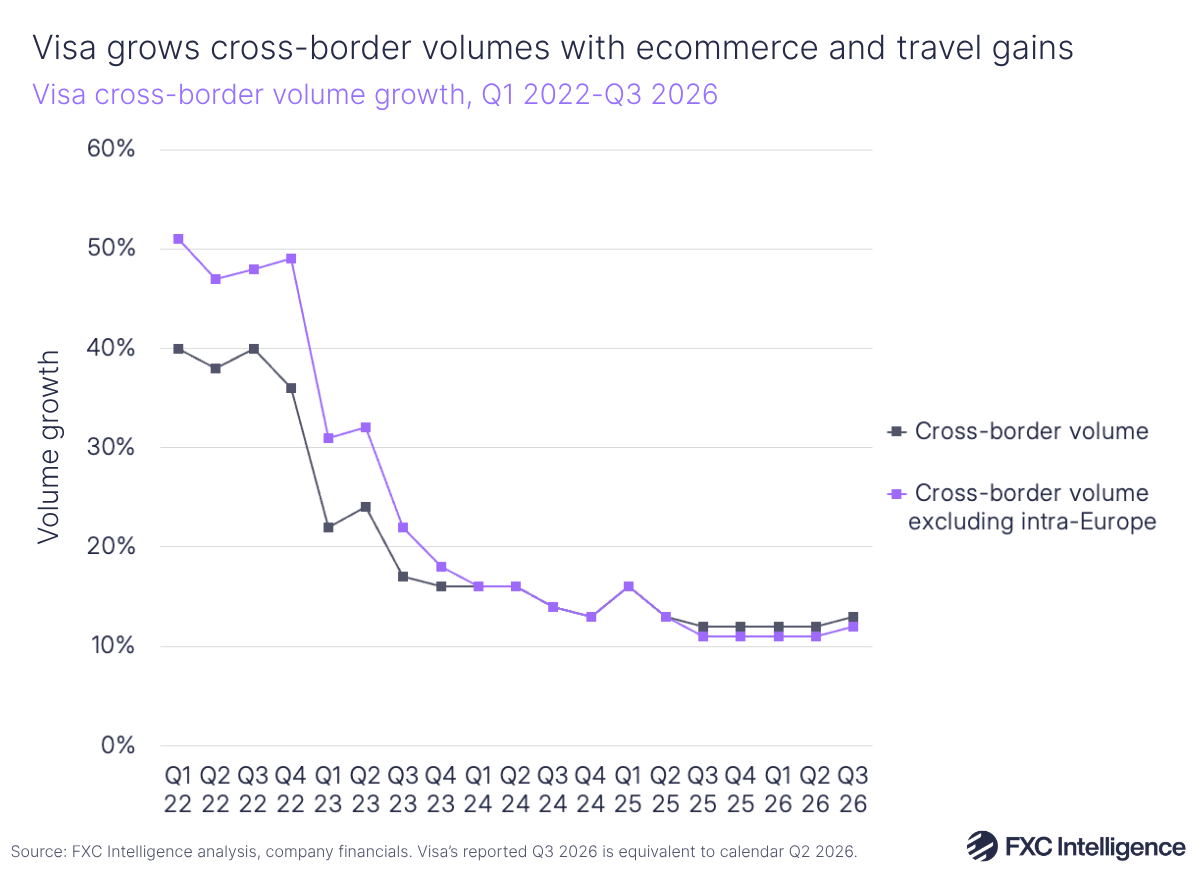
Meanwhile, travel-related cross-border volume was up by 10%, consistent with previous quarters. Visa CFO Chris Suh noted that the company continued to see an offset from conflict regions, with cross-border travel driven by commercial products and US inbound volumes.
International transaction revenue rose 6% in Visa’s Q3, below a 12% increase in constant dollar cross-border volume growth excluding intra-Europe. Visa attributed this gap between revenue growth and volume growth to two things: one being the company lapping a currency volatility peak last year, and the second being that some clients and products – including Visa Direct – typically carry a lower yield than carded transactions.
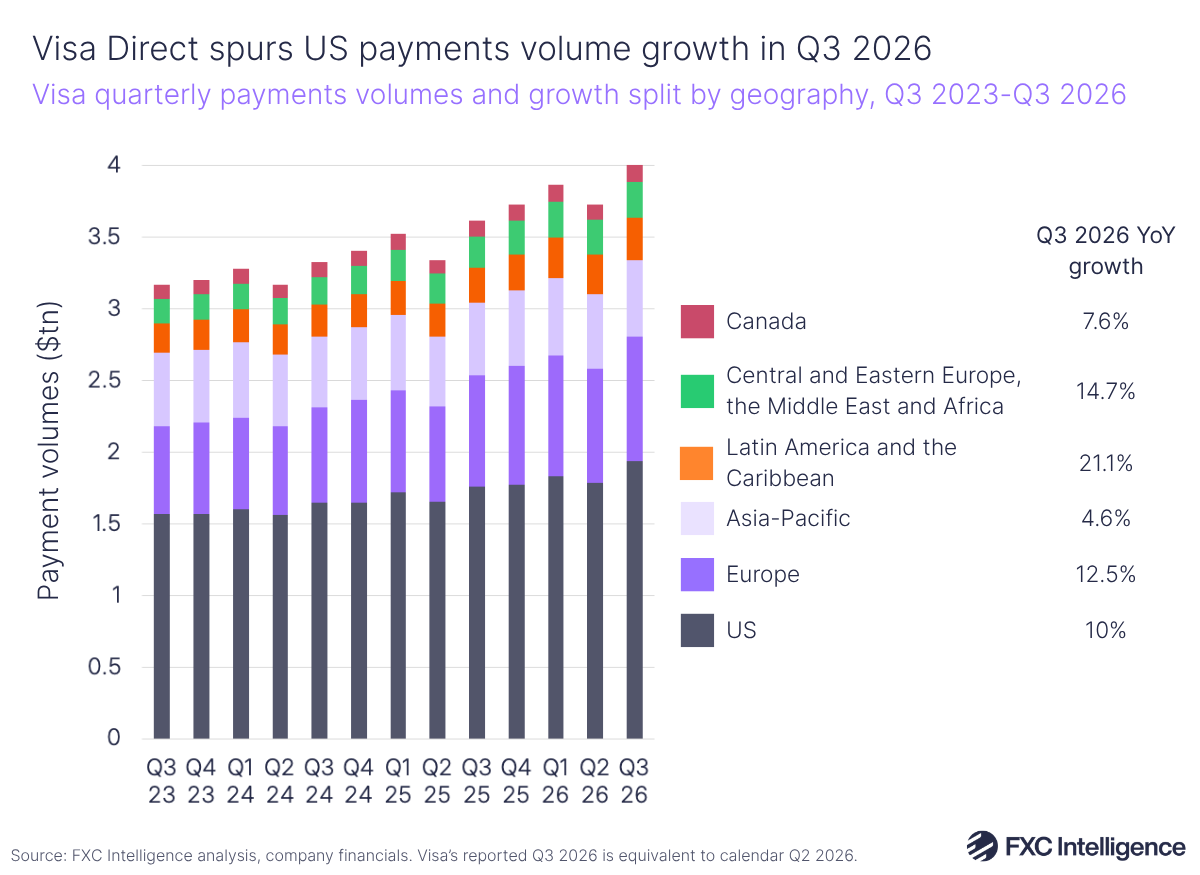
Visa Direct was also one of several factors named as a key driver for growth in US payments volume, with this rising 10% in the quarter – the fastest growth rate seen in this metric since FY 2019 (excluding the post-Covid recovery). Visa saw around 52% of its overall payment volumes outside the US during the quarter, with Latin America and the Caribbean seeing the fastest growth at 21% YoY.
Visa also noted some of the impacts from the FIFA World Cup, for which the company was a sponsor partner. In particular, the tournament boosted the company’s inbound North America and Latin America volumes, with card-present transactions in US host cities up by as much as 20% on match days. Mexico and Canada saw inbound cross-border card-present volume rise by more than 70% and 35% on match days.
Suh mentioned that overall, inbound cross-border card-present spending increased by nearly 25% YoY in US host cities from 11 June to 30 June, covering roughly the first half of the World Cup period. However, he stressed that overall no single region accounted for more than 25% of cross-border volume during the quarter, showing a continued health in travel and ecommerce growth the company expects to continue to drive growth going into Q4.
Visa pushes deeper into stablecoins with new platform
Visa also commented substantively on its stablecoin plans, including its recent joining of Open Standard – a group of partners aiming to launch the Open USD stablecoin focused specifically on money movement.
Connected to this, McInerney also gave an update on Visa Stablecoin Platform, its recently launched platform for financial institutions, fintechs and crypto natives that enables minting, movement and management services related to stablecoins. The platform will allow partners to settle in stablecoins, offer on-chain wallet-as-a-service and move money between fiat and stablecoins, starting with Open USD.
In addition, Visa plans to enhance its new platform through an integration with Pismo – the cloud banking and card issuer platform that Visa acquired for $1bn in January 2024. This will specifically be to enable tokenised deposits for financial institutions, and Visa said there is “much more to come in this space” as it builds new products and adds new partners.
Visa’s strategy as it moves into Q4
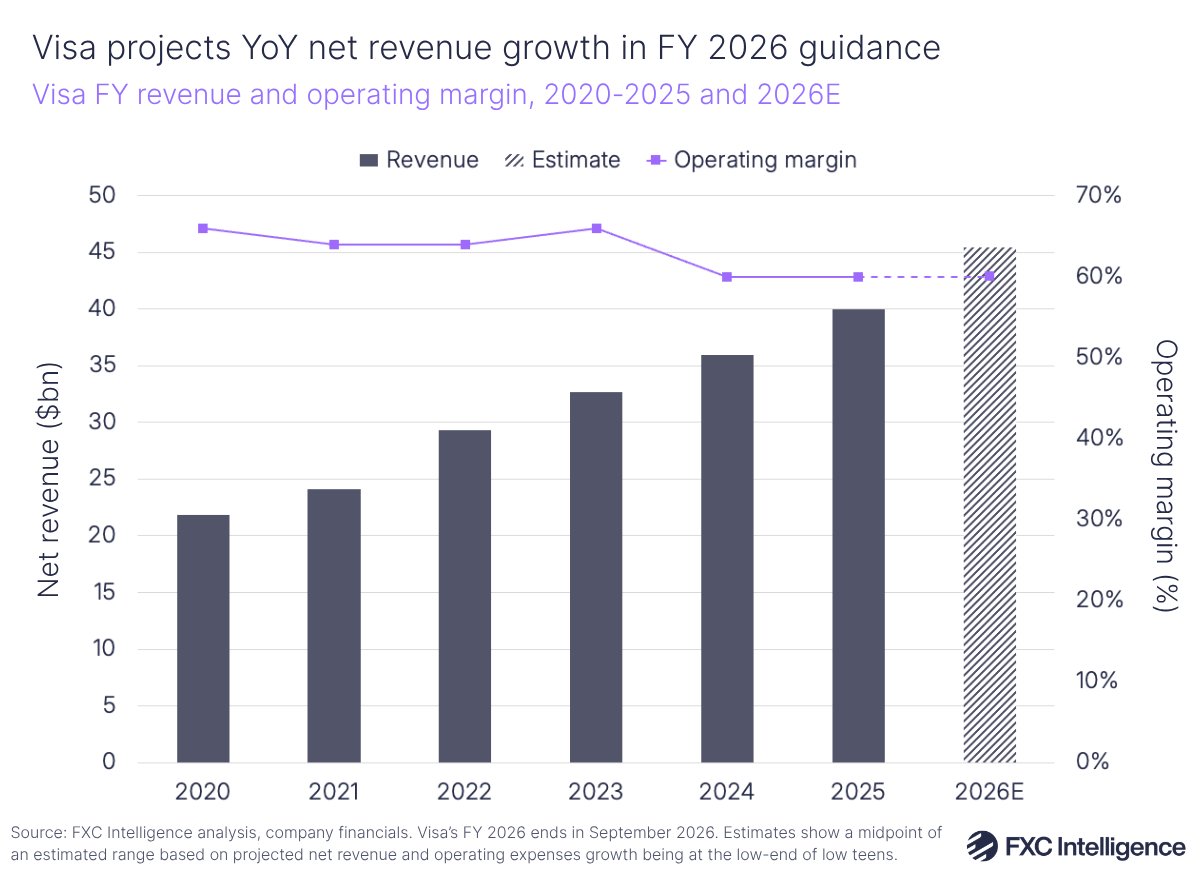
Visa provided a slightly updated version of its guidance for its FY 2026, with net revenue growth and operating expenses growth guided to the low end of low teens on a non-GAAP adjusted constant-dollar basis. This would give the company a net revenue of around $45bn, with an operating margin of 60% (the latter would be the same as the company’s FY 2025 results).
In terms of where Visa is going next, McInerney said in the earnings calls that the investments in front of the company are “enormous”, with efficiency being a key driver. These comments align with news reported by Bloomberg earlier this week, in which an internal memo revealed that the company plans to cut around 7% of its workforce, though this was not mentioned in the earnings call.
McInerney noted a range of investment opportunities across CMS, including unified B2B payments acceptance, embedded finance and Visa Direct. The company also wants to expand its acceptance in “cash-rich markets around the world”.
On AI, McInerney referenced continued progress through a recent partnership with Open AI, through which Visa will provide its network and infrastructure to support agentic commerce experiences, as well as a deal with Meta as part of which Visa’s Intelligent Commerce platform enables users to securely transact with Visa tokens on Facebook and Instagram.
McInerney said that AI and agentic commerce would expand the company’s addressable market, but that Visa was still in the “very early stages” of adoption. As we identified in our wider report on agentic commerce earlier this year, the impact of the technology on cross-border payments is still largely yet to be seen.