PayPal has announced its Q3 2026 financial results, providing a key update on the company’s ongoing transformation under recently appointed CEO Enrique Lores. Having joined the business in Q1 of this year, Lores is tasked with returning this large and highly profitable payments major to notable growth, a goal that is set to be the company’s key focus for several years to come.
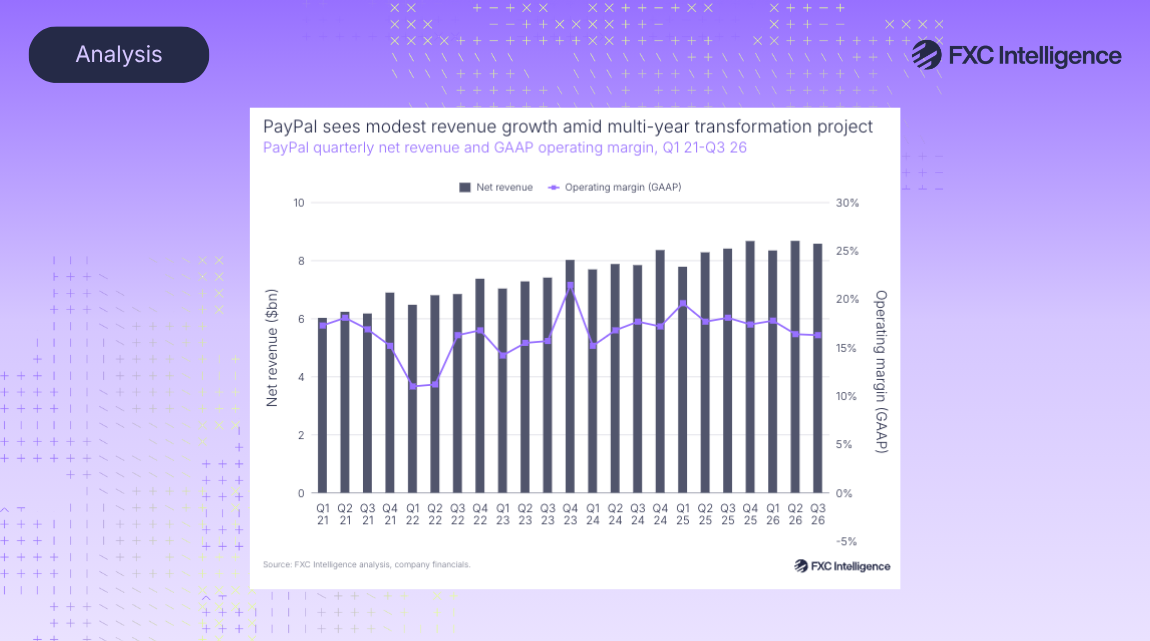
While there have been some early wins for the company, so far this transformation project has not had a pronounced impact on its top-line numbers. The company saw net revenues increase by 2% year-on-year to $8.6bn – or 1% on a currency-neutral basis – while GAAP operating income dropped 8% YoY to $1.4bn, although non-GAAP operating income grew by 3% YoY to $1.6bn.
This has translated into a squeeze on PayPal’s GAAP operating margin, which contracted by 173 bps to 16.3%, while total payment volume (TPV) increased by 6% to $487.1bn, or 7% on an FX-neutral basis.
Chart data
| Quarter | Net revenue | Operating margin (GAAP) |
|---|---|---|
| Q1 21 | $6.0bn | 17.3% |
| Q2 21 | $6.2bn | 18.1% |
| Q3 21 | $6.2bn | 16.9% |
| Q4 21 | $6.9bn | 15.2% |
| Q1 22 | $6.5bn | 11.0% |
| Q2 22 | $6.8bn | 11.2% |
| Q3 22 | $6.8bn | 16.3% |
| Q4 22 | $7.4bn | 16.8% |
| Q1 23 | $7.0bn | 14.2% |
| Q2 23 | $7.3bn | 15.5% |
| Q3 23 | $7.4bn | 15.7% |
| Q4 23 | $8.0bn | 21.5% |
| Q1 24 | $7.7bn | 15.2% |
| Q2 24 | $7.9bn | 16.8% |
| Q3 24 | $7.8bn | 17.7% |
| Q4 24 | $8.4bn | 17.2% |
| Q1 25 | $7.8bn | 19.6% |
| Q2 25 | $8.3bn | 17.7% |
| Q3 25 | $8.4bn | 18.1% |
| Q4 25 | $8.7bn | 17.4% |
| Q1 26 | $8.4bn | 17.8% |
| Q2 26 | $8.7bn | 16.4% |
| Q3 26 | $8.6bn | 16.3% |
PayPal sees challenging international environment in Q2 2026
At the heart of the company’s Q3 2026 results is a story of two halves: while PayPal is seeing solid growth in its US business, it is facing a tougher time internationally.
The company reported a 5% YoY increase in US net revenues to $5bn, while international net revenues dropped by 2% to $3.6bn. This translated to a 41.7% international share of net revenues, the second lowest share since Q1 2023.
Meanwhile, TPV shows a similar picture. While TPV in the US climbed 11% YoY to $317bn, international TPV dropped by 1% YoY to $171bn, giving it a multi-year low share of 35%.
PayPal cited the EU de minimis charge, a €3 parcel duty that applies to B2C shipments valued at €150 or less entering the EU from outside the bloc, as the primary driver of this. While parcels below this value had previously been exempted, this exception was paused at the start of July this year, with the duty set to remain in place for low-value shipments until mid 2028.
This has been a headwind for multiple companies serving the region, however PayPal reports it being a particular challenge. In its Q3 2026 earnings call, the company said the move had cost it around 70 bps of branded checkout growth company-wide, with a far greater impact on international revenue alone.
The company also says that it is seeing a longer-lasting impact than from the equivalent ending of the de minimis exemption in the US in August 2025. While that impact was only felt for a few months, PayPal anticipates headwinds from the EU version to continue throughout Q4, with China to EU commerce set to be particularly impacted.
Despite this, the company is continuing to invest in Europe, however its focus is on more domestic elements, including buy now, pay later solutions, checkout presentation and co-marketing. On a country-level basis, PayPal also cited the UK as a “challenging” environment, while characterising France and Italy as stable and Germany as stable to slightly improving.
Chart data
| Quarter | US TPV | International TPV | International share of TPV |
|---|---|---|---|
| Q2 23 | $238.9bn | $137.6bn | 36.6% |
| Q3 23 | $242.7bn | $145.0bn | 37.4% |
| Q4 23 | $257.9bn | $151.9bn | 37.1% |
| Q1 24 | $259.2bn | $144.7bn | 35.8% |
| Q2 24 | $265.5bn | $151.3bn | 36.3% |
| Q3 24 | $265.7bn | $156.9bn | 37.1% |
| Q4 24 | $275.9bn | $161.9bn | 37.0% |
| Q1 25 | $269.9bn | $147.3bn | 35.3% |
| Q2 25 | $276.8bn | $166.8bn | 37.6% |
| Q3 25 | $286.0bn | $172.1bn | 37.6% |
| Q4 25 | $300.8bn | $174.3bn | 36.7% |
| Q1 26 | $300.1bn | $163.8bn | 35.3% |
| Q2 26 | $315.6bn | $170.9bn | 35.1% |
| Q3 26 | $316.5bn | $170.6bn | 35.0% |
PayPal centres Venmo in growth plans, but quiet on P2P cross-border
While PayPal is seeing a challenging international environment, it is centring much of its transformation efforts on its US business, with domestic-focused Venmo being a particular driver of growth for the company.
The digital wallet brand saw a 14% YoY increase in TPV, while the company also reported double-digit growth in both revenue per user and debit card use. This helped drive TPV growth for the company’s P2P & other consumer segment up by 10% YoY, with the segment now accounting for 27% of TPV.
Branded checkout, meanwhile, is being buoyed by improvements in the US market as well as strength in its BNPL and Pay with Venmo offerings, offset by international headwinds. Elsewhere, the company’s payment service provider (PSP) growth was buoyed by double-digit growth in its Venmo brand.
However, while the P2P & other segment saw the strongest growth of the three main segments, P2P alone saw slower growth of 5% YoY. Covering Venmo P2P, alongside P2P via PayPal and money transfer brand Xoom, this is likely being impacted by slower growth in non-Venmo P2P solutions, and speaks to a lack of focus on cross-border payment solutions within the company’s current strategy.
Chart data
| Quarter | Payment service provider | Branded checkout (online) | P2P & other consumer |
|---|---|---|---|
| Q1 24 | $181.7bn | $121.2bn | $101.0bn |
| Q2 24 | $187.6bn | $120.9bn | $108.4bn |
| Q3 24 | $190.2bn | $122.6bn | $109.9bn |
| Q4 24 | $188.3bn | $140.1bn | $109.5bn |
| Q1 25 | $183.6bn | $121.0bn | $112.6bn |
| Q2 25 | $195.2bn | $128.6bn | $119.8bn |
| Q3 25 | $206.1bn | $132.8bn | $123.7bn |
| Q4 25 | $204.3bn | $147.3bn | $123.5bn |
| Q1 26 | $208.8bn | $134.5bn | $120.6bn |
| Q2 26 | $218.9bn | $136.2bn | $131.3bn |
| Q3 26 | $215.3bn | $133.5bn | $133.5bn |
| FX-neutral YoY growth | 8% | 1% | 10% |
Having stopped reporting cross-border TPV as a separate line item earlier this year, PayPal has largely been silent on how cross-border payments solutions fit into its overall plan, which focuses more on broadening its financial services offerings as well as growing Venmo and its PSP offerings while reducing its cost base.
Financial services are being particularly characterised as a core growth engine, with average revenue per user being an increasingly important metric for the company as it looks to make PayPal and Venmo a more central part of its users’ everyday financial lives, particularly in the US.
This is seeing it increasingly focus on BNPL and card products, with such users bringing in notably more revenue than those that don’t – around 3-5 times for PayPal users and 5-6 times for Venmo users. It is also helping the company grow average revenue per active account at a faster rate than its number of active accounts.
Chart data
| Quarter | Active accounts | Average revenue per active account |
|---|---|---|
| Q1 23 | 433 million | $16.26 |
| Q2 23 | 431 million | $16.91 |
| Q3 23 | 428 million | $17.33 |
| Q4 23 | 426 million | $18.84 |
| Q1 24 | 427 million | $18.03 |
| Q2 24 | 429 million | $18.38 |
| Q3 24 | 432 million | $18.16 |
| Q4 24 | 434 million | $19.28 |
| Q1 25 | 436 million | $17.87 |
| Q2 25 | 438 million | $18.92 |
| Q3 25 | 438 million | $19.22 |
| Q4 25 | 439 million | $19.76 |
| Q1 26 | 439 million | $19.03 |
| Q2 26 | 439 million | $19.78 |
| Q3 26 | 440 million | $19.51 |
PayPal sees costs shift amid transformation plan
While growing key product areas is central to the company’s transformation plan, it is also working to reduce costs and expects to see gross run-rate savings of at least $700m by the end of 2026. This is being achieved by a mix of AI adoption, operational and portfolio optimisation and a c. 2,000-person reduction in headcount, including a 25% reduction in managerial roles.
However, for Q3 2026 there has yet to be a pronounced impact on top-line operating costs, with a notable jump in costs associated with the restructuring effort, although customer support and operational costs have seen a decline.
Chart data
| Quarter | Technology and development | General and administrative | Sales and marketing | Customer support and operations | Restructuring and other |
|---|---|---|---|---|---|
| Q1 24 | $742m | $464m | $421m | $454m | $212m |
| Q2 24 | $718m | $570m | $446m | $436m | $113m |
| Q3 24 | $746m | $519m | $508m | $427m | $63m |
| Q4 24 | $772m | $587m | $586m | $451m | $37m |
| Q1 25 | $731m | $496m | $448m | $398m | $27m |
| Q2 25 | $767m | $454m | $542m | $413m | $24m |
| Q3 25 | $800m | $506m | $482m | $447m | $68m |
| Q4 25 | $803m | $495m | $666m | $446m | $74m |
| Q1 26 | $792m | $473m | $495m | $446m | $63m |
| Q2 26 | $846m | $495m | $523m | $462m | $67m |
| Q3 26 | $831m | $520m | $508m | $434m | $255m |
| YoY change | 3.9% | 2.8% | 5.4% | -2.9% | 275% |
Nevertheless, PayPal is set to continue its cost-reduction strategy over the next few years, and is targeting at least $1.5bn in gross run-rate savings within 2-3 years. This will see it continue to simplify the company’s structure in 2027, as well as optimising the company’s business units and portfolio, which could ultimately see it selling off some units that align less clearly with its current focus.
This may also see the company consider future acquisition offers. While it rejected a $53bn buyout offer from Stripe earlier this year, CEO Enrique Lores told analysts on the latest earnings call that PayPal would “be open to analyse objectively any option that is presented” in the future.