Earlier this month, PayPal reportedly declined an offer of around $53bn from Stripe and Advent International to acquire the company and make it private in the process. During its Q2 2026 earnings, the fintech gave more insight into its plans to drive faster growth, including rebuilding the consumer side of its network and leveraging AI to reduce costs and boost productivity, as well as continuing to expand its agentic and stablecoin capabilities.
PayPal outlined these plans as it reported positive results across its three main business segments and raised its guidance for the full year.
PayPal balances long-term investment with current growth
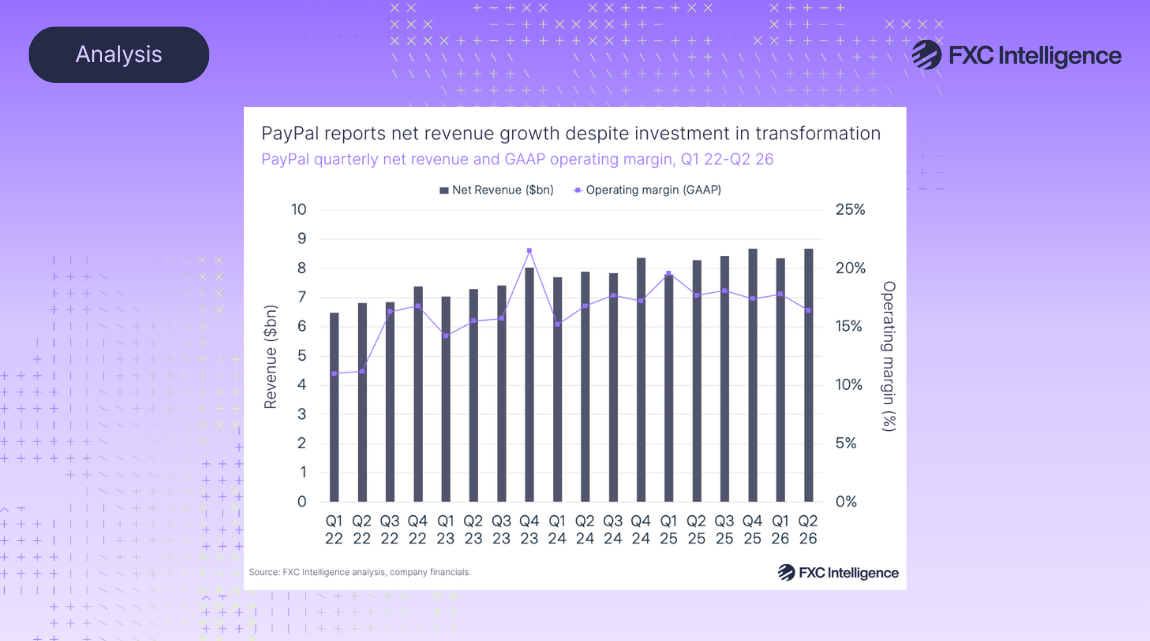
In Q2, PayPal saw net revenue increase 5% to $8.7bn (3% on an FX-neutral basis). The payments giant also reported a 10% YoY increase (or an FX-neutral 9% increase) in total payment volume (TPV), while recording 6.75 billion payments transactions in the quarter – 8% more than in Q2 2025.
Slower growth than US net revenues (7% YoY), saw international net revenues (2% YoY) make up a 132 basis point lower share of overall revenue compared to Q2 2025, falling to 42%.
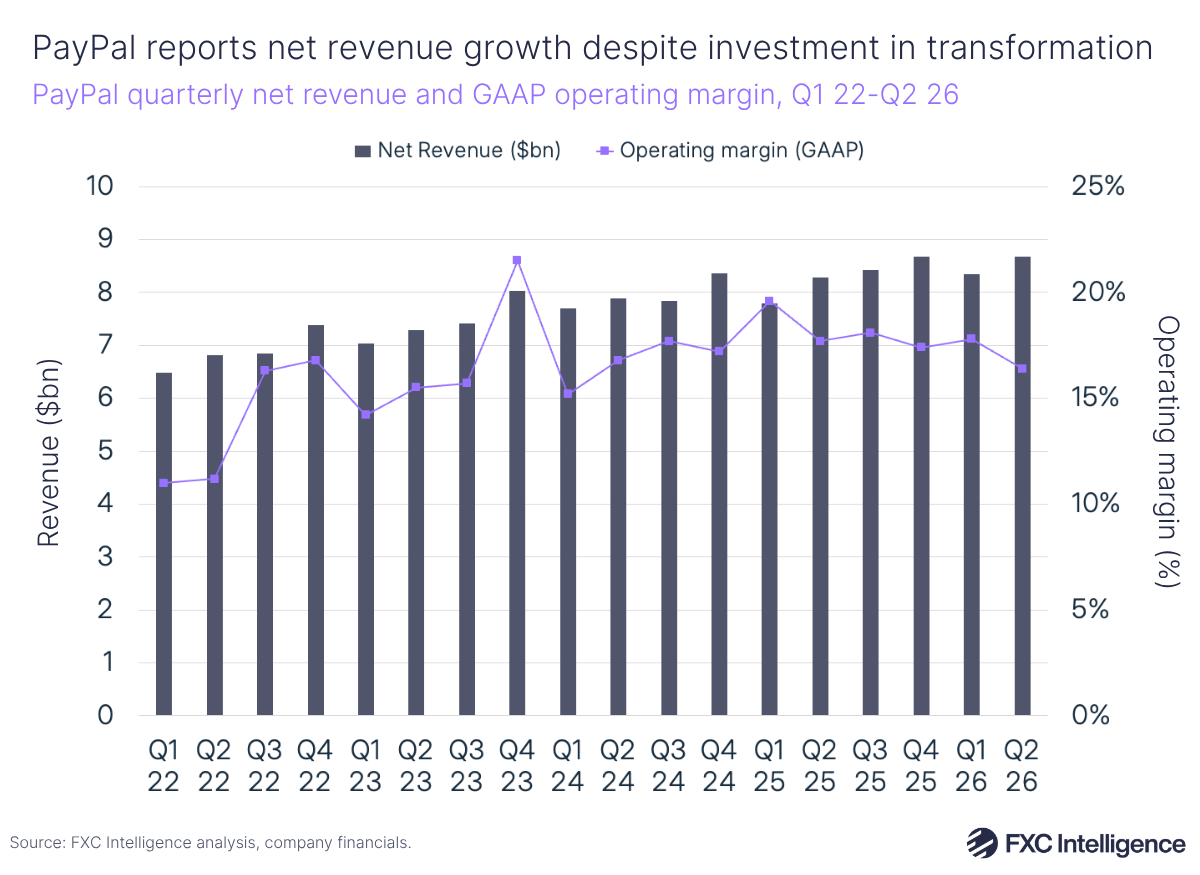
Despite overall growth, PayPal saw its GAAP operating margin contract 171 basis points to 16.4% – the company’s lowest since Q3 2023. This decline was largely driven by a 5% YoY drop in operating income, which the company attributed to higher operating expenses as a result of investment in “high-priority” areas such as platform and cloud modernisation.
This investment comes as PayPal moves towards larger long-term goals, including reducing costs – a benefit that it currently expects to start seeing in the fourth quarter of 2026. CEO Enrique Lores explained that it has made “good progress” on its plan to deliver at least $1.5bn of gross run rate savings over the next two to three years.
PayPal’s business refocus brings early results
Since PayPal’s Q1 earnings call in May, the fintech has refined its transformation roadmap, with Lores sharing that the company plans to diversify its business model beyond checkout and into financial services. By building on strong recent growth in both its mobile payment service Venmo and its payment service provider businesses including Braintree, PayPal wants to expand its addressable market and realise new opportunities for growth.
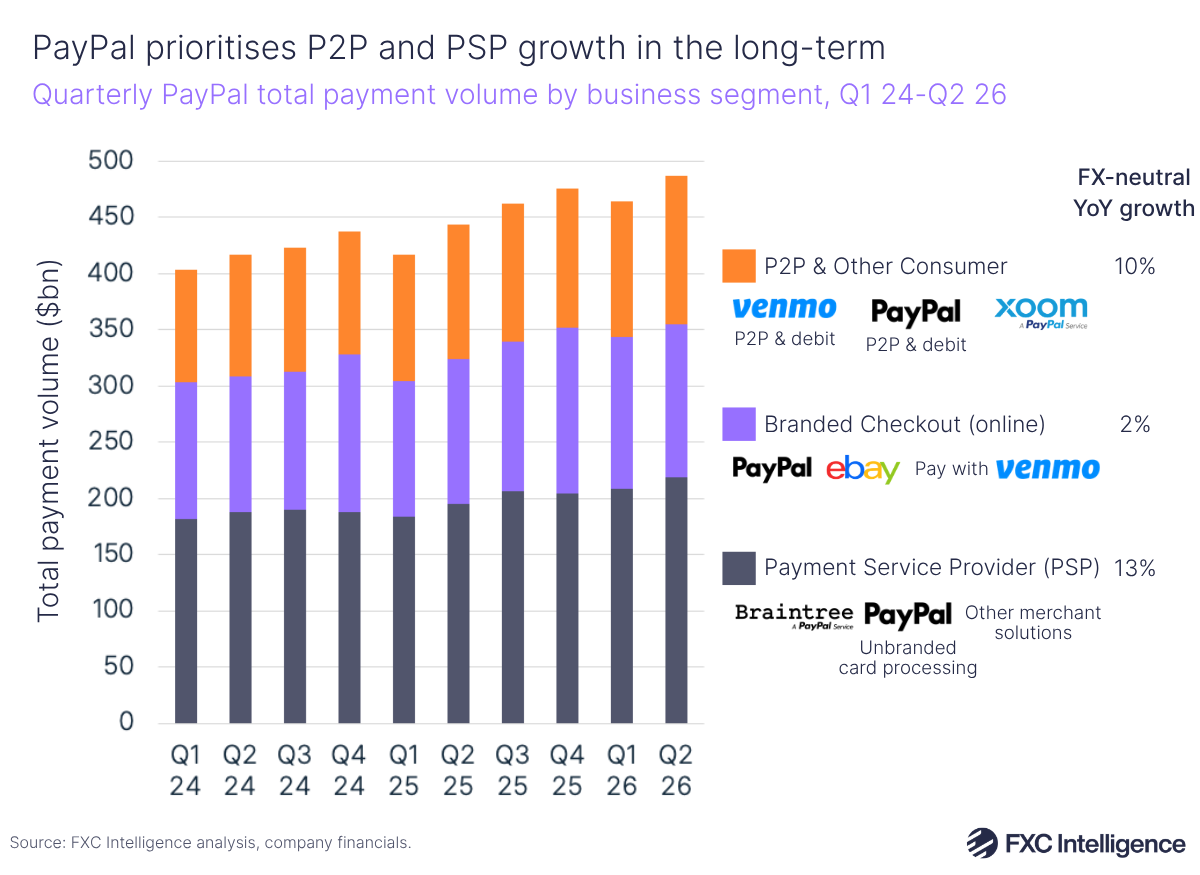
These efforts already appear to be paying off as PayPal’s TPV growth was largely driven by its Payment Service Provider (PSP) segment, which includes unbranded card processing across PayPal and Braintree and saw a 13% increase on an FX-neutral basis.
P2P & Other Consumer, which contains money transfer service Xoom as well as PayPal and Venmo’s P2P and debit segments, also grew 10% on an FX-neutral basis – bringing its share of total TPV to within 1% of Branded Checkout, suggesting that it may become the second-largest segment by TPV in the near future. This aligns with PayPal’s new, consumer-led strategy, which will look to evolve Venmo from a P2P app into a broader money management platform.
PayPal also shared that it has seen Venmo product feature development become four times quicker in H1 2026 compared to H1 2025, with the company recently working to scale biometrics on the P2P app. It now looks set to unveil a major app refresh for the brand in the near future.
This comes after the company began rolling out its global digital wallet payment network PayPal World last year, which enables consumers to use Venmo to send money across borders or shop internationally.
How do cross-border, agentic and stablecoin payments fit into PayPal’s long-term vision?
Although much of PayPal’s Q2 2026 earnings call focused on PayPal’s new business focus, CEO Lores did also outline some of the company’s longer-term plans moving into 2028 and beyond. He explained that the company views agentic payments and PayPal World as significant opportunities that it expects to “become increasingly meaningful contributors” to the business.
There are signs of this growth already, with PayPal World reportedly facilitating around $200m TPV between Venmo and PayPal in Q2.
Much of PayPal’s recent investments have been aimed at positioning the company at the forefront of these technologies so that it can take full advantage as they grow in influence across the industry.
Aside from mentioning that its US dollar-pegged stablecoin PayPal USD (PYUSD) will eventually support the company in launching more commercial offerings in the long-term, the offering did not receive much attention in the latest earnings call. Despite this, PYUSD continues to see strong growth, significantly outpacing major market leaders, including USDC and USDT.
PYUSD has seen its market capitalisation grow by 185% YoY as of the end of June, while USDC and USDT saw 19% and 17% YoY growth respectively for the same period.
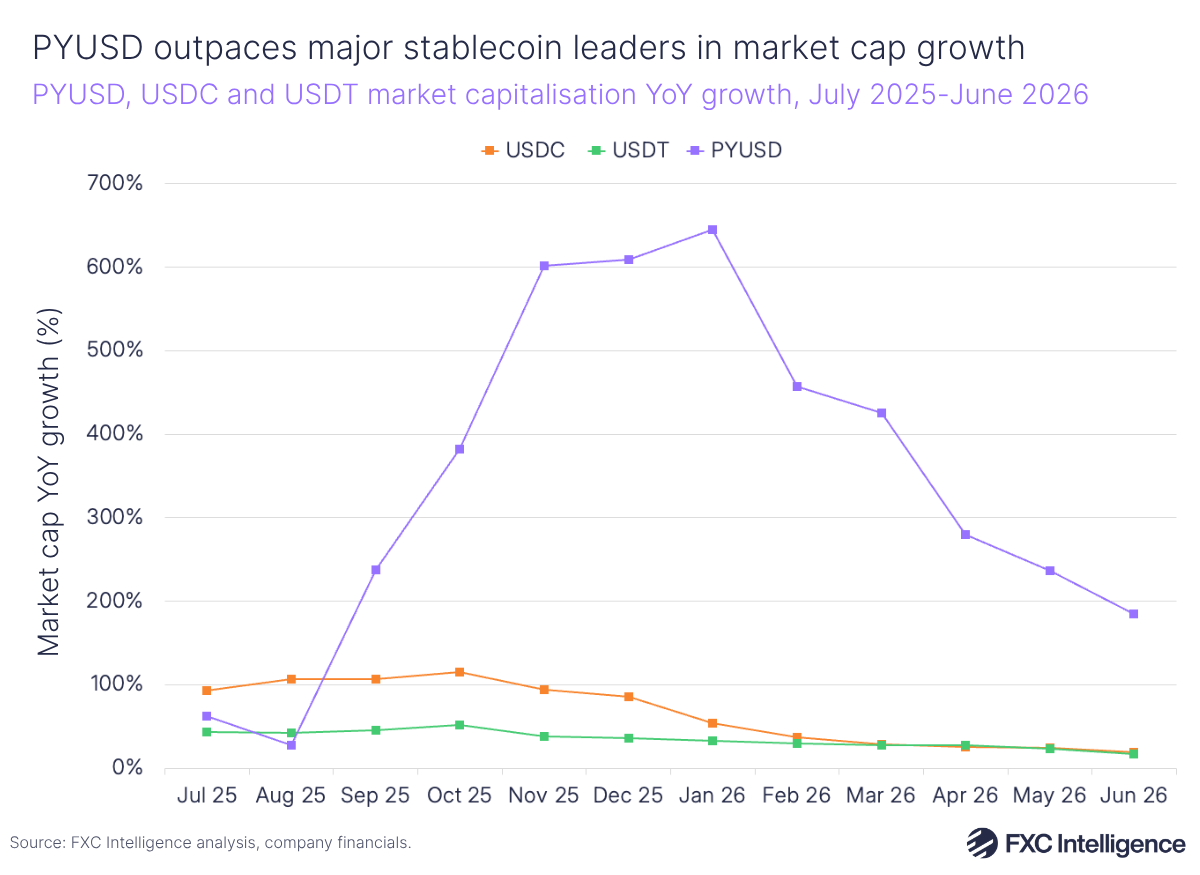
Despite this strong performance, PYUSD remains a long way off from these market leaders, with USDT commanding a 59% market share and USDC a 24% market share, compared to PYUSD’s 0.9% share.
However, the signs are good for PayPal and its new CEO, with continuing growth as the company invests heavily in its future, in line with its new vision. Following the latest earnings call, PayPal’s stock price closed 4% higher than the previous day, indicating market confidence that the company is setting strong foundations for future growth.