Circle, the digital assets giant behind leading stablecoin USDC, has announced record quarterly earnings for Q3 2026, buoyed almost entirely by the success of the mainnet launch of its payments-focused blockchain Arc.
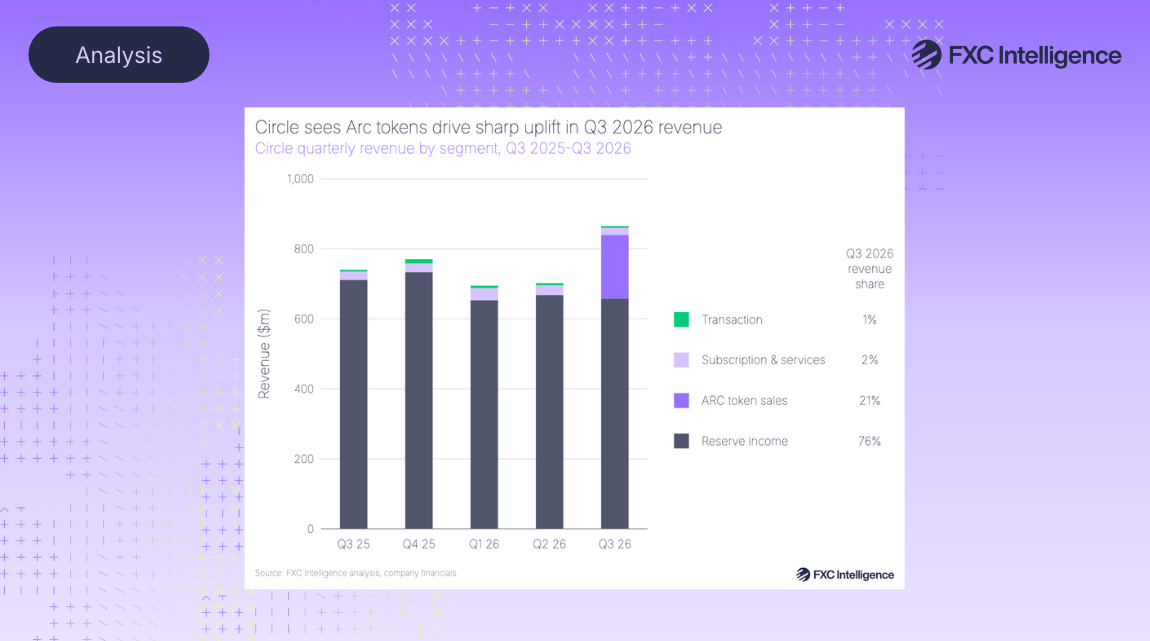
At the top level, overall revenue climbed 17% YoY to $865m, although crucially this growth came entirely from other revenue, rather than the reserve income that has historically accounted for the vast majority of the company’s earnings but which Circle has increasingly been looking to reduce its reliance on. However, this was entirely reliant on Arc’s contribution from its token sale. Without Arc, other revenue dropped 11% YoY, with subscription & services revenue dropping by 17% YoY to $20m while transaction revenue was flat at $5bn.
Meanwhile, reserve income that Circle earns on the backings from its USDC and other stablecoins dropped 7.5% YoY to $658m.
Chart data
| Quarter | Revenue | RLDC margin |
|---|---|---|
| 2022 | $1bn | 60% |
| 2023 | $1bn | 50% |
| 2024 | $2bn | 39% |
| 2025 | $3bn | 39% |
| 2026E (projection) | $3bn | 43% |
The company’s preferred metric of revenue less distribution costs (RLDC) also grew 55% to $453m, for a record RLDC margin of 52%, while Circle saw its adjusted EBITDA margin grow to 37% when measured as a share of revenue, or 70% as a share of revenue minus costs.
In an earnings call once again designed to appeal to retail investors as much as institutional ones, Circle also framed itself as poised to capitalise on the GENIUS Act, the much-discussed stablecoin-focused law that is set to take effect in the US in January 2027, describing the company as “made for this moment” with its mix of stablecoin products and services.
Circle reaffirmed its full-year guidance on the back of the results, which it had previously increased in anticipation of a revenue rise in H2 following the launch of Arc. It is projecting other revenue of between $310m and $330m, which at the average USDC growth and reserve return rate for the first three quarters of 2026 would translate into FY overall revenue of around $3.4bn, while the company is projecting a FY RLDC margin of 41.7-43.7%.
One-off Arc income drives Circle’s earnings jump
At the heart of Circle’s Q3 2026 earnings earnings success is its blockchain Arc, which saw its mainnet launch on 16 September this year. As part of this, Circle began selling Arc tokens, which will enable holders to participate in network validation, earning rewards and fee income, once the blockchain moves to a proof of stake consensus mechanism in 2027, as well as enabling them to vote on critical network issues. However, some purchasers are also likely to be buying these tokens speculatively.
This has proved to be a major source of revenue, generating $182m for Q3 and driving the overall other revenue bracket up by 627% YoY. As a result, Arc tokens accounted for 21% of the company’s revenue in Q3 2026. However, this is a relatively one-off event from the token presale, which overall raised $242m, around 75% of which was recognised in Q3. Circle has retained 2.5 billion (25%) of the Arc tokens and may opt to enact another token sale in the future, but for the most part ongoing revenue will come from staking rewards once the blockchain moves to proof-of-stake in 2027, meaning that Arc is unlikely to be a notable regular revenue source for some time to come.
Despite this, the blockchain is showing some strong initial signs, with $1.5bn in assets already on the platform, $1.1bn of which are in USDC, and more than $30bn in transaction volume and 50 million in transactions since launch. The company is currently seeing daily volume of over $1bn and more than 500,000 in transactions.
Chart data
| Quarter | Reserve income | ARC token sales | Subscription & services | Transaction |
|---|---|---|---|---|
| Q3 25 | $711m | — | $24m | $5m |
| Q4 25 | $733m | — | $25m | $12m |
| Q1 26 | $653m | — | $35m | $7m |
| Q2 26 | $668m | — | $28m | $6m |
| Q3 26 | $658m | $182m | $20m | $5m |
| Q3 2026 revenue share | 76% | 21% | 2% | 1% |
Circle Payments Network sees volume surge
Meanwhile, Circle Payments Network (CPN) now also runs on Arc, and has seen a significant uptick in volume this quarter as it sees accelerating adoption of the cross-border payment network. This quarter saw Circle Payments Network reach annualised TPV of $41.3bn, a 1,430% YoY increase and a gain of 181% on the previous quarter. Meanwhile, the number of financial institutions enrolled grew to 205, up from 175 in Q2 2026.
Circle has also reported that it has seen annualised TPV pass $58bn as of the end of October.
Crucially, the company is now beginning to monetise the platform, by charging fees for money moved using CPN. This has not yet had an impact on the company’s results, but Circle does expect this to translate into material revenue in 2027, and plans to provide guidance relating to this in the company’s end-of-year results.
Meanwhile, the $400m acquisition of B2B payments platform Tazapay announced earlier this year is also expected to further impact CPN next year, following its expected closing in 2027, with the company highlighting that it currently sees around $25bn in annualised volume, approximately 60% of which involves stablecoin-based money movement.
Chart data
| Quarter | Annualised TPV | FIs enrolled |
|---|---|---|
| Q2 25 | $0bn | 4 |
| Q3 25 | $3bn | 29 |
| Q4 25 | $7bn | 55 |
| Q1 26 | $8bn | 136 |
| Q2 26 | $15bn | 175 |
| Q3 26 | $41bn | 205 |
Circle highlights USDC’s liquidity depth in Q3 2026
This quarter also saw Circle slightly shift how it talks about its centrepiece stablecoin USDC, with a focus on mint and redeem volume, which refers to stablecoins that are created when they are purchased, and those that are destroyed when they are converted back into fiat currency. The company saw a combined $208bn minted and redeemed in Q3 2026, up 42% YoY.
Equivalent to $2.3bn a day, this underscored Circle’s narrative that USDC has very strong liquidity strength, making it a key option for companies increasingly looking to use stablecoins to move large volumes of funds globally, particularly for applications such as treasury.
Chart data
| Quarter | USDC mint volume | USDC redeem volume |
|---|---|---|
| Q3 25 | $80bn | $67bn |
| Q4 25 | $82bn | $81bn |
| Q1 26 | $73bn | $72bn |
| Q2 26 | $83bn | $87bn |
| Q3 26 | $104bn | $104bn |
However, Circle also saw its share of supply remain flat versus Q2 of this year, and down two percentage points compared to a year ago, while the USDC in circulation at the end of Q3 2026 was less than a percentage point higher than at the end of either Q3 2025 or Q2 2026.
While acknowledging this, the company highlighted that it is seeing ongoing growth in usage, pointing to a 49% YoY increase in on-chain transaction volume for USDC to $13.9tn.
Chart data
| Quarter | USDC in circulation | Share of stablecoins in circulation |
|---|---|---|
| Q1 24 | $32bn | 22% |
| Q2 24 | $32bn | 20% |
| Q3 24 | $36bn | 23% |
| Q4 24 | $44bn | 24% |
| Q1 25 | $60bn | 29% |
| Q2 25 | $61bn | 28% |
| Q3 25 | $74bn | 29% |
| Q4 25 | $75bn | 28% |
| Q1 26 | $77bn | 28% |
| Q2 26 | $73bn | 27% |
| Q3 26 | $74bn | 27% |
Meanwhile Circle’s euro-pegged stablecoin EURC remains far smaller than USDC in terms of circulation, but is seeing rapid growth, with circulating supply climbing 92% YoY to €413m. The company’s money market fund-focused digital asset USYC, meanwhile, saw growth of 230% to $2.4bn.