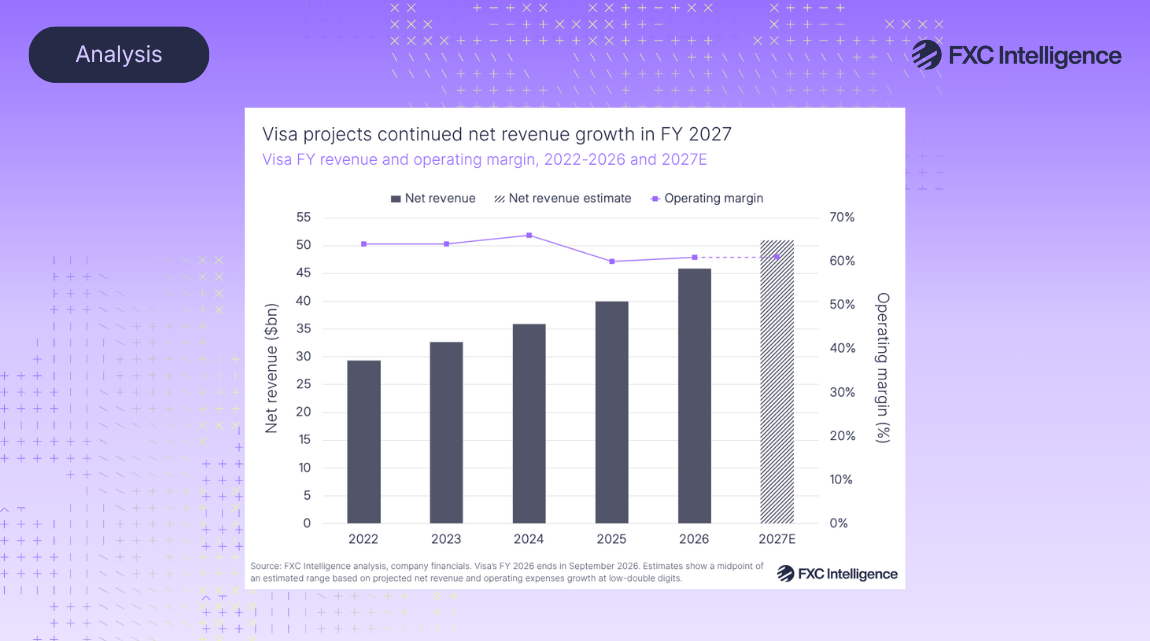
Visa has reported its earnings results for its Q4 2026 (spanning calendar Q3 2026), in which the company saw net revenue rise 13% to $12.1bn. Cross-border volumes continue to play a significant role for Visa, outpacing overall payments volume growth as the company saw strong acceleration in cross-border travel, increased card overseas spending and gains for its global money movement service Visa Direct.
Chart data
| Year | Net revenue | Operating margin |
|---|---|---|
| 2022 | $29.31bn | 64% |
| 2023 | $32.65bn | 64% |
| 2024 | $35.93bn | 66% |
| 2025 | $40.00bn | 60% |
| 2026 | $45.90bn | 61% |
| 2027E (net revenue estimate) | $50.95bn | 61% |
Visa’s operating income rose by 18% to $7.3bn, which gives a calculated operating margin of 60%, up from 57% the previous year.
For its full financial year (spanning calendar Q4 2025 to Q3 2026), Visa’s net revenue rose by 15% to $45.9bn, with CEO Ryan McInerney noting this was the company’s strongest growth in over 15 years excluding post-pandemic recovery and acquisitions.
For its FY 2027 results, the company now expects to see low double-digit YoY growth across both its net revenue and operating expenses on a non-GAAP adjusted, constant dollar basis.
Visa’s cross-border volumes buoyed by travel in Q4 2026
Cross-border payments volume continued to outpace overall payments volume across every quarter of Visa’s FY 2026, with CFO Christopher Suh saying the company continues to see strong consumer sentiment, more demand for travel experiences and the broadening of ecommerce to cover both discretionary and non-discretionary spending.
Visa’s total payments volume rose by 9% YoY in Q4 2026 and FY 2026 in constant dollar terms. Meanwhile, cross-border volume and cross-border volume excluding intra-Europe both grew by 14% in Q4 2026, with the former growing 13% across the full year and the latter growing 12%.
Chart data
| Quarter | Cross-border volume | Cross-border volume excluding intra-Europe | Payments volume |
|---|---|---|---|
| Q1 22 | 40% | 51% | 20% |
| Q2 22 | 38% | 47% | 17% |
| Q3 22 | 40% | 48% | 12% |
| Q4 22 | 36% | 49% | 10% |
| Q1 23 | 22% | 31% | 7% |
| Q2 23 | 24% | 32% | 10% |
| Q3 23 | 17% | 22% | 9% |
| Q4 23 | 16% | 18% | 9% |
| Q1 24 | 16% | 16% | 8% |
| Q2 24 | 16% | 16% | 8% |
| Q3 24 | 14% | 14% | 7% |
| Q4 24 | 13% | 13% | 8% |
| Q1 25 | 16% | 16% | 9% |
| Q2 25 | 13% | 13% | 8% |
| Q3 25 | 12% | 11% | 8% |
| Q4 25 | 12% | 11% | 9% |
| Q1 26 | 12% | 11% | 8% |
| Q2 26 | 12% | 11% | 9% |
| Q3 26 | 13% | 12% | 10% |
| Q4 26 | 14% | 14% | 9% |
A particular driver for cross-border volumes this quarter was cross-border travel volumes, which rose 13% in Q4 2026, up from 10% in Q3 2026 and the fastest growth the company has seen in this metric since Q1 2025. Visa linked this to growth in inbound and outbound payments in Central Europe, the Middle East and Africa (CEMEA), as well as elevated US inbound volumes in July that the company said reflected continued demand around the FIFA World Cup.
Cross-border ecommerce volume, which covers card-not-present spending excluding travel, also rose faster than usual in Q4 2026, growing 17% in the quarter. This saw a significant contribution from retail, including spending on AI platforms.
Chart data
| Quarter | Data processing | Services | International transactions | Other revenues |
|---|---|---|---|---|
| Q1 23 | $3.83bn | $3.51bn | $2.80bn | $0.59bn |
| Q2 23 | $3.82bn | $3.77bn | $2.75bn | $0.55bn |
| Q3 23 | $4.11bn | $3.67bn | $2.92bn | $0.60bn |
| Q4 23 | $4.26bn | $3.88bn | $3.17bn | $0.74bn |
| Q1 24 | $4.36bn | $3.92bn | $3.02bn | $0.69bn |
| Q2 24 | $4.26bn | $4.03bn | $2.98bn | $0.76bn |
| Q3 24 | $4.49bn | $3.97bn | $3.19bn | $0.78bn |
| Q4 24 | $4.61bn | $4.20bn | $3.47bn | $0.97bn |
| Q1 25 | $4.75bn | $4.21bn | $3.44bn | $0.91bn |
| Q2 25 | $4.70bn | $4.40bn | $3.29bn | $0.94bn |
| Q3 25 | $5.15bn | $4.33bn | $3.63bn | $1.03bn |
| Q4 25 | $5.39bn | $4.60bn | $3.80bn | $1.18bn |
| Q1 26 | $5.54bn | $4.76bn | $3.65bn | $1.21bn |
| Q2 26 | $5.54bn | $4.98bn | $3.63bn | $1.32bn |
| Q3 26 | $6.04bn | $4.92bn | $3.85bn | $1.50bn |
| Q4 26 | $6.25bn | $5.25bn | $4.12bn | $1.65bn |
| YoY growth | 16% | 14% | 8% | 40% |
However, Visa continues to see a gap between its larger cross-border volume growth and how this translates to revenue. International transactions revenue rose 8% to $4.1bn, slower than cross-border volume growth excluding intra-Europe, with the company putting this down to lower volatility levels than last year and mix. The company also expects volatility throughout 2027 to be generally consistent with Q4 2026, giving a slight benefit to Q1 2027 but a drag for the full year overall.
International transactions revenue also grew more slowly than revenues across Visa’s other larger segments, with data processing revenue rising by 16% YoY to $6.2bn and services revenue growing by 14% YoY to $5.3bn. Pricing continues to drive both of these other segments, though Visa did note that cross-border’s greater role in Visa’s transaction mix was contributing to Data Processing growth.
Visa Direct grows share of transactions
Visa also gave some positive updates on Visa Direct, which saw over 15 billion transactions for the full year and represented about $1.5tn in payments volume.
Chart data
| Year | Visa Direct processed transactions | YoY growth |
|---|---|---|
| FY 2021 | 5.2bn | 48.6% |
| FY 2022 | 5.9bn | 13.5% |
| FY 2023 | 7.5bn | 27.1% |
| FY 2024 | 9.9bn | 32.0% |
| FY 2025 | 12.6bn | 27.3% |
| FY 2026 | 15.6bn | 23.6% |
In Q4, the company saw Visa Direct transactions grow by 23% YoY, nearly two percentage points faster than Q3, with Suh saying that this was primarily due to strength in the US and Latin American and Caribbean regions. This growth was faster than the growth of total processed transactions (10%), with Visa Direct accounting for around 6% of transactions in Q4 2026, up from approximately 5% the previous year.
Visa has significantly expanded its network, growing its total number of endpoints for Visa Direct across cards, accounts and wallets to more than 18 billion, up from 12 billion in 2025. Visa has over 40 clients who used more than five different Visa Direct use cases, and the company also noted that Wells Fargo is now using the system across cross-border payroll, accounts payable and disbursement payments.
Chart data
| Quarter | Other transactions | Visa Direct |
|---|---|---|
| Q4 23 | 53.94bn | 2.02bn |
| Q1 24 | 55.27bn | 2.20bn |
| Q2 24 | 53.16bn | 2.30bn |
| Q3 24 | 56.72bn | 2.60bn |
| Q4 24 | 58.71bn | 2.80bn |
| Q1 25 | 60.90bn | 2.90bn |
| Q2 25 | 57.65bn | 3.00bn |
| Q3 25 | 62.14bn | 3.30bn |
| Q4 25 | 64.25bn | 3.40bn |
| Q1 26 | 65.70bn | 3.70bn |
| Q2 26 | 62.41bn | 3.69bn |
| Q3 26 | 67.66bn | 4.00bn |
| Q4 26 | 70.00bn | 4.18bn |
| Q4 2026 YoY growth | 9% | 23% |
| Total processed transactions, Q4 2026 YoY growth | 10% | |
Visa’s stablecoin and agentic commerce push
Stablecoins were a regular topic across Visa’s earnings call, with the company reporting that it continues to see strong engagement across its offerings. In particular, the company saw its run rate for stablecoin settlement surpass $25bn in annualised volume, up by 10 times compared to the previous year.
Visa has also more than doubled the number of blockchains it supports to 10, and supports five stablecoins (USDC, USDG, EURC, PYUSD and SBC) for settlement. During the call, McInerney expressed that Visa was “stablecoin-agnostic” and “blockchain-agnostic”, with the goal of activating stablecoins to support clients with different needs around the world.
Chart data
| Quarter | Stablecoin settlement annualised run rate |
|---|---|
| Q4 2025 | $2.5bn |
| Q1 2026 | $4.6bn |
| Q2 2026 | $7.0bn |
| Q3 2026 | Figure not provided |
| Q4 2026 | $25.0bn |
Visa’s wider goal is to integrate blockchain into its network in such a way that it offers one network combining fiat, stablecoins and tokenised deposits, and it has taken several steps to support its push into the area. The company was invited to be a founding validator for Circle’s Arc blockchain during the quarter and was also part of the consortium that launched Open USD in September. It also moved stablecoin pre-funding from pilot to production this month, with Inyo Global being its first partner processor able to prefund Visa Direct transactions using stablecoins.
Visa has also grown the number of stablecoin-linked card programmes it supports to more than 225, up by more than 70% YoY. Alongside this, it has seen 150%+ volume growth across five million cards in more than 50 countries, with issuers across crypto exchanges, neobanks, wallets and remitters.
Separately, the company also gave an update on Visa Stablecoin Platform, its product enabling institutions to mint, move and manage stablecoins, which is now available in the US, Mexico, Puerto Rico, Colombia, Switzerland and the UK, with more countries to follow and more than 300 partners in the pipeline.
Aside from stablecoins, AI and agentic commerce saw in-depth discussion during the call. Visa said that the company now had nearly 50 AI partners live and in production, with this number expected to double in the coming months. It has seen B2B payments as an area of fast adoption for agentic, giving examples such as Ramp using Visa Intelligent Commerce – its recently launched platform enable secure, trusted agentic transactions on behalf of consumers – to automate bill payments for clients.
McInerney said that “trust is the biggest barrier to scale” for agentic payments, and the company wants to position its offering to support this through Visa Intelligent Commerce. However, when asked about the opportunity in agentic commerce and new money movement capabilities, he said that these remain “very small” in the grand scheme of Visa’s business in 2027.
Going forward, Suh said that the company expects that the impact of the Middle East conflict could bring continued near-term uncertainty to cross-border travel spending in the CEMEA region, though the company expects key business drivers to “improve modestly” from 2026 as it laps the impact of the Middle East from last year. The company is continuing to invest in increasing its reach in money movement and enhancing its cross-border offerings as it grows its reach across key markets globally.