

Two years on from its acquisition of More Payment Evolution, UniTeller continues to expand its remittances network while increasingly targeting business payments. We caught up with CEO Alberto Guerra to find out more about the company’s strategy and the potential impact it could see from stablecoin and AI.
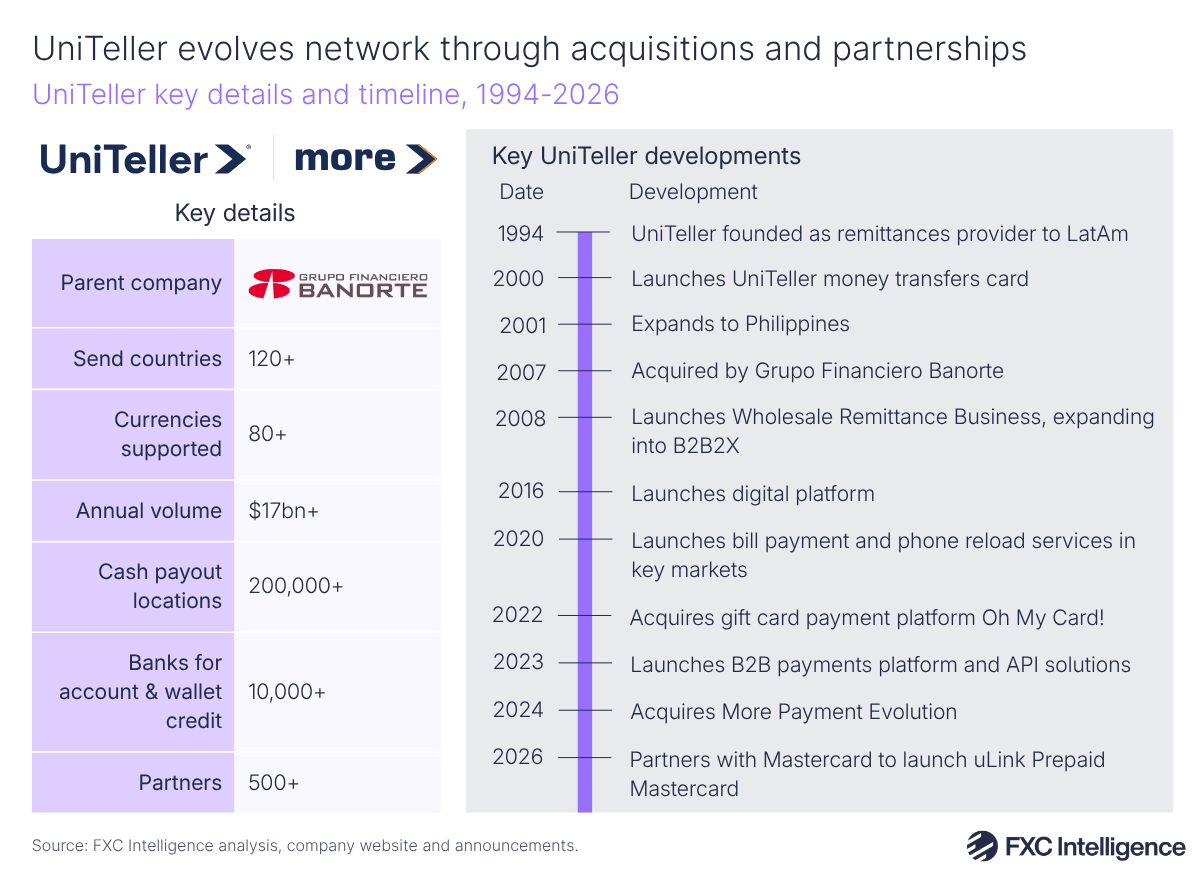
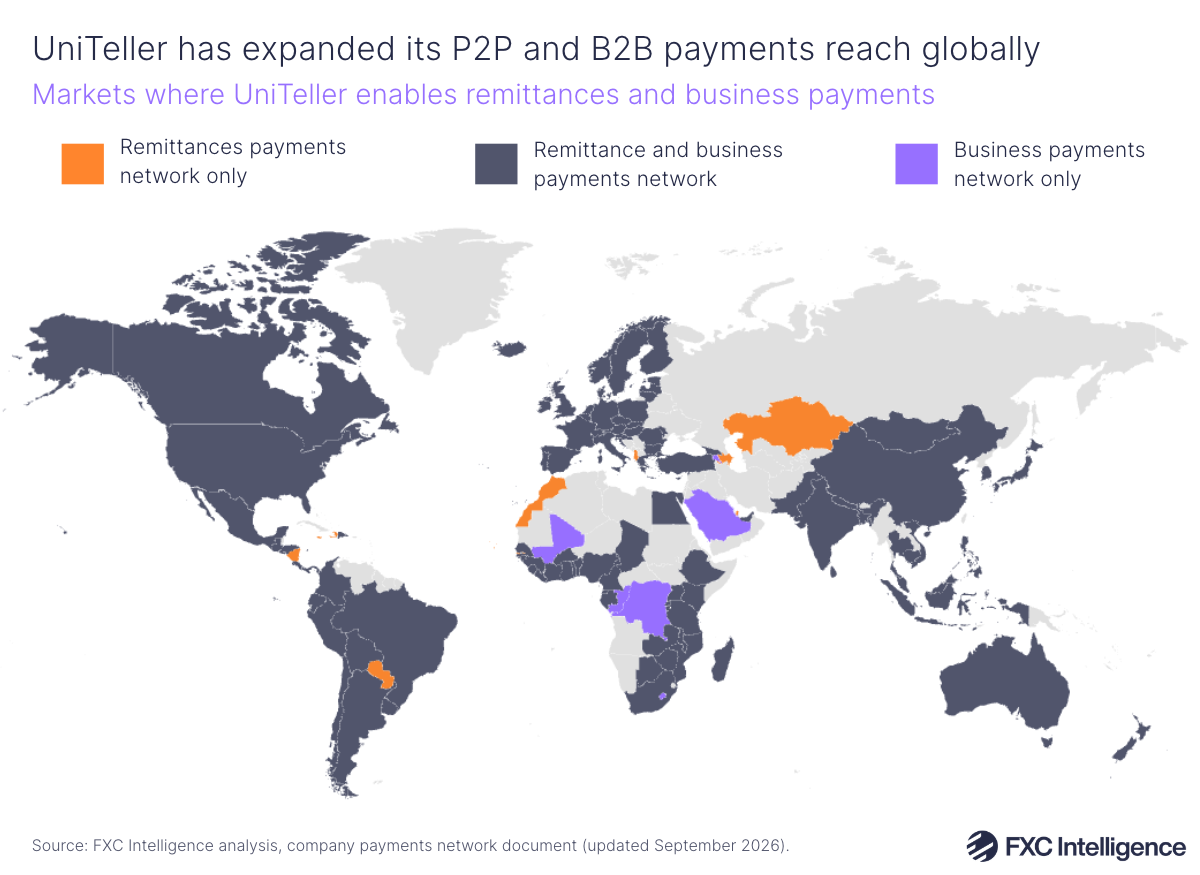
Over the course of more than three decades, UniTeller has moved from being a cash remittances provider to a global money movement platform, serving consumers, businesses and institutions with a network spanning more than 120 markets.
Beyond its remittances offering, the company continues to build out solutions supporting B2B, B2C and C2B payments, and has increasingly been building out its B2B2X offering, through which it facilitates cross-border payment systems for money transfer operators, corporations, banks and retailers.
Though the company has a strong focus on Latin America, it has increasingly set its sights abroad, with its 2024 acquisition of More Payment Evolution adding additional licences in Latin America as well as extending the company’s reach in Europe, Africa and Asia.
We caught up with UniTeller CEO Alberto Guerra at Money20/20 USA to explore the company’s expansion plans, its shifting focus to B2B payments and the potential impact of stablecoins and AI on its business. You can watch the video here or see the full transcript of our conversation below.
The next phase of UniTeller’s expansion with More
Daniel Webber:
Alberto, a pleasure to be here with you today. Talk us through how you’re thinking about the next phase of the strategy and what is more of a global expansion for the business.
Alberto Guerra:
We have a mission and a vision of expanding the company globally. With the acquisition of More, that helped us complement better in some regions where More had already been investing in developing certain business verticals, as well as certain corridors.
We didn’t want to just have everything convert into UniTeller. On a corporate level, the corporate brand name will be UniTeller. The strategy will be UniTeller. But for specific markets and specific regions, we are going to keep the More name. More focused on the consumer level, so we continue to showcase the UniTeller | More PE brand name because of the synergies that we still see that they’re bringing, but at the end of the day, we don’t want the company to change the vision from being UniTeller to UniTeller | More PE.
We’re taking that as an opportunity to expand. We improve our capabilities in Latin America. We thought we were already good in Latin America, but having More and the possibility of what More has brought to the table in terms of local capabilities in South America, local licensing, and what More was already building in Africa as well as in Europe, those are very unique opportunities.
UniTeller was primarily focused mostly in North America, Mexico, Central America, Southeast Asia and a few countries in South America like Colombia and Peru, but again, now with the More addition, our globalisation effort got a huge boost.
UniTeller’s growing business payments opportunity
Daniel Webber:
Let’s talk about the business payment side, which you’ve been expanding. What have customers been asking you for on the business side,and what have you been delivering for them?
Alberto Guerra:
That’s a completely new line of business that we have been working [on], because four years ago, 100% of our volume was P2P-related or B2B transactions that had a P2P component on the transaction.
Three years ago, we began developing and adjusting our P2P rails into allowing and bringing the capability for business payments. There are countries where that is more natural because we already had access to the local rails. In other countries where your connections are with the local banks, an effort had to be made to talk with the banks, explore what would be the best opportunity. Should we use the same rails that we were doing for P2P? Can we use them for business payments? And of course, it took a lot of education and negotiations for that to take place.
We’ve been working on that. With the addition of More, I think that helped us improve and accelerate those capabilities. Our business payment rails are very competitive right now. In the P2P space, we have a competitive network in around 120 countries, which are the countries that we really want to work with. Whereas in business payments, we have been dramatically growing our numbers to come from maybe less than 20 countries, which we had two years ago, to now roughly around 60 to 70 countries where we have built those capabilities to do business payment transactions.
We also continue to improve the network capabilities, because we initially were mostly focused on payouts and distribution. Now we’re also converting and making our network available for pay-ins and collections. That is a little bit more challenging, because not only were we using the alternative rails or the cash rails, but also connecting the bank networks, connecting the card processing capabilities. Of course, that is a little bit more challenging, because you need to certify yourself, you need to be PCI compliant, you need to have sufficient security tokenisation to be able to to to offer this in a in a secure way, which is the only way that you you can do it when you start taking bank accounts and card numbers instead of just cash.
We’ve been converting our network, and we have put a huge effort in place in having that network ready. We are also finding very good partners that are helping us accelerate that in certain regions and countries. So we’re also leveraging on that, but where we can have our direct access, we go that route.
As we believe that the product is more complete, we now have a very good effort in place where we are going after large companies, acquirers and different use cases where we are now sitting down and saying, “Hey, you know, at the end of the day, I control the last mile. Why don’t you use us directly instead of having to go with other companies that may use one or two additional rails to go to the last mile?”
So, I think that is a good value proposition. We continue to invest, and we believe that we’re on the right track to accelerate our business payments growth. Last year, we already got a meaningful figure processed with our business-to-business rails. This year, we’re experiencing 80% growth versus the volumes of last year. So, that’s still a small part of what we process in total, but I think by the way it’s been growing, I think within three to five years, it’s going to be a relevant component of our generating capabilities.
So, we’re really excited about it and we are investing. And now, the purpose of participating in a bigger scale at a conference like this is for UniTeller to portray itself as a broader, more complete and comprehensive global payment institution than what we were five to eight years ago, [which was] a remittance company that is just trying to grow. So that’s where we see ourselves, and that’s the huge push that we’ve been making over the past few years.
Stablecoin and AI’s impact on UniTeller
Daniel Webber:
From the technology standpoint, there’s AI, there’s stablecoins, there’s tokenised deposits, there are many things going on at the moment. Where have you seen the most impact for UniTeller, and what’s been most relevant for you?
Alberto Guerra:
I think a combination of all. AI may have taken everyone by surprise on how fast it’s coming across. We already have some use cases for how AI is helping us to be better, to accelerate our transaction processing, clearing, compliance-related review of transactions and risk rating of transactions and customers.
My IT team have all been telling us how much more efficient they are now in integrating business partners, in creating code and developing products with the use of AI.
From a marketing perspective, we developed a very good customer relationship management (CRM) tool for us to use and sell. That was something that we have been researching for many years and exploring tools from different vendors, and our marketing team was able to to develop something with the help of AI in less than three months. We’ve been using that last year, with very good results on the CRM network, [across] planning, strategy, follow-up, CRM and KPIs. It’s interesting because we did it in-house, instead of buying tools that eventually you need to adapt.
These are some of the use cases. Of course, payment processing is huge. How do we orchestrate or make our processing of transactions more efficient in terms of finding not just the better route, but also the better time to process? There are some companies that we work with that are very keen and adamant about processing times, and others are not as adamant about processing times, but about pricing. So, how do you prioritise and how do you orchestrate that within your core to make sure that you also make a more efficient use of your processing capabilities?
AI has a lot of use cases that we have been implementing, and that we have yet to understand and [we] continue deploying. It is going to continue transforming the industry as we move ahead. I’m a little bit intrigued on some use cases where AI agents are making transaction decisions instead of consumers, and all the debate that is around it.
So, how do we get ready and how do we start working in a way where we can feel comfortable, not only from a technology perspective but also from a regulatory perspective? Because there’s also a lot of discussion. Can an AI agent place a transaction instead of a consumer, even though the consumer gave the instruction? Yes, but regulatory-wise, you have to portray the rate to the consumer, so does the AI agent qualify as the consumer placing a transaction?
There’s a lot of things that we need to understand. AI is going to have a large influence in how we’re doing things, and we need to be ready for that.
[On] stablecoins, you and I have talked a lot about stablecoins and discussions on how a lot of people are using or finding use cases for stablecoins. We continue to see that more as a treasury settlement opportunity to be more efficient in certain use cases. But again, is that going to be a main changer? Probably. I don’t think it is there yet, and I continue to talk with people like you and other business partners and colleagues and it’s like, what’s your view on that?
And it’s amazing and surprising. Some [companies] that have even made huge announcements for stablecoins are still questioning how relevant stablecoins are going to be for the main volumes that they process. But again, you need to be ready, you need to have your infrastructure ready and capable, because there’s going to be a use case that, if you’re not ready, other people are going to take advantage and you’re going to be left out. So, I think that’s also something that we are investing in and monitoring, you know, very closely.
For me, network expansion and product capabilities continue to be the top value driver. Being local in a global space is crucial. Having local licences, local teams, local access to the local real-time networks of those countries that have opened these networks is going to be key, because that gives you better access to the network, better pricing and if you’re able to build the volume both ways, you can do your own settlement and be more efficient on the trading as well. That continues, in my opinion, to be one of the main drivers.
Of course, the technology, the AI, the stablecoins, all of that is going to help. But if you don’t have global capabilities, you’re going to struggle, not to do transactions through specific corridors, but to really gain volume. One of the main challenges in the industry continues to be margin compression, especially in large-volume use cases and large-volume corridors. At the end of the day, do you want to be niche, high margin in specific corridors, or do you continue to to become more global, compete in the larger corridors and be capable of dealing with the margin pressure from everyone that has those capabilities?
It’s a very interesting development in the industry that we’re seeing. And we’re happy that we’re there and that we have the capabilities to continue growing and developing our own capabilities.
Key predictions for the industry in 2027
Daniel Webber:
What would be your main prediction for the industry for 2027?
Alberto Guerra:
Margin compression, AI use cases, stablecoins use cases and better, broader product capabilities. I think the companies that are capable of managing all these topics are the companies that are going to succeed.
You continue to see new companies coming up, and some of them finding [a] very interesting niche in how they offer the value proposition to other companies in the industry. You see here now new names that four, five years ago you didn’t see that are becoming very relevant. So, I do see new companies with new ideas and specific value propositions that are also adding value in specific situations. So I see innovation, new technologies, new products and continuous margin compression on the core, traditional, large-volume use cases.
Also, I can never stop talking about the relevance of compliance. Compliance continues to be key, and as these new opportunities, markets and corridors become more scalable, you always have a regulatory and compliance push in terms of, is this being done right? We have to continue to be very careful and invest in making sure that we’re always knowledgeable of the local regulations and requirements to make sure that our growth is well-founded and can scale.
Daniel Webber:
Alberto, thank you very much. It’s been a great conversation with you.
Alberto Guerra:
Thank you, Daniel.