

Several major geopolitical events have impacted the flow of UK trade in recent years, driving the digitalisation of trade finance forward and supporting a push towards AI-assisted decision making.
Trade finance ultimately looks to enable business between companies based in different countries, reducing associated risk and providing working capital to solve cash flow issues.
Banks typically offer letters of credit to sellers wanting to ensure they receive payment after shipping goods or providing services to companies based elsewhere. This offering guarantees each seller receives payment from buyers, providing all conditions relating to the deliverables are met. Credit insurance policies are also offered, protecting exports against not receiving payment from overseas buyers.
Cash flow regularly poses challenges for businesses trading internationally, particularly for those that require funds to produce the goods or services for buyers in other markets. Export factoring is one method that enables businesses to gain access to working capital by selling the invoice at a slightly discounted rate, giving them access to capital before the buyer makes payment.
However, trade finance has traditionally been slow and paper-heavy, requiring passing physical documents between exporters, importers and banks – with this process often taking several days. The global trade market is difficult to predict and can be directly impacted by major geopolitical events.
To solve these challenges, major UK banks have begun investing in digitising several trade finance processes, providing businesses faster access to capital and enabling them to make decisions more quickly. We take a look at how UK trade is changing over time and how trade finance solutions are adapting to these changes.
What drives change in UK trade over time?
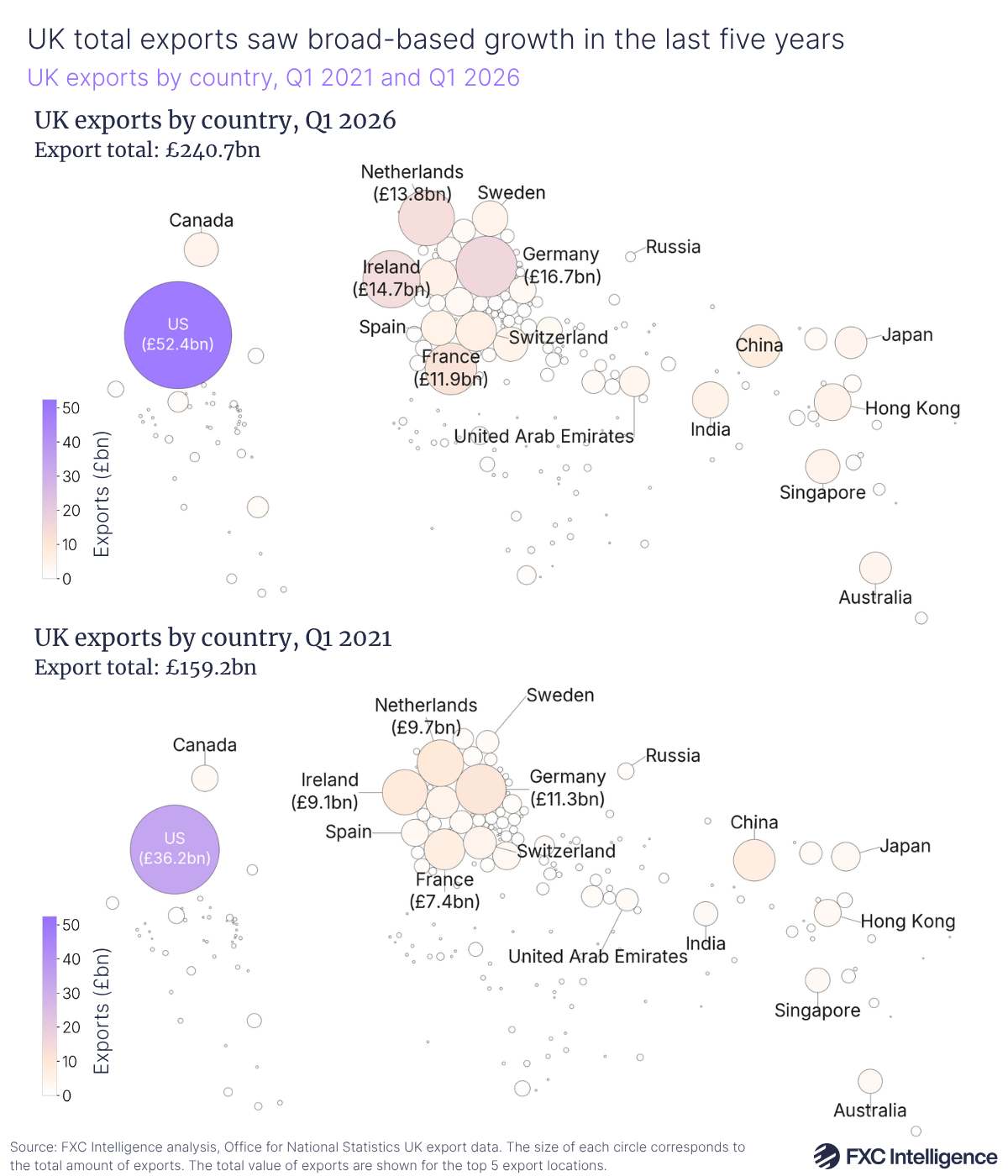
Between Q1 2021 and Q1 2026, UK exports grew 51% from £159.2bn to £240.7bn, while imports saw faster, 58% growth from £159.5bn to £252.6bn.
During this period, the US cemented its position as the UK’s largest single trading partner, with UK exports to the US rising 45% from £36.2bn to £52.4bn and imports rising 75% from £19.5bn to £34.3bn.
Between Q1 2021 and Q1 2026, Germany remained the second-largest export market for the UK, seeing 47% growth to £16.7bn. It also grew to become the second-largest import source for the UK, increasing 46% to £24.2bn, surpassing China, which both fell out of the top five export destinations and sat as the third-largest import market for the UK for large parts of this period, following more muted growth than other major import and export destinations.
Ireland surpassed the Netherlands as the UK’s third-largest export market, rising 61% from Q1 2021 to £14.7bn. Exports to France also grew by 60% to £11.9bn, while imports saw a faster 95% increase to £14.7bn.
Meanwhile, Russia saw significant declines as exports fell 67% in this period and imports fell by 96% from £2.8bn to £120m. This was largely caused by coordinated sanctions against Russia following its invasion of Ukraine in February 2022, as the UK pledged to phase out oil and coal exports by the end of 2022.
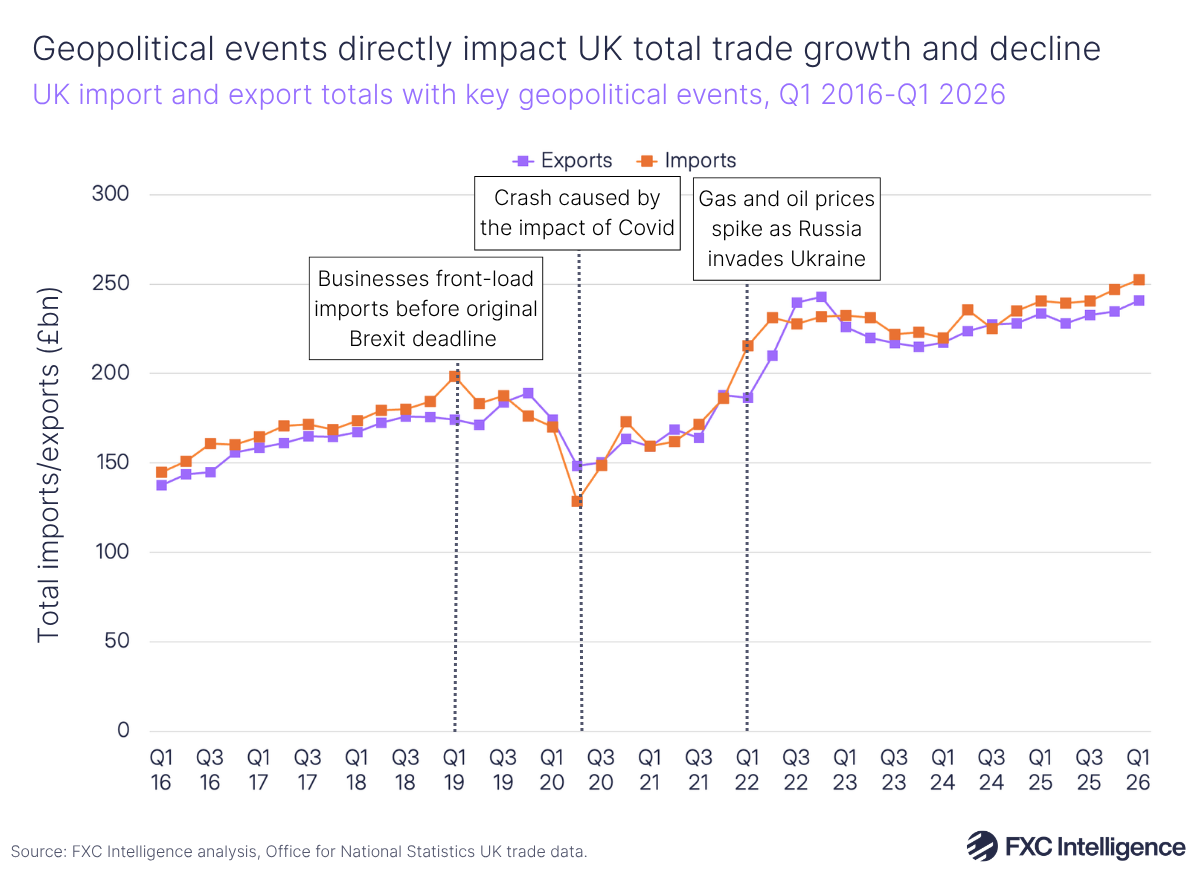
Geopolitical events such as this can trigger significant growth or disruption to the UK’s overall trade as well as to specific countries. For example, in Q1 2019 total imports spiked, rising 8% QoQ and 14% YoY as some businesses increased the amount of goods they imported in the lead-up to the initial end of March 2019 deadline for Brexit, in case of significant price increases.
UK imports and exports fell significantly in Q2 2020, declining 30% and 14% YoY respectively following the first Covid-19 national lockdown, which came into force at the end of March 2020.
Sanctions on Russia had a knock-on effect on oil and gas prices, which increased as European countries turned to new non-Russian suppliers – a factor behind the 35% YoY jump in the total spent on imports in Q1 2022.
In September 2023, the Electronic Trade Documents Act (ETDA) was passed in the UK, giving trade documents the same legal standing and recognition as physical paper documents. At the time, the International Chamber of Commerce projected that digitalising trade documents could boost economic growth by around £25bn by 2024.
By officially enabling digital trade documents to be legally possessed in the same way that was previously only possible with physical paper documents, the government gave local banks the clarity needed to begin speeding up all trade finance processes.
How are trade finance solutions evolving?
Unpredictable factors that impact global trade have shown the importance of being able to remain flexible and quickly make decisions for businesses. Recognising this, many banks are well underway to releasing working capital and repricing risks more quickly.
Immediately after the ETDA was passed, Lloyds Bank completed the first transaction under the new law, issuing a digital promissory note to retailer Matalan on the same day. This came after the bank invested €3m into digital trade technology company Enigio, supporting the expansion of its trace:original solution, which removes the need to physically transfer paper documentation within trade transactions and was eventually used for Lloyds’s first ETDA transaction.
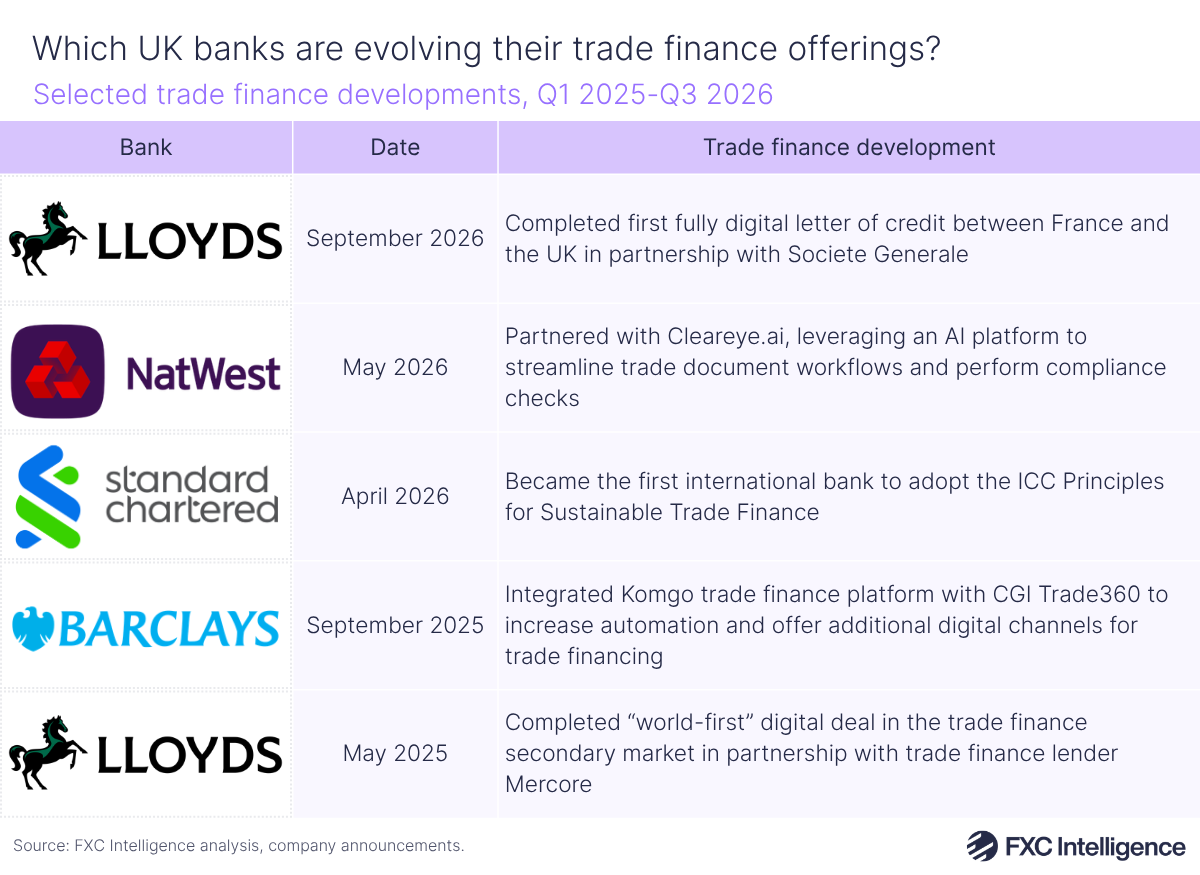
Since then, Lloyds has been busy bolstering its digital trade finance offerings, launching a new Paperless Guarantee solution, giving its clients the ability to request digital direct guarantees or standby letters of credit. In May 2025, it also completed a series of digital transactions on the secondary market in partnership with fintech Mercore, which Lloyds believed to be the first of their kind. Most recently, the bank teamed up with partners including Société Générale to complete the first digital letter of credit transaction between France and the UK.
Several other major UK banks have also made strides into digitalising their trade finance offerings. April 2024 saw Standard Chartered launch SCeChain, a supply chain finance platform that provides financing for businesses across the supply chain in partnership with China-based supply chain financing platform Linklogis. The move reduced manual querying and automated the trade finance offering, enabling it to approve financing requests more quickly.
In 2025, Barclays integrated multi-bank trade finance platform Konsole by Komgo with trade finance solution CGI Trade360, adding to its digital trade finance offerings and giving its clients additional digital channels for financing.
More recently, Standard Chartered announced it had successfully integrated the International Chamber of Commerce Principles for Sustainable Trade Finance Framework into its trade finance operations. By doing so, the bank plans to improve its sustainability across trade finance, a move that could be followed by several other banks in the space.
AI is also becoming a key area of focus within trade finance for banks. In 2024, Lloyds teamed up with AI platform Cleareye.ai to streamline the processing and compliance checking of trade finance documentation to drive efficiencies for clients. NatWest also began working with Cleareye.ai in May 2026, with a view to achieving the same aims.
With the ETDA removing a legal barrier to the digitisation of trade finance, banks are increasingly utilising AI to speed up compliance and processing. As all aspects of trade finance become more digital, faster and more automated, many UK banks are positioning themselves and their clients to respond to industry disruption more quickly and ease cross-border trade.