

Unified financial infrastructure brand Movantis (formerly Transnetwork) is expanding to new markets while bringing digital assets into its offering through new partnerships. We spoke to Chairman and CEO Gustavo Ruiz about the next phase of the company’s expansion and where it is seeing success with customers.
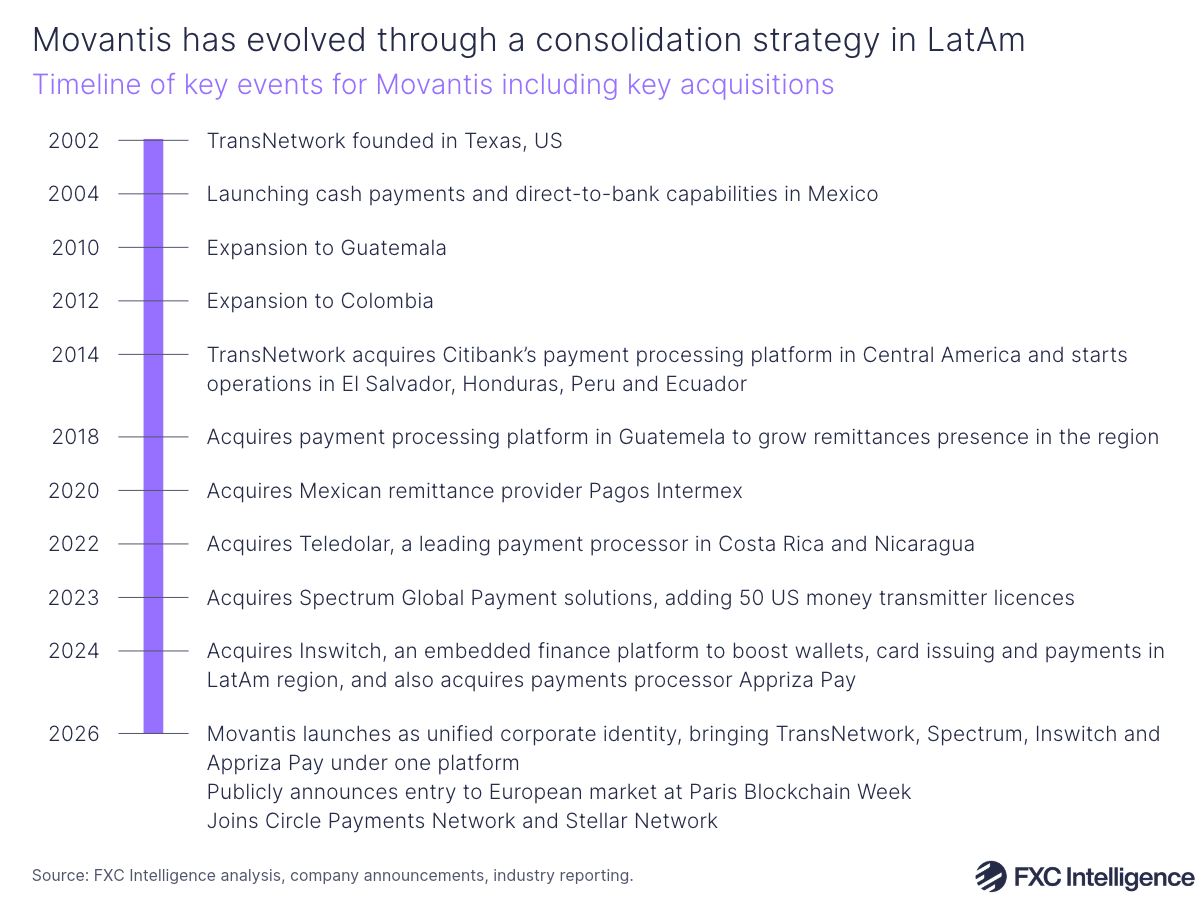
Back in March, TransNetwork and its associated entities rebranded as Movantis, bringing together the cumulative force of over 20 years of experience, consolidation and developments in payments processing and infrastructure.
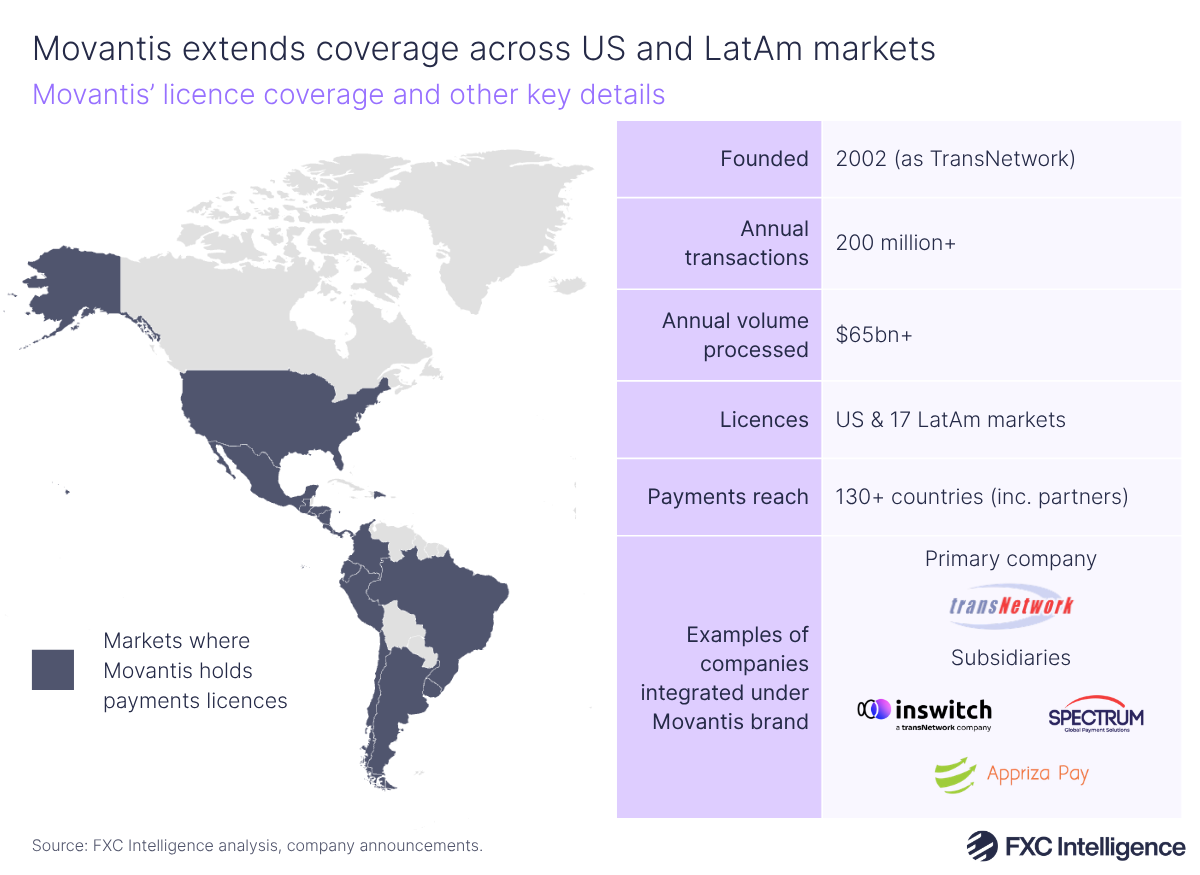
The Movantis brand is the trademark used to represent the collective payments capabilities offered by TransNetwork, founded in 2002 and expanded through several acquisitions including Spectrum, Inswitch and Appriza. The collective brand’s offering revolves around global money movement, spanning remittances, FX & liquidity, card issuing, wallet infrastructure and embedded finance solutions.
Altogether, entities under Movantis enable more than 200 million transactions a year, processing more than $65bn in value. Holding licences across the US and markets in LatAm, the company supports payments connectivity across more than 130 countries with over 90,000 payout locations worldwide. It supports use cases for a wide variety of companies, including banks and financial institutions, remittance providers, fintechs, neobanks, marketplace and gig economy platforms, and other global platforms seeking to expand in LatAm.
Now, Movantis is expanding on several fronts, moving beyond its original LatAm focus with market entries into Europe and Asia, and adding support for digital asset rails through integrations with Circle’s Payments Network and, as of last week, Stellar’s network. With Stellar, the company is commencing with USDC settlement for cross-border flows from the US to El Salvador, but expects its system to support additional B2B and consumer flows across Europe, Asia and LatAm.
We sat down with Gustavo Ruiz, Chairman and CEO of Movantis, at Money20/20 USA to discuss the company’s consolidation strategy, its global expansion and where it is seeing the most traction from customers, as well as where digital assets could play a role for the business. You can watch our video interview here or read the full transcript below.
How Movantis built its business
Daniel Webber:
Gustavo, a pleasure to be here with you today. Movantis has been a very successful recent consolidator in the industry. You have a number of brands you’ve now brought under the Movantis brand. Talk us through how the strategy is evolving and how you’re looking to take the business forward.
Gustavo Ruiz:
We’ve been around for more than 22 years, and when you think about constructing infrastructure and connectivity, it’s a very complex business. So, what we have been focusing on is solving issues in complex markets and it entails not only ensuring that we are compliant – that we have the licences in place, that we have the regulatory framework – but that we also have all the pay-in/payout capability.
We’ve put together several pieces. We’re getting licences across more than 50 entities. We have entities in the US, we have entities across 17 markets in Latin America where we can operate. We then looked at the tech stack and the infrastructure we need, the connectivity we need to local banks [and] to payers, which are our primary customers and our primary partners. And then we also looked at how we could actually benefit the end consumer by supplying the best-in-class transaction so you get instant confirmation.
When you think about our business, a financial business has liquidity risk, it has credit risk, it takes time to actually get money. But what we enable is the ability for a consumer to be able to transfer their funds on an instant basis while we take care of the complexity on the [backend].
Movantis’ expansion beyond Latin America
Daniel Webber:
Latin America is where the company had its starting point, but you’ve been expanding into Europe and Asia. Talk us through how you’re seeing that geographic expansion and some of the use cases that you’re focusing on in those geographies.
Gustavo Ruiz:
When we integrated the 11 companies that we have integrated so far, the focus is: get it right in one region. I think we are at a stage where we now have stabilised all the processes, the governance around what we want to deliver in the market. So, the next question is how do we expand geographically? Part of the strategy was not only to expand from a product standpoint, but also to then expand into other latitudes.
We have started with Europe, as well as Southeast Asia, and we’re doing it through partners. We’re enabling cross-border transactions and we’re focusing on different verticals. We develop use cases, then we go to the region, we partner, we replicate the same model where we do direct connectivity, we create the entity, all the bank accounts, all the interfaces from an infrastructure perspective, and then we can serve our customers.
So, we are now serving customers from Latin America into Southeast Asia, China and Singapore. We’re working on expanding our remittance reach not only in Southeast Asia, but also in the European [and] African corridor. There’s a lot of work being done to expand in terms of use cases, verticals and then how do we enable our services to those customers.
Movantis’ target customers and use cases
Daniel Webber:
Who would you say are the typical ‘sweet spot’ customers and use cases for the business?
Gustavo Ruiz:
Our sweet spot, and where we’re more relevant today, is on the remittance front. We connect money transfer operators with payers across regions. That’s the first use case. But now we’re evolving and we’re doing supply chain-driven FX transfers, investment transfers that are cross-border in nature. So our nature is cross-border.
We can enable local payments, and we do enable pay-in/payout capabilities, wallets and card issuance. So, we have a multiple set of products, but the real nature of our business is cross-border. If you need to move money from one country to another, we’re the right partner to actually be engaged with.
Where digital assets could have an impact for Movantis
Daniel Webber: How have you seen the digital asset space evolve and impact your business?
Gustavo Ruiz:
We see it as a complementary means of payment. Let’s talk about a stablecoin. You basically need to convert from fiat to stablecoin, then you can hold the currency in that stablecoin for some time and then you need to transfer that into the market, but you still need to pay it out somehow, either through a card, cash or a bank transfer.
A good use case in Latin America are hyperinflationary countries, where you actually are losing money every day you hold a peso, for example, in Argentina. By having and enabling digital assets, you allow the consumer to maintain their money in an account which is pegged to a US dollar, which is stable, and when they want to make use of it they have to bring it back into the local currency.
When you think about how it operates, the digital part of it actually helps to improve efficiency, let’s say, over the weekend and how you hold funds, but it’s not going to change the dynamic in terms of customer behaviours and how they use cash, or how they use payments at a store or how they buy online. So, it’s just a complement, and that’s how we’re seeing it.
However, we do see a shift, and we’ve enabled a partnership with Circle, and we’re now part of their preferred partner network. We are working to basically be their settlement partner in multiple countries. We’ve started with use cases in Colombia, in Mexico, where we are that last leg, the partner that drives into the last part of the equation.
Tracking the scale of Movantis’ business
Daniel Webber:
What can you share with us about the scale of the business?
Gustavo Ruiz:
[We have] more than 200 million transactions a year, more than $65bn of volume being moved across borders and coverage of, at this point, 17 countries. We can enable services to originate from the US or from any other countries with our licences. So, now we’re looking not only at going from north to south, but all over the place. We’re looking at opportunities, for example, between Costa Rica, Nicaragua or within the Andean region where you’ve got a lot of Colombians and Peruvians going back and forth.
There’s lots of opportunities that are not only one-sided, and now we’re looking at the whole scheme. If you think about our company, we’ve become that regional balance sheet, and we’re actually moving money without moving money because we’re receiving pesos on one end, we have dollars, we settle on each of the countries and then we allow for the spread to be much better and more competitive in nature.
What’s next for cross-border payments in 2027?
Daniel Webber:
Thinking ahead to 2027, what do you think is going to change in the industry and what might not change?
Gustavo Ruiz:
What will not change, at this point, is infrastructure, connectivity and the dependency on the financial institutions. That’s going to take some time to change. Think about the regulatory changes that are happening on the digital front and even with the Clarity Act, what’s been done around stablecoins. That’s just been put out, but hasn’t evolved as was expected. Then you need to actually embed it into the local regulatory stance, so even if you have a global framework, the regulators at a local regulatory level have to supervise it, analyse it and embed it into their own processes. And then the banks need to take, so it’s going to take some time.
I don’t see, for example, cash changing, because the behaviour of the customer receiving, for example, remittances, is not going to change that significantly. Where we’re seeing more uptake on the digital front is wallets. We as a company can issue cards in more than 100 countries with the networks, with our licences. So we’re enabling wallets where the customer can actually use them to pay either physically or online.
That’s, I think, what’s going to change. As the new generations come in, we’ll see some further change, but if I think about 2027, it’s not like there’s going to be a big bang. We’re going to see continuous evolution. Three years ago, the share of cash versus digital was 70% cash, 30% digital. Today we’re almost 50-50. I would say next year is going to be somewhere between 45-55%, more or less. So, it’s gradual. It’s becoming gradual. The growth of digital is not as fast now as it was before.
Why data is crucial for driving Movantis’ strategy
Daniel Webber:
What do you think about the importance of data as it relates to the cross-border payments world?
Gustavo Ruiz:
I talked about the need to be able to track, to have transparency, to be compliant, so data becomes really relevant. Because when you have one point-to-point connection, it’s hard to see what else is happening across the industry.
Since we have a very well-structured compliance process, we can see everything that happens through all of the MTOs, into all of the payers, into all the markets. And companies like yours actually help create those insights, because then we can understand what’s the shift in terms of corridors, what’s the shift in terms of usage, how much adoption is there between digital, cash or how are trends moving from consumers? How are they using or how are they leveraging different assets or different products to actually participate in the market, to pay in the market and so on?
I think the value of being able to consolidate information and have a more holistic view allows us to then become more granular in understanding how to drive strategy. You can’t drive strategy without information as a starting point.
Daniel Webber:
Is there anything else you’d like to mention or that is exciting you as you look forward?
Gustavo Ruiz:
If you are thinking about going into LatAm, we’re the largest player from a cross-border perspective. It took us 23 years to set up the infrastructure; it’s not an easy deal. We deal with complex regulations, we deal with complex markets and we understand different behaviours and customer needs. So if you actually want to do business in Latin America as a starting point, we’re the best partner to work with.
Don’t think of Movantis only as a remittance player; think of Movantis as somebody that can give you pay-in, payout capabilities, wallets in fiat, wallets in stablecoins. It can give you card issuance, we can give you processing capabilities, connectivity to all the back networks, to the ACHs, to RFPs, whatever you need in terms of connectivity and being able to move money around. We’re the company to be embedded with and engage with.
Daniel Webber:
Gustavo, it’s been an absolute pleasure. Thank you for the time.
Gustavo Ruiz:
Thank you, Daniel.