Kenya is one of Africa’s largest money transfer receiving markets, with remittances topping $5bn in 2025. The country provides insights into its source markets that may highlight how policy shifts in certain regions – particularly the US – affect corridors used by large diaspora communities.
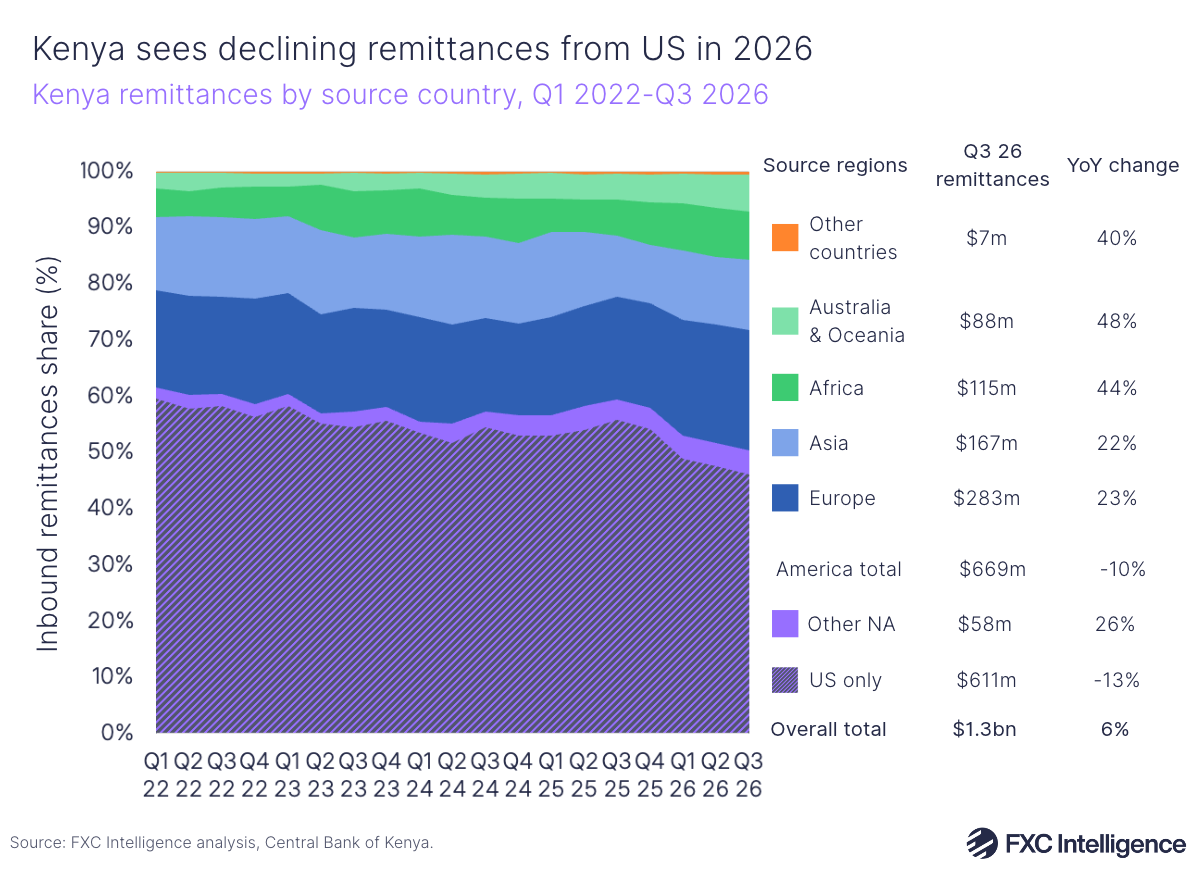
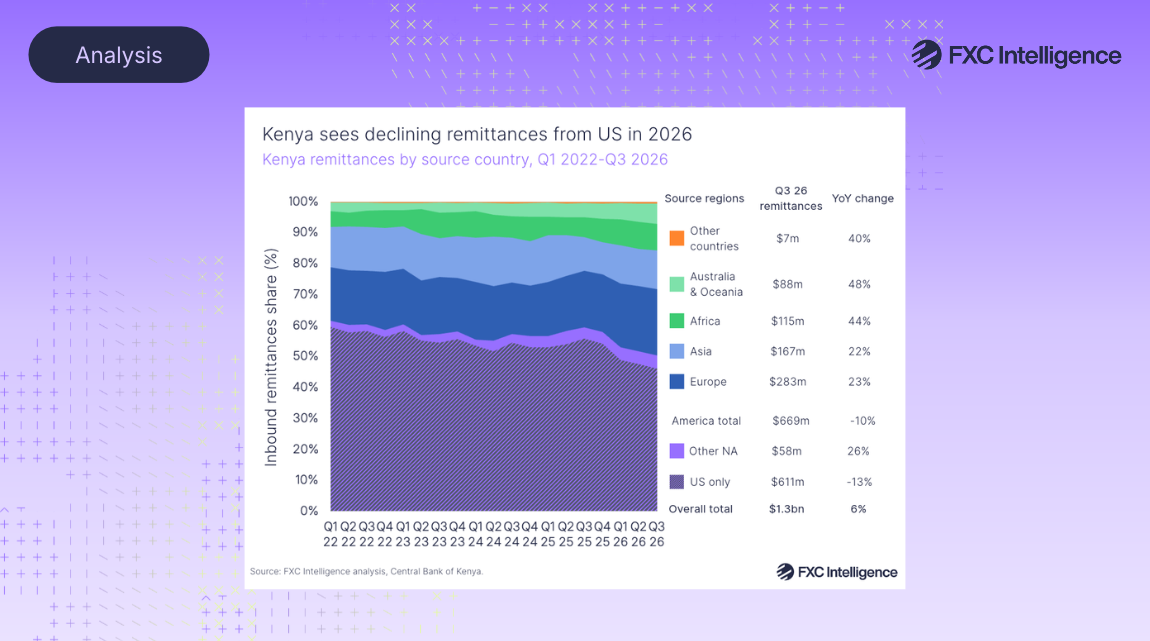
Data from Kenya’s central bank shows that the country has seen remittances from the US – its biggest sender country – decrease by 28% YoY to $178m in October 2026. This reflects a quarterly trend, with the US seeing a 13% decline in Q3 2026, driving a 10% fall in total remittances to Kenya from America overall. However, remittances from other countries grew 29% in Q3 2026, offsetting the US decline and driving a 6% rise in total remittances to Kenya to $1.3bn.
Overall, remittances from the US fell 14% to $1.97bn in the period from January to October 2026. This means that the US’s share of Kenya’s total remittances during this time fell to 47%, down from 54% a year earlier and marking its first dip below 50% since the central bank began making country-level remittances data available in 2019.
The decline coincides with the 1% US excise tax on cash-funded remittances, which took effect on 1 January. However, remittances have continued to fall throughout the year, suggesting that this policy may not be the main driver of the decrease. US inflows fell by 5% YoY in Q1 2026 (when the tax was introduced), but the decline was higher in Q2 at 20% and 13% in Q3 2026.
Some commentators have suggested that the decline could also be linked to an impact from rising living costs in the US, tied to factors such as inflation and growing energy costs. Overall, the US remains the biggest emigration market for Kenya, with 211,000 (over a third of its emigrants) having moved to the US as of 2024 UN data, and these factors may have impacted their potential to send remittances. By comparison, during the same period from January to October, remittances from Canada, Kenya’s second-largest American sender market, rose by 16% to $158m.
The US corridor is not the only one to significantly change. Spanning the period from January to October, Kenya has seen remittances from Saudi Arabia halve – to $133m – compared to the previous year. The Central Bank of Kenya Governor Dr Kamau Thugge attributed the decline to a falling number of Kenyan workers in Saudi Arabia, due to changes prioritising skilled workers over semi-skilled labour.
While Kenya saw strong declines in this corridor, remittances have grown in other regions. For example, in the period from January to October, remittances sent by other African countries have grown by 44% YoY, driven by strength in Tanzania and South Sudan among others. Other markets in the Gulf saw net remittances rise, with the UAE offsetting Saudi Arabia losses and rising 81% to $189m. Meanwhile, Europe as a whole grew by 16%, driven largely by remittances from the UK – another big Kenyan migration market – growing 15% to $343m.
For cross-border payments providers, the shift in Kenya’s remittances shows a move away from the US, with other corridors filling in the gap. It is not the only example of a US shift on a key corridor recently, with Mexico seeing $2.5bn fewer remittances from the country in 2025, though the corridor has seen some recovery this year. Combined, the data shows that it is vital for remittance providers to consider the impact of macroeconomic factors, which can change the makeup of remittance flows on key corridors.