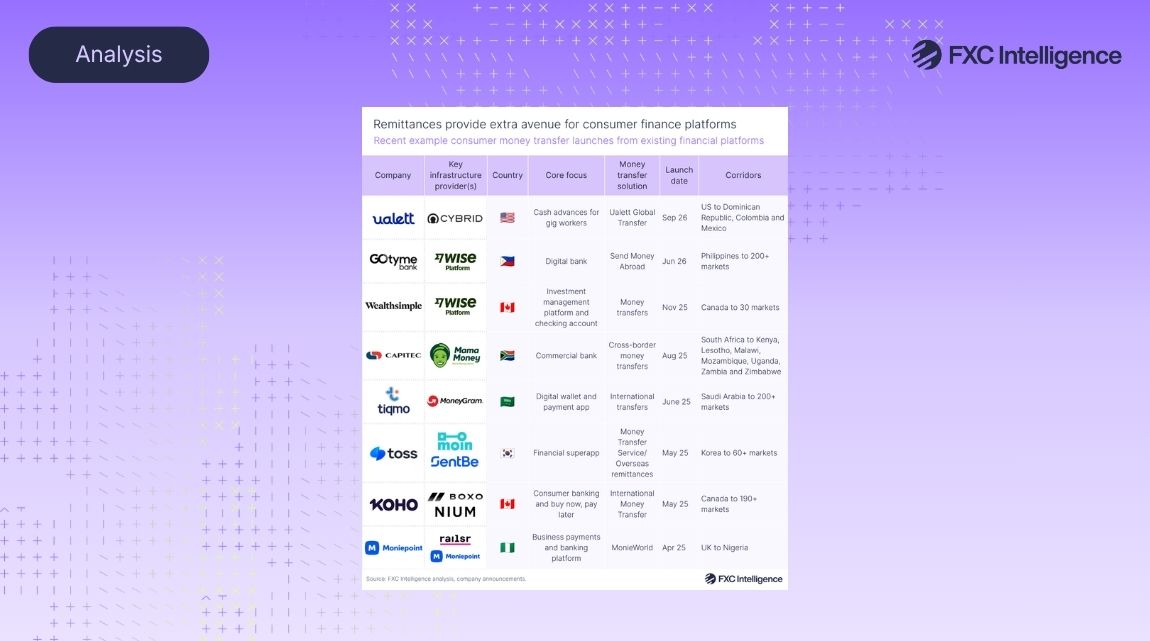
Over the last few years, we’ve seen growing numbers of regional financial platforms enter the consumer remittances space as they look to broaden revenue from their existing customer bases. We assess below some of the types of players taking this approach and how they are harnessing existing infrastructure providers in the process.
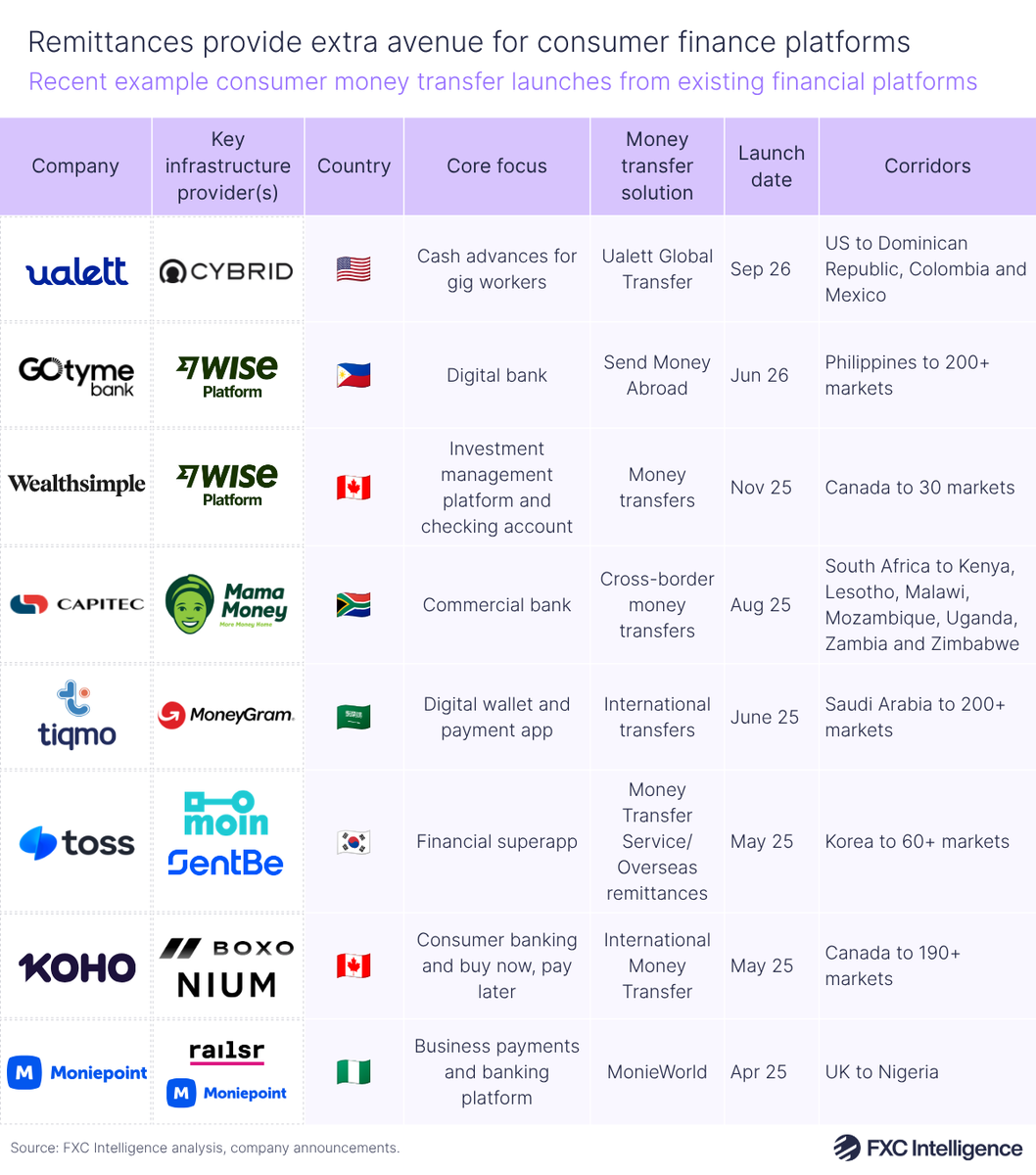
Established financial platforms launching a new consumer money transfer offering is widespread globally, with examples across North America, the Middle East, Africa and Asia in the last few years alone. And while there are regional variations, there are some common trends.
Firstly, these are platforms that already have their own consumer base, and which have launched an international money transfers solution in order to broaden the services they can offer to their existing customers. Ualett, for example, offers cash advances to US-based gig workers and has this month announced Ualett Global Transfer to provide remittance services to those same users, many of whom are migrants.
By contrast, Canadian investment-focused platform Wealthsimple’s money transfers product is a less formal brand in its own right, but is designed to support higher-value money transfers to a variety of key markets, echoing the typical profile of its customer base. Others are adding the capabilities as part of a growing range of solutions, with Korean superapp Toss adding a money transfer service for Korean citizens and a remittance service for migrants in the country.
In almost all cases, these platforms are delivering the services via partnerships with infrastructure providers, rather than face the high costs of building their own rails, which in the majority of cases they do not already have due to their existing focus. This has seen some partner with major infrastructure providers such as Wise Platform, in the case of Wealthsimple and the Philippines’ GoTyme, and MoneyGram in the case of Saudi Arabia’s tiqmo, while Capitec is harnessing Africa major Mama Money.
However, there are some with a more unusual approach. Canadian platform Koho, for example, is leveraging Boxo, a provider of white-label miniapps, which uses Nium to underpin its remittances miniapp. Ualett, meanwhile, has added stablecoin money movement infrastructure provider Cybrid to support its delivery of its own services. South Africa’s Moniepoint is a rare exception, harnessing its own rails for its MonieWorld service while utilising Railsr as a UK-based partner for last-mile delivery.
As companies look to increasingly diversify their revenue streams, and money transfer providers are increasingly leveraging their rails as an infrastructure solution, expect to see more platforms make moves into the remittance arena.