Stablecoin infrastructure provider Circle announced its earnings for Q4 and FY 2025, in which the company continued to see significant growth on the back of reserve incomes.
The company reported its total revenue rose 77% to $770m in Q4 2025, beating analysts’ projections and driving revenue growth for the full year up 64% to $2.7bn. This means that, in total, Circle added over $1bn to its annual revenue figure in 2025 compared to the previous year, with the majority of this being reserve incomes.
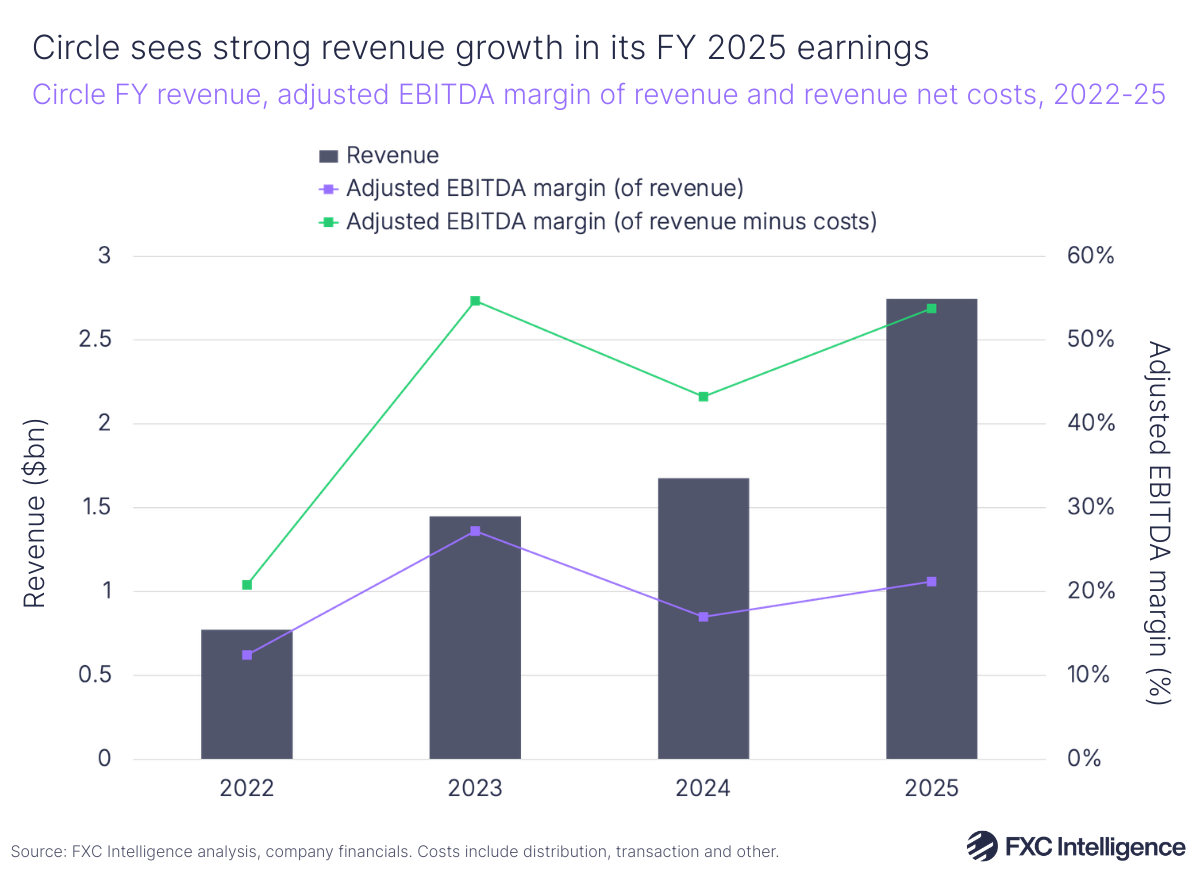
In Q4 2025, Circle’s adjusted EBITDA rose by 412% to $167m, which Circle said reflected the operating leverage inherent in its model as well as a one-time payment to a distribution partner of $60m it made in Q4 2024.
The company reports its adjusted EBITDA margin as a share of revenue less costs; this was 54% for both Q4 and full-year 2025, over double its margin of 25% in Q4 2024. When calculated against Circle’s overall revenue figure, Circle’s adjusted EBITDA margin is still impressive, growing from 8% in Q4 2024 to 22% in Q4 2025, highlighting the company’s strong profitability.
Investors responded well to Circle’s earnings, with the company’s share price having risen by 35% at close on the day it announced its results.
Circle’s USDC continues to take larger share of stablecoin transactions
Circle continues to see its USDC stablecoin take a growing share of the overall stablecoins opportunity. There was over $75bn worth of USDC in circulation by the end of the year, up 72% YoY, though the company mentioned some declines in Q4 due to challenging conditions in the wider crypto market.
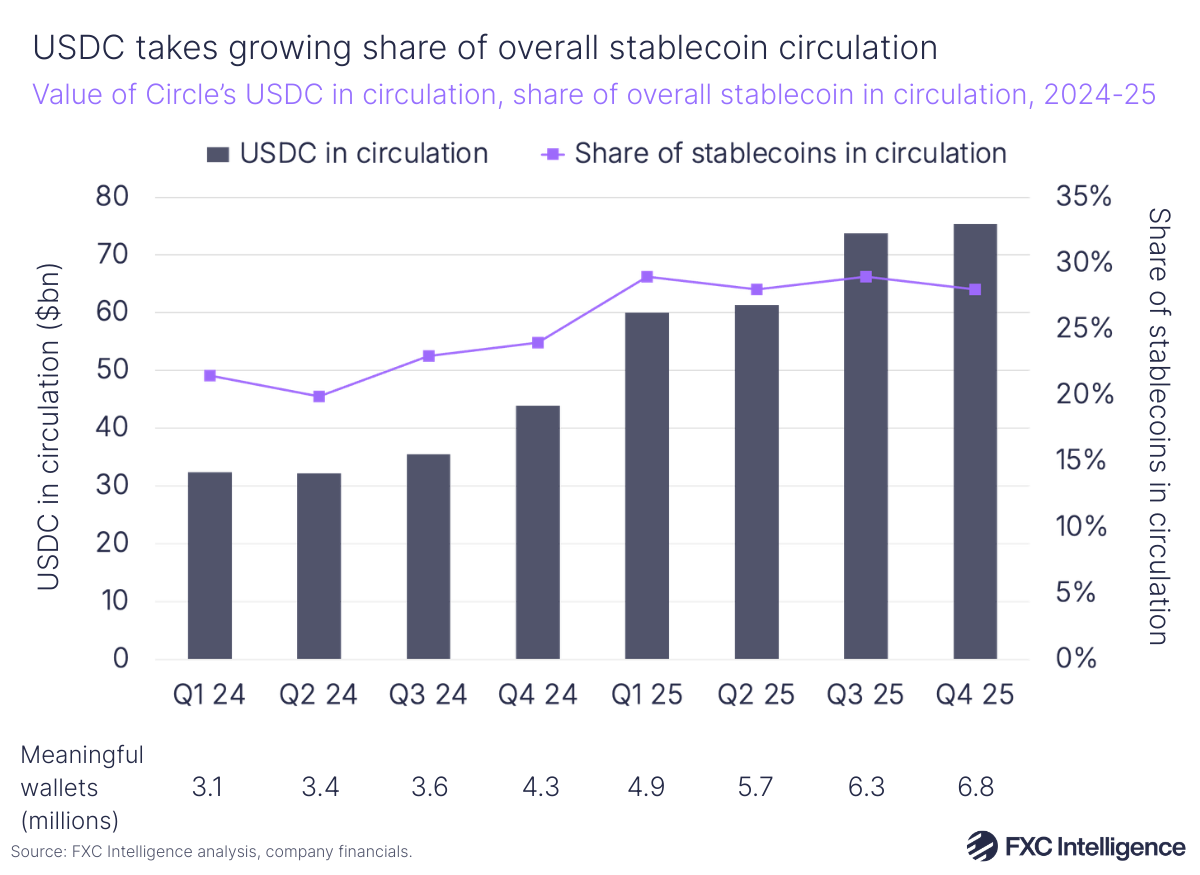
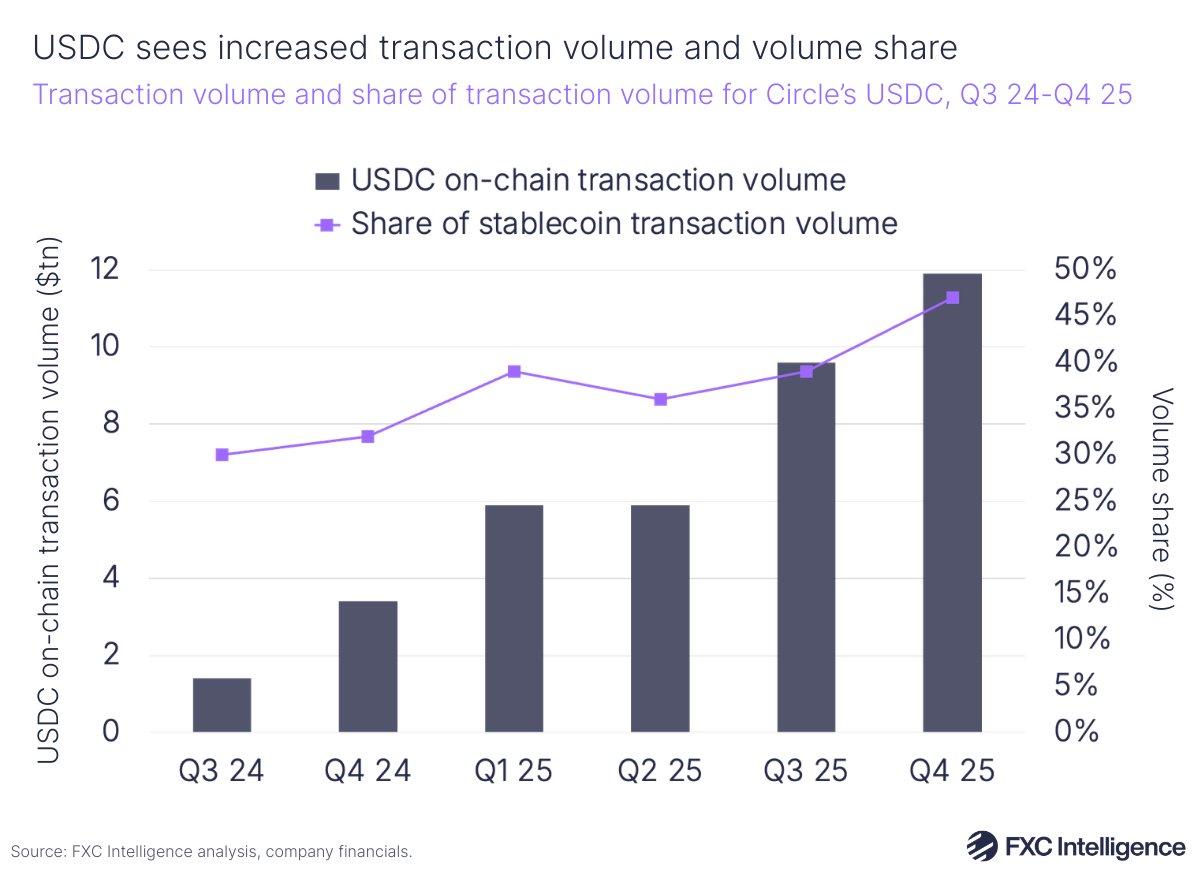
In addition, Circle’s on-chain USDC volume hit $11.9tn, representing 247% YoY growth, while USDC’s share of all stablecoin transactions was 47%, up from 32% in Q4 2024. On-chain transaction volumes rose by 250% to $11.9tn, reinforcing the growing use of USDC in payments. Meaningful wallets, which refer to on-chain digital asset wallets holding at least $10 in USDC, rose 59% to 6.8 million by the end of Q4 2025.
Having said this, Circle is also noting significant growth in its other assets. In particular, EURC, the leading regulated digital euro, has seen strong growth, with assets in circulation reaching €310m ($361m based on Q4 2025 exchange rates), up by 284% YoY. This signals a rising demand for regulated euro-backed digital assets.
Circle continues to grow revenues beyond reserve income
In Q4 2025, Circle’s reserve income rose 69% to $733m, taking a 95% share of its overall revenue. Having said this, its Other Revenue segment rose by 1,434%, from just $2m in Q4 2024 to $37m in Q4 2025. Other Revenue pertains to additional services that provide Circle with revenue beyond reserve income, such as Circle Mint, which allows businesses to mint and redeem large volumes of Circle stablecoins.
Within Other Revenue, subscription and services, which primarily draws from revenue through Circle’s blockchain partnerships, was $24.7m. Transaction revenue – which includes fees from redeeming Circle stablecoins and USYC (the company’s tokenised money market fund product), blockchain rewards revenue and use of Circle infrastructure in facilitating digital asset transactions – was $12.2m, driven primarily by blockchain rewards.
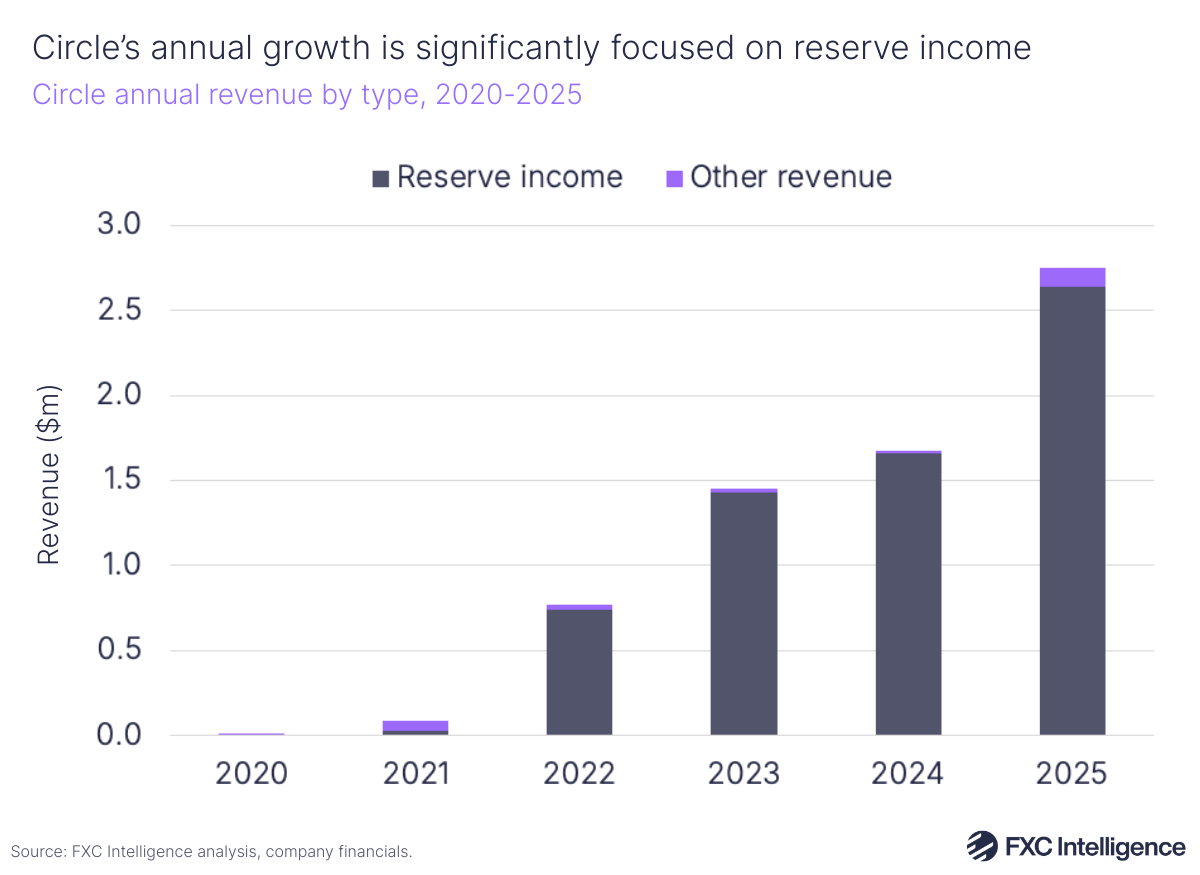
As a result Other Revenue took a 5% share of total revenue in the company’s Q4 2025 earnings, up from 0.6% in Q4 2024. In Circle’s full-year results, Other Revenue rose 624% to $110m, faster than reserve income growth and beating the company’s guidance of $90m-100m, and now takes a 4% share of Circle’s revenues.
Circle sees growing costs but continues to grow key revenue margin
Increased ownership and use of USDC is key to Circle’s growth, as the company makes the majority of its money from interest on reserves underpinning the stablecoin. As discussed in our teardown of Circle’s IPO last year, a large portion of Circle’s costs are paid to Coinbase, which retains a deal under which Circle must pay the company for any stablecoins held on its platform.
Circle continues to see its total distribution, transaction and other costs rise. This metric rose 52% to $461m, while for the full year it rose 64% YoY to $1.7bn.
Having said this, Circle has continued to grow its revenue less distribution costs (RLDC), with this rising by 138% in Q4 2025 to $309m, driving an RLDC margin of 40% for the quarter, up from 30% in the prior year period. This reflected the impact of growth in Other Revenue, according to the company.
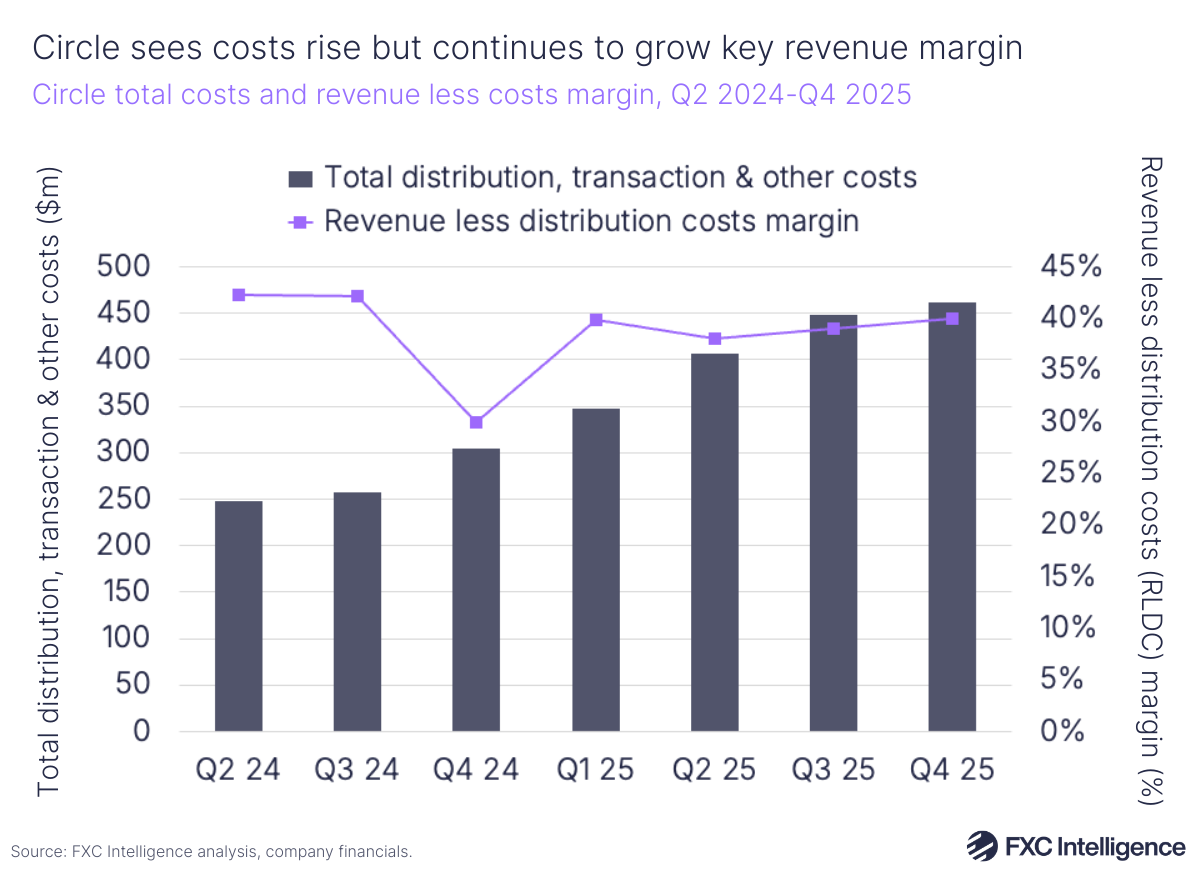
Having said this, Circle has been continuing to grow the amount of USDC it holds on its own platform, with this rising to 17% in Q4 2025, up from 5% in Q4 2024 and 14% in Q3 2025. Coinbase still retained a higher share of USDC on its platform in Q4 2025 at 24%, up from 20% in Q4 2024, but this share has not changed QoQ.
Though Circle is diversifying while growing the share of the USDC it can gain interest yields on, it is becoming more significant for the company to continue to raise its non-reserve interest income share as interest rates fall. The company’s reserve return rate was 3.8% in Q4 2025, down from 4.49% in Q4 2024, emphasising the need for Circle to scale its fee-based and transaction revenues versus reserve income.
Moving forward, Circle did not project specific revenue guidance for overall FY 2026 revenue, but says it wants to grow Other Revenue to $150m-170m, equating to a rise of 37-55% YoY. It projects its RLDC margin will continue to remain steady in 2026, with a range between 38% and 40%, while it also targets a 40% CAGR for USDC in circulation across multiple years.
Circle Payments Network grows volumes
Circle had much to say about how it is growing its various pillars and initiatives beyond reserve incomes.
The company talked about how it has evolved from being a stablecoin network to being a platform and infrastructure partner for on-chain finance, with three specific platform pillars: its digital asset services, including USDC and EURC; its developer infrastructure focused on providing tools and protocols to enable digital finance, including incoming blockchain solution Arc; and its apps, which among other services includes its stablecoin partnership scheme Circle Payments Network (CPN) and StableFX, a new application FX service for businesses.
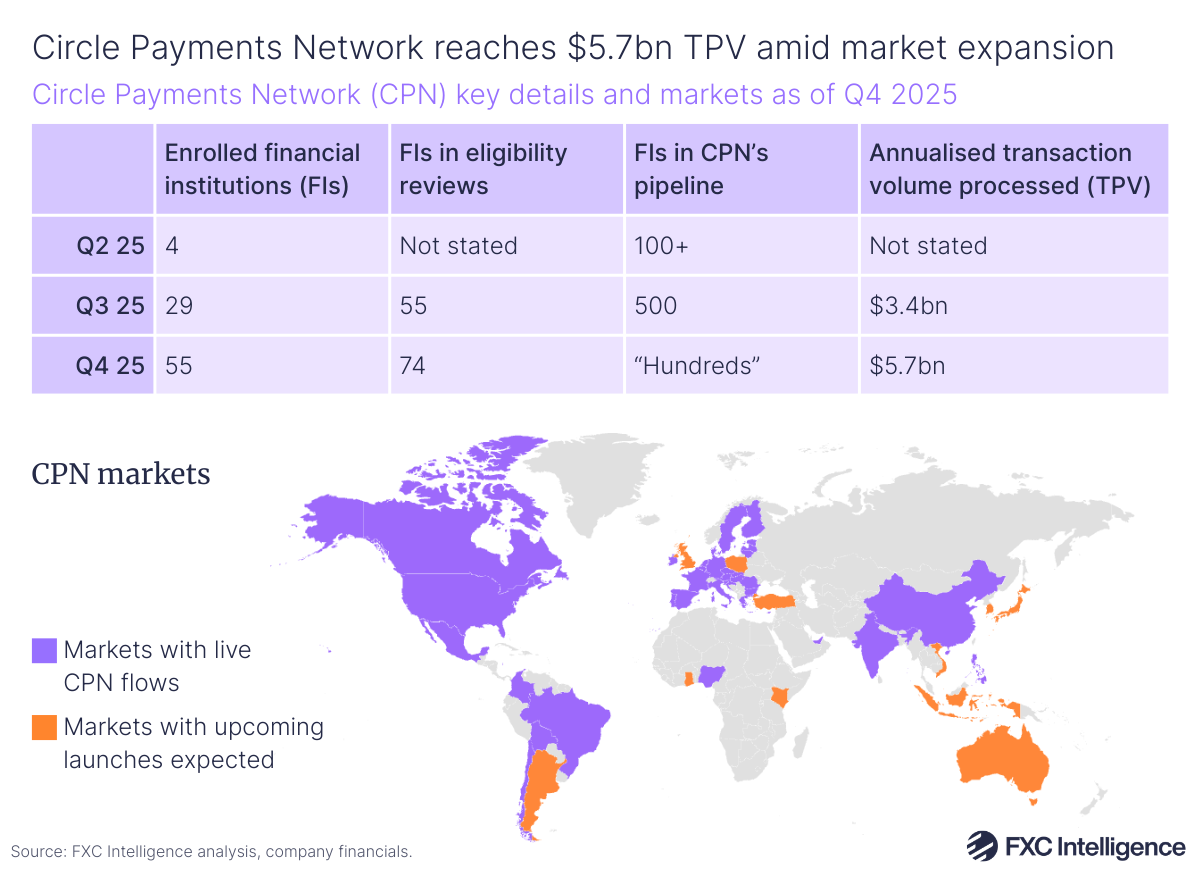
CPN delivered annualised volumes of $5.7bn as of 20 February, up 68% from the figure Circle gave in its Q3 25 earnings. The company continues to add financial institutions to the platform, with 55 enrolled and 74 at the eligibility review. CEO Jeremy Allaire said that the company was maintaining a strong pipeline with hundreds of banks, payment firms and other companies globally.
The CPN is now seeing live flows across markets in North America, South America, Europe, APAC and Africa (specifically in Nigeria), with a further 11 markets preparing to launch, including the UK and Australia.
The company also gave an update on Arc, with the company noting that it launched its testnet with over 100 companies across banking, payments and other areas of finance. Since launching the testnet in October, it has seen more than 166 million total transactions through 1.9 million unique wallets, with the company saying it is on track to launch its mainnet in 2026.
Connected to this is Circle StableFX. Announced in November and launched in beta on the Arc testnet, it will allow institutions to access and settle select stablecoin currency pairs 24/7 and avoid needing bilateral agreements with multiple counterparties. Allaire said that stablecoin issuers for many jurisdictions were “participating” in the product’s development and that it will provide key infrastructure as the company continues to scale up CPN.
How GENIUS is driving more engagement with stablecoins
During the earnings call, Allaire said that the GENIUS Act – the US’s regulation framework for stablecoin usage signed into law last July – had been a boon for the business and was giving a legal foundation for major institutions to enter the stablecoins space. He added that as more banks, payment companies and enterprises globally look to add stablecoins to their strategy, it was also creating a need for international regulators to consider the potential role of GENIUS-compliant stablecoins within their markets.
Circle also recently received conditional approval to form a national trust bank, something that other blockchain infrastructure providers such as Ripple have also done to embed themselves in regulated US payment flows. Allaire said that this would be “important” for USDC and USDC reserves and how the company works with the US Office of the Comptroller of the Currency under the GENIUS Act, as well as something that will strengthen the custody infrastructure it provides to clients.